
ADVANCED SUBJECTS · LIVE 1:1 TUTORING
ANSYS Fluent Tutoring Online
Personalized instruction for demanding courses and technical subjects. Learn with a tutor selected for your topic, level, and learning goals.
University · Master’s & PhD · Professional learning
Request tutor availability and a quote. Or email [email protected].

Since 2008
Established Tutoring Service
~1 min
Average First Response
Specialist Match
For Your Subject & Level
30-Min Trial
Try Tutoring Before a Longer Plan
Hire The Best ANSYS Fluent Tutor



Your CFD simulation keeps diverging and you don’t know why. That’s exactly what an Ansys Fluent tutor fixes — live, on screen, in your actual project file.
Ansys Fluent Tutor Online
Ansys Fluent is a computational fluid dynamics (CFD) software tool used to simulate fluid flow, heat transfer, turbulence, and chemical reactions. It is widely used in aerospace, mechanical, civil, and chemical engineering coursework and industry projects.
Finding a reliable Ansys Fluent tutor online matters when your simulation setup is broken and your deadline is in 48 hours. MEB connects you with expert Fluent tutors who work inside your mesh, your boundary conditions, and your solver settings — not just theory slides. If you’ve been searching for an Ansys Fluent tutor near me, online 1:1 sessions deliver the same depth as in-person, with screen sharing and a digital pen-pad. MEB covers the full spectrum of computer-aided design and simulation subjects, including Fluent at every level from undergraduate coursework to PhD research projects.
- 1:1 online sessions matched to your exact project or course syllabus
- Expert-vetted tutors with hands-on Fluent simulation experience
- Flexible time zones — US, UK, Canada, Australia, Gulf
- Structured session plan built after a diagnostic of your current setup
- Guided project support — tutors explain every step, you build and submit
52,000+ students across the US, UK, Canada, Australia, and the Gulf have used MEB since 2008 — including students in Computer-Aided Design and simulation subjects like Ansys Fluent, Ansys CFX, and STAR-CCM+.
Source: My Engineering Buddy, 2008–2025.
How Much Does an Ansys Fluent Tutor Cost?
Most Ansys Fluent tutoring sessions run $20–$40/hr for undergraduate project work. Graduate and PhD-level CFD — complex multiphase flows, UDF development, large-scale HPC simulations — reaches up to $100/hr. Start with the $1 trial: 30 minutes of live 1:1 tutoring or one project problem explained in full.
| Level / Need | Typical Rate | What’s Included |
|---|---|---|
| Undergraduate project support | $20–$35/hr | 1:1 sessions, mesh review, solver guidance |
| Graduate / Masters CFD | $35–$70/hr | Advanced turbulence models, UDF scripting, post-processing |
| PhD / Research-level | $70–$100/hr | Specialist tutor, multiphase/reactive flows, HPC setup |
| $1 Trial | $1 flat | 30 min live session or one project question explained |
Tutor availability tightens at semester end and during thesis submission windows. Book early if your deadline is within three weeks.
WhatsApp MEB for a quick quote — average response time under 1 minute.
Who This Ansys Fluent Tutoring Is For
Ansys Fluent attracts students who are technically capable but stuck at a specific wall — a diverging solver, a mesh quality warning they can’t interpret, or a turbulence model they chose without fully understanding the implications. The sessions work best when there’s a real problem to solve.
- Undergraduate engineering students with a CFD coursework project due
- Masters students using Fluent for their dissertation or thesis simulation
- PhD researchers setting up complex boundary conditions or UDFs for the first time
- Students retaking a computational methods module after a failed first attempt
- Engineers in industry who need to get up to speed on Fluent for a new role or project
- Students with a thesis submission deadline approaching and a simulation that won’t converge
MEB tutors have worked with students at universities across the US, UK, Canada, Australia, and the Gulf — including programmes at institutions like MIT, Imperial College London, Delft University of Technology, University of Toronto, KAUST, and ETH Zurich. No fabricated outcomes — just structured guidance for wherever you are in your programme.
1:1 Tutoring vs Self-Study vs AI vs YouTube vs Online Courses
Self-study works if you have weeks to experiment, but Fluent error messages are notoriously opaque. AI tools explain concepts quickly but can’t look at your mesh and tell you why your y+ values are wrong. YouTube covers setup walkthroughs but stops the moment your geometry diverges from the example. Online courses teach general CFD theory at a fixed pace — no one checks your boundary conditions. With a 1:1 Ansys Fluent tutor from MEB, the session is built around your actual simulation file, your solver log, and your deadline.
Outcomes: What You’ll Be Able To Do in Ansys Fluent
After focused 1:1 sessions, students consistently report being able to set up and run complete CFD simulations with confidence — from geometry import through to post-processed results. You’ll be able to select the right turbulence model for your flow regime, interpret residual plots and convergence monitors without guesswork, and apply correct boundary conditions for inlet velocity profiles, pressure outlets, and wall functions. Students also develop the ability to analyse mesh quality metrics — skewness, aspect ratio, orthogonality — and fix them before they kill the solve. You’ll be able to present and explain your simulation results to supervisors or examiners, not just generate them.
Based on feedback from 40,000+ sessions collected by MEB from 2022 to 2025, 58% of students improved by one full grade after approximately 20 hours of 1:1 tutoring in subjects like Ansys Fluent. A further 23% achieved at least a half-grade improvement.
Source: MEB session feedback data, 2022–2025.
What We Cover in Ansys Fluent (Syllabus / Topics)

Track 1: Geometry, Meshing & Pre-Processing
- Importing and cleaning CAD geometry from SpaceClaim, CATIA, or external formats
- Mesh generation in Fluent Meshing — sizing, inflation layers, patch conforming
- Mesh quality checks: skewness, aspect ratio, orthogonal quality thresholds
- Named selections and zone assignment for boundary condition application
- Polyhedral vs tetrahedral vs hexahedral mesh trade-offs
- Mesh independence studies — how to run them and what to report
Reference texts: An Introduction to Computational Fluid Dynamics by Versteeg & Malalasekera; Computational Fluid Dynamics by Anderson; Ansys Fluent User’s Guide (official documentation).
Track 2: Solver Setup, Physics Models & Boundary Conditions
- Pressure-based vs density-based solver selection
- Turbulence model selection: k-ε, k-ω, k-ω SST, Spalart-Allmaras — when and why
- Steady-state vs transient simulation setup and time-stepping
- Boundary condition types: velocity inlet, pressure outlet, wall, symmetry, periodic
- Heat transfer: conjugate heat transfer, natural and forced convection setup
- Multiphase flows: VOF, mixture model, Eulerian framework basics
- User-Defined Functions (UDFs) — writing and hooking C-based UDFs in Fluent
- Initialisation methods: standard, hybrid, patch-based
Reference texts: Turbulent Flows by Pope; Fluent Theory Guide (Ansys documentation); An Introduction to Computational Fluid Dynamics by Versteeg & Malalasekera.
Track 3: Post-Processing, Validation & Reporting
- Residual monitoring and convergence criteria — what good convergence actually looks like
- Creating contour plots, velocity vectors, streamlines, and pathlines
- Surface and volume integrals: mass flow rate, heat flux, drag, lift calculations
- Exporting data to CSV or Tecplot for further analysis
- Validation against experimental data or analytical solutions
- Report writing for engineering submissions — what examiners look for
Reference texts: Computational Fluid Dynamics for Engineers by Andersson et al.; Ansys Fluent Tutorial Guide (official); Numerical Heat Transfer and Fluid Flow by Patankar.
Platforms, Tools & Textbooks We Support
Ansys Fluent sessions run over Google Meet with screen sharing of your active Fluent session. Tutors work directly inside Fluent’s GUI or via the Fluent console. MEB also supports related environments and tools commonly used alongside Fluent in engineering programmes:
- Ansys Workbench (linked simulation workflows)
- Ansys SpaceClaim and DesignModeler (geometry prep)
- Fluent Meshing and ICEM CFD
- ParaView and Tecplot (post-processing)
- MATLAB (for pre/post-processing scripts and validation)
- Linux / HPC cluster environments (for large-scale Fluent batch runs)
What a Typical Ansys Fluent Session Looks Like
The tutor opens by checking what happened in the previous session — usually reviewing whether the mesh independence study you ran actually showed grid convergence, or whether the residuals from your last solver run actually dropped below 10-4. From there, the session moves into your active problem: you share your Fluent window, the tutor uses a digital pen-pad to annotate directly on the residual plot or boundary condition panel, and you walk through the fix together — whether that’s correcting a pressure outlet backflow condition or switching from k-ε standard to k-ω SST for your wall-bounded flow. You make the change, re-run a short calculation, and the tutor checks the result with you. The session closes with a specific task: run the full transient simulation overnight, export the drag coefficient data, and bring the convergence history to the next session.
How MEB Tutors Help You with Ansys Fluent (The Learning Loop)
Diagnose: In the first session, the tutor reviews your current simulation file, mesh metrics, and solver log. They identify whether the problem is a meshing issue, a boundary condition error, an inappropriate physics model, or a solver settings problem — before any teaching begins.
Explain: The tutor works through the fix live using a digital pen-pad, annotating your actual Fluent interface. Every decision — why k-ω SST outperforms k-ε for separated flows, why your y+ target changed the wall treatment — gets explained in terms of your specific geometry, not abstract theory.
Students consistently tell us that Ansys Fluent clicked only when someone walked them through a real mesh — not a textbook diagram. The moment a tutor points to your own skewness contour and explains why that cell is killing your convergence, everything else falls into place.
Practice: You attempt the next step — modifying boundary conditions, re-meshing a region, adjusting relaxation factors — with the tutor watching. They let you work through it before stepping in, which is the fastest way to build independent simulation competence.
Feedback: The tutor reviews what you did, explains exactly where the logic broke down, and shows the corrected approach side by side with your version. No vague comments — specific, step-level corrections.
Plan: Before the session ends, the tutor maps the next two or three steps in your simulation workflow and sets a concrete task. You leave knowing exactly what to run before the next session.
Sessions run over Google Meet. Tutors use a digital pen-pad or iPad with Apple Pencil for live annotation. Before your first session, share your simulation files or project brief, your current solver log or error messages, and your submission deadline. The first session functions as your diagnostic — no time is wasted on irrelevant content. Start with the $1 trial — 30 minutes of live Fluent tutoring that doubles as your first diagnostic session. Whether you need a quick fix before a deadline, structured support over 4–8 weeks, or ongoing weekly sessions through a semester-long CFD module, the tutor maps the plan after seeing your actual files.
At MEB, we’ve found that Fluent users who share their actual simulation file in the first session make faster progress than those who describe the problem from memory. The solver log tells the tutor in 30 seconds what a 20-minute description might not.
Tutor Match Criteria (How We Pick Your Tutor)
Not every engineer who knows Fluent can teach it. MEB vets tutors specifically on their ability to diagnose and explain — not just run simulations.
Subject depth: Tutors are matched based on the specific Fluent application area — turbomachinery, HVAC, combustion, external aerodynamics, or multiphase flows — not just “CFD generally.” Tools: All tutors use Google Meet with screen sharing and a digital pen-pad or iPad with Apple Pencil for live annotation inside your Fluent session. Time zone: Matched to your region — US, UK, Gulf, Canada, or Australia. Goals: Whether you need a convergent simulation by Friday or a full dissertation-ready CFD chapter by end of term, the tutor is selected to match that specific timeline and output.
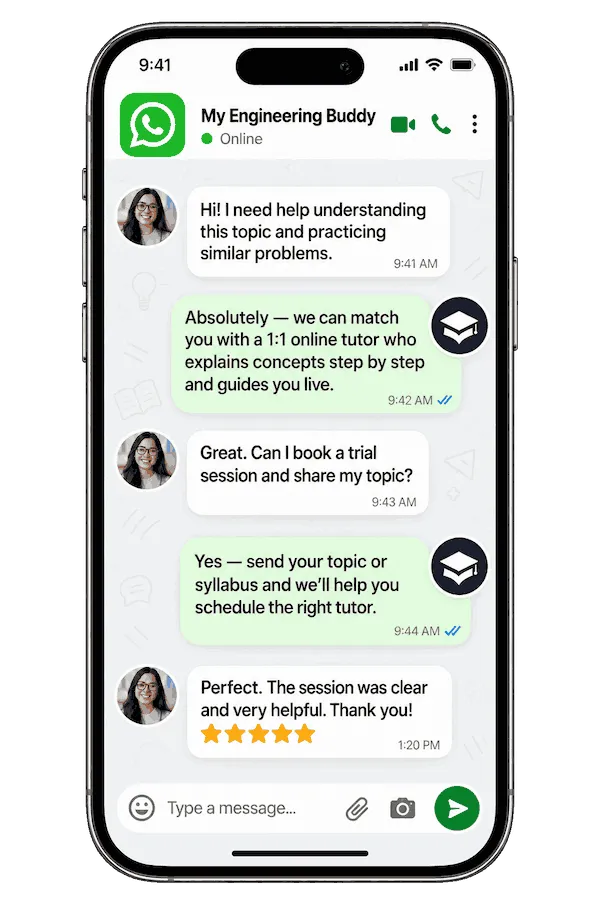
Unlike platforms where you fill out a form and wait, MEB responds in under a minute, 24/7. Tutor match takes under an hour. The $1 trial means you test before you commit. Everything runs over WhatsApp — no logins, no intake forms.
Pricing Guide
Ansys Fluent tutoring starts at $20/hr for undergraduate-level project support. Masters and PhD-level work — complex turbulence modelling, reactive flows, UDF development, HPC batch setup — runs $70–$100/hr. Rate is set by level, application complexity, timeline pressure, and tutor availability.
Peak demand hits at semester end and thesis submission periods. If your deadline is within two weeks, flag that when you message — MEB will prioritise matching accordingly.
For students targeting roles at aerospace firms, automotive OEMs, or energy companies where Fluent proficiency is a hiring requirement, tutors with professional CFD industry backgrounds are available at higher rates — share your specific goal and MEB matches the tier to your target.
Start with the $1 trial — 30 minutes, no registration, no commitment. WhatsApp MEB for a quick quote.
Most students start unsure whether 2–3 sessions will be enough. For a single convergence problem, that’s often true. For a full dissertation CFD chapter — mesh independence, turbulence model justification, validated results — plan for 10–15 hours of guided work.
Source: MEB session planning data, 2022–2025.
FAQ
Is Ansys Fluent hard to learn?
Fluent has a steep early curve — the interface is dense, error messages are cryptic, and small mesh or boundary condition errors cause simulation failures that are hard to trace alone. With a tutor walking through your actual files, the learning curve compresses significantly.
How many sessions will I need?
A single convergence or boundary condition fix often takes 1–2 sessions. A full project — geometry, meshing, solver setup, post-processing, and report — typically needs 8–15 hours of guided work depending on complexity and your starting level.
Can you help with my CFD project and portfolio work?
Yes. MEB provides guided project support — tutors explain every decision, you execute and submit the work yourself. This applies to coursework submissions, dissertation CFD chapters, and portfolio simulations. MEB does not submit work on your behalf. See our Policies page for full details on what we help with and what we don’t.
Will the tutor match my exact syllabus or course requirements?
Yes. Share your course outline, project brief, or thesis proposal when you message. MEB matches tutors who have specific experience with your application area — turbomachinery, heat transfer, aerodynamics, or others — not just generic Fluent knowledge.
What happens in the first session?
The first session is a diagnostic. Share your simulation files, solver log, and deadline. The tutor reviews your setup, identifies the root cause of any problems, and maps the session plan. No time is spent on content you already understand.
Is online Ansys Fluent tutoring as effective as in-person?
For Fluent specifically, online is often better — screen sharing means the tutor sees your exact interface, mesh, and solver log in real time. A digital pen-pad lets them annotate directly on your screen. There’s no travel delay when a deadline is 48 hours away.
What’s the difference between Ansys Fluent and Ansys CFX — should I be learning both?
Fluent and Ansys CFX tutoring cover overlapping physics but use different solver architectures. Fluent dominates in most academic programmes and external aerodynamics work. CFX is preferred in turbomachinery. Check your course software list — most programmes specify one, and MEB tutors can support either.
Can you help with User-Defined Functions (UDFs) in Fluent?
Yes. UDF work — writing C-based functions, hooking them to boundary conditions or source terms, debugging compile errors — is one of the more common advanced requests. Tutors with UDF experience are available for graduate and PhD-level sessions.
Can I get Ansys Fluent help at midnight or over the weekend?
Yes. MEB operates 24/7 across time zones. If your solver diverged at 11pm the night before a submission, WhatsApp MEB. Average response time is under a minute, and a tutor can often be matched within the hour for urgent requests.
What if I don’t get on with my assigned tutor?
Say so. MEB will rematch you with a different tutor, usually within a few hours. The $1 trial is specifically designed so you can test the fit before committing to a full session block.
How do I get started?
Start with the $1 trial — 30 minutes of live Fluent tutoring or one project problem explained in full. WhatsApp MEB, share your project brief or simulation file, and you’ll be matched with a tutor and start the trial session, usually within the hour.
Trust & Quality at My Engineering Buddy
Every MEB tutor goes through subject-specific screening — not just a general interview. For Ansys Fluent, that means demonstrating hands-on simulation competence: they run a diagnostic on a test case, explain their meshing decisions, and show they can teach, not just operate the software. Rated 4.8/5 across 40,000+ verified reviews on Google. Tutors are re-evaluated through ongoing session feedback, and any tutor with declining ratings is removed from active matching.
MEB provides guided learning support. All project work is produced and submitted by the student. See our Policies page for details.
MEB has served 52,000+ students across the US, UK, Canada, Australia, the Gulf, and Europe since 2008 — across 2,800+ subjects. The Computer-Aided Design and simulation category is one of MEB’s most active, with strong demand for Ansys Workbench tutoring, Ansys Mechanical APDL help, and Ansys Fluent project support at every level. See how MEB’s tutoring methodology works and why students choose MEB over other platforms.
MEB tutors are matched on application area, not just software name. A student simulating combustion in a gas turbine and a student modelling urban wind loads are both using Fluent — but they need different tutors.
Source: My Engineering Buddy, internal matching guidelines, 2024.
Try your first session for $1 — 30 minutes of live 1:1 tutoring or one homework question explained in full. No registration. No commitment. WhatsApp MEB now and get matched within the hour.
Explore Related Subjects
Students studying Ansys Fluent often also need support in:
Next Steps
Getting started takes under two minutes. Share your project brief or course outline, your current simulation files or error messages, your exam or submission deadline, and your time zone and availability. MEB matches you with a verified Fluent tutor — usually within an hour for urgent requests, within 24 hours otherwise.
Before your first session, have ready:
- Your course outline or project specification
- Your current Fluent case file and data file, plus any solver logs or error messages
- Your submission or defence date
The tutor handles the rest. The first session starts with a diagnostic so every minute is used on your actual problem — not generic Fluent orientation.
Visit www.myengineeringbuddy.com for more on how MEB works.
WhatsApp to get started or email [email protected].
Reviewed by Subject Expert
This page has been carefully reviewed and validated by our subject expert to ensure accuracy and relevance.

What Students Say About Their Learning Experience




Related Subjects
