

Hire Verified & Experienced
ANSYS Motor-CAD Tutors
Email: [email protected]
4.8/5 40K+ session ratings collected on the MEB platform



Hire The Best ANSYS Motor-CAD Tutor
Top Tutors, Top Grades. Without The Stress!


Most engineers don’t fail Motor-CAD because the physics is hard — they fail because nobody explained the thermal-electromagnetic coupling in a way that actually clicked.
Ansys Motor-CAD Tutor Online
Ansys Motor-CAD is a dedicated electric motor design software tool used for fast multiphysics analysis — covering electromagnetic, thermal, and mechanical performance — enabling engineers to model and optimise motor geometries across the full operating range.
If you’ve searched for an Ansys Motor-CAD tutor near me, you already know the problem: there are almost no structured courses, and the official documentation assumes you already know what you’re doing. MEB connects you with a computer-aided design specialist who knows Motor-CAD’s geometry editor, loss models, and thermal networks inside out. One session can clear weeks of confusion. No guarantees — but students consistently tell us it moves faster than they expected.
- 1:1 online sessions tailored to your exact Motor-CAD workflow and project goals
- Expert verified tutors with hands-on Motor-CAD and electric drive experience
- Flexible time zones — US, UK, Canada, Australia, Gulf covered
- Structured learning plan built after a diagnostic session
- Guided project support — we explain the method, you run the simulation
52,000+ students across the US, UK, Canada, Australia, and the Gulf have used MEB since 2008 — across CAD and simulation subjects including Ansys multiphysics, Ansys Fluent CFD, and Ansys Motor-CAD electric motor design.
Source: My Engineering Buddy, 2008–2025.
How Much Does an Ansys Motor-CAD Tutor Cost?
Rates start at $20–$40/hr for most engineering software levels. Specialist Motor-CAD tutoring — covering advanced loss map generation, NVH analysis, or full drivetrain integration — runs up to $100/hr. Start with the $1 trial: 30 minutes of live 1:1 tutoring or one project problem explained in full, no registration required.
| Level / Need | Typical Rate | What’s Included |
|---|---|---|
| Standard (grad / industry learner) | $20–$40/hr | 1:1 sessions, geometry setup, thermal modelling |
| Advanced / Specialist | $40–$100/hr | Expert tutor, loss maps, NVH, drivetrain integration |
| $1 Trial | $1 flat | 30 min live session or 1 project question explained |
Tutor availability tightens significantly around university project submission windows and EV industry conference deadlines. Book early if you have a fixed date.
WhatsApp MEB for a quick quote — average response time under 1 minute.
Who This Ansys Motor-CAD Tutoring Is For
Motor-CAD sits at an unusual intersection: it’s used by final-year MEng students, PhD researchers, and practising powertrain engineers all at once. The pain points are similar across all three groups — nobody explained the software systematically, and the official tutorials skip the hard bits.
- Final-year MEng and BEng students with a motor design project due in weeks
- PhD students modelling permanent magnet or switched reluctance machines and hitting convergence issues
- Engineers at automotive and aerospace OEMs upskilling on Motor-CAD for EV drivetrain roles
- Students with a conditional university place or internship offer depending on demonstrable simulation skills
- Researchers who can set up the geometry but can’t get the thermal network to match test data
- Anyone who has spent three days on one Motor-CAD model and is still getting results that don’t make physical sense
Students come from programmes at Loughborough University, TU Delft, University of Michigan, ETH Zurich, Georgia Tech, University of Sheffield, and RWTH Aachen — all institutions where motor design and electric drives are taught seriously.
At MEB, we’ve found that Motor-CAD users hit the same three walls: not understanding the difference between the thermal and electromagnetic solve modes, not knowing how to interpret the loss breakdown, and not being sure which winding template matches their physical machine. One session targeting the right wall saves days.
1:1 Tutoring vs Self-Study vs AI vs YouTube vs Online Courses
Self-study works if you have the application notes and time — most people have neither. AI tools explain Motor-CAD concepts in general terms but can’t load your actual model or diagnose why your copper loss figure is 40% off. YouTube has a handful of Motor-CAD walkthroughs that stop exactly where things get complicated. Online courses for Motor-CAD barely exist. With MEB, a tutor looks at your specific geometry, your thermal boundary conditions, and your loss model choices — live — and tells you what’s wrong and why. That’s the difference for Motor-CAD specifically, where the errors are almost always in the settings nobody documents.
Outcomes: What You’ll Be Able To Do in Ansys Motor-CAD
After working with an MEB Ansys Motor-CAD tutor, students consistently report being able to build and mesh motor geometries from scratch in the geometry editor, run and interpret electromagnetic and thermal co-simulations without conflating the two solve outputs, analyse efficiency maps and loss distributions across operating points, apply winding templates correctly for both distributed and concentrated winding configurations, and present simulation results — including torque ripple, iron loss breakdown, and thermal hotspot predictions — in a format that holds up to academic or industry review. These are concrete, tool-specific skills. Not general simulation literacy.
Based on feedback from 40,000+ sessions collected by MEB from 2022 to 2025, 58% of students improved by one full grade after approximately 20 hours of 1:1 tutoring in subjects like Ansys Motor-CAD. A further 23% achieved at least a half-grade improvement.
Source: MEB session feedback data, 2022–2025.
Try your first session for $1 — 30 minutes of live 1:1 tutoring or one homework question explained in full. No registration. No commitment.
WhatsApp MEB now
and get matched within the hour.
What We Cover in Ansys Motor-CAD (Syllabus / Topics)

Track 1: Geometry, Winding Design & Electromagnetic Analysis
- Motor geometry editor — stator and rotor template selection and parameter customisation
- Winding layout configuration — distributed, concentrated, and hairpin winding types
- Electromagnetic solve setup — magnetostatic and transient analysis modes
- Torque, back-EMF, and cogging torque calculation and interpretation
- Iron loss and copper loss computation — Steinmetz and Bertotti models
- Efficiency map generation across speed-torque operating ranges
- Comparison of PMSM, BLDC, SRM, and induction machine topologies within Motor-CAD
Recommended references: Design of Rotating Electrical Machines by Pyrhönen, Jokinen & Hrabovcová; Electric Motor Design by Hanselman; Ansys Motor-CAD official application notes.
Track 2: Thermal Modelling & Cooling System Analysis
- Lumped parameter thermal network (LPTN) — node setup, thermal resistances, boundary conditions
- Steady-state and transient thermal analysis — identifying hotspot locations
- Cooling channel geometry — water jacket, end-cap, and shaft cooling configurations
- Housing and frame material properties — thermal conductivity inputs and validation
- Coupling thermal and electromagnetic results — interpreting co-simulation outputs
- Thermal runaway scenarios and derating analysis for EV duty cycles
Recommended references: Heat Transfer in Electric Motors (various IEEE Transactions papers); Electrical Machine Drives Control by Pyrhönen et al.; IEEE Xplore for peer-reviewed motor thermal modelling studies.
Track 3: NVH, Mechanical Analysis & Drive Cycle Integration
- Electromagnetic force and vibration — radial force density and spatial harmonic analysis
- NVH predictions — torque ripple sources and mitigation strategies (skewing, notching)
- Mechanical stress analysis on rotor — centrifugal loading at high-speed operation
- Drive cycle import and duty cycle analysis — WLTP and custom EV profiles
- Motor-CAD to Ansys Mechanical and Ansys Fluent data exchange workflows
- Scripting and automation in Motor-CAD using the ActiveX / COM interface
Recommended references: Brushless Permanent Magnet Motor Design by Hanselman; NIST engineering standards documentation at NIST Engineering Laboratory; Ansys Motor-CAD scripting guide.
Platforms, Tools & Textbooks We Support
Motor-CAD sessions run entirely within the Ansys Motor-CAD environment, but tutors also work across connected tools depending on your project scope. If your workflow extends beyond Motor-CAD itself, tell MEB when you book — the tutor will be matched accordingly.
- Ansys Motor-CAD (all current versions)
- Ansys Workbench — for structural and coupled-field simulation integration
- Ansys Mechanical APDL — for advanced rotor stress and modal analysis
- MATLAB / Simulink — for drive cycle scripting and Motor-CAD ActiveX automation
- Python — for Motor-CAD batch scripting and parametric geometry sweeps
- Microsoft Excel — for loss map data export, post-processing, and reporting
What a Typical Ansys Motor-CAD Session Looks Like
The tutor opens by checking where you got stuck in the previous session — usually something specific like why the thermal model’s winding temperature is diverging from test data or why the efficiency map has an unexpected dip at high speed. From there, you share your screen and work through the problem together. The tutor uses a digital pen-pad to annotate directly on your Motor-CAD model — marking which thermal resistance nodes are misconfigured or walking through the loss breakdown panel step by step. You make the changes; the tutor doesn’t touch your model. By the end of the session, you have a specific task — rerun the thermal solve with corrected boundary conditions, regenerate the loss map with the updated iron loss coefficients — and a clear starting point for the next session.
How MEB Tutors Help You with Ansys Motor-CAD (The Learning Loop)
Diagnose: In the first session, the tutor asks you to walk through your current Motor-CAD model. They’re looking for three things: whether your geometry parameters are physically reasonable, whether your loss model inputs match your material data sheet, and whether you understand what each output is actually telling you. Most issues surface within 20 minutes.
Explain: The tutor works through the correct method live — showing the right winding template selection, the correct thermal boundary condition setup, or the proper way to set up a loss map sweep — using a digital pen-pad so every step is visible and annotated. You see exactly why the previous approach produced wrong results.
Practice: You replicate the method on your own model while the tutor watches. This is where the actual learning happens. If you pause or guess, the tutor prompts — not by giving the answer, but by asking what the parameter physically represents.
Feedback: The tutor reviews your output against expected physical behaviour. If your copper loss is 35% higher than the analytical estimate, the tutor explains which input is driving that and why — not just that it’s wrong.
Plan: At the end of each session, the tutor sets a specific follow-up task and notes which Motor-CAD module to cover next. Progress is tracked session to session, not left to chance.
Sessions run on Google Meet with screen sharing. The tutor uses a digital pen-pad or iPad with Apple Pencil to annotate your model in real time. Before the first session, share your Motor-CAD version, a description of the motor topology you’re modelling, and what you’ve already tried. Start with the $1 trial — 30 minutes of live tutoring that also serves as your first diagnostic.
Students consistently tell us that the Motor-CAD thermal network is where confidence collapses. They can set up the geometry fine, but the moment the thermal solve doesn’t converge, they don’t know what to change first. Two sessions on LPTN fundamentals usually fixes this permanently.
Tutor Match Criteria (How We Pick Your Tutor)
Not every engineer who knows Ansys knows Motor-CAD — it’s a specialised tool with its own logic. MEB matches on four criteria.
Subject depth: The tutor must have direct Motor-CAD experience at your level — academic project, PhD research, or industry application. Relevant backgrounds include electric drives, power electronics, EV powertrain, and aerospace motor design.
Tools: All tutors use Google Meet with screen sharing plus a digital pen-pad or iPad with Apple Pencil for live annotation. No exceptions.
Time zone: Matched to your region — US Eastern and Pacific, UK and Europe, Gulf, Canada, and Australia all covered with tutors active in those windows.
Goals: Whether you need to fix a single model, complete a project deliverable, or build systematic Motor-CAD competency from scratch, the tutor is briefed on your specific goal before session one.
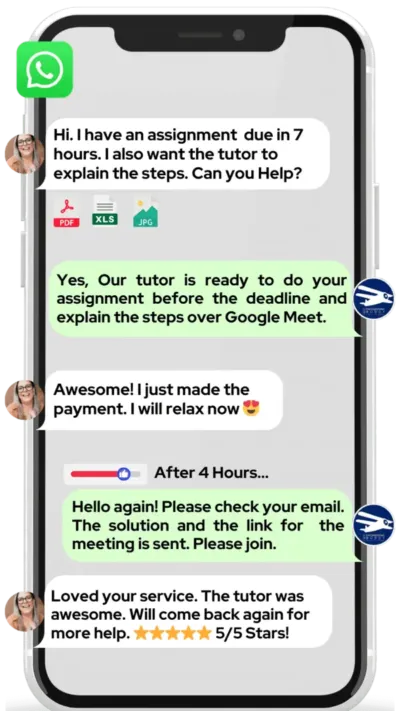
Unlike platforms where you fill out a form and wait, MEB responds in under a minute, 24/7. Tutor match takes under an hour. The $1 trial means you test before you commit. Everything runs over WhatsApp — no logins, no intake forms.
Pricing Guide
Most Motor-CAD sessions run at $20–$40/hr. Rate factors include your level (undergraduate project vs. PhD vs. industry professional), topic complexity (geometry setup vs. full NVH and drive cycle analysis), timeline urgency, and tutor availability. Rates for specialist sessions — loss map optimisation, scripting automation, multi-physics co-simulation with Ansys Fluent or Ansys CFX — can reach $100/hr.
For engineers targeting roles at Tesla, Rivian, BMW, Stellantis, or Tier 1 suppliers where Motor-CAD proficiency is assessed at interview, tutors with direct industry backgrounds in EV powertrain design are available at higher rates — share your specific goal and MEB will match the tier to your target.
Availability tightens during university project submission periods in April–May and November–December. Book with lead time if you have a hard deadline.
Start with the $1 trial — 30 minutes, no registration, no commitment. WhatsApp MEB for a quick quote.
MEB has been matching students with verified engineering software tutors since 2008. In computer-aided engineering, simulation tools, and motor design, the gap between knowing the theory and getting correct simulation output is exactly where 1:1 tutoring earns its value fastest.
Source: My Engineering Buddy, 2008–2025.
FAQ
Is Ansys Motor-CAD hard to learn?
Yes — more than most simulation tools at the same level. The difficulty isn’t the interface; it’s understanding what the electromagnetic and thermal outputs actually mean and how to connect them correctly. Most users hit serious confusion within the first real project.
How many sessions are typically needed?
For a focused project fix — geometry error, thermal model misconfiguration, loss map issue — two to four sessions usually resolves it. For systematic Motor-CAD competency from geometry to NVH analysis, expect eight to twelve sessions over four to six weeks.
Can you help with Motor-CAD projects and portfolio work?
MEB provides guided learning support — the tutor explains the method, you run the simulation and produce the deliverable yourself. All project work is produced and submitted by the student. See our Policies page for full details on what we help with and what we don’t.
Will the tutor match my exact Motor-CAD version and project topology?
Yes. When you message MEB, share your Motor-CAD version, the motor topology (PMSM, BLDC, SRM, induction), and your project goal. The tutor is briefed on all three before session one — no generic support.
What happens in the first session?
The tutor reviews your current model setup, identifies where inputs or boundary conditions are likely causing the problem, and works through the correct approach live. You leave with a specific corrected method and a clear next step — not a list of things to read.
Is online Motor-CAD tutoring as effective as in-person?
For simulation software, online is often better. Screen sharing lets the tutor see your exact model, your settings panel, and your output simultaneously. The digital pen-pad annotation adds the same clarity as a whiteboard. In-person would require the tutor to sit at your machine anyway.
Can I get Ansys Motor-CAD help at midnight or on weekends?
Yes. MEB tutors are active across US, UK, Gulf, and Australian time zones, which means coverage extends to most hours including evenings and weekends. WhatsApp MEB with your time zone and availability — matches typically happen within the hour.
What’s the difference between Motor-CAD’s electromagnetic and thermal solve — and why does it matter?
The electromagnetic solve calculates loss sources — copper, iron, magnet losses. The thermal solve uses those losses as heat inputs to predict temperature distribution. Confusing the two outputs, or running them without correctly linking loss data, produces results that look plausible but are physically wrong. This is the single most common Motor-CAD error MEB tutors correct.
Do you offer group Ansys Motor-CAD sessions?
No — MEB sessions are 1:1 only. Group sessions dilute the diagnostic precision that makes Motor-CAD tutoring effective. Your model, your topology, your specific error — that’s what the session is built around.
How do I find an Ansys Motor-CAD tutor if I’m not in a major city?
Location doesn’t matter. All sessions are online via Google Meet. MEB has matched Motor-CAD students from across the US, UK, Europe, Gulf, Canada, and Australia. WhatsApp MEB with your time zone — that’s the only location factor that matters.
Can Motor-CAD scripting and automation be covered in sessions?
Yes. MEB tutors cover Motor-CAD’s ActiveX and COM scripting interface — used for parametric geometry sweeps, automated loss map generation, and Python or MATLAB integration. Share what you’re trying to automate when you book, so the tutor comes prepared with relevant examples.
How do I get started?
WhatsApp MEB, share your Motor-CAD version and project description, get matched with a verified tutor — usually within an hour. First session is the $1 trial: 30 minutes live or one full project question explained. No registration, no commitment.
Trust & Quality at My Engineering Buddy
Every MEB tutor goes through subject-specific vetting — not a generic engineering screen. For Motor-CAD, that means demonstrating hands-on experience with electromagnetic-thermal co-simulation, loss map generation, and at least one real machine topology. Tutors complete a live demo session before joining the platform, and ongoing feedback from every session is reviewed. Rated 4.8/5 across 40,000+ verified reviews on Google.
MEB provides guided learning support. All project work is produced and submitted by the student. For full details on what we help with and what we don’t, read our Academic Integrity policy and Why MEB.
MEB has served 52,000+ students across the US, UK, Canada, Australia, Gulf, and Europe in 2,800+ subjects since 2008. In computer-aided design and engineering simulation — including Motor-CAD, Ansys AQWA hydrodynamic analysis, and STAR-CCM+ CFD — the platform covers the full spectrum of specialist engineering software that universities teach but rarely support well. See how MEB tutoring works for the full methodology.
Explore Related Subjects
Students studying Ansys Motor-CAD often also need support in:
Next Steps
Before your first session, have ready: your Ansys Motor-CAD version, the motor topology you’re modelling (PMSM, SRM, induction, BLDC), a description of where you’re stuck or what output doesn’t match expectations, and your project deadline. The tutor handles the rest.
- Share your Motor-CAD version, topology, and current issue over WhatsApp
- Share your time zone and availability
- MEB matches you with a verified Motor-CAD tutor — usually within 24 hours
First session starts with a diagnostic so every minute is used on what actually matters for your project.
Visit www.myengineeringbuddy.com for more on how MEB works.
WhatsApp to get started or email [email protected].
52,000+ Happy Students From Various Universities



How Much For Private 1:1 Tutoring & Hw Help?
Private 1:1 Tutoring and HW help Cost $20 – 35 per hour* on average.
Reviewed by Subject Expert
This page has been carefully reviewed and validated by our subject expert to ensure accuracy and relevance.

