Hire Verified & Experienced
Flight Mechanics Tutors
4.8/5 40K+ session ratings collected on the MEB platform
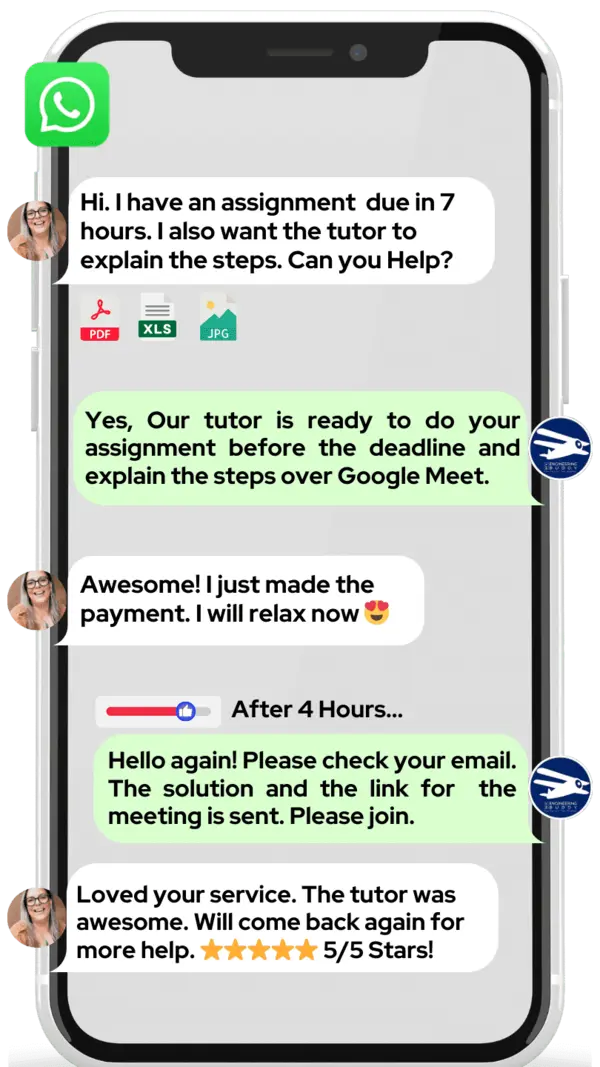



Hire The Best Flight Mechanics Tutor
Top Tutors, Top Grades. Without The Stress!


52,000+ Happy Students From Various Universities






How Much For Private 1:1 Tutoring & Hw Help?
Private 1:1 Tutoring and HW help Cost $20 – 35 per hour* on average.
Your aircraft performance equations aren’t wrong — your understanding of the force balance is. One session fixes that.
Flight Mechanics Tutor Online
Flight Mechanics is the study of forces acting on an aircraft in flight — lift, drag, thrust, and weight — and how they govern stability, control, and performance. It equips aerospace engineering students to model, analyze, and predict aircraft behavior across all flight regimes.
MEB offers 1:1 online tutoring and homework help in 2,800+ advanced subjects, including a dedicated Flight Mechanics tutor online service used by aerospace students across the US, UK, Canada, Australia, and the Gulf. If you’ve been searching for a Flight Mechanics tutor near me, online 1:1 sessions eliminate the geography problem entirely. Your tutor knows your exact syllabus — equations of motion, longitudinal dynamics, trim analysis — and works through it with you live.
- 1:1 online sessions tailored to your course syllabus and exam board
- Expert verified tutors with aerospace engineering backgrounds
- Flexible time zones — US, UK, Canada, Australia, Gulf covered
- Structured learning plan built after a diagnostic session
- Ethical homework and assignment guidance — you understand before you submit
52,000+ students across the US, UK, Canada, Australia, and the Gulf have used MEB since 2008 — across 2,800+ subjects, from AP Calculus to A Level Music Technology to Data Science.
Source: My Engineering Buddy, 2008–2025.
How Much Does a Flight Mechanics Tutor Cost?
Most Flight Mechanics tutoring sessions run $20–$40/hr. Graduate-level work — nonlinear dynamics, aeroelasticity, advanced stability analysis — can reach $70–$100/hr depending on tutor specialization. There’s a $1 trial: 30 minutes of live tutoring or one homework question explained in full.
| Level / Need | Typical Rate | What’s Included |
|---|---|---|
| Undergraduate (most levels) | $20–$40/hr | 1:1 sessions, homework guidance, problem sets |
| Graduate / Advanced Specialist | $40–$100/hr | Expert tutor, nonlinear dynamics, aeroelasticity |
| $1 Trial | $1 flat | 30 min live session or 1 homework question |
Tutor availability tightens sharply in the 4–6 weeks before final exam periods. Book early if your deadline is approaching.
WhatsApp MEB for a quick quote — average response time under 1 minute.
Who This Flight Mechanics Tutoring Is For
Flight Mechanics sits at the intersection of physics, mathematics, and engineering judgment. Most students hit a wall somewhere between deriving the phugoid mode and interpreting a root locus plot. This service exists for that wall.
- Undergraduate aerospace and aeronautical engineering students stuck on equations of motion or static stability
- Graduate students working through nonlinear flight dynamics or control system design
- Students with a university conditional offer at risk because Flight Mechanics is the course pulling their average down
- Students at MIT, Georgia Tech, TU Delft, Imperial College London, UNSW, Ryerson, or Khalifa University taking Flight Mechanics as a core module
- Students who need aircraft performance tutoring alongside their dynamics coursework
- Parents supporting an engineering student whose confidence has dropped alongside their grades
1:1 Tutoring vs Self-Study vs AI Tools
Self-study works for motivated students — until it doesn’t. Flight Mechanics problems chain together: a wrong assumption about reference frames in week two corrupts everything that follows, and a textbook won’t tell you where the chain broke. AI tools can explain the phugoid approximation in plain English and generate example problems, but they cannot watch you set up a trim condition, spot that you’ve resolved forces in the wrong axis, and correct it mid-calculation. That real-time catch is where human instruction earns its rate. MEB tutoring combines the flexibility of online sessions with a structured feedback loop calibrated to your exact course — whether that’s at an FAA-accredited program or a European aeronautics MSc.
Outcomes: What You’ll Be Able To Do in Flight Mechanics
After consistent 1:1 Flight Mechanics tutoring, students report a clear shift in what they can actually do. You’ll solve equations of motion for a rigid aircraft in all six degrees of freedom without losing track of sign conventions. You’ll analyze longitudinal and lateral-directional stability using eigenvalue methods and interpret whether a mode is stable, neutral, or divergent. You’ll model thrust-required and thrust-available curves to determine climb performance, service ceiling, and range. You’ll explain the physical meaning behind the short-period and phugoid modes to an examiner — not just reproduce the math. You’ll apply linear control theory to basic autopilot design problems, including root locus sketching for pitch-hold systems.
Supporting a student through Flight Mechanics? MEB works directly with parents to set up sessions, track progress, and keep coursework on schedule. WhatsApp MEB — average response time is under a minute, 24/7.
Based on feedback from 40,000+ sessions collected by MEB from 2022 to 2025, 58% of students improved by one full grade after approximately 20 hours of 1:1 tutoring in a single subject. A further 23% achieved at least a half-grade improvement.
Source: MEB session feedback data, 2022–2025.
What We Cover in Flight Mechanics (Syllabus / Topics)

Track 1: Aircraft Performance
- Lift, drag, thrust, and weight in steady level flight
- Thrust-required and thrust-available curves
- Climb performance: rate of climb, angle of climb, service ceiling
- Range and endurance: Breguet equations for jet and propeller aircraft
- Glide performance and minimum sink rate
- Takeoff and landing ground roll calculations
- V-n diagrams and structural load limits
Textbooks used in this track include Anderson’s Introduction to Flight, Raymer’s Aircraft Design: A Conceptual Approach, and Houghton & Carpenter’s Aerodynamics for Engineering Students.
Track 2: Stability and Control
- Static longitudinal stability: stick-fixed and stick-free neutral points
- Trim conditions and elevator deflection requirements
- Lateral and directional static stability: dihedral effect, directional stiffness
- Equations of motion for a rigid aircraft: six-degree-of-freedom formulation
- Linearization and small-perturbation theory
- Longitudinal modes: short-period and phugoid — eigenvalue analysis
- Lateral-directional modes: roll, spiral, and Dutch roll
Core texts include Etkin & Reid’s Dynamics of Flight, Nelson’s Flight Stability and Automatic Control, and Cook’s Flight Dynamics Principles.
Track 3: Flight Dynamics and Control Systems
- Transfer function derivation for pitch, roll, and yaw responses
- Root locus analysis for stability augmentation systems
- Basic autopilot design: pitch-hold, altitude-hold, heading-hold
- Handling qualities criteria: Cooper-Harper scale and MIL-SPEC requirements
- Introduction to nonlinear flight dynamics and limit cycles
- Simulation using MATLAB/Simulink for dynamic response analysis
Recommended references include Stevens, Lewis & Johnson’s Aircraft Control and Simulation and Brogan’s Modern Control Theory. The American Society of Mechanical Engineers publishes applied dynamics resources relevant to advanced coursework in this area.
What a Typical Flight Mechanics Session Looks Like
The tutor opens by checking your previous topic — usually something like the phugoid derivation or a static margin calculation you attempted since the last session. You share your working on screen. They identify immediately whether your force resolution is off or whether you’ve dropped a term in the linearization. Then you move to the current problem: maybe it’s deriving the short-period approximation from the full longitudinal equations, or plotting a root locus for a pitch damper. The tutor writes the steps on a digital pen-pad while you follow, then pauses and asks you to reconstruct the argument in your own words or replicate the next step yourself. The session closes with a specific task — two trim condition problems and one phugoid frequency calculation — and the next topic is logged so no session starts cold.
How MEB Tutors Help You with Flight Mechanics (The Learning Loop)
Diagnose: In the first session, the tutor locates exactly where your understanding breaks down. For most Flight Mechanics students, it’s either the reference frame conventions in the equations of motion or the physical interpretation of eigenvalues — not the algebra itself.
Explain: The tutor works through live problems on a digital pen-pad. Every step is written out, every assumption stated. You see the derivation built from scratch, not copied from a slide.
Practice: You attempt the next problem yourself while the tutor watches. This is where most online tutoring fails — skipping from explanation to homework without the supervised attempt in between.
Feedback: The tutor corrects errors step by step and tells you why a particular mistake would cost marks in an exam context. Knowing where you lost points matters as much as getting the answer right.
Plan: At the end of each session, the tutor sets the next topic in sequence. Stability before dynamics. Dynamics before control. No jumping ahead until the foundation is solid.
Sessions run over Google Meet with a digital pen-pad or iPad and Apple Pencil. Before your first session, share your course outline or past paper, your most recent homework attempt, and your exam date. The first session functions as both diagnostic and first lesson. Start with the $1 trial — 30 minutes of live tutoring that also serves as your first diagnostic.
At MEB, we’ve found that Flight Mechanics students who struggle with stability analysis almost always have the same root problem: they’re treating the linearized equations as abstract algebra rather than as a description of physical aircraft motion. Fixing that framing — usually in one session — changes everything that follows.
Tutor Match Criteria (How We Pick Your Tutor)
Not every aerospace engineer is the right tutor for Flight Mechanics. Here’s how MEB matches.
Subject depth: The tutor must have demonstrable coursework or professional experience in flight dynamics, stability analysis, or aircraft performance — not just general aerospace knowledge.
Tools: Every session uses Google Meet with a digital pen-pad or iPad and Apple Pencil for annotated problem-solving. For MATLAB/Simulink-heavy coursework, the tutor shares a live coding environment on screen.
Time zone: MEB covers New York, Los Angeles, Chicago, London, Dubai, Toronto, Sydney, Melbourne, and all major US, UK, Gulf, Canadian, Australian, and European time zones, including evenings and weekends.
Learning style: Calibrated from the first session — some students need step-by-step derivations; others need the physical picture first and the math second.
Communication: Clear technical English, adapted to the student’s level. No jargon left unexplained.
Goals: Whether you’re targeting exam marks, completing a specific assignment, or building deep understanding for a research thesis, the tutor’s approach is set accordingly.
Unlike platforms where you fill out a form and wait, MEB responds in under a minute, 24/7. Tutor match takes under an hour. The $1 trial means you test before you commit. Everything runs over WhatsApp — no logins, no intake forms.
Study Plans (Pick One That Matches Your Goal)
After the first diagnostic session, your tutor builds a session sequence around one of three structures. Catch-up (1–3 weeks): close a specific gap — stability derivations, performance calculations — before an upcoming exam or submission. Exam prep (4–8 weeks): work through all major topics systematically, timed past-paper practice in final two weeks. Weekly support: ongoing sessions aligned to your semester schedule, covering each topic as it appears in lectures. The tutor chooses the sequence; you bring the problems.
Students consistently tell us that the biggest shift in Flight Mechanics isn’t suddenly understanding more equations — it’s knowing which equation to reach for and why. That judgment develops through repeated supervised problem-solving, not extra reading. Two weeks of structured sessions will move you further than two months of rereading notes alone.
Pricing Guide
Flight Mechanics tutoring starts at $20/hr for standard undergraduate coursework. Rates depend on level, topic complexity, how quickly you need sessions, and tutor availability. Graduate-level dynamics and control system design typically fall in the $50–$100/hr range.
For students targeting competitive aerospace graduate programs or positions at firms such as Boeing, Airbus, or NASA JPL, tutors with professional flight test or research backgrounds are available at higher rates — share your specific goal and MEB will match the tier to your ambition.
Availability drops fast in the 4–6 weeks before finals. If your exam is close, book sooner rather than later.
Start with the $1 trial — 30 minutes, no registration, no commitment. WhatsApp MEB for a quick quote.
Flight Mechanics sits at the center of an aerospace engineering degree. Students who fall behind in stability and control often find that later modules — aeroelasticity, aircraft design, propulsion integration — compound the gap. Early intervention pays back across the degree, not just in one exam.
Source: My Engineering Buddy, tutor feedback summary, 2022–2025.
FAQ
Is Flight Mechanics hard?
It’s one of the more demanding core modules in aerospace engineering. The difficulty isn’t the individual equations — it’s holding together the physical reasoning, the mathematics, and the sign conventions simultaneously. Most students need guided problem-solving to connect those three layers.
How many sessions are needed?
Students with one or two specific gaps — a single topic like phugoid mode or trim analysis — often close them in 3–5 sessions. Students needing full-course coverage before an exam typically book 12–20 sessions. The tutor gives a clearer estimate after the first diagnostic.
Can you help with homework and assignments?
Yes. MEB tutors explain the method, work through a similar example, and guide you to solve the problem yourself. You understand the work, then submit it yourself. MEB tutoring is guided learning — you understand the work, then submit it yourself. For full details on what we help with and what we don’t, read our Academic Integrity policy and Why MEB.
Will the tutor match my exact syllabus or exam board?
Yes. Before matching, MEB asks for your university, course code, and any syllabus document you have. The tutor covers what’s on your actual course — not a generic Flight Mechanics outline. Exam board and assessment format are confirmed before the first session.
What happens in the first session?
The tutor runs a short diagnostic — usually 10–15 minutes of questions and one worked problem — to locate where your understanding breaks down. The rest of the session covers the most pressing gap. You leave with a specific practice task and a plan for the next session.
Is online tutoring as effective as in-person?
For a subject like Flight Mechanics, yes — and in some respects better. The tutor’s digital pen-pad annotation on a shared screen is clearer than a whiteboard viewed from across a desk. Session recordings and shared notes also mean you can review the worked examples afterward.
Can I get Flight Mechanics help at midnight?
Yes. MEB operates across all time zones and responds to WhatsApp messages 24/7. If you have a problem set due at 8 AM and it’s currently midnight, message MEB. Response time averages under a minute; tutor availability varies but late-night sessions are regularly booked.
What if I don’t like my assigned tutor?
Tell MEB over WhatsApp after the first session. Tutor reassignment is routine — no forms, no waiting period. MEB matches you with a replacement and the $1 trial applies to the new tutor if you haven’t used it yet.
Do you cover MATLAB and Simulink for Flight Mechanics assignments?
Yes. Several Flight Mechanics courses require MATLAB for eigenvalue computation, root locus plotting, and Simulink for dynamic response simulation. MEB tutors who specialize in computational flight dynamics share a live screen and walk through the code alongside the theory. See also: computational fluid dynamics tutoring for related numerical methods support.
How do I get started?
Three steps: WhatsApp MEB with your course details, get matched with a verified Flight Mechanics tutor within the hour, then start the $1 trial — 30 minutes of live tutoring or one homework question explained in full. No registration. No forms.
Trust & Quality at My Engineering Buddy
Every MEB tutor goes through subject-specific screening: a live demo session evaluated against the topic they claim to teach, a review of their academic or professional background, and ongoing monitoring through student feedback. Rated 4.8/5 across 40,000+ verified reviews on Google. For Flight Mechanics, tutors hold aerospace engineering degrees at minimum — many have graduate-level research or industry experience in flight dynamics, flight test, or control systems design.
MEB tutoring is guided learning — you understand the work, then submit it yourself. For full details on what we help with and what we don’t, read our Academic Integrity policy and Why MEB.
MEB has served 52,000+ students across the US, UK, Canada, Australia, the Gulf, and Europe in 2,800+ subjects since 2008. Students working through related aerospace modules can also get help with aerodynamics tutoring, aerospace propulsion tutoring, and aircraft structures homework help. For a full breakdown of how MEB sessions are structured, see our tutoring methodology.
A common pattern our tutors observe is this: Flight Mechanics students who finally pass do so not because they studied more, but because someone showed them exactly where their reasoning was wrong and made them correct it in real time. That’s what 1:1 tutoring does that nothing else does.
MEB has matched students with specialist tutors in subjects as specific as gas dynamics, compressible flow, and turbulence modeling — the same depth applies to Flight Mechanics.
Source: My Engineering Buddy, subject catalogue, 2025.
Try your first session for $1 — 30 minutes of live 1:1 tutoring or one homework question explained in full. No registration. No commitment. WhatsApp MEB now and get matched within the hour.
Explore Related Subjects
Students studying Flight Mechanics often also need support in:
- Aeroacoustics
- Aircraft Design
- Aircraft Maintenance
- Aviation
- Aviation Safety
- Missile and Rocket Propulsion
- Propulsion
Next Steps
Getting started takes under five minutes.
- Share your exam board or university course code, your hardest topic right now, and how much time you have before your exam or deadline
- Share your availability and time zone
- MEB matches you with a verified Flight Mechanics tutor — usually within 24 hours, often faster
- Your first session opens with a diagnostic so every minute counts from the start
Before your first session, have ready: your course outline or syllabus, a recent past paper attempt or homework you struggled with, and your exam or deadline date. The tutor handles the rest.
Visit www.myengineeringbuddy.com to read more about how MEB sessions are structured and what to expect from the matching process.
WhatsApp to get started or email meb@myengineeringbuddy.com.
Reviewed by Subject Expert
This page has been carefully reviewed and validated by our subject expert to ensure accuracy and relevance.