




~1 min
Average Reply Time
~1 hour
To Be Matched With A Tutor
30 Min Trial
75% Find Their Tutor On The 1st Trial
$20-35+/hr
Premium Yet Affordable Learning
Hire The Best Aircraft Design Tutor







Most students who struggle with aircraft design don’t lack ability — they hit a wall on drag polars or structural load paths with no one to walk them through it live.
Aircraft Design Tutor Online
Aircraft design is the multidisciplinary engineering process of conceptualizing, analyzing, and developing fixed-wing or rotary-wing aircraft. Covering aerodynamics, structures, propulsion, and systems integration, it equips students to apply airworthiness principles and translate design requirements into flight-capable configurations.
If you’ve searched for an Aircraft Design tutor near me and found only generic engineering tutors, MEB is different. We connect you with 1:1 online Aircraft Design tutors who know the specific course materials, design methodologies, and analysis tools your programme uses — from preliminary sizing to full conceptual design reviews. Sessions are focused, technical, and built around what you haven’t understood yet.
- 1:1 online sessions tailored to your course syllabus and design brief
- Expert verified tutors with aerospace engineering backgrounds
- Flexible time zones — US, UK, Canada, Australia, Gulf
- Structured learning plan built after a diagnostic session
- Ethical homework and assignment guidance — you understand the work before you submit it
52,000+ students across the US, UK, Canada, Australia, and the Gulf have used MEB since 2008 — across 2,800+ subjects, from AP Calculus to A Level Music Technology to Data Science.
Source: My Engineering Buddy, 2008–2025.
How Much Does an Aircraft Design Tutor Cost?
Most Aircraft Design tutoring sessions run $20–$40 per hour. Graduate-level and highly specialised topics — such as multidisciplinary design optimisation or aeroelasticity — can reach up to $100/hr depending on tutor expertise and timeline. A $1 trial gets you 30 minutes of live 1:1 tutoring or one full homework question explained from first principles.
| Level / Need | Typical Rate | What’s Included |
|---|---|---|
| Undergraduate (most courses) | $20–$40/hr | 1:1 sessions, homework guidance |
| Advanced / Graduate-level | $40–$100/hr | Expert tutor, niche depth, MDO topics |
| $1 Trial | $1 flat | 30 min live session or 1 homework question |
Tutor availability tightens in the weeks before final design reviews and end-of-semester submissions. Book early if your deadline is within four weeks.
WhatsApp MEB for a quick quote — average response time under 1 minute.
Who This Aircraft Design Tutoring Is For
Aircraft Design is taught across aerospace engineering degrees worldwide, and the students who come to MEB are almost never struggling with effort — they’re struggling with feedback. No one has told them exactly where their drag breakdown went wrong or why their tail sizing assumptions don’t hold. MEB closes that gap.
- Undergraduate aerospace engineering students working through conceptual design coursework
- Graduate students tackling MDO, aeroelasticity, or advanced configuration analysis
- Students whose design project grade is tied to a university conditional offer — and who cannot afford to submit work they don’t fully understand
- Students returning to Aircraft Design after failing or withdrawing from a previous attempt
- Students at Delft University of Technology, MIT, Cranfield University, Georgia Tech, TU Munich, RMIT University, or Embry-Riddle Aeronautical University who need subject-specific support beyond what office hours provide
- Students needing help with aerodynamics tutoring or aircraft structures help as part of their design programme
1:1 Tutoring vs Self-Study vs AI Tools
Self-study works for motivated students, but aircraft design involves iterative trade-offs — you can work through a textbook chapter on constraint analysis and still not know whether your wing loading selection is physically justified. AI tools can explain the Breguet range equation quickly, but they cannot watch you build a drag polar in real time, catch where your wetted area estimate diverges, and correct it in the same session. In Aircraft Design specifically, the errors that cost marks are usually quiet — a wrong assumption in the T/W diagram that propagates through five subsequent calculations. A live tutor sees that in minutes. MEB combines the flexibility of online access with a structured, session-by-session feedback loop calibrated to your exact course and design brief.
Outcomes: What You’ll Be Able To Do in Aircraft Design
After working with an MEB Aircraft Design tutor, students can apply constraint analysis to size thrust-to-weight and wing loading for a given design mission. They can analyze aerodynamic performance across the flight envelope, including cruise drag breakdown and climb gradient calculations. Students learn to model structural load paths for primary airframe components and explain the trade-offs between structural weight and stiffness. They can present a complete conceptual design — from requirements capture through configuration selection — with defensible numbers at each stage. They can also solve propulsion-airframe integration problems and connect aerospace propulsion choices to overall aircraft performance targets.
Supporting a student through Aircraft Design? MEB works directly with parents to set up sessions, track progress, and keep coursework on schedule. WhatsApp MEB — average response time is under a minute, 24/7.
Based on feedback from 40,000+ sessions collected by MEB from 2022 to 2025, 58% of students improved by one full grade after approximately 20 hours of 1:1 tutoring in a single subject. A further 23% achieved at least a half-grade improvement.
Source: MEB session feedback data, 2022–2025.
What We Cover in Aircraft Design (Syllabus / Topics)

Track 1: Conceptual and Preliminary Design
- Mission requirements and design specifications
- Initial weight estimation and fuel fraction methods
- Constraint analysis — thrust-to-weight and wing loading diagrams
- Configuration selection and trade studies
- Fuselage layout and passenger / payload volume sizing
- Design iteration and sensitivity analysis
Key references: Aircraft Design: A Conceptual Approach by Daniel Raymer; Introduction to Flight by John D. Anderson; Synthesis of Subsonic Airplane Design by Egbert Torenbeek.
Track 2: Aerodynamics and Performance
- Wing geometry — aspect ratio, taper, sweep, and twist
- Drag polar construction and drag breakdown analysis
- Lift curve slope and high-lift device sizing
- Performance calculations — take-off, climb, cruise, and landing
- Stability and control surface sizing
- Connections to compressible flow tutoring and transonic effects
Key references: Aerodynamics for Engineers by Bertin and Cummings; Aircraft Performance and Design by Anderson; Low-Speed Aerodynamics by Katz and Plotkin.
Track 3: Structures, Propulsion, and Systems Integration
- Primary load paths — wing bending, shear, and torsion
- Material selection and structural weight estimation
- Engine selection and propulsion-airframe integration
- Landing gear geometry, retraction, and ground loads
- Aircraft systems overview — hydraulic, electrical, fuel, and avionics
- Airworthiness considerations and design for certification
Key references: Aircraft Structures for Engineering Students by T.H.G. Megson; Elements of Gas Turbine Propulsion by Jack Mattingly; General Aviation Aircraft Design by Snorri Gudmundsson.
What a Typical Aircraft Design Session Looks Like
The tutor opens by checking your constraint diagram from the previous session — specifically whether your updated stall speed assumption shifted the wing loading boundary. From there, you and the tutor work through your drag polar on screen together: the tutor annotates each component — zero-lift drag, induced drag, wave drag if you’re in the transonic regime — and asks you to explain where each term comes from before moving on. You replicate the calculation steps with the tutor watching, not just watching the tutor do it. If your structural weight estimate is feeding incorrectly into the sizing loop, the tutor catches it here. The session closes with a specific task: recalculate your T/W constraint curve using the corrected CLmax value, and note three assumptions you’d revisit if the design mission changed. Next topic: empennage sizing.
How MEB Tutors Help You with Aircraft Design (The Learning Loop)
Diagnose: In the first session, the tutor reviews your current design brief, past submissions or problem sets, and any tutor or examiner feedback you’ve received. They identify the exact stage in the design process where your reasoning breaks down — often constraint analysis or the transition from aerodynamic sizing to structural estimation.
Explain: The tutor works through live examples on a digital pen-pad — drawing your V-n diagram, annotating your drag polar, or rebuilding your weight fraction table from scratch. You see every step as it’s written, not just the final answer.
Practice: You attempt the next problem while the tutor watches. This is where most tutoring platforms stop. MEB tutors stay present during the attempt — they don’t just mark it afterward.
Feedback: Every error gets a specific explanation: which assumption was wrong, where it propagated, and what the marker or examiner would have deducted. Not “you made a mistake” — “here’s exactly why the induced drag calculation diverged.”
Plan: Each session ends with a clear next topic and a specific task. No vague “review chapter 5” instructions. The tutor tracks progress across sessions and adjusts the sequence if a new gap surfaces.
All sessions run on Google Meet with a digital pen-pad or iPad and Apple Pencil for real-time annotation. Before your first session, share your course outline or design brief, any marked work you’ve received, and your submission or exam date. The first session is diagnostic — the tutor uses it to map exactly where to start. Start with the $1 trial — 30 minutes of live tutoring that also serves as your first diagnostic.
At MEB, we’ve found that aircraft design students almost always know more than they think. The problem is usually a single shaky assumption in the sizing chain — not a fundamental misunderstanding of the subject. One session that finds that assumption saves weeks of reworking the entire design.
Tutor Match Criteria (How We Pick Your Tutor)
Not every aerospace tutor is right for every student. Here’s how MEB matches you.
Subject depth: Tutors are matched to your specific level — undergraduate conceptual design, graduate MDO, or research-focused aerostructures work. A tutor who knows Raymer’s method inside out is not automatically the right fit for a student doing computational aeroelasticity.
Tools: All sessions use Google Meet with a digital pen-pad or iPad and Apple Pencil for annotated problem-solving. If your course uses specific design tools, tell MEB before the match — tutors with hands-on experience in those tools are prioritised.
Time zone: Tutors are available across New York, Los Angeles, Chicago, London, Dubai, Toronto, Sydney, and Melbourne time zones — including evenings and weekends.
Learning style: The tutor calibrates to you in the first session. Some students need the derivation before the formula makes sense. Others need to work a problem first and understand it in reverse. Both approaches work here.
Communication: Clear technical English adapted to your level — whether you’re comfortable with the jargon or still building vocabulary around lift coefficient and Mach number.
Goals: Whether you need to pass a design review, improve a specific assignment grade, or build conceptual depth for a research project, the tutor builds the session structure around that goal.
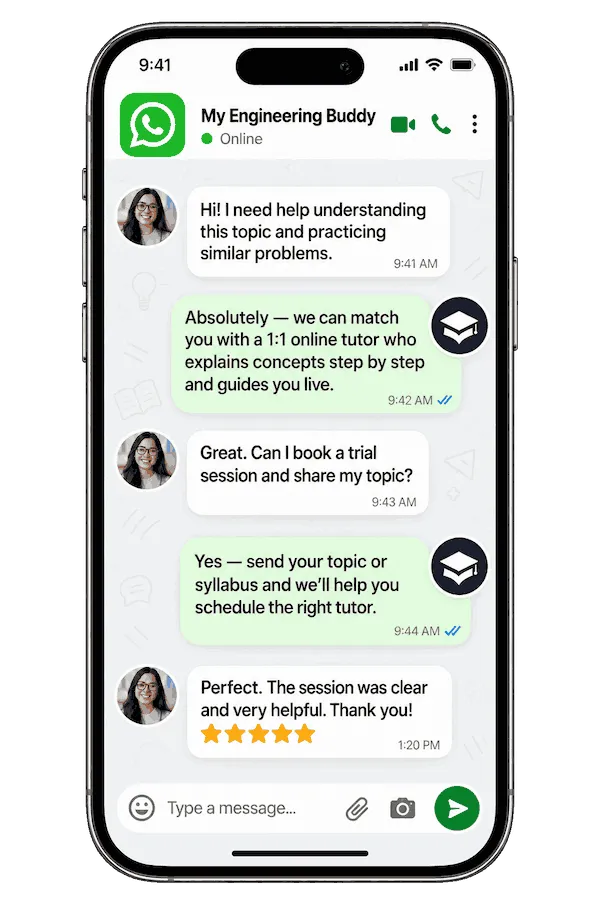
Unlike platforms where you fill out a form and wait, MEB responds in under a minute, 24/7. Tutor match takes under an hour. The $1 trial means you test before you commit. Everything runs over WhatsApp — no logins, no intake forms.
Study Plans (Pick One That Matches Your Goal)
Whether you have three weeks before a design submission or a full semester ahead, the tutor builds your session sequence after the first diagnostic. A catch-up plan (1–3 weeks) focuses on the one or two topics blocking your progress — usually constraint analysis or structural sizing. An exam or review prep plan (4–8 weeks) works through all major design stages in order, with practice problems and mock review questions. Weekly support runs alongside your semester, aligned to each design phase as your course moves forward. The tutor maps the specific sequence after seeing your brief and any marked work.
Pricing Guide
Aircraft Design tutoring starts at $20/hr for standard undergraduate coursework. Graduate-level topics — aeroelasticity, MDO, advanced CFD-informed design — typically run $40–$100/hr depending on tutor background and the complexity of the material. Rate factors include your level, the specific design stage, how close your deadline is, and tutor availability.
For students targeting places at top aerospace programmes or working on advanced research projects, tutors with professional aerospace industry or research backgrounds are available at higher rates — share your specific goal and MEB will match the tier to your ambition.
Availability tightens significantly in the four weeks before major submission deadlines. Start with the $1 trial — 30 minutes, no registration, no commitment. WhatsApp MEB for a quick quote.
FAQ
Is Aircraft Design hard?
Aircraft Design is demanding because it combines aerodynamics, structures, propulsion, and systems into a single iterative problem. Most students find the difficulty comes from connecting the disciplines — not from any single topic in isolation. That’s exactly where a tutor helps most.
How many sessions are needed?
It depends on where you’re starting. Students with specific gaps — one broken step in the sizing chain — often need 3–6 sessions. Students working through a full conceptual design project typically need 10–20 hours of structured support across the semester.
Can you help with homework and assignments?
Yes — MEB tutors explain the method, walk through the reasoning, and make sure you understand each step before you write it up yourself. MEB tutoring is guided learning — you understand the work, then submit it yourself. For full details on what we help with and what we don’t, read our Academic Integrity policy and Why MEB.
Will the tutor match my exact syllabus or exam board?
Yes. When you contact MEB, share your course outline, university, and current design phase. The tutor is matched specifically to your programme — not assigned from a generic aerospace pool. Syllabus fit is a primary matching criterion.
What happens in the first session?
The tutor reviews your brief, any marked work or feedback you’ve received, and your current understanding of the design process. They identify the specific point where your reasoning breaks down and build the session plan from there. No time is wasted on topics you already know.
Is online tutoring as effective as in-person?
For Aircraft Design, yes — because the core work is annotated diagrams, calculation walkthroughs, and design trade discussions, all of which transfer well to a digital pen-pad on Google Meet. Many students find it easier to record and revisit key steps afterward.
Can I get Aircraft Design help at midnight or on weekends?
Yes. MEB tutors operate across all major time zones, including US East and West Coast, UK, Gulf, and Australian hours. Evening and weekend sessions are available. WhatsApp MEB at any time — response time is typically under a minute.
What if I don’t get on with my assigned tutor?
Tell MEB via WhatsApp and a replacement is arranged — usually within the same day. The $1 trial is specifically designed to let you assess the match before committing to a full session block. No contracts, no lock-in.
Do you offer help with Aircraft Design tools like XFOIL, OpenVSP, or MATLAB?
Yes. If your design coursework uses specific analysis tools, tell MEB before the match. Tutors with hands-on experience in those tools are available. For broader computational support, see CFD tutoring and flight mechanics help.
How do I get started?
Three steps: WhatsApp MEB with your course outline and deadline, get matched with a verified Aircraft Design tutor within the hour, then start your $1 trial — 30 minutes of live tutoring or one assignment question explained in full. No registration required.
Trust & Quality at My Engineering Buddy
Every MEB tutor goes through subject-specific vetting: a live demo evaluation, degree and experience verification, and ongoing review based on student feedback after each session. Tutors are not approved on credentials alone — they have to demonstrate they can teach the material in real time, under the same conditions a student faces. Rated 4.8/5 across 40,000+ verified reviews on Google.
MEB tutoring is guided learning — you understand the work, then submit it yourself. For full details on what we help with and what we don’t, read our Academic Integrity policy and Why MEB.
MEB has served 52,000+ students across the US, UK, Canada, Australia, the Gulf, and Europe since 2008, covering 2,800+ subjects. Whether you need an aircraft performance tutor, support with aviation safety tutoring, or 1:1 turbulence modeling help, the subject-specific match process is the same. See MEB’s tutoring methodology for how sessions are structured and why the diagnostic-first approach produces consistent results.
Students consistently tell us that the first session is the most valuable — not because of what the tutor teaches, but because of what they discover they’d been assuming incorrectly for weeks. Catching one wrong assumption early in aircraft design is worth three weeks of solo revision.
Explore Related Subjects
Students studying Aircraft Design often also need support in:
Next Steps
Getting started takes about two minutes. Here’s what to do:
- Have your course outline or design brief ready, along with any marked work or feedback you’ve received
- Note your submission or exam date and your current time zone
- Share your hardest topic or the specific stage in the design process where you’ve stalled
Before your first session, have ready: your exam board and syllabus (or course outline), a recent past paper attempt or homework you struggled with, and your exam or deadline date. The tutor handles the rest.
MEB matches you with a verified Aircraft Design tutor within 24 hours — usually faster. The first session starts with a diagnostic so every minute counts. Visit www.myengineeringbuddy.com to read more about how MEB works.
Try your first session for $1 — 30 minutes of live 1:1 tutoring or one homework question explained in full. No registration. No commitment. WhatsApp MEB now and get matched within the hour.
WhatsApp to get started or email [email protected].
Reviewed by Subject Expert
This page has been carefully reviewed and validated by our subject expert to ensure accuracy and relevance.



