~1 min
Average Reply Time
~1 hour
To Be Matched With A Tutor
30 Min Trial
75% Find Their Tutor On The 1st Trial
$20-35+/hr
Premium Yet Affordable Learning
Most students who struggle with Neuroanatomy don’t lack intelligence — they lack a tutor who can draw the corticospinal tract live on screen while explaining exactly where the lesion produces the deficit.
Neuroanatomy Tutor Online
Neuroanatomy is the branch of neuroscience studying the structure, organisation, and function of the nervous system — including the brain, spinal cord, and peripheral nerves — equipping students to map neural pathways, interpret clinical cases, and understand neurological disease mechanisms.
MEB provides 1:1 online tutoring and academic guidance in Neuroscience and its specialist branches, including Neuroanatomy. If you’ve searched for a Neuroanatomy tutor near me, you’re in the right place — our tutors work across every time zone, from the US and UK to Canada, Australia, and the Gulf. Sessions are built around your exact course, textbook, and deadline. No generic content. No wasted time.
- 1:1 online sessions tailored to your course syllabus and exam board
- Expert-verified tutors with neuroscience and clinical anatomy backgrounds
- Flexible time zones — US, UK, Canada, Australia, Gulf covered daily
- Structured learning plan built after a diagnostic session in your first hour
- Ethical academic guidance — you understand the work before you submit
52,000+ students across the US, UK, Canada, Australia, and the Gulf have used MEB since 2008 — including students in Neuroscience subjects like Neuroanatomy, Neurophysiology, and Cognitive Neuroscience.
Source: My Engineering Buddy, 2008–2025.
How Much Does a Neuroanatomy Tutor Cost?
Most Neuroanatomy sessions run at $20–$40 per hour. Graduate-level and clinical neuroanatomy tutoring — covering topics like functional MRI interpretation or surgical approach anatomy — can reach up to $100/hr depending on tutor background. You can test the whole setup first with the $1 trial before committing to any hourly rate.
| Level / Need | Typical Rate | What’s Included |
|---|---|---|
| Undergraduate (Year 1–2) | $20–$35/hr | 1:1 sessions, homework guidance, diagram walkthroughs |
| Advanced / Graduate | $35–$70/hr | Clinical case mapping, research support, niche pathway work |
| Medical / Professional | $70–$100/hr | Board exam prep, surgical anatomy, specialist tutor matching |
| $1 Trial | $1 flat | 30 min live session or one full homework question explained |
Tutor availability tightens sharply in the four weeks before medical board exams and end-of-semester practicals. Book early if your deadline is within six weeks.
WhatsApp MEB for a quick quote — average response time under 1 minute.
Who This Neuroanatomy Tutoring Is For
Neuroanatomy is one of the most spatially demanding subjects in any medical or life-science curriculum. Students typically hit a wall somewhere between cranial nerve nuclei and the thalamic relay system — and a single confused week can cascade quickly into a failed practical or a missed exam mark.
- Undergraduate students in medicine, dentistry, physiotherapy, or neuroscience struggling with 3D spatial orientation of brain structures
- Graduate and medical students preparing for USMLE Step 1, MRCS, or equivalent board exams with neuroanatomy components
- Students retaking after a failed first attempt who need a tutor to rebuild the foundations properly — not just redo the same notes
- Students with a university conditional offer that depends on passing this module
- Masters and PhD students needing support connecting tract anatomy to neuroimaging findings or experimental design
- Parents watching a student’s confidence fall alongside their anatomy grades and looking for reliable, expert-matched help
MEB has worked with students at universities across the US, UK, Canada, and Australia — including students at institutions like Johns Hopkins, UCL, University of Toronto, University of Melbourne, and McGill — as well as students preparing for UK Foundation Programme applications and North American residency placements.
1:1 Tutoring vs Self-Study vs AI vs YouTube vs Online Courses
Self-study works if you’re disciplined — but Neuroanatomy is a subject where most students don’t know what they don’t know until a viva question exposes it. AI tools give fast definitions but can’t correct your spatial reasoning error in real time. YouTube covers the basics well and stops entirely when you’re confused about why the posterior limb of the internal capsule carries corticospinal fibres but not the ones you drew. Online courses are structured but run at a fixed pace that waits for no one’s exam date. 1:1 tutoring with MEB is live, calibrated to your exact module and assessment format, and catches the specific misconception — not a generic one — before it costs you marks.
Outcomes: What You’ll Be Able To Do in Neuroanatomy
After consistent 1:1 Neuroanatomy tutoring, students can do specific things they couldn’t before. You’ll be able to map ascending and descending spinal cord pathways and predict the clinical deficit from any given lesion level. You’ll be able to explain the functional role of each cranial nerve nucleus and work through cranial nerve palsy cases without guessing. Students can analyse MRI brain slices and identify key landmarks — thalamus, basal ganglia, hippocampus — used in both clinical settings and exam questions. You’ll be able to apply neuroanatomical knowledge to written clinical scenarios in USMLE-style or UK medical exam formats. And you’ll be able to present your reasoning in viva or OSCE settings, not just recall isolated facts.
Based on feedback from 40,000+ sessions collected by MEB from 2022 to 2025, 58% of students improved by one full grade after approximately 20 hours of 1:1 tutoring in subjects like Neuroanatomy. A further 23% achieved at least a half-grade improvement.
Source: MEB session feedback data, 2022–2025.
Students consistently tell us that Neuroanatomy clicked only when someone drew the pathway in real time while talking through it — not from reading the same diagram a fifth time. That’s what live sessions do that no textbook reread achieves.
What We Cover in Neuroanatomy (Syllabus / Topics)

Track 1: Central Nervous System Structure and Pathways
- Gross anatomy of the brain: lobes, sulci, gyri, and key landmarks
- Ventricular system and cerebrospinal fluid circulation
- Ascending sensory pathways: dorsal column–medial lemniscal and spinothalamic tracts
- Descending motor pathways: corticospinal, corticobulbar, and reticulospinal tracts
- Basal ganglia circuits: direct and indirect pathways and their clinical relevance
- Limbic system: hippocampus, amygdala, fornix, and their roles in memory and emotion
- Thalamic nuclei and their cortical projection targets
Core texts for this track include Clinical Neuroanatomy by Snell, Neuroanatomy: An Illustrated Colour Text by Crossman and Neary, and Gray’s Anatomy for Students.
Track 2: Brainstem, Cranial Nerves, and Spinal Cord
- Internal anatomy of the medulla, pons, and midbrain — level-by-level cross-sections
- Cranial nerve nuclei: location, fibre type, and function for all 12 cranial nerves
- Cranial nerve palsy patterns and localisation of lesions from clinical signs
- Spinal cord organisation: grey matter laminae, white matter columns, and tract positions
- Brown-Séquard syndrome, central cord syndrome, and anterior cord syndrome
- Dermatomes, myotomes, and reflex arcs — used in both written exams and OSCEs
Recommended texts include Fitzgerald’s Clinical Neuroanatomy and Neuroscience by Mtui, Gruener, and Dockery, and High-Yield Neuroanatomy by Fix — both widely used in US and UK medical curricula.
Track 3: Peripheral Nervous System, Neuroimaging, and Clinical Application
- Peripheral nerve plexuses: brachial, lumbar, and sacral — root values and injury patterns
- Autonomic nervous system: sympathetic and parasympathetic divisions, ganglia, and reflexes
- Blood supply to the brain: circle of Willis, arterial territories, and stroke localisation
- Interpreting CT and MRI brain sequences: identifying key structures in axial, coronal, and sagittal planes
- Common neuroanatomical bases of neurological conditions: Parkinson’s, Huntington’s, stroke, and multiple sclerosis
- Integration of neuroanatomy with neuroimaging findings in case-based learning formats
Supporting texts include Neuroanatomy through Clinical Cases by Blumenfeld — the standard reference for case-based neuroanatomy teaching — and relevant chapters in Adams and Victor’s Principles of Neurology.
A common pattern our tutors observe is that students memorise tract names and then freeze when asked to apply them to a clinical scenario. The fix is always the same: work through five lesion cases in a row, live. That repetition builds the reflex.
What a Typical Neuroanatomy Session Looks Like
The tutor opens by checking the previous session’s topic — often spinal cord tracts or brainstem cross-sections — asking one targeted question to see what stuck. From there, the session moves into the current topic: say, the internal capsule and its somatotopic organisation. The tutor draws the structure live on a digital pen-pad, labelling the anterior limb, genu, and posterior limb while the student follows. The student then replicates the diagram and explains it back, which is where the real gaps surface. Clinical scenarios — a patient with a pure motor hemiplegia after a lacunar infarct — get worked through step by step. The session closes with two or three practice questions set for before the next meeting, and the tutor notes exactly where to pick up next time.
How MEB Tutors Help You with Neuroanatomy (The Learning Loop)
Diagnose: In the first session, the tutor asks you to walk through a pathway or label a cross-section from memory. Within 20 minutes, your tutor knows whether the problem is spatial orientation, pathway sequencing, clinical application, or all three.
Explain: The tutor works through live examples on a digital pen-pad — drawing the thalamus, marking relay nuclei, tracing fibres to cortex — while narrating every step. Nothing is assumed. Nothing is skipped.
Practice: You attempt the next case or diagram while the tutor watches. Errors get caught immediately — not after you’ve reproduced them 20 times and submitted an assignment.
Feedback: The tutor shows exactly where reasoning broke down and why that error would cost marks on your specific exam format — whether that’s a UK medical school written paper, a USMLE Step 1 question block, or a viva.
Plan: Each session ends with the next topic confirmed, a practice task set, and a clear position on the timeline to your exam or submission date.
Sessions run on Google Meet. Tutors use a digital pen-pad or iPad with Apple Pencil. Before your first session, share your course outline or module guide, any past paper questions you’ve struggled with, and your exam or assessment date. The tutor handles the session plan from there. Start with the $1 trial — 30 minutes of live tutoring that also functions as your first diagnostic.
Whether you need a focused catch-up in the week before a practical, structured revision over six weeks, or ongoing weekly support through a semester-long anatomy course, the tutor maps the specific session sequence after that first diagnostic.
MEB tutors work across 2,800+ subjects — from core Neurochemistry and Electrophysiology to clinical Neuroanatomy — with the same diagnostic-first approach on every page.
Source: My Engineering Buddy, 2008–2025.
Try your first session for $1 — 30 minutes of live 1:1 tutoring or one homework question explained in full. No registration. No commitment. WhatsApp MEB now and get matched within the hour.
Tutor Match Criteria (How We Pick Your Tutor)
Not every neuroscience tutor can handle clinical neuroanatomy at the level medical students need. Here’s what MEB checks before matching you.
Subject depth: Tutors are matched by the exact level — preclinical medical neuroanatomy, graduate neuroscience, or board exam prep — not just by broad subject area. A tutor covering USMLE Step 1 neuroanatomy has different depth requirements than one covering a first-year undergraduate module.
Tools: All tutors use Google Meet with a digital pen-pad or iPad and Apple Pencil. Real-time diagram drawing is non-negotiable for Neuroanatomy — static slides don’t cut it.
Time zone: Matched to your region. Students in the Gulf, Australia, and North America all get tutors available during usable hours — not 2am sessions.
Goals: Whether your aim is passing a semester exam, clearing a board exam, building conceptual depth for research, or rescuing a grade in the next four weeks, the tutor is matched to that specific goal.
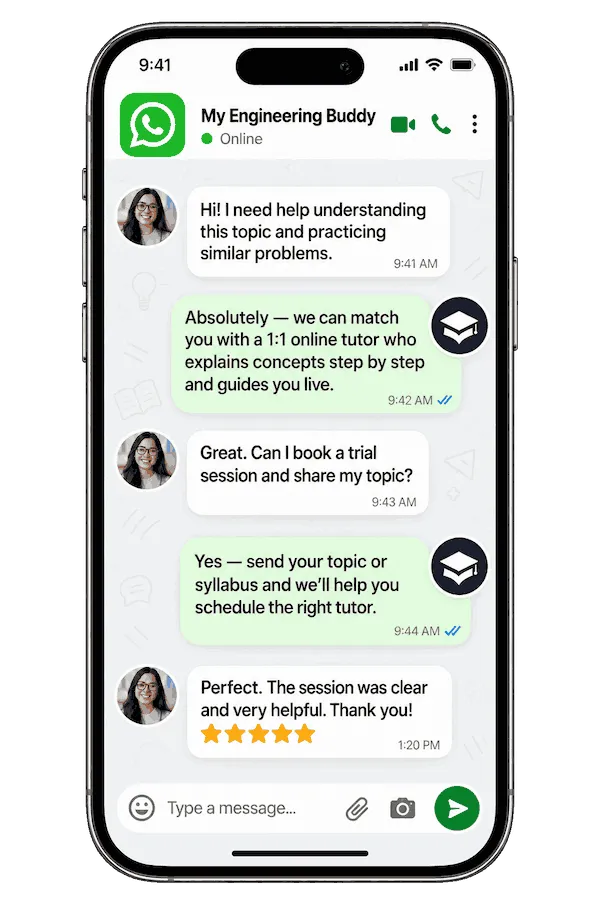
Unlike platforms where you fill out a form and wait days, MEB responds in under a minute, 24/7. Tutor match takes under an hour. The $1 trial means you test the fit before committing to a block of sessions. Everything runs over WhatsApp — no logins, no intake forms.
Pricing Guide
Standard Neuroanatomy tutoring runs $20–$40/hr. Graduate-level work, board exam preparation, and clinically focused sessions with tutors who have professional research or medical backgrounds can reach up to $100/hr. Rate depends on topic complexity, tutor background, level, and how quickly you need to be matched.
Availability shrinks fast in the six weeks before major exam windows — USMLE Step 1 season, UK medical school finals, and semester end. If your timeline is tight, book sooner rather than later.
For students targeting top medical residency programmes, competitive graduate schools, or specialist neuroscience research positions, MEB can match tutors with active research or clinical backgrounds at higher rates. Share your specific goal and MEB will find the right tier.
Start with the $1 trial — 30 minutes, no registration, no commitment. WhatsApp MEB for a quick quote.
FAQ
Is Neuroanatomy hard?
Yes — consistently rated among the most difficult preclinical medical subjects. The combination of dense three-dimensional spatial information and the expectation that you apply it to clinical cases in real time creates a steep curve for most students, even strong ones.
How many sessions are needed?
Most students see meaningful improvement within 8–12 sessions of focused work. Students coming in with significant gaps — particularly around brainstem anatomy or pathway localisation — typically need 15–20 hours to reach exam-ready confidence. The tutor maps this after the first diagnostic.
Can you help with homework and assignments?
MEB tutoring is guided learning — you understand the work, then submit it yourself. See our Academic Integrity policy and Why MEB page for full details on what we help with and what we don’t. Tutors will work through the reasoning behind any question without doing the submission for you.
Will the tutor match my exact syllabus or exam board?
Yes. When you contact MEB, share your course outline, institution, and exam format — USMLE, UK medical school written exam, or a university module. The tutor is matched specifically to that structure, not to a generic neuroanatomy curriculum.
What happens in the first session?
The tutor runs a short diagnostic — asking you to trace a pathway, interpret a cross-section, or work through a clinical case — to locate exactly where your knowledge breaks down. The rest of that first session is spent on the highest-priority gap. Nothing is wasted.
Is online tutoring as effective as in-person for Neuroanatomy?
For this subject, yes — often more so. A tutor drawing in real time on a digital pen-pad, zooming on specific cross-sections, and annotating MRI images live is more flexible than a whiteboard in a room. The spatial learning happens through the live interaction, not the physical location.
Can you help with USMLE Step 1 neuroanatomy specifically?
Yes. USMLE Step 1 neuroanatomy questions test lesion localisation, pathway-to-deficit mapping, and clinical case reasoning — not just structure recall. MEB tutors with Step 1 experience know the question format, the high-yield topics, and where most students drop marks in this section.
Do you cover neuroanatomy for physiotherapy and allied health programmes?
Yes. Physiotherapy, occupational therapy, speech pathology, and nursing neuroanatomy have different depth requirements and clinical application points than medical programmes. MEB tutors are matched to your specific programme’s syllabus, not a generic medical school one.
Can I get Neuroanatomy help at midnight or over the weekend?
Yes. MEB operates 24/7 via WhatsApp. Tutors are available across time zones, so students in the Gulf, Australia, and North America can all reach someone during their working hours — including late evenings and weekends before exams.
What if I don’t get on with my assigned tutor?
Tell MEB via WhatsApp. A replacement tutor is matched, usually within the same day. The $1 trial exists precisely so you can check the fit before committing to sessions. If the match isn’t right, you pay nothing extra to switch.
How do I get started?
Three steps: WhatsApp MEB with your course details and timeline, get matched to a verified Neuroanatomy tutor within an hour, then start the $1 trial — 30 minutes of live 1:1 tutoring or one full homework question explained from first principles. No forms, no delays.
Trust & Quality at My Engineering Buddy
Every MEB tutor goes through subject-specific vetting before working with students. For Neuroanatomy, that means demonstrating depth in pathway anatomy, clinical case application, and the ability to draw and explain cross-sections live — not just describe them. Tutors hold relevant degrees in neuroscience, medicine, or allied disciplines and are evaluated on their first live demo session before being assigned independently. Ongoing student feedback is reviewed after every session block. Rated 4.8/5 across 40,000+ verified reviews on Google.
MEB tutoring is guided learning — you understand the work, then submit it yourself. For full details on what we help with and what we don’t, read our Academic Integrity policy and Why MEB.
MEB has served 52,000+ students across the US, UK, Canada, Australia, the Gulf, and Europe since 2008 — across 2,800+ subjects in Neuroscience and related disciplines. Students working on Computational Neuroscience tutoring, Neurophysiology help, and core Neuroanatomy modules have all gone through the same tutor matching and diagnostic-first process. Read more about the approach at MEB’s tutoring methodology.
The New England Journal of Medicine consistently publishes neurological case studies that mirror the clinical reasoning format used in medical neuroanatomy exams — a useful benchmark for the standard of applied knowledge MEB tutors build toward.
Source: New England Journal of Medicine.
At MEB, we’ve found that the students who improve fastest in Neuroanatomy are the ones who commit to explaining the pathway back to the tutor — out loud, in their own words — before moving on. Passive reviewing never closes the gap. Active retrieval does.
Explore Related Subjects
Students studying Neuroanatomy often also need support in:
Next Steps
When you contact MEB, have these three things ready:
- Your course outline, module guide, or exam syllabus — and the name of your exam format if applicable (USMLE, UK medical school, university module)
- A past paper question, practical task, or homework problem you’ve struggled with recently
- Your exam or assessment date and your current availability by time zone
MEB matches you with a verified Neuroanatomy tutor — usually within one hour. The first session starts with a short diagnostic so every minute from there is spent on what actually matters for your grade.
Before your first session, have ready: your exam board and syllabus or course outline, a recent past paper attempt or homework you struggled with, and your exam or deadline date. The tutor handles the rest.
Visit www.myengineeringbuddy.com for more on how MEB works.
WhatsApp to get started or email [email protected].
Reviewed by Subject Expert
This page has been carefully reviewed and validated by our subject expert to ensure accuracy and relevance.