Contact MEB Today To Get The Best
Neuro-linguistic programming Tutoring Online
Email: [email protected]



~1 min
Average Reply Time
~1 hour
To Be Matched With A Tutor
30 Min Trial
75% Find Their Tutor On The 1st Trial
$20-35+/hr
Premium Yet Affordable Learning
Most students who struggle with NLP aren’t confused about the concepts — they’re missing the framework to apply them in real situations.
Neuro-linguistic programming Tutor Online
Neuro-linguistic programming (NLP) is a psychological approach that examines the relationship between language, neurological patterns, and behaviour, equipping practitioners with techniques to model communication, reframe thought patterns, and influence outcomes in coaching, therapy, and professional settings.
Finding a Neuro-linguistic programming tutor near me online means working 1:1 with someone who has actually applied NLP frameworks — in Neuroscience and adjacent fields like cognitive science, counselling, and behavioural coaching. MEB has connected 52,000+ students with verified tutors since 2008. You don’t get a random match from a pool. You get someone who knows Bandler and Grinder’s original modelling work, can walk through submodalities with you, and corrects your thinking in real time.
- 1:1 online sessions tailored to your NLP course, certification track, or self-directed study
- Expert-verified tutors with applied NLP and behavioural science backgrounds
- Flexible time zones — US, UK, Canada, Australia, Gulf
- Structured learning plan built after a diagnostic session
- Guided practice plans and skill progression tracking
52,000+ students across the US, UK, Canada, Australia, and the Gulf have used MEB since 2008 — including students in Neuroscience subjects like Neuro-linguistic programming, cognitive neuroscience, and neurophysiology.
Source: My Engineering Buddy, 2008–2025.
How Much Does a Neuro-linguistic programming Tutor Cost?
Most NLP tutoring sessions run $20–$40/hr, depending on the level of study and how specialist the focus is. Certification-track or practitioner-level NLP can run higher. The $1 trial gets you 30 minutes live or one question explained in full — no registration needed.
| Level / Need | Typical Rate | What’s Included |
|---|---|---|
| Introductory / Foundation NLP | $20–$35/hr | 1:1 sessions, concept walkthroughs |
| Practitioner / Master level | $35–$70/hr | Expert tutor, technique depth, practice scenarios |
| $1 Trial | $1 flat | 30 min live session or 1 question explained |
Tutor availability tightens significantly during certification exam windows and cohort enrolment periods. Book early if you have a fixed deadline.
WhatsApp MEB for a quick quote — average response time under 1 minute.
Who This Neuro-linguistic programming Tutoring Is For
NLP sits at an unusual crossroads — it draws from linguistics, cognitive psychology, and behavioural science, and students come to it from very different directions. Whether you’re working toward a practitioner certification, writing a dissertation chapter on communication models, or trying to apply NLP frameworks in a coaching or therapy context, the gap between reading about it and actually using it is real.
- Undergraduate and postgraduate students studying psychology, communication, or counselling with NLP modules
- Students pursuing NLP Practitioner or Master Practitioner certification through accredited providers
- Coaching professionals building NLP technique into their practice
- Students whose confidence has dropped alongside their grades as NLP theory gets more abstract
- Students 4–6 weeks from a certification assessment with significant technique gaps still to close
- Researchers applying NLP frameworks in qualitative studies on language and behaviour
Students have come to MEB’s NLP tutoring from programmes at institutions including UCL, the University of Edinburgh, NYU, the University of Melbourne, and coaching bodies accredited by the American Psychological Association.
1:1 Tutoring vs Self-Study vs AI vs YouTube vs Online Courses
Self-study works if you’re disciplined — but NLP is technique-heavy, and reading about anchoring is nothing like being walked through it. AI tools give fast explanations and can’t watch you make the same reframing error three times. YouTube covers the overview well and goes silent the moment you’re stuck on a live scenario. Online courses are structured but locked to a fixed pace with no one to tell you your rapport-building approach is off. With a 1:1 online Neuro-linguistic programming tutor from MEB, every session is calibrated to your actual course, certification level, or application goal — and errors get corrected the moment they happen, not in the next module’s quiz.
Outcomes: What You’ll Be Able To Do in Neuro-linguistic programming
After structured 1:1 sessions, students can apply the NLP meta-model to identify and challenge linguistic distortions in real conversations. They can explain the presuppositions of NLP with precision and use them to analyse communication patterns. Students learn to present anchoring and submodality techniques accurately in written assignments or live practice scenarios. They can model behavioural strategies using the TOTE model and articulate the differences between surface and deep structure in language — both for academic writing and practitioner application.
Based on feedback from 40,000+ sessions collected by MEB from 2022 to 2025, students working 1:1 on Neuro-linguistic programming consistently report faster progress in applying technique under pressure than self-directed practice alone, with particular gains in live scenario work and written concept articulation. Progress varies by starting level and practice frequency.
Source: MEB session feedback data, 2022–2025.
At MEB, we’ve found that NLP students often arrive with solid theoretical knowledge but freeze when asked to apply a technique in a live scenario. The shift happens fastest when the tutor creates a low-stakes practice environment in session — then gradually increases the complexity until the student is doing it without thinking.
What We Cover in Neuro-linguistic programming (Syllabus / Topics)

Foundations and Core Models
- Origins of NLP — Bandler, Grinder, and the modelling of Perls, Satir, and Erickson
- Presuppositions of NLP and their application in communication
- Representational systems (VAK/VAKOG) and their role in learning and rapport
- The map is not the territory — epistemological basis
- The TOTE model and behavioural strategy elicitation
- Rapport-building techniques: matching, mirroring, pacing, and leading
Core texts: The Structure of Magic Vol. I (Bandler & Grinder), Frogs into Princes (Bandler & Grinder), NLP: The New Technology of Achievement (Andreas & Faulkner).
Language Patterns and the Meta-Model
- Surface structure vs deep structure in language
- The three major meta-model violations: deletion, distortion, generalisation
- Meta-model questions and their use in coaching and therapy contexts
- The Milton Model — hypnotic language patterns and indirect suggestion
- Sleight of Mouth patterns for reframing beliefs
- Linguistic presuppositions and embedded commands
Key texts: The Structure of Magic Vol. II (Bandler & Grinder), Sleight of Mouth (Dilts), Patterns of the Hypnotic Techniques of Milton H. Erickson (Bandler & Grinder).
Techniques, Change Work, and Practitioner Application
- Anchoring — setting, stacking, chaining, and collapse techniques
- Submodalities — working with internal representations to create change
- Parts integration and the six-step reframe
- Swish pattern and fast phobia cure
- Timeline therapy concepts and future-pacing
- NLP in organisational and coaching contexts — neurological levels (Dilts)
Recommended texts: Using Your Brain for a Change (Bandler), Changing Belief Systems with NLP (Dilts), Time for a Change (Bandler).
Students consistently tell us that the meta-model is the make-or-break section of any NLP course. It looks straightforward on paper. In practice, identifying the specific violation type in a live statement — and choosing the right challenge question — takes repetition with feedback. That’s exactly the kind of work that needs another person in the room.
What a Typical Neuro-linguistic programming Session Looks Like
The tutor opens by checking how the previous topic landed — usually something like anchoring technique or the meta-model violations from the prior session. From there, the student and tutor work through the current focus together: if it’s language patterns, the tutor presents sample statements and the student identifies violation types and drafts challenge questions, with the tutor correcting reasoning in real time using a digital pen-pad to annotate examples on screen. If it’s technique practice, the tutor walks through the procedure step by step, then has the student narrate back or role-play the application. The session closes with a concrete practice task — usually a scenario-based exercise tied to the next topic — and the tutor notes what to pick up first next time.
How MEB Tutors Help You with Neuro-linguistic programming (The Learning Loop)
Diagnose: In the first session, the tutor identifies exactly where the breakdown is — whether it’s the theoretical foundations, technique sequencing, language pattern recognition, or the ability to apply models under pressure. NLP has a wide range of entry points and the gap is rarely where students expect it to be.
Explain: The tutor works through live examples using a digital pen-pad — mapping out meta-model violations on screen, annotating transcripts, or walking through a technique procedure step by step. Nothing is assumed. Everything is shown.
Practice: The student attempts the technique or analysis with the tutor present. This is where most online NLP tutoring fails — it stops at explanation. MEB sessions don’t move on until the student can do it, not just describe it.
Feedback: Errors are corrected at the point they happen. The tutor explains not just what went wrong but why — whether a meta-model challenge was misdirected, why a particular anchor didn’t hold, or where a reframe lost its logic.
Plan: The tutor sets the next topic sequence, flags which techniques need more practice time, and keeps a running picture of progress across sessions.
Sessions run over Google Meet with a digital pen-pad or iPad and Apple Pencil for live annotation. Before your first session, have a copy of your course outline or certification syllabus, any written work or practice transcripts you’ve struggled with, and your assessment or certification date. The first session is your diagnostic — it sets the entire plan. Start with the $1 trial — 30 minutes of live tutoring that also serves as your first diagnostic.
NLP technique isn’t memorised — it’s calibrated through repetition with correction. One session of live practice with targeted feedback does more than three weeks of re-reading the same chapter.
Source: My Engineering Buddy, tutor observation across NLP sessions, 2022–2025.
Tutor Match Criteria (How We Pick Your Tutor)
Not every tutor who knows NLP theory is the right match for every student. MEB matches on four criteria.
Subject depth: The tutor’s background is checked against your specific focus — whether that’s academic NLP (psychology or linguistics programme), practitioner certification, or applied coaching. A tutor covering neurochemistry tutoring and NLP in the same week has a different profile than one who specialises in communication models.
Tools: Every MEB tutor uses Google Meet with a digital pen-pad or iPad and Apple Pencil — not just voice-over-slides.
Time zone: Matched to your region — US, UK, Gulf, Canada, or Australia — so sessions start when you need them.
Goals: Exam or assessment preparation, conceptual depth, technique practice, or research and writing support. The tutor match changes depending on which of these applies.
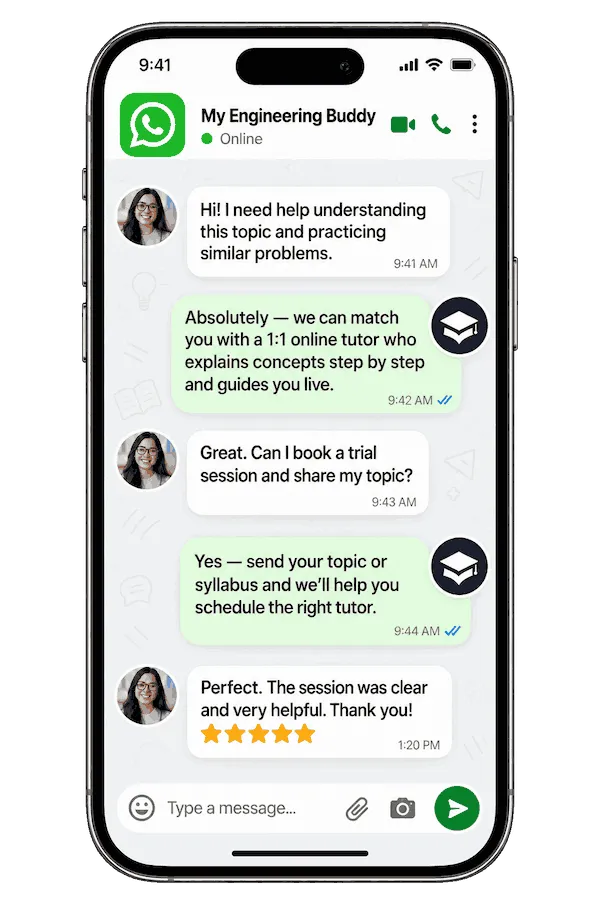
Unlike platforms where you fill out a form and wait, MEB responds in under a minute, 24/7. Tutor match takes under an hour. The $1 trial means you test before you commit. Everything runs over WhatsApp — no logins, no intake forms.
Study Plans (Pick One That Matches Your Goal)
After the first diagnostic session, the tutor builds the sequence. If you’re behind on a certification module and have three weeks before assessment, that’s a targeted catch-up plan covering the highest-priority gaps first. If you have 6–8 weeks, the tutor runs structured revision across all technique areas with scenario-based practice built in. Ongoing weekly support follows your programme schedule — aligned to module deadlines, coursework submission, or coaching practice hours. The tutor maps it after session one.
Pricing Guide
NLP tutoring starts at $20/hr for foundational and introductory levels. Practitioner-level and Master Practitioner work, or sessions focused on specialist applications in therapy or organisational coaching, typically run $35–$70/hr. For PhD-level or research-focused NLP work, tutors with academic publication backgrounds are available at higher rates — share your specific goal and MEB will match the tier.
Rate factors include: certification level, topic complexity, how close your assessment date is, and tutor availability at your time zone. Availability tightens around major certification windows. Book before that window closes.
Start with the $1 trial — 30 minutes, no registration, no commitment. WhatsApp MEB for a quick quote.
FAQ
Is Neuro-linguistic programming hard to learn?
The foundations are accessible. The difficulty is in application — recognising linguistic patterns live, executing techniques under pressure, and understanding why a particular intervention works. Most students find the gap between reading NLP and doing NLP is wider than expected. A tutor closes that gap faster.
How many sessions will I need?
Students covering one NLP module or a specific certification section typically need 6–12 sessions. Those working through a full Practitioner programme from scratch usually need 15–25 sessions. The first diagnostic session gives a clearer estimate based on your actual starting point and timeline.
How do you structure practice between sessions?
The tutor assigns scenario-based exercises after each session — real or constructed conversations where you apply the technique and write up your reasoning. You bring that back to the next session for review. Practice between sessions is where NLP skills actually consolidate.
Will the tutor match my current level and goals?
Yes. MEB matches on your specific focus — academic coursework, certification track, coaching application, or research. The tutor is selected for familiarity with your programme or certification body’s framework, not just general NLP knowledge.
What happens in the first session?
The tutor reviews your course outline or certification syllabus, identifies where your understanding breaks down, and maps the session sequence. You leave the first session with a clear picture of exactly what to work on and in what order. It’s a diagnostic, not an introduction.
Are online lessons as effective as in-person?
For NLP, yes — and in some ways better. The digital pen-pad allows real-time annotation of transcripts and technique diagrams that’s difficult to replicate on a whiteboard. Role-play and scenario practice translate well to video. The key is live interaction, which MEB sessions always include.
Is NLP considered scientifically valid, and does that affect how it’s taught?
NLP’s empirical basis is debated in academic psychology. MEB tutors are aware of this — they teach technique application accurately while also helping students engage with the critical literature where coursework or research requires it. Both dimensions are covered based on your programme’s requirements.
What’s the difference between NLP Practitioner and Master Practitioner, and which should I get help with?
Practitioner covers the core models — meta-model, Milton Model, anchoring, submodalities. Master Practitioner goes deeper into advanced language patterns, modelling, and change-work design. MEB tutors cover both levels. Which one depends on where you are in your certification path — the tutor will confirm after the diagnostic.
Can I get Neuro-linguistic programming help at short notice or late at night?
Yes. MEB operates 24/7 across time zones. WhatsApp response is typically under a minute. If you have a certification assessment in two days or a submission deadline tomorrow morning, message MEB and a tutor can usually be matched the same day.
Do you offer group NLP sessions?
No. MEB provides 1:1 sessions only. NLP technique practice requires individual attention — group formats don’t allow the real-time error correction and scenario-specific feedback that makes the difference. Every session is private and calibrated to one student.
How do I get started?
Message MEB on WhatsApp. Share your course or certification level, your hardest topic, and your nearest deadline. You’ll be matched with a verified NLP tutor — usually within the hour. The first session is the $1 trial: 30 minutes live or one question explained in full.
Trust & Quality at My Engineering Buddy
Every MEB tutor is screened before their first session — subject knowledge verified, live demo session evaluated, and ongoing session feedback reviewed. Tutors covering NLP hold relevant academic qualifications in psychology, linguistics, or behavioural science, or hold accredited NLP Practitioner or Master Practitioner credentials. Rated 4.8/5 across 40,000+ verified reviews on Google, MEB has maintained that standard since 2008 by removing tutors who don’t hold it. For neuromarketing help or NLP, the vetting process is the same.
MEB tutoring is guided learning — you understand the work, then submit it yourself. For full details on what we help with and what we don’t, read our Academic Integrity policy and Why MEB.
MEB has served students across the US, UK, Canada, Australia, Gulf, and Europe in 2,800+ subjects since 2008. In Neuroscience and adjacent fields, that includes students working on neuroimaging tutoring, psychiatry help, and Neuro-linguistic programming. The platform’s reach means tutors are available across every major time zone without compromising on subject-specific match quality. Read more about how sessions are structured at MEB’s tutoring methodology page.
Our experience across thousands of sessions shows that NLP students who come with a specific scenario they’ve already attempted — even imperfectly — make significantly faster progress than those who arrive with only theory questions. Bring your hardest example. That’s where the real work starts.
Explore Related Subjects
Students studying Neuro-linguistic programming often also need support in:
Next Steps
Before your first session, have ready:
- Your course outline, certification syllabus, or exam framework
- A recent practice attempt, written exercise, or scenario you found difficult
- Your certification assessment date or submission deadline
Share your availability and time zone. MEB matches you with a verified NLP tutor — usually within 24 hours. The first session starts with a diagnostic so every minute is used well.
Visit www.myengineeringbuddy.com for more on how MEB works.
WhatsApp to get started or email [email protected].
Reviewed by Subject Expert
This page has been carefully reviewed and validated by our subject expert to ensure accuracy and relevance.