




~1 min
Average Reply Time
~1 hour
To Be Matched With A Tutor
30 Min Trial
75% Find Their Tutor On The 1st Trial
$20-35+/hr
Premium Yet Affordable Learning
Neurophysiology at graduate level catches more students off guard than almost any other neuroscience module — and it usually shows up in your marks before you realise you’re lost.
Neurophysiology Tutor Online
Neurophysiology is the branch of physiology studying how the nervous system generates and transmits electrical signals. It covers action potentials, ion channels, synaptic transmission, and sensory-motor integration, equipping students to analyse neural function at cellular and systems levels.
If you’ve searched for a Neurophysiology tutor near me, you already know the subject demands more than reading. MEB connects you with a 1:1 online Neurophysiology tutor who works through your exact course material — from Hodgkin-Huxley models to central pattern generators — live on screen. Part of our broader Neuroscience tutoring offering, Neurophysiology sessions are available across US, UK, Canada, Australia, and Gulf time zones from $20/hr. One outcome you can expect: by the time your tutor is done with action potential kinetics, you’ll be able to explain it, not just recite it.
- 1:1 online sessions matched to your specific course or syllabus
- Expert-verified tutors with postgraduate neuroscience backgrounds
- Flexible scheduling across US, UK, Canada, Australia, and Gulf time zones
- Structured learning plan built after an initial diagnostic session
- Ethical academic guidance — you understand the work, then submit it yourself
52,000+ students across the US, UK, Canada, Australia, and the Gulf have used MEB since 2008 — including students in Neuroscience subjects like Neurophysiology, Cognitive Neuroscience, and Neuroanatomy.
Source: My Engineering Buddy, 2008–2025.
How Much Does a Neurophysiology Tutor Cost?
Most Neurophysiology tutoring sessions run $20–$40/hr depending on your level and the depth of the topic. Graduate and research-level work can reach up to $100/hr. Not sure if it’s worth it? The $1 trial gives you 30 minutes of live tutoring or a full explanation of one homework question before you commit to anything.
| Level / Need | Typical Rate | What’s Included |
|---|---|---|
| Undergraduate (standard) | $20–$35/hr | 1:1 sessions, homework guidance |
| Graduate / Research-level | $40–$100/hr | Expert tutor, advanced topic depth |
| $1 Trial | $1 flat | 30 min live session or 1 homework question explained |
Tutor availability tightens during semester exam windows — particularly around spring finals and December assessment periods. Book early if you have a fixed deadline.
WhatsApp MEB for a quick quote — average response time under 1 minute.
Who This Neurophysiology Tutoring Is For
Neurophysiology attracts students who are strong in biology but hit a wall when mathematics enters — differential equations for membrane potentials, Nernst equation calculations, or quantitative models of synaptic conductance. This is also a subject where lecture slides alone rarely get anyone through assessments.
- Undergraduate students in neuroscience, physiology, biomedical science, or medicine hitting their first quantitative neuroscience module
- Graduate students preparing for candidacy exams or systems neuroscience coursework
- Students retaking after a failed first attempt who need to close specific conceptual gaps before the next sitting
- PhD students needing to sharpen electrophysiology concepts before lab rotations or qualifying exams
- Students with a university conditional offer depending on this grade who cannot afford a second attempt
- Parents watching a child’s confidence drop alongside their marks as the module progresses
Students at institutions including Johns Hopkins, University College London, the University of Toronto, McGill, the University of Melbourne, and Imperial College London have worked with MEB tutors on neurophysiology modules at undergraduate and graduate levels.
1:1 Tutoring vs Self-Study vs AI vs YouTube vs Online Courses
Self-study works if you’re disciplined, but neurophysiology has too many interlocking concepts to learn in isolation — miss one and the next three won’t make sense. AI tools give fast definitions but can’t watch you misinterpret an I-V curve and correct you in real time. YouTube handles action potential overviews well and stops short the moment you need to work through a Hodgkin-Huxley simulation. Online courses are structured but move at a fixed pace with no adaptation for your specific exam format. 1:1 tutoring with MEB is live, calibrated to your course syllabus, and corrects reasoning errors the moment they appear — not after you’ve submitted the wrong answer.
Outcomes: What You’ll Be Able To Do in Neurophysiology
After working with an MEB Neurophysiology tutor, students can solve membrane potential problems using the Goldman equation, analyze patch-clamp data to identify channel kinetics, explain synaptic integration at both excitatory and inhibitory synapses, apply the Hodgkin-Huxley model to predict spike threshold behaviour, and present the neural basis of sensory adaptation clearly in written assessments. These aren’t generic study goals — they’re the specific capabilities examiners test at undergraduate and graduate level.
Based on feedback from 40,000+ sessions collected by MEB from 2022 to 2025, 58% of students improved by one full grade after approximately 20 hours of 1:1 tutoring in subjects like Neurophysiology. A further 23% achieved at least a half-grade improvement.
Source: MEB session feedback data, 2022–2025.
Supporting a student through Neurophysiology? MEB works directly with parents to set up sessions, track progress, and keep coursework on schedule. WhatsApp MEB — average response time is under a minute, 24/7.
Try your first session for $1 — 30 minutes of live 1:1 tutoring or one homework question explained in full. No registration. No commitment. WhatsApp MEB now and get matched within the hour.
What We Cover in Neurophysiology (Syllabus / Topics)

Cellular Neurophysiology
- Resting membrane potential and the Goldman-Hodgkin-Katz equation
- Voltage-gated ion channels: Na⁺, K⁺, Ca²⁺ kinetics
- Action potential generation, propagation, and refractory periods
- Patch-clamp technique: whole-cell and single-channel recordings
- Hodgkin-Huxley model: mathematical framework and parameter estimation
- Myelination, saltatory conduction, and conduction velocity
- Synaptic vesicle release and quantal analysis
Core texts for this track include Kandel et al. Principles of Neural Science (6th ed.), Hille’s Ion Channels of Excitable Membranes, and Johnston & Wu’s Foundations of Cellular Neurophysiology.
Synaptic Transmission and Integration
- Ionotropic vs metabotropic receptor mechanisms
- Excitatory and inhibitory postsynaptic potentials (EPSPs and IPSPs)
- Temporal and spatial summation at the axon hillock
- Long-term potentiation (LTP) and long-term depression (LTD)
- Neuromuscular junction physiology and acetylcholine release
- Neuromodulation: dopamine, serotonin, and norepinephrine pathways
- Short-term synaptic plasticity: facilitation and depression
Recommended references include Purves et al. Neuroscience (6th ed.), Levitan & Kaczmarek’s The Neuron, and Bear, Connors & Paradiso’s Neuroscience: Exploring the Brain.
Systems and Sensory Neurophysiology
- Sensory transduction: mechanoreceptors, photoreceptors, chemoreceptors
- Receptive fields and lateral inhibition in sensory coding
- Central pattern generators and rhythmic motor output
- Somatosensory pathways: dorsal column-medial lemniscal and spinothalamic tracts
- Visual system physiology: retinal processing through V1
- Auditory transduction and tonotopic organisation in the cochlea
- Electrophysiology methods: EEG, LFP, single-unit recording contexts
Useful texts include Squire et al. Fundamental Neuroscience (4th ed.), Shepherd’s The Synaptic Organization of the Brain, and Dayan & Abbott’s Theoretical Neuroscience.
At MEB, we’ve found that students who struggle with neurophysiology are often tripped up not by biology but by the mathematics embedded in it. The Nernst equation, Hodgkin-Huxley parameters, and cable theory all require comfort with differential equations that most neuroscience programmes don’t formally teach.
What a Typical Neurophysiology Session Looks Like
The tutor opens by checking the previous session’s topic — usually action potential threshold calculations or synaptic conductance problems. From there, you and the tutor work through the current problem set on screen: the tutor annotates a membrane voltage trace using a digital pen-pad, identifies where your interpretation of the ion channel gating variables went wrong, and walks through the correction live. You then replicate the reasoning on a new example while the tutor watches. Common session topics include Hodgkin-Huxley gating equations, EPSP summation diagrams, and receptive field mapping problems from past papers at your institution. The session closes with a targeted practice task — typically two to three past exam questions on the next topic — and a note on what the following session will address. You always leave knowing exactly what to do before you return.
How MEB Tutors Help You with Neurophysiology (The Learning Loop)
Diagnose: In the first session, the tutor identifies where your understanding breaks down — whether that’s the mathematical framework behind membrane potentials, confusion between ionotropic and metabotropic pathways, or uncertainty about how to interpret electrophysiological data. This isn’t a generic quiz. It’s a targeted conversation that maps the gaps.
Explain: The tutor works through the concept live — drawing ion channel states on a digital pen-pad, annotating voltage clamp traces, and building from first principles rather than reciting definitions. The Oxford Medical Sciences department at Oxford describes neurophysiology as requiring students to move fluidly between molecular, cellular, and systems levels — that’s exactly how MEB tutors structure their explanations.
Practice: You attempt the next problem while the tutor is present. No waiting until the homework is submitted and marked. Errors surface immediately.
Feedback: The tutor walks through each error step by step — not just what was wrong, but why the reasoning failed and which mark scheme criterion it would have missed.
Plan: Before the session ends, the tutor notes the next topic, sets a specific practice task, and confirms the timeline against your exam or coursework deadline.
Sessions run over Google Meet. The tutor uses a digital pen-pad or iPad with Apple Pencil for all diagram work. Before your first session, share your course syllabus or module outline and any recent work you’ve struggled with. That first session functions as your diagnostic — and your first 30 minutes costs $1 through the trial.
Students consistently tell us that the biggest shift in neurophysiology comes when they stop trying to memorise circuit diagrams and start working through the underlying logic with someone who can answer back in real time.
Source: MEB session feedback summary, 2022–2025.
Tutor Match Criteria (How We Pick Your Tutor)
Not every neuroscience postgraduate has the depth to teach neurophysiology well. MEB matches on four criteria.
Subject depth: Tutors must hold postgraduate qualifications in neuroscience, physiology, biomedical science, or a directly related field — and must demonstrate working knowledge of the specific sub-topic you need, whether that’s electrophysiology, synaptic plasticity, or systems-level sensory coding. Get Neurochemistry tutoring from the same pool of vetted specialists.
Tools: Every tutor works on Google Meet with a digital pen-pad or iPad and Apple Pencil — non-negotiable for a subject this diagram-heavy.
Time zone: Matched to your region. Students in the US, UK, Gulf states, Canada, and Australia all get tutors available in their working hours.
Goals: Whether you need to pass an undergraduate exam, prepare for a PhD qualifying, or understand a specific journal paper for your dissertation, the tutor is matched to that specific goal.
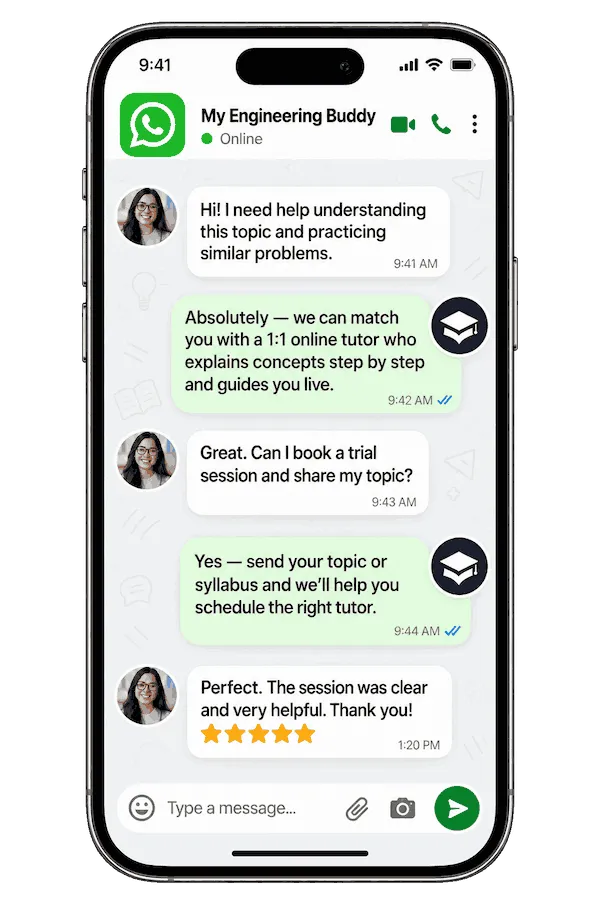
Unlike platforms where you fill out a form and wait, MEB responds in under a minute, 24/7. Tutor match takes under an hour. The $1 trial means you test before you commit. Everything runs over WhatsApp — no logins, no intake forms.
Study Plans (Pick One That Matches Your Goal)
A catch-up plan over one to three weeks targets students with a specific gap — say, ion channel kinetics or synaptic integration — before an upcoming exam. A structured revision plan over four to eight weeks works through the full syllabus in sequence, using past papers to calibrate pace. Weekly support runs alongside your semester, aligned to lecture topics and assignment deadlines. The tutor maps the exact session sequence after the first diagnostic — there’s no fixed template because no two students arrive with the same gaps.
Pricing Guide
Neurophysiology tutoring starts at $20/hr for standard undergraduate modules and reaches $40/hr for advanced coursework. Graduate-level sessions and research-support work — covering topics like computational modelling, patch-clamp data interpretation, or dissertation-level neuroscience — are available up to $100/hr. Rate depends on topic complexity, your timeline, and tutor availability.
For students targeting competitive graduate programmes at research-intensive universities, tutors with active research backgrounds in systems or cellular neurophysiology are available at higher rates. Share your specific goal and MEB will match the tier to what you need.
Availability tightens in April–May and November–December. Start with the $1 trial — 30 minutes, no registration, no commitment. WhatsApp MEB for a quick quote.
Students consistently tell us that they wish they’d started two weeks earlier. In neurophysiology, a two-week head start on ion channel mathematics changes what’s possible by exam day. One session to find the gap. One week to close it.
FAQ
Is Neurophysiology hard?
Yes — it’s one of the more technically demanding neuroscience modules because it combines cellular biology with quantitative mathematics. Students who struggle most are typically strong in biology but haven’t worked with differential equations or electrical circuit analogies before. Those gaps are fixable with targeted help.
How many sessions are needed?
Students with a focused gap — say, synaptic transmission or action potential kinetics — usually need four to six sessions. Students revising the full module for exams typically work through ten to fifteen sessions over four to eight weeks. The tutor maps a specific plan after the first diagnostic.
Can you help with homework and assignments?
MEB tutoring is guided learning — you understand the work, then submit it yourself. The tutor explains the concept and works through a similar example with you. See our Academic Integrity policy and Why MEB page for full details on what we help with and what we don’t.
Will the tutor match my exact syllabus or exam board?
Yes. Share your module outline, institution, and course level when you contact MEB. Tutors are matched to your specific syllabus — whether that’s a UK undergraduate physiology module, a US graduate neuroscience course, or a biomedical programme in Australia or Canada.
What happens in the first session?
The tutor runs a diagnostic: short questions across your module’s main topics to identify where understanding breaks down. From there, the session addresses the most urgent gap. You leave with a clear topic list and a practice task. The diagnostic is included in your first session — no separate intake process.
Is online tutoring as effective as in-person for Neurophysiology?
For a diagram-heavy subject like this, yes — provided the tutor uses a digital pen-pad, which all MEB tutors do. Live annotation of voltage traces, ion channel diagrams, and synaptic circuit models on screen is equivalent to working at a whiteboard, without the commute.
Can I get Neurophysiology help at short notice — even late at night?
MEB operates 24/7. WhatsApp MEB at any hour and you’ll typically get a response within a minute. Tutor matching for your first session usually happens within an hour of contact, depending on time zone availability. Urgent exam-week requests are handled as a priority.
What if the assigned tutor isn’t the right fit?
Tell MEB over WhatsApp. A different tutor will be matched — no forms, no delays. The $1 trial exists precisely so you can test the fit before committing to a full session rate. If the match isn’t right, MEB fixes it immediately.
Do you offer group Neurophysiology sessions?
No. MEB runs 1:1 sessions only. Group formats don’t allow the real-time error correction and diagnostic-driven pacing that makes Neurophysiology tutoring effective. Every session is built around one student’s specific gaps and timeline.
What’s the difference between Neurophysiology and Neuroscience tutoring at MEB?
Neuroscience is the broader discipline. Neurophysiology is specifically the study of electrical signalling — action potentials, ion channels, synaptic transmission, and sensory-motor coding. MEB tutors cover both, but Neurophysiology sessions go deeper into quantitative modelling and electrophysiological methods than a general neuroscience session would.
Do MEB tutors cover computational neurophysiology and Hodgkin-Huxley modelling?
Yes. Several MEB tutors have research backgrounds in Computational Neuroscience and can work through Hodgkin-Huxley parameter fitting, cable theory, and MATLAB or Python-based neural simulations alongside the conceptual coursework.
How do I get started?
Contact MEB over WhatsApp. Share your subject, institution, and exam date. MEB matches you with a verified tutor — usually within an hour. Your first session starts with a diagnostic and costs $1 for the first 30 minutes or one homework question explained in full.
Trust & Quality at My Engineering Buddy
Every MEB tutor goes through a multi-stage screening process: subject knowledge interview, live demo session evaluation, and ongoing review based on student feedback. Neurophysiology tutors hold postgraduate degrees in neuroscience, physiology, or biomedical science. Many have active or recent research experience in electrophysiology or systems neuroscience. Rated 4.8/5 across 40,000+ verified reviews on Google, MEB has served 52,000+ students since 2008 across the US, UK, Canada, Australia, and the Gulf.
MEB tutoring is guided learning — you understand the work, then submit it yourself. For full details on what we help with and what we don’t, read our Academic Integrity policy and Why MEB.
MEB covers 2,800+ advanced subjects. Within Neuroscience, that includes Neuroimaging tutoring, help with Neuroanatomy, and support for students studying Psychiatry at undergraduate and graduate levels. The platform serves students in Germany, France, the Netherlands, Singapore, Hong Kong, and New Zealand alongside the primary English-speaking regions.
A common pattern our tutors observe is that Neurophysiology marks improve fastest when sessions target the mathematical layer first — Nernst, Goldman, Hodgkin-Huxley — and then rebuild the conceptual understanding on top of that foundation.
Source: MEB tutor feedback summary, 2022–2025.
Explore Related Subjects
Students studying Neurophysiology often also need support in:
Next Steps
Share your exam board or course outline, the topics you’re finding hardest, and your exam or submission date. MEB matches you with a verified Neurophysiology tutor — usually within 24 hours.
Before your first session, have ready:
- Your syllabus or module outline
- A recent past paper attempt or a homework problem you struggled with
- Your exam date or coursework deadline
The tutor handles everything else. The first session starts with a diagnostic so every minute is used well.
Visit www.myengineeringbuddy.com for more on how MEB works.
WhatsApp to get started or email [email protected].
Reviewed by Subject Expert
This page has been carefully reviewed and validated by our subject expert to ensure accuracy and relevance.




