

Contact MEB Today To Get The Best
Numerical Solutions of PDEs Tutoring Online
Email: [email protected]



~1 min
Average Reply Time
~1 hour
To Be Matched With A Tutor
30 Min Trial
75% Find Their Tutor On The 1st Trial
$20-35+/hr
Premium Yet Affordable Learning
Finite difference schemes. Stability analysis. Boundary conditions that won’t converge. If any of these have cost you marks this semester, you’re not alone — and you’re in the right place.
Numerical Solutions of PDEs Tutor Online
Numerical solutions of PDEs is the branch of applied mathematics concerned with approximating solutions to partial differential equations using computational methods such as finite difference, finite element, and spectral approaches — equipping students to solve real engineering and physics problems computationally.
MEB provides 1:1 online tutoring and homework help in Mathematics — including specialist support for students who need a Numerical Solutions of PDEs tutor near me but can’t find one locally. Whether you’re working through finite element methods in a graduate engineering course or tackling Crank-Nicolson schemes in an undergraduate numerical analysis module, an expert tutor works through each topic with you directly. No pre-recorded lectures. No group classes. One tutor. Your course. Your problems.
- 1:1 online sessions aligned to your course syllabus and institution
- Tutors with graduate-level expertise in numerical methods and PDEs
- Flexible scheduling across US, UK, Canada, Australia, and Gulf time zones
- Structured learning plan built after an initial diagnostic session
- Ethical homework and assignment guidance — you understand the work, then submit it yourself
52,000+ students across the US, UK, Canada, Australia, and the Gulf have used MEB since 2008 — including students in Mathematics subjects like Numerical Solutions of PDEs, Partial Differential Equations, and Numerical Analysis.
Source: My Engineering Buddy, 2008–2025.
How Much Does a Numerical Solutions of PDEs Tutor Cost?
Most sessions run $20–$40/hr. Graduate-level or highly specialised numerical methods work can reach $100/hr depending on topic depth and tutor background. Not sure where you fall? Start with the $1 trial — 30 minutes of live tutoring or one full homework question explained from setup to final answer.
| Level / Need | Typical Rate | What’s Included |
|---|---|---|
| Undergraduate (most levels) | $20–$40/hr | 1:1 sessions, homework guidance |
| Graduate / Masters | $40–$70/hr | Expert tutor, advanced scheme depth |
| PhD / Research-Level | Up to $100/hr | Specialist tutor, research problem support |
| $1 Trial | $1 flat | 30 min live session or 1 homework question |
Tutor availability tightens significantly in the weeks before semester finals and dissertation submission deadlines. Book early if your deadline is within four weeks.
WhatsApp MEB for a quick quote — average response time under 1 minute.
Who This Numerical Solutions of PDEs Tutoring Is For
This is not a subject where confusion clears itself up. Numerical solutions of PDEs demands solid foundations in calculus, linear algebra, and programming — and gaps in any of those will compound fast. MEB tutoring is built for students who need targeted, expert help now.
- Undergraduate engineers or mathematicians hitting finite difference or finite element methods for the first time
- Masters students whose PDEs coursework involves MATLAB, Python, or FreeFEM and who need guided project support
- PhD students troubleshooting convergence issues or implementing numerical schemes for thesis chapters
- Students retaking after a failed first attempt — particularly those who lost marks on stability analysis or boundary condition implementation
- Students at MIT, Georgia Tech, ETH Zürich, Imperial College London, University of Toronto, Delft University of Technology, or KAUST whose numerical methods course has moved faster than expected
- Students who need help understanding an assignment before they submit it themselves
At MEB, we’ve found that students struggling with numerical PDEs almost always have the same two gaps: they don’t fully trust their discretisation step, and they second-guess their boundary condition implementation. Two focused sessions on those two points alone changes the trajectory of the whole course.
1:1 Tutoring vs Self-Study vs AI vs YouTube vs Online Courses
Self-study works if your textbook is clear and your errors are obvious — in numerical PDEs, neither is usually true. AI tools give fast answers but can’t watch you discretise a PDE incorrectly and stop you mid-step. YouTube covers the theory well but goes silent the moment your finite element assembly matrix doesn’t match. Online courses move at a fixed pace with no room for your specific instability problem. 1:1 tutoring with MEB is live, calibrated to your exact scheme and course, and corrects errors in the moment — specifically the kind of conceptual mistakes that cause students to lose marks on stability proofs and convergence checks in numerical PDEs assessments.
Outcomes: What You’ll Be Able To Do in Numerical Solutions of PDEs
After working with an MEB tutor, students can solve parabolic, elliptic, and hyperbolic PDEs using appropriate numerical schemes and explain why a particular method was chosen. They can analyze stability using von Neumann analysis and apply the CFL condition correctly. Students can model heat diffusion, wave propagation, or fluid flow problems from governing equation to implemented code. They can present error analysis and demonstrate convergence order for a given scheme. They can write clean, documented numerical code in MATLAB or Python that produces verifiable results for their assessed coursework.
“Based on feedback from 40,000+ sessions collected by MEB from 2022 to 2025, 58% of students improved by one full grade after approximately 20 hours of 1:1 tutoring in subjects like Numerical Solutions of PDEs. A further 23% achieved at least a half-grade improvement.”
Source: MEB session feedback data, 2022–2025.
What We Cover in Numerical Solutions of PDEs (Syllabus / Topics)

Track 1: Finite Difference Methods (FDM)
- Taylor series expansions and truncation error derivation
- Explicit and implicit schemes for the heat equation (parabolic PDEs)
- Crank-Nicolson method — derivation, implementation, and stability
- Upwind and central difference schemes for hyperbolic PDEs
- Von Neumann stability analysis and the CFL condition
- Convergence, consistency, and the Lax equivalence theorem
- Boundary condition implementation: Dirichlet, Neumann, and Robin types
Core texts for this track include Strikwerda’s Finite Difference Schemes and Partial Differential Equations and Morton & Mayers’ Numerical Solution of Partial Differential Equations.
Track 2: Finite Element Methods (FEM)
- Weak formulation and variational principles
- Galerkin and Petrov-Galerkin methods
- Element types: linear, quadratic, triangular, and tetrahedral
- Assembly of global stiffness matrices and load vectors
- Applying essential and natural boundary conditions in FEM
- Error estimates and h- vs p-refinement strategies
- Introduction to FEniCS, FreeFEM, or MATLAB PDE Toolbox implementation
Key references include Brenner & Scott’s The Mathematical Theory of Finite Element Methods and Reddy’s An Introduction to the Finite Element Method.
Track 3: Spectral and Advanced Methods
- Fourier and Chebyshev spectral methods for smooth problems
- Method of lines (MOL) and time-stepping strategies
- Runge-Kutta schemes applied to semidiscretised PDEs
- Finite volume methods and conservation law discretisation
- Operator splitting for multi-physics problems
- Adaptive mesh refinement fundamentals
Recommended references include Trefethen’s Spectral Methods in MATLAB and LeVeque’s Finite Difference Methods for Ordinary and Partial Differential Equations.
Platforms, Tools & Textbooks We Support
Numerical solutions of PDEs is inseparable from scientific computing environments. MEB tutors work directly inside the tools your course uses — including MATLAB, Python (NumPy, SciPy), FEniCS, FreeFEM, and Mathematica. If your course uses a specific solver or visualisation library, tell MEB when you book and the tutor will be matched accordingly.
- MATLAB (including PDE Toolbox)
- Python: NumPy, SciPy, Matplotlib
- FEniCS / DOLFINx
- FreeFEM
- SymPy for symbolic verification
- Mathematica
- SageMath
What a Typical Numerical Solutions of PDEs Session Looks Like
The tutor opens by checking where the previous session ended — usually a specific scheme like Crank-Nicolson or a weak formulation the student was still uncertain about. The student shares their screen: code, notes, or a problem sheet. Together they work through the discretisation of a new PDE, with the tutor writing each step on a digital pen-pad so the student sees exactly how the finite difference stencil is constructed. When the student makes an error — wrong sign in the flux term, incorrect boundary condition type — the tutor catches it immediately and explains the reasoning before moving on. The session closes with a specific practice problem: implement this scheme, check stability, plot the error. Next topic is noted. Nothing is left vague.
Students consistently tell us that the moment a tutor catches their discretisation error live — on screen, mid-step — is when the method finally makes sense. Reading about truncation error in a textbook is one thing. Seeing it caught in your own code is another entirely.
How MEB Tutors Help You with Numerical Solutions of PDEs (The Learning Loop)
Diagnose: In the first session, the tutor identifies exactly where understanding breaks down — whether that’s the leap from a continuous PDE to its discrete approximation, instability in a scheme the student has already implemented, or confusion between consistency and convergence. That diagnosis drives every subsequent session.
Explain: The tutor works through problems live on a digital pen-pad. For numerical PDEs, this means showing each discretisation step by hand before touching code — so the student understands the mathematics before debugging the implementation.
Practice: The student attempts the next problem with the tutor present. For numerical methods, this typically means setting up a scheme from scratch: choosing the grid, writing the update equations, applying boundary conditions. The tutor watches and corrects in real time.
Feedback: Every error is explained at the step where it occurred. The tutor shows why a central difference scheme becomes unstable at high Courant numbers, or why a Neumann boundary condition must be discretised differently at a corner node. Marks are recovered by understanding exactly where they were lost.
Plan: After each session, the tutor sets a specific task and outlines the next topic. For a student working toward an exam, the sequence is mapped against the syllabus. For a dissertation student, the sequence is mapped against the chapter deadline.
Sessions run on Google Meet with a digital pen-pad or iPad and Apple Pencil. Before the first session, share your course outline or assignment sheet and your most recent attempt — even a partially done one. The tutor uses it to set the diagnostic immediately. Start with the $1 trial — 30 minutes of live tutoring that also serves as your first diagnostic. Whether you need a quick catch-up before an exam, structured revision over 4–8 weeks, or ongoing weekly support through the semester, the tutor maps the session plan after that first session.
MEB tutors in numerical methods come from graduate programmes in computational mathematics, engineering, and physics — most have implemented the exact schemes they teach. That’s a different level of help than a generalist tutor who learned PDEs from the same textbook you’re using now.
Source: My Engineering Buddy tutor profile data, 2024.
Tutor Match Criteria (How We Pick Your Tutor)
Not every mathematics tutor can handle numerical PDEs at graduate level. MEB matches on specifics.
Subject depth: Tutors are matched to your exact track — FDM, FEM, spectral methods — and your course level, from second-year undergraduate through PhD. A tutor who has implemented finite element solvers in research is not the same as one who taught introductory calculus.
Tools: Sessions run on Google Meet with a digital pen-pad or iPad and Apple Pencil. If your course uses MATLAB or Python, the tutor works in that environment.
Time zone: Matched to your region — US, UK, Gulf, Canada, or Australia. Evening and weekend slots available in most zones.
Goals: Whether you’re targeting a specific exam grade, debugging a dissertation solver, or building conceptual depth in differential equations before an assessment, the tutor is matched to that goal — not to a generic syllabus.
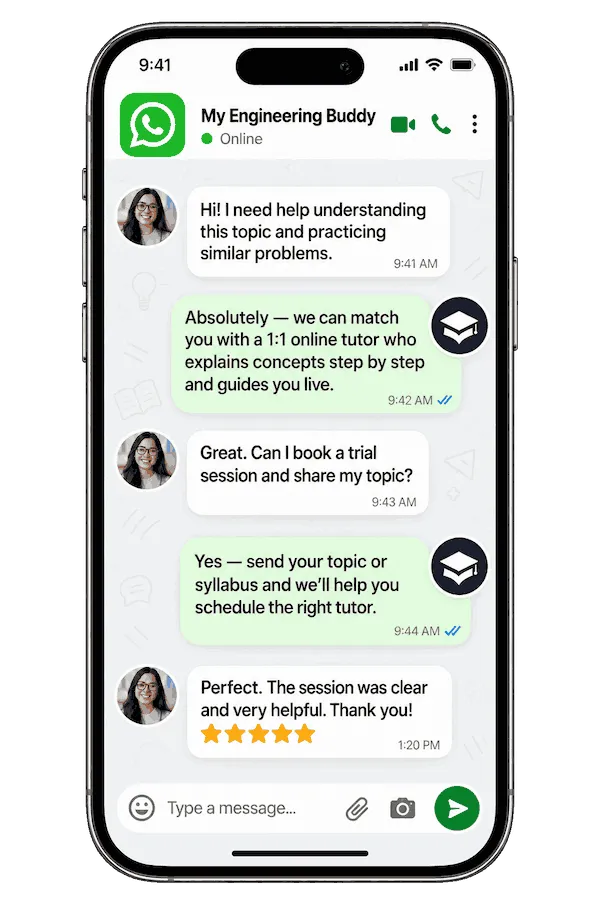
Unlike platforms where you fill out a form and wait, MEB responds in under a minute, 24/7. Tutor match takes under an hour. The $1 trial means you test before you commit. Everything runs over WhatsApp — no logins, no intake forms.
Pricing Guide
Fees start at $20/hr for undergraduate-level numerical methods and rise to $100/hr for PhD-level or research-adjacent work. Rate factors include the specific topic, your timeline, and tutor availability for your time zone.
For students targeting top graduate programmes at institutions like Carnegie Mellon, Oxford, EPFL, or Caltech, tutors with active research backgrounds in computational mathematics and scientific computing are available at higher rates. Share your specific goal and MEB will match the tier to your ambition.
Availability tightens sharply during semester finals and around major dissertation submission windows. If your exam or deadline is within six weeks, book now.
Start with the $1 trial — 30 minutes, no registration, no commitment. WhatsApp MEB for a quick quote.
Try your first session for $1 — 30 minutes of live 1:1 tutoring or one homework question explained in full. No registration. No commitment. WhatsApp MEB now and get matched within the hour.
FAQ
Is Numerical Solutions of PDEs hard?
Yes — it combines rigorous mathematics (convergence proofs, stability theory) with practical computing (scheme implementation, debugging). Students who struggle usually have gaps in either calculus and linear algebra, or in scientific programming. Both are fixable with targeted help.
How many sessions are needed?
Most students see clear progress within 4–6 sessions. Closing a full gap for an end-of-semester exam typically takes 10–15 hours. PhD students working on dissertation chapters often continue with weekly sessions across a full term.
Can you help with homework and assignments?
Yes. MEB tutoring is guided learning — you understand the work, then submit it yourself. The tutor explains the method, works through a similar example, and guides you to the answer. See our Academic Integrity policy and Why MEB page for full details on what we help with and what we don’t.
Will the tutor match my exact syllabus or exam board?
Yes. Share your course outline, institution, and specific topics when you book. The tutor is matched to your exact syllabus — whether that’s an FDM-focused undergraduate module or a FEM-heavy graduate course with specific software requirements.
What happens in the first session?
The tutor reviews your course outline or assignment, identifies the most urgent gaps, and works through at least one problem from start to finish. By the end of the first session, you’ll have a clear plan for the next two to three weeks.
Is online tutoring as effective as in-person?
For numerical PDEs, yes — often more so. The tutor shares screen to show code, writes derivations on a digital pen-pad, and can annotate your work directly. The format suits this subject particularly well because both code and maths are on screen simultaneously.
What’s the difference between FDM and FEM, and which should I focus on?
FDM is typically introduced first — it’s algebraically direct and good for rectangular domains. FEM handles complex geometries and is dominant in engineering applications. Your course determines the focus; most students need both, but the tutor sequences them based on your syllabus and current gaps.
Can you help with stability analysis specifically? That’s where I keep losing marks.
Stability analysis — particularly von Neumann analysis and CFL conditions — is one of the most common loss points in numerical PDEs assessments. MEB tutors treat this as a standalone topic and work through it methodically until the student can apply it independently on unseen problems.
Do you help with MATLAB or Python implementation, not just the maths?
Yes. The tutor works in your chosen environment — MATLAB, Python, or FEniCS. Implementation errors are debugged live during the session. The goal is that you understand why the code does what it does, not just that it runs.
Can I get Numerical Solutions of PDEs help at midnight?
Yes. MEB operates 24/7 across all major time zones. WhatsApp the team at any hour — average response time is under a minute. Tutors are available for late-night sessions in US, UK, Gulf, and Australian time zones.
How do I get started?
WhatsApp MEB with your course topic and timeline. You’ll be matched with a tutor — usually within an hour. The first session is the $1 trial: 30 minutes of live tutoring or one full homework question walked through from problem statement to final answer. Three steps: WhatsApp, matched, start trial.
MEB has been operating since 2008 across 2,800+ subjects — including Computational Mathematics, Fourier Analysis, and Numerical Solutions of PDEs. Every tutor goes through a live demo evaluation before working with any student.
Source: My Engineering Buddy, 2008–2025.
Trust & Quality at My Engineering Buddy
Every MEB tutor in numerical methods is screened through a subject-specific vetting process that includes a live demo session and assessment of their ability to explain scheme derivations clearly under exam conditions. Rated 4.8/5 across 40,000+ verified reviews on Google. Tutors hold graduate degrees in mathematics, engineering, or physics — many have active or recent research experience in computational methods. Ongoing feedback after every session keeps quality accountable.
MEB tutoring is guided learning — you understand the work, then submit it yourself. For full details on what we help with and what we don’t, read our Academic Integrity policy and Why MEB.
MEB has served 52,000+ students since 2008 across the US, UK, Canada, Australia, the Gulf, and Europe — in 2,800+ subjects including Mathematics, Mathematical Modeling, and Engineering Mathematics. The platform was built specifically for advanced technical subjects — not a general tutoring marketplace with numerical methods added as an afterthought.
Explore Related Subjects
Students studying Numerical Solutions of PDEs often also need support in:
- Real Analysis
- Functional Analysis
- Mathematical Methods
- Dynamical Systems
- Integral Equations
- Laplace Transform
- Mathematical Optimization
Next Steps
When you WhatsApp MEB, share your exam board or institution, your hardest topic right now (stability analysis, weak formulation, or implementation debugging are the most common), and your exam or deadline date.
Share your time zone and availability. MEB matches you with a verified tutor — usually within 24 hours, often within the hour.
The first session starts with a diagnostic so every minute is used well. Nothing is wasted on topics you already understand.
Before your first session, have ready:
- Your course outline or syllabus (or the specific assignment sheet)
- A recent problem you attempted — even a partial attempt is useful
- Your exam date or coursework submission deadline
The tutor handles everything else.
Visit www.myengineeringbuddy.com for more on how MEB works.
WhatsApp to get started or email [email protected].
Reviewed by Subject Expert
This page has been carefully reviewed and validated by our subject expert to ensure accuracy and relevance.




