~1 min
Average Reply Time
~1 hour
To Be Matched With A Tutor
30 Min Trial
75% Find Their Tutor On The 1st Trial
$20-35+/hr
Premium Yet Affordable Learning
Stability proofs, bifurcation diagrams, phase portraits — most students hit a wall in Dynamical Systems within three weeks of starting.
Dynamical Systems Tutor Online
Dynamical Systems is a branch of mathematics studying how systems evolve over time using differential equations, maps, and qualitative analysis. It equips students to model stability, chaos, and long-term behaviour in physical, biological, and engineering systems.
MEB provides 1:1 online tutoring and homework help in Mathematics and its advanced branches — including a dedicated Dynamical Systems tutor online matched to your exact course, university, or research level. Whether you’re looking for a Dynamical Systems tutor near me or need help across time zones, MEB tutors work live with you on the specific topics you’re stuck on. No generic explanations. No recorded videos. Just a tutor who knows the subject and can diagnose exactly where your reasoning breaks down.
- 1:1 online sessions tailored to your course syllabus and exam board
- Expert-verified tutors with graduate-level subject knowledge
- Flexible time zones — US, UK, Canada, Australia, Gulf
- Structured learning plan built after a diagnostic session
- Ethical homework and assignment guidance — you understand before you submit
52,000+ students across the US, UK, Canada, Australia, and the Gulf have used MEB since 2008 — including students in Mathematics subjects like Dynamical Systems, Nonlinear Dynamics, and Differential Equations.
Source: My Engineering Buddy, 2008–2025.
How Much Does a Dynamical Systems Tutor Cost?
Most Dynamical Systems tutoring sessions run $20–$40/hr. Graduate-level or highly specialised topics — such as ergodic theory or hyperbolic dynamics — can reach up to $100/hr depending on tutor expertise. Not sure if it’s worth it? Start with the $1 trial: 30 minutes of live 1:1 tutoring or one full homework question explained in detail.
| Level / Need | Typical Rate | What’s Included |
|---|---|---|
| Undergraduate (most levels) | $20–$40/hr | 1:1 sessions, homework guidance |
| Graduate / Specialist | $40–$100/hr | Expert tutor, research-level depth |
| $1 Trial | $1 flat | 30 min live session or 1 homework question |
Tutor availability tightens significantly during finals weeks and semester-end deadlines. Book early if you have a hard exam date.
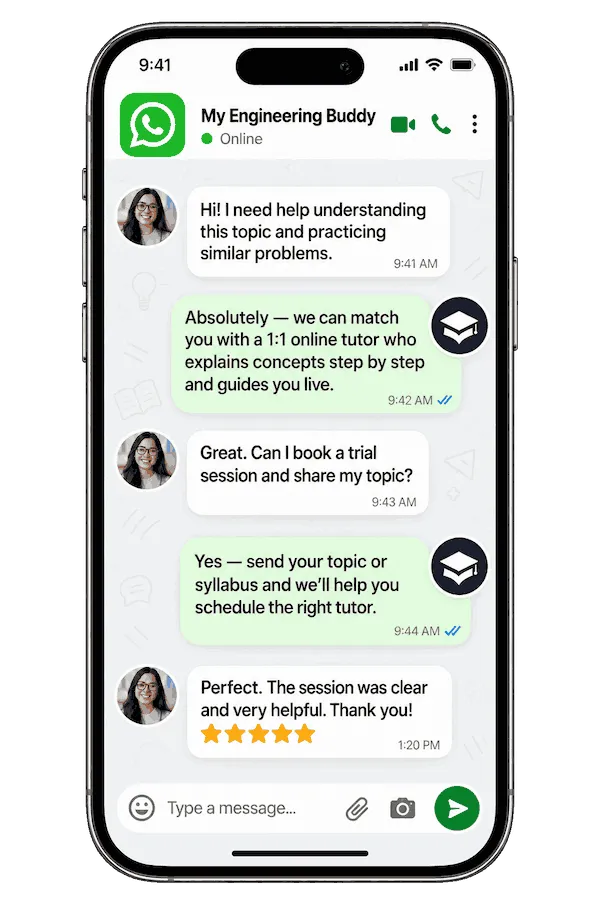
WhatsApp MEB for a quick quote — average response time under 1 minute.
Who This Dynamical Systems Tutoring Is For
Dynamical Systems draws students from mathematics, physics, engineering, and biology — and the difficulty profile is steep. Students who struggle rarely lack intelligence; they lack a tutor who can show them how to think through a phase plane or construct a Lyapunov function step by step.
- Undergraduate and graduate students taking Dynamical Systems as a core or elective module
- Students whose Dynamical Systems grade is dragging down their overall GPA
- Students retaking after a failed first attempt — often a single tutor session clarifies what months of lectures didn’t
- PhD students needing support in chaos theory, ergodic theory, or stability analysis for research
- Engineering and physics students applying dynamical systems concepts to control theory or fluid mechanics
- Students needing assignment guidance — understood first, submitted by you
Students taking this subject have come from programmes at MIT, Caltech, Imperial College London, ETH Zurich, the University of Toronto, McGill University, the University of Melbourne, and TU Delft, among others.
At MEB, we’ve found that most students stuck in Dynamical Systems are perfectly capable — they’re missing one or two foundational links between differential equations and qualitative behaviour. One targeted session on equilibrium classification or Poincaré maps tends to unlock the rest of the course faster than three weeks of re-reading lecture notes.
1:1 Tutoring vs Self-Study vs AI vs YouTube vs Online Courses
Self-study works if you’re disciplined, but phase portrait construction and bifurcation analysis need feedback — not just re-reading. AI tools answer fast but can’t catch the reasoning error in your stability proof or guide you through a Hopf bifurcation live. YouTube covers the basics well; it stops when you need to prove asymptotic stability for a specific system in your problem set. Online courses move at a fixed pace with no adjustment for your gaps. With MEB, a 1:1 Dynamical Systems tutor works through your exact problems in real time, corrects errors as they happen, and adapts the session to where you actually are — not where the syllabus assumes you should be.
Outcomes: What You’ll Be Able To Do in Dynamical Systems
After working with an MEB tutor, students report real, measurable shifts in what they can actually do — not just vague confidence boosts. You’ll be able to analyze the stability of equilibria using linearisation and classify them correctly from eigenvalue sign and type. You’ll solve autonomous systems and sketch accurate phase portraits for 2D systems without guessing. Students learn to apply the Lyapunov method to prove global stability in nonlinear systems. You’ll model real phenomena — from predator-prey population cycles to mechanical oscillators — and interpret what the long-run behaviour means. And you’ll explain the onset of chaos through period-doubling and bifurcation diagrams in a way that holds up under exam questioning.
Based on feedback from 40,000+ sessions collected by MEB from 2022 to 2025, 58% of students improved by one full grade after approximately 20 hours of 1:1 tutoring in subjects like Dynamical Systems. A further 23% achieved at least a half-grade improvement.
Source: MEB session feedback data, 2022–2025.
Try your first session for $1 — 30 minutes of live 1:1 tutoring or one homework question explained in full. No registration. No commitment. WhatsApp MEB now and get matched within the hour.
What We Cover in Dynamical Systems (Syllabus / Topics)

Track 1: Continuous Dynamical Systems and ODEs
- First-order autonomous equations and vector fields
- Phase line analysis, equilibria, and stability classification
- Linear systems in 2D — eigenvalue analysis, node, spiral, saddle, centre
- Nonlinear systems: linearisation near equilibria (Hartman-Grobman theorem)
- Limit cycles and the Poincaré-Bendixson theorem
- Lyapunov functions and direct method for stability
- Periodic orbits, index theory, and global behaviour
Core texts: Strogatz Nonlinear Dynamics and Chaos; Perko Differential Equations and Dynamical Systems; Hirsch, Smale & Devaney Differential Equations, Dynamical Systems, and an Introduction to Chaos.
Track 2: Bifurcation Theory and Chaos
- Bifurcations in 1D: saddle-node, transcritical, pitchfork
- Hopf bifurcation in 2D systems
- Introduction to chaos: sensitive dependence on initial conditions
- The logistic map, period-doubling, and Feigenbaum universality
- Strange attractors and the Lorenz system
- Lyapunov exponents and quantifying chaos
- Poincaré sections and return maps
Core texts: Strogatz Nonlinear Dynamics and Chaos; Guckenheimer & Holmes Nonlinear Oscillations, Dynamical Systems, and Bifurcations of Vector Fields; Devaney An Introduction to Chaotic Dynamical Systems.
Track 3: Discrete Dynamical Systems and Advanced Topics
- Iteration of maps, fixed points, and periodic orbits
- Stability of fixed points for discrete maps
- Symbolic dynamics and topological entropy
- Ergodic theory: invariant measures, ergodicity, mixing
- Hamiltonian systems and conservative dynamics
- Applications: population models, neural oscillators, mechanical systems
Core texts: Robinson Dynamical Systems: Stability, Symbolic Dynamics, and Chaos; Katok & Hasselblatt Introduction to the Modern Theory of Dynamical Systems; Wiggins Introduction to Applied Nonlinear Dynamical Systems and Chaos.
What a Typical Dynamical Systems Session Looks Like
The tutor opens by checking what happened since the last session — often picking up from a phase portrait problem or a Lyapunov stability argument that didn’t close cleanly. From there, the session moves to the core topic: the student and tutor work through live problems on screen, typically covering things like classifying equilibria for a specific nonlinear system, constructing a bifurcation diagram as a parameter varies, or tracing the onset of chaos in the logistic map. The tutor uses a digital pen-pad to sketch phase planes in real time, annotating directly on the problem. The student attempts steps, explains their reasoning out loud, and the tutor corrects errors at the point they appear — not after. The session closes with a concrete practice task: two or three problems on the next topic, plus a note on what the following session will address.
How MEB Tutors Help You with Dynamical Systems (The Learning Loop)
Diagnose: In the first session, the tutor identifies exactly where the breakdown is — often it’s not where the student thinks. A student who says “I can’t do bifurcations” usually has a gap in linearisation or eigenvalue interpretation that’s upstream of the bifurcation content itself.
Explain: The tutor works through problems live using a digital pen-pad on Google Meet. Every step is shown, annotated, and explained — not just stated. For Dynamical Systems, this means drawing phase portraits, sketching nullclines, and walking through Lyapunov candidate construction in real time.
Practice: The student attempts the next problem with the tutor present. This is where the real learning happens — not in watching, but in doing under guided conditions. The tutor can intervene at the first wrong turn rather than after a full page of incorrect work.
Feedback: Every error gets a specific explanation: not just “that’s wrong” but “here’s the step where the logic broke, here’s why, and here’s how to check yourself next time.” For exam preparation, the tutor flags exactly which types of errors cost marks and how to avoid them.
Plan: At the end of each session, the tutor sets the next topic and practice task, tracks progress against the student’s exam date or assignment deadline, and adjusts the pace if new gaps emerge.
Sessions run on Google Meet with a digital pen-pad or iPad and Apple Pencil. Before the first session, share your course syllabus or module outline, any past paper attempts, and your exam or submission date. The first session is a diagnostic — by the end of it, you’ll have a clear picture of what to work on and in what order. Start with the $1 trial — 30 minutes of live tutoring that also serves as your first diagnostic.
Students consistently tell us that the moment a Dynamical Systems concept clicks — usually when they can finally sketch a phase portrait correctly or explain why a limit cycle exists — the rest of the course opens up. Getting to that moment faster is what 1:1 tutoring is for.
Source: My Engineering Buddy, student feedback compilation, 2022–2025.
A common pattern our tutors observe is students spending hours on worked examples without ever testing their own understanding. In Dynamical Systems especially, where visual intuition and analytic technique have to work together, the only way to know if you understand something is to close the notes and try it yourself — with a tutor ready to catch the first mistake.
Tutor Match Criteria (How We Pick Your Tutor)
Match quality determines whether tutoring works. MEB doesn’t assign whoever is available — the match is made on four criteria.
Subject depth: The tutor holds at least a graduate degree in mathematics, physics, or a closely related engineering discipline, with demonstrated expertise in dynamical systems specifically — not just general ODE knowledge. Tutors covering chaos theory or ergodic theory at PhD level are matched for those topics.
Tools: Every tutor works on Google Meet with a digital pen-pad or iPad and Apple Pencil. If your course uses MATLAB, Python (SciPy/SymPy), or Mathematica for numerical simulation of dynamical systems, the tutor is matched accordingly.
Time zone: Matched to your region — US, UK, Gulf, Canada, or Australia — so sessions happen at sensible hours without compromise on tutor quality.
Goals: Whether you need exam-focused revision, conceptual depth for research, or structured homework support, the tutor selection reflects your actual objective.
Unlike platforms where you fill out a form and wait days, MEB responds in under a minute, 24/7. Tutor match takes under an hour. The $1 trial means you test before you commit. Everything runs over WhatsApp — no logins, no intake forms.
Study Plans (Pick One That Matches Your Goal)
After the diagnostic session, the tutor builds a specific sequence — but most students fall into one of three patterns. Catch-up (1–3 weeks): you’re behind on core topics like stability analysis or phase portraits and need to close the gap before an exam. Exam prep (4–8 weeks): structured revision across all examinable content, with past paper practice and timed problem sets. Weekly support: ongoing sessions aligned to your semester timetable, keeping pace with lectures and coursework deadlines. The tutor adjusts between these as your needs shift.
Pricing Guide
Dynamical Systems tutoring starts at $20/hr for undergraduate-level work and runs to $40/hr for most advanced coursework. Research-level topics — ergodic theory, hyperbolic dynamics, Hamiltonian systems at PhD level — are available at up to $100/hr depending on tutor background and topic complexity. Rate factors include your level, the specific sub-topic, your timeline, and tutor availability in your time zone.
For students targeting programmes at top research universities or doctoral programmes where Dynamical Systems forms a core component, tutors with active research backgrounds in the field are available at higher rates — share your specific goal and MEB will match the tier to your ambition.
Availability tightens at finals time. If you have a hard exam date, don’t leave the first contact until the last week. Start with the $1 trial — 30 minutes, no registration, no commitment. WhatsApp MEB for a quick quote.
FAQ
Is Dynamical Systems hard?
Yes, for most students. It demands simultaneous fluency in differential equations, linear algebra, and geometric intuition. The jump from solving ODEs to interpreting global behaviour of nonlinear systems is significant. With a tutor matching your exact course level, the difficulty becomes manageable step by step.
How many sessions are needed?
Students with specific gaps — say, Lyapunov stability or bifurcation classification — often see real progress in 4–6 sessions. Students needing full-course support through an undergraduate module typically work with a tutor over 8–15 sessions across a semester.
Can you help with homework and assignments?
Yes. MEB tutoring is guided learning — you understand the work, then submit it yourself. The tutor explains the method, works through a similar example, and checks your reasoning. See our Academic Integrity policy and Why MEB page for full details on what we help with and what we don’t.
Will the tutor match my exact syllabus or exam board?
Yes. Share your course outline, university, and module name before the first session. Tutors are matched to your specific content — whether that’s a standard undergraduate module, an MIT OpenCourseWare-aligned course, or a graduate-level treatment including ergodic theory and hyperbolic sets.
What happens in the first session?
The first session is a diagnostic. The tutor identifies exactly where your understanding breaks down — often upstream from where you think the problem is. By the end, you’ll have a topic-by-topic plan and a clear sense of what the next two to four sessions will cover.
Is online tutoring as effective as in-person?
For mathematics subjects like Dynamical Systems, yes — often more so. The tutor draws phase portraits and annotates proofs live on a digital pen-pad via Google Meet. Students can share their own work in real time. The American Mathematical Society recognises online collaboration tools as standard in mathematical research and education.
Can I get Dynamical Systems help at midnight?
Yes. MEB operates 24/7 across time zones. WhatsApp MEB at any hour — a tutor or coordinator responds in under a minute on average. Assignment deadline at 2 AM? It happens. MEB is set up for it.
What if I don’t like my assigned tutor?
Tell MEB on WhatsApp immediately. A replacement is arranged — usually within the same day. The $1 trial exists partly for this reason: you test the match before committing to a paid session schedule.
What’s the difference between Dynamical Systems and Differential Equations?
Differential Equations focuses on solving equations analytically. Dynamical Systems uses those equations to study long-run behaviour — stability, periodicity, chaos — often without explicit solutions. Most Dynamical Systems courses assume solid ODE fluency as a prerequisite. If yours is shaky, the tutor addresses it directly.
Do I need to know MATLAB or Python before starting?
Not necessarily. Some courses require numerical simulation using MATLAB, Python, or Mathematica to generate phase portraits or bifurcation diagrams. If yours does, tell MEB upfront and a tutor with the relevant software background is matched. If your course is purely analytical, no software background is needed.
How do I get started?
Three steps: WhatsApp MEB, get matched to a tutor (usually within an hour), start with the $1 trial — 30 minutes of live tutoring or one homework question explained in full. No registration. No commitment. If it works, continue. If not, you’re out $1.
Trust & Quality at My Engineering Buddy
Every MEB tutor goes through subject-specific screening before taking a single session. That means a live demo evaluation, a review of their academic and professional background, and ongoing session feedback monitoring. Tutors covering Dynamical Systems hold at least a master’s degree in mathematics, physics, or engineering, and many hold PhDs with research experience in nonlinear systems, control theory, or mathematical physics. Rated 4.8/5 across 40,000+ verified reviews on Google — that score is maintained through ongoing quality checks, not a one-time count. Need help with Chaos Theory tutoring alongside your Dynamical Systems work? Tutors covering both are available.
MEB tutoring is guided learning — you understand the work, then submit it yourself. For full details on what we help with and what we don’t, read our Academic Integrity policy and Why MEB.
MEB has served 52,000+ students across the US, UK, Canada, Australia, the Gulf, and Europe since 2008, covering 2,800+ subjects. In Mathematics, MEB tutors work across the full spectrum — from undergraduate applied mathematics tutoring and Real Analysis help through to research-level support in Dynamical Systems and related advanced fields.
Our experience across thousands of sessions shows that students who share their course syllabus and a recent piece of work before the first session make noticeably faster progress. The tutor arrives knowing exactly what level to pitch at — not spending the first 20 minutes calibrating from scratch.
Explore Related Subjects
Students studying Dynamical Systems often also need support in:
- Ergodic Theory
- Partial Differential Equations
- Fourier Analysis
- Measure Theory
- Topology
- Functional Analysis
- Mathematical Modeling
- Numerical Analysis
Next Steps
Getting started takes about two minutes. Have these ready before your first contact:
- Your exam board, course name, or module code — and your university or programme
- Your exam date or assignment deadline
- A recent problem set, past paper attempt, or homework you struggled with
WhatsApp MEB, get matched to a verified Dynamical Systems tutor — usually within the hour — and start your $1 trial. The first session is a diagnostic: by the end of it, you’ll have a clear session plan and a tutor who knows exactly where to start.
Visit www.myengineeringbuddy.com for more on how MEB works.
WhatsApp to get started or email [email protected].
Reviewed by Subject Expert
This page has been carefully reviewed and validated by our subject expert to ensure accuracy and relevance.