

Contact MEB Today To Get The Best
Permutations and combinations Tutoring Online
Email: [email protected]



~1 min
Average Reply Time
~1 hour
To Be Matched With A Tutor
30 Min Trial
75% Find Their Tutor On The 1st Trial
$20-35+/hr
Premium Yet Affordable Learning
Counting problems trip up more students than almost any other topic in discrete math — not because they’re impossible, but because one wrong decision at step one cascades into a completely wrong answer.
Permutations and Combinations Tutor Online
Permutations and combinations is a branch of Mathematics covering counting methods: permutations count ordered arrangements, combinations count unordered selections. Used across probability, statistics, and discrete math at secondary and undergraduate levels.
If you’ve searched for a permutations and combinations tutor near me, you already know the problem: most generic math help skips the one thing that actually matters — teaching you when to multiply, when to divide, and when the order changes everything. MEB’s 1:1 online tutoring in discrete mathematics and counting theory is built around exactly that decision-making process. One clear session can break the logjam.
- 1:1 online sessions tailored to your exact course and syllabus
- Expert-verified tutors with subject-specific knowledge in combinatorics and discrete math
- Flexible time zones — US, UK, Canada, Australia, Gulf
- Structured learning plan built after a diagnostic session
- Ethical homework and assignment guidance — you understand the work before you submit
52,000+ students across the US, UK, Canada, Australia, and the Gulf have used MEB since 2008 — including students in Mathematics subjects like Permutations and Combinations, Probability, and Combinatorics.
Source: My Engineering Buddy, 2008–2025.
How Much Does a Permutations and Combinations Tutor Cost?
Most permutations and combinations tutoring sessions run $20–$40/hr. Graduate-level or competition-math depth can reach $70–$100/hr. The $1 trial gets you 30 minutes of live 1:1 tutoring or one full homework question explained — no registration required.
| Level / Need | Typical Rate | What’s Included |
|---|---|---|
| Standard (high school / early undergrad) | $20–$35/hr | 1:1 sessions, homework guidance |
| Advanced / Specialist (graduate, olympiad) | $35–$100/hr | Expert tutor, niche depth |
| $1 Trial | $1 flat | 30 min live session or 1 homework question |
Tutor availability tightens significantly in the four weeks before finals and standardized exam windows. Book early to secure your preferred time slot.
WhatsApp MEB for a quick quote — average response time under 1 minute.
Who This Permutations and Combinations Tutoring Is For
This isn’t a subject where reading the textbook twice fixes the problem. Most students who struggle with permutations and combinations know the formulas — they just don’t know which one applies. That’s a conceptual gap, not a memory gap. MEB tutors work with students at every level where counting methods appear.
- High school students tackling permutations and combinations for the first time in Algebra 2 or Pre-Calculus
- Students retaking after a failed first attempt on a discrete math or probability exam
- Undergraduates in Computer Science, Statistics, or Engineering where combinatorics reappears in harder contexts
- Students with a university conditional offer depending on a math grade this semester
- Students 4–6 weeks from an exam with significant counting-method gaps still to close
- Parents watching a child’s confidence drop alongside their math grades
Students come to MEB from universities and programs across the US, UK, Canada, Australia, and the Gulf — including students at institutions such as MIT, University of Toronto, University College London, University of Sydney, and NYU Abu Dhabi. If your course covers factorial notation, the multiplication principle, or binomial coefficients, this tutoring applies to you.
Start with the $1 trial — one session is often enough to untangle the ordered-vs-unordered confusion that’s been costing points.
1:1 Tutoring vs Self-Study vs AI vs YouTube vs Online Courses
Self-study works if you’re disciplined, but counting problems need someone to catch your reasoning error before it becomes a habit. AI tools give fast answers but can’t watch you work through a multi-step problem and spot where your logic broke. YouTube handles basic nCr and nPr well — it stops working the moment your question adds a restriction or a “at least” condition. Online courses move at a fixed pace and skip the problems that trip up your specific course. 1:1 tutoring with MEB is live, corrects errors the moment they happen, and is calibrated to your exact syllabus — whether that’s a discrete math unit, a probability course, or a standardized test section on counting.
Outcomes: What You’ll Be Able To Do in Permutations and Combinations
After working with an MEB permutations and combinations tutor, you won’t just remember formulas — you’ll know how to read a problem and identify whether order matters before you write a single symbol. Solve multi-step counting problems involving restrictions, repetition, and circular arrangements. Apply the multiplication principle correctly to compound events without over- or under-counting. Analyze “at least” and “at most” problems using complementary counting rather than brute force. Explain the difference between a permutation and a combination in exam-context language, which is exactly what graders reward. Present solutions to binomial coefficient problems with clear logical structure across exam formats from AP to undergraduate discrete math.
At MEB, we’ve found that students who struggle with permutations and combinations almost always have the same root issue: they try to memorize which formula goes where instead of learning to ask “does order matter here?” Once that question becomes automatic, the rest follows quickly.
Based on feedback from 40,000+ sessions collected by MEB from 2022 to 2025, 58% of students improved by one full grade after approximately 20 hours of 1:1 tutoring in subjects like Permutations and Combinations. A further 23% achieved at least a half-grade improvement.
Source: MEB session feedback data, 2022–2025.
Supporting a student through Permutations and Combinations? MEB works directly with parents to set up sessions, track progress, and keep coursework on schedule. WhatsApp MEB — average response time is under a minute, 24/7.
What We Cover in Permutations and Combinations (Syllabus / Topics)

Track 1: Foundations of Counting
- The fundamental counting principle (multiplication rule)
- Factorial notation and its properties
- Permutations of n objects taken r at a time (nPr)
- Permutations with repeated elements
- Circular permutations
- Combinations (nCr) and the choose notation
- Distinguishing permutation problems from combination problems
Key texts: Discrete Mathematics and Its Applications by Kenneth Rosen; Concrete Mathematics by Graham, Knuth, and Patashnik.
Track 2: Probability and Counting Applications
- Using combinations to calculate classical probability
- Complementary counting (“at least one” problems)
- Inclusion-exclusion principle for overlapping sets
- The binomial theorem and binomial coefficients
- Pascal’s triangle identities and combinatorial proofs
- Multinomial coefficients
- Counting with restrictions and conditions
Key texts: Introduction to Probability by Blitzstein and Hwang; A Walk Through Combinatorics by Miklós Bóna.
Track 3: Advanced Combinatorics and Exam Strategy
- Stars and bars (distributing indistinct objects into distinct bins)
- Pigeonhole principle and its applications
- Generating functions as a counting tool
- Derangements and restricted permutations
- Exam-specific problem types: AP, SAT, GRE, undergraduate discrete math
- Writing clear combinatorial arguments for partial credit
Key texts: Combinatorics: Topics, Techniques, Algorithms by Peter Cameron; Problems in Combinatorics by T. Andreescu and R. Gelca.
Students consistently tell us that the hardest part of permutations and combinations isn’t the calculation — it’s deciding which tool to reach for. Our tutors build that decision-making instinct deliberately, through varied problems, not repetition of the same problem type.
What a Typical Permutations and Combinations Session Looks Like
The tutor opens by checking the previous topic — for example, whether circular permutations from last session clicked or whether the student is still treating them like linear ones. From there, you work through live problems on screen: the tutor writes on a digital pen-pad, showing step-by-step reasoning for problems like “how many ways can a committee of 4 be chosen from 10 people if two specific members must both be included or both excluded.” You try the next problem while the tutor watches your reasoning, not just your answer. When you write nPr where nCr belongs, you get corrected immediately — with the question that fixes it, not just the right number. The session closes with two or three targeted practice problems set for before next time, and the next topic (typically the inclusion-exclusion principle or binomial coefficients) is noted so you know what to read in advance.
How MEB Tutors Help You with Permutations and Combinations (The Learning Loop)
Diagnose: In the first session, the tutor gives you two or three diagnostic problems — one straightforward nCr, one with a restriction, one probability application. Your answers and your working reveal exactly where the confusion lives: factorial manipulation, the ordered/unordered distinction, or multi-step logic.
Explain: The tutor works through a model problem on a digital pen-pad in real time, narrating every decision point. Not just what the answer is — why this is a combination problem and not a permutation problem, and what in the question’s phrasing signals that.
Practice: You attempt the next problem while the tutor watches. This matters. The tutor sees your reasoning process, not just whether the final number is right.
Feedback: When you pick the wrong formula or miss a restriction, the tutor walks back to the exact step where the logic broke and rebuilds from there. You see specifically why marks would be lost on an exam.
Plan: At the end of every session, the tutor notes what’s solid and what the next session will cover — typically moving from basic permutations and combinations toward binomial coefficients, inclusion-exclusion, or stars-and-bars depending on your course. Progress is tracked and adjusted after each session.
Sessions run on Google Meet. The tutor uses a digital pen-pad or iPad with Apple Pencil. Before your first session, share your course outline or exam syllabus, one past paper or homework problem you found hard, and your exam or assignment deadline. The first session starts with a diagnostic so no time is wasted on topics you’ve already mastered. Start with the $1 trial — 30 minutes of live tutoring that also serves as your first diagnostic.
A common pattern our tutors observe is that students who can recite the permutation formula perfectly still lose marks on exam day — because the real skill tested is identifying problem type, not executing the formula. That gap closes fast with focused 1:1 work.
Source: MEB tutor observations, 2008–2025.
Tutor Match Criteria (How We Pick Your Tutor)
MEB doesn’t assign the first available tutor. The match is based on four things.
Subject depth: The tutor must have demonstrable experience with your specific level — whether that’s high school discrete math, an undergraduate combinatorics module, or graduate-level probability. Tools: Every tutor works on Google Meet with a digital pen-pad or iPad and Apple Pencil — visual explanation is non-negotiable for counting problems. Time zone: Matched to your region — US, UK, Canada, Australia, or Gulf — so sessions don’t require you to work at 2am. Goals: Whether you need exam score improvement, homework support on a specific assignment, or conceptual depth for a research methods course, the tutor is matched to that outcome.
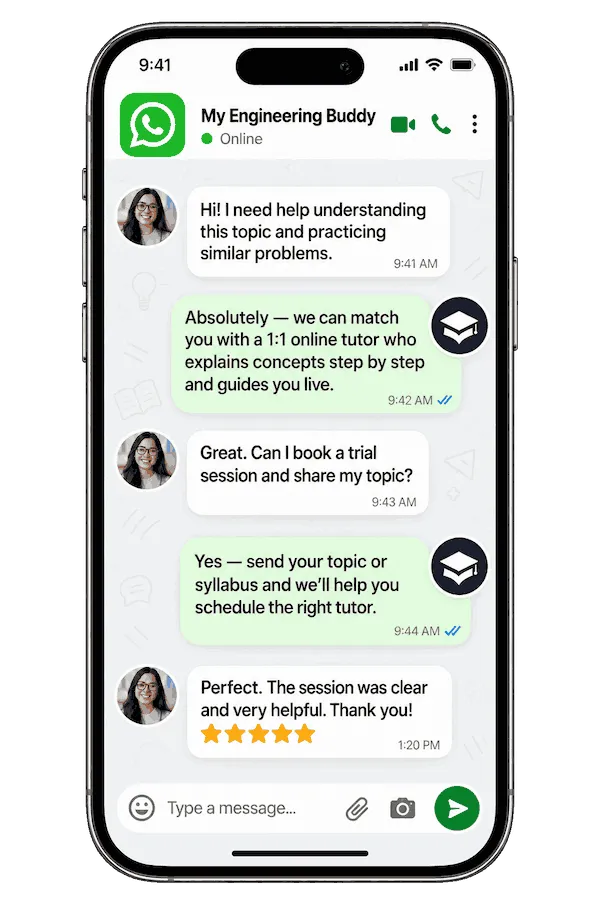
Unlike platforms where you fill out a form and wait, MEB responds in under a minute, 24/7. Tutor match takes under an hour. The $1 trial means you test before you commit. Everything runs over WhatsApp — no logins, no intake forms.
Pricing Guide
Permutations and combinations tutoring runs $20–$40/hr for most high school and undergraduate levels. Graduate-level or competition-prep depth — where problems require generating functions or advanced combinatorial arguments — runs up to $100/hr. Rate factors include topic complexity, your deadline, and tutor availability at your preferred time.
For students targeting selective university programs in Mathematics, Computer Science, or Statistics — where combinatorics appears in entrance exams and competitive assessments — tutors with research or olympiad backgrounds are available at higher rates. Share your specific goal and MEB will match the right tier.
Availability tightens during finals weeks and standardized exam windows. Start with the $1 trial — 30 minutes, no registration, no commitment. WhatsApp MEB for a quick quote.
FAQ
Is permutations and combinations hard?
For most students, yes — but not because the math is advanced. The difficulty is deciding when to use each method. Once you learn to ask “does order matter?” as the first step, most problems become manageable. A single focused session fixes the core confusion for many students.
How many sessions are needed?
Students with a specific gap — like confusing nPr and nCr — often need 2–4 sessions. Students building toward an exam covering the full counting topic, including binomial theorem and inclusion-exclusion, typically benefit from 8–15 sessions spread over 4–6 weeks.
Can you help with homework and assignments?
MEB tutoring is guided learning — you understand the work, then submit it yourself. The tutor explains the method and reasoning behind each problem type so you can complete similar questions independently. See our Academic Integrity policy and Why MEB page for full details on what we help with and what we don’t.
Will the tutor match my exact syllabus or exam board?
Yes. Share your course outline, textbook, or exam board when you message MEB. Tutors are matched based on syllabus fit — whether that’s an AP course, an IB Math module, a UK A Level, or a specific university combinatorics or probability unit.
What happens in the first session?
The tutor starts with 2–3 diagnostic problems spanning basic and applied counting. Your working reveals where the confusion actually lives — not just whether your final answer was wrong. The rest of the session addresses the most urgent gap, and the tutor maps the plan from there.
Is online tutoring as effective as in-person?
For a subject like permutations and combinations, it is. The digital pen-pad replicates whiteboard working exactly. Students see the tutor’s step-by-step reasoning in real time. The feedback loop is identical to in-person — and scheduling across time zones is far more flexible.
Can I get permutations and combinations help at midnight or on weekends?
Yes. MEB operates 24/7. Tutors are available across multiple time zones, which means students in the Gulf, US, Australia, and UK can all find sessions outside standard business hours. Message on WhatsApp and you’ll get a response in under a minute regardless of the time.
What if I don’t like my assigned tutor?
Request a different tutor through WhatsApp. MEB re-matches without delay. The $1 trial exists specifically so you can test the fit before committing to paid sessions — no pressure to continue if the match isn’t right.
Do I need to know probability before studying permutations and combinations?
Not necessarily. Permutations and combinations is often taught before formal probability — it provides the counting tools that probability theory depends on. If you’re coming from a probability course and struggling, counting methods are likely the gap. The tutor assesses your baseline in the first session.
What’s the difference between permutation and combination in exam problems — how do I tell them apart?
The key question is whether the order of selection changes the outcome. “First, second, third place in a race” — order matters, so it’s a permutation. “A 3-person committee from 10 candidates” — order doesn’t matter, so it’s a combination. Exams test this distinction repeatedly, often with misleading wording designed to trip students up.
Do you offer group permutations and combinations sessions?
MEB specialises in 1:1 tutoring. Group sessions aren’t offered as a standard format. The individual model is deliberate — counting problems require the tutor to watch your reasoning process specifically, not deliver a lecture to several students at once.
How do I get started?
Message MEB on WhatsApp, describe your topic and exam date, and you’ll be matched with a tutor — usually within the hour. The first session runs as a $1 trial: 30 minutes of live tutoring or one full question explained. Three steps: WhatsApp → matched → start trial.
Trust & Quality at My Engineering Buddy
Every MEB tutor goes through subject-specific vetting: a live demo session, review of their academic background, and an assessment of how they explain — not just whether they know the content. Tutors covering permutations and combinations are evaluated on how they handle the ordered/unordered distinction and multi-step counting problems, because that’s where explanations either land or don’t. Rated 4.8/5 across 40,000+ verified reviews on Google. Ongoing session feedback keeps tutor quality in check — not just at onboarding.
MEB tutoring is guided learning — you understand the work, then submit it yourself. For full details on what we help with and what we don’t, read our Academic Integrity policy and Why MEB.
MEB has served 52,000+ students across the US, UK, Canada, Australia, the Gulf, and Europe in 2,800+ subjects since 2008. Mathematics is one of MEB’s largest subject areas — covering everything from foundational algebra tutoring and calculus help through to graph theory tutoring and advanced number theory homework help. The same depth applies to permutations and combinations — at every level it appears in your course.
Explore Related Subjects
Students studying Permutations and Combinations often also need support in:
- Analytic Combinatorics
- Discrete Mathematics
- Finite Mathematics
- Set Theory
- Mathematical Logic
- Quantitative Reasoning
- Logical Reasoning
Next Steps
Before your first session, have ready: your exam board and syllabus (or course outline), a recent past paper attempt or homework problem you struggled with, and your exam or deadline date. The tutor handles the rest.
- Share your exam board, the specific counting topics causing trouble, and your current timeline
- Share your availability and time zone
- MEB matches you with a verified tutor — usually within 24 hours
The first session starts with a diagnostic so every minute is used well. Visit www.myengineeringbuddy.com for more on how MEB works.
WhatsApp to get started or email [email protected].
Reviewed by Subject Expert
This page has been carefully reviewed and validated by our subject expert to ensure accuracy and relevance.




