




~1 min
Average Reply Time
~1 hour
To Be Matched With A Tutor
1 Trial
75% Find Their Tutor On The 1st Trial
$20-35+/hr
Premium Yet Affordable Learning
Hire The Best Probability Tutor





Related Subjects
Most students don’t fail Probability because it’s impossible — they fail because nobody ever showed them where their sample space logic broke down.
Probability Tutor Online
Probability is the mathematical study of uncertainty and likelihood. It equips students to model random events, compute distributions, and apply statistical reasoning across data science, engineering, actuarial work, and academic research.
If you’re searching for a Probability tutor near me, MEB’s 1:1 online tutoring and homework help in Mathematics connects you with a verified expert who knows your exact syllabus — whether that’s AP Statistics, IB, first-year university, or a graduate stochastic processes course. One tutor. Your topics. Your pace. Students who commit to 1:1 sessions typically notice the shift within the first three or four hours of targeted work.
- 1:1 online sessions tailored to your course and syllabus
- Expert-verified tutors with subject-specific Probability knowledge
- Flexible time zones — US, UK, Canada, Australia, Gulf
- Structured learning plan built after a diagnostic session
- Ethical homework and assignment guidance — you understand before you submit
52,000+ students across the US, UK, Canada, Australia, and the Gulf have used MEB since 2008 — including students in Mathematics subjects like Probability, Statistics, and Combinatorics.
Source: My Engineering Buddy, 2008–2025.
How Much Does a Probability Tutor Cost?
Most Probability tutoring sessions run $20–$40/hr. Graduate-level topics — stochastic processes, measure-theoretic probability, Bayesian inference — can reach $70–$100/hr. Start with the $1 trial: 30 minutes of live 1:1 tutoring or one full homework question explained from setup to final answer.
| Level / Need | Typical Rate | What’s Included |
|---|---|---|
| Standard (most levels) | $20–$35/hr | 1:1 sessions, homework guidance |
| Advanced / Specialist | $35–$100/hr | Expert tutor, graduate-level depth |
| $1 Trial | $1 flat | 30 min live session or 1 homework question |
Tutor availability tightens significantly in the four weeks before AP, IB, and university exam periods. Book early to secure your preferred time slot.
WhatsApp MEB for a quick quote — average response time under 1 minute.
Who This Probability Tutoring Is For
Probability sits at the crossroads of pure logic and applied data work. Students hit walls at different points — and those walls are very specific.
- Undergraduates stuck on joint distributions, conditional probability, or Bayes’ theorem in a statistics or engineering module
- AP Statistics students working through sampling distributions and inference before the May exam
- IB Mathematics (AA or AI) students tackling the Probability and Statistics option
- Graduate students whose stochastic processes or measure-theoretic probability coursework has outpaced their foundations
- Students retaking after a failed first attempt — specifically those who passed earlier modules but lost ground when random variables were introduced
- Parents watching a student’s confidence drop after three failed problem sets on Bayesian networks or combinatorial probability
MEB has worked with students at universities including MIT, Imperial College London, University of Toronto, ETH Zurich, University of Melbourne, and the University of Amsterdam — across undergraduate, graduate, and professional programmes.
1:1 Tutoring vs Self-Study vs AI vs YouTube vs Online Courses
Self-study works if you already know which gaps to close — most Probability students don’t. AI tools generate answers fast but can’t watch you misread a conditional probability tree and correct you mid-step. YouTube explains the central limit theorem clearly enough; it stops when your specific exam question involves a non-standard distribution. Online courses move at a fixed pace that rarely matches a six-week exam countdown. 1:1 tutoring with MEB is live, calibrated to your exact Probability course, and catches the specific reasoning error that costs you marks — whether that’s confusing P(A|B) with P(B|A) or misapplying independence assumptions in joint problems.
Outcomes: What You’ll Be Able To Do in Probability
After working with an online Probability tutor at MEB, you’ll be able to solve conditional probability problems correctly the first time — not by formula recall but by understanding the sample space structure. You’ll analyze discrete and continuous distributions, apply Bayes’ theorem to real inference problems, model random variables using expectation and variance, and explain the central limit theorem in a way that holds up under exam questioning. For graduate students, you’ll apply measure-theoretic foundations to stochastic processes with confidence.
Supporting a student through Probability? MEB works directly with parents to set up sessions, track progress, and keep coursework on schedule. WhatsApp MEB — average response time is under a minute, 24/7.
Based on feedback from 40,000+ sessions collected by MEB from 2022 to 2025, 58% of students improved by one full grade after approximately 20 hours of 1:1 tutoring in subjects like Probability. A further 23% achieved at least a half-grade improvement.
Source: MEB session feedback data, 2022–2025.
What We Cover in Probability (Syllabus / Topics)

Track 1: Foundations — AP, IB, and Early Undergraduate
- Sample spaces, events, and set notation
- Classical and empirical probability definitions
- Addition and multiplication rules; mutually exclusive and independent events
- Conditional probability and Bayes’ theorem
- Discrete random variables: PMF, expectation, variance
- Binomial, Poisson, and geometric distributions
- Introduction to continuous distributions and the normal curve
Core texts for this track include Sheldon Ross’s A First Course in Probability and DeGroot & Schervish’s Probability and Statistics — tutors work directly from your edition and assignment sheets.
Track 2: Intermediate Probability — Second/Third Year Undergraduate
- Joint, marginal, and conditional distributions (discrete and continuous)
- Covariance, correlation, and independence for random vectors
- Moment generating functions and characteristic functions
- The central limit theorem and law of large numbers (proofs and applications)
- Sampling distributions: chi-squared, t, and F
- Introduction to Markov chains and transition matrices
- Basic simulation: Monte Carlo methods and random number generation
Tutors commonly work from Blitzstein & Hwang’s Introduction to Probability and Pitman’s Probability — both editions covered, including the Harvard Stat 110 course structure.
Track 3: Advanced and Graduate Probability
- Measure-theoretic foundations: sigma-algebras, measurable functions, Lebesgue integration
- Probability spaces and the Kolmogorov axioms at formal level
- Convergence of random variables: almost sure, in probability, in L^p
- Martingales and optional stopping theorem
- Brownian motion and introduction to stochastic calculus (Ito’s lemma)
- Stochastic processes: Poisson processes, renewal theory
- Measure theory connections and Radon-Nikodym theorem
Graduate-level sessions draw on Durrett’s Probability: Theory and Examples and Williams’s Probability with Martingales — tutors hold postgraduate degrees in Mathematics or Statistics and have worked through these texts in their own research.
At MEB, we’ve found that the students who struggle most with Probability aren’t weak at mathematics — they’re reading problems too quickly and skipping the step where they define the sample space explicitly. That one habit change, enforced in the first two or three sessions, tends to unlock everything else.
What a Typical Probability Session Looks Like
The tutor opens by checking the previous session’s topic — say, conditional independence or moment generating functions — and asks you to talk through one problem from your practice set without prompting. From there, you and the tutor work through two or three new problems on screen: the tutor uses a digital pen-pad to annotate sample space diagrams, walk through distribution derivations, or mark up your Bayes’ theorem setup step by step. You replicate the reasoning on your own — not just copy the working. The tutor watches where you slow down or make an assumption without justifying it. By the end, you have a specific practice task (usually two or three exam-style questions on the new topic) and the next session topic is already noted. No wasted time. No going over things you already have.
How MEB Tutors Help You with Probability (The Learning Loop)
Diagnose: In the first session, the tutor asks you to attempt a short set of problems — typically spanning event probability, a conditional problem, and one distribution question. The goal isn’t to test you. It’s to find exactly where the reasoning breaks down, whether that’s at set-up, formula selection, or final interpretation.
Explain: The tutor works through the same problems live, on a digital pen-pad or iPad with Apple Pencil. You see every step annotated in real time — including the decision points most textbooks skip over, like why a particular counting argument applies or when to use the complement rule.
Practice: You attempt problems with the tutor present. Not after the session. During it. This is where the actual learning happens — the tutor can see exactly which step trips you up and intervene before the wrong reasoning gets reinforced.
Feedback: Error correction is specific: not “that’s wrong” but “here you’ve treated two events as independent when the problem says otherwise — here’s what that changes in your calculation.” You leave knowing which marks you would have lost and why.
Plan: Each session ends with a topic sequence for the next two to three sessions, mapped against your exam date or assignment deadlines. If your exam is six weeks away, the plan accounts for every topic that needs covering and builds in review weeks.
Sessions run on Google Meet with a digital pen-pad or iPad + Apple Pencil for live annotation. Before your first session, share your course outline or syllabus, a recent past paper attempt or homework problem you got stuck on, and your exam or assignment date. The tutor maps the plan from there. Start with the $1 trial — 30 minutes of live tutoring that also serves as your first diagnostic.
Students consistently tell us that the shift happens when they stop treating Probability as a collection of formulas and start seeing it as a discipline of precise language — defining events before computing anything.
Source: MEB tutor feedback, compiled 2022–2025.
Tutor Match Criteria (How We Pick Your Tutor)
Not every mathematician is equipped to tutor Probability at every level. Here’s what MEB checks before matching.
Subject depth: Tutors are matched by level — AP/IB, undergraduate, or graduate — and by the specific track within Probability (discrete, continuous, stochastic, measure-theoretic). A tutor covering graduate stochastic processes holds a postgraduate degree in a quantitative field and has worked through the relevant material at research level.
Tools: Every tutor is set up on Google Meet with a digital pen-pad or iPad + Apple Pencil. Probability without live diagram annotation is guesswork.
Time zone: Matched to your region — US, UK, Gulf, Canada, Australia — so sessions run at times that don’t require you to be awake at 2am.
Goals: Whether you’re targeting an A in AP Statistics, closing gaps before a university resit, or building research-level foundations for a PhD programme, the tutor is matched to that specific target — not assigned generically.
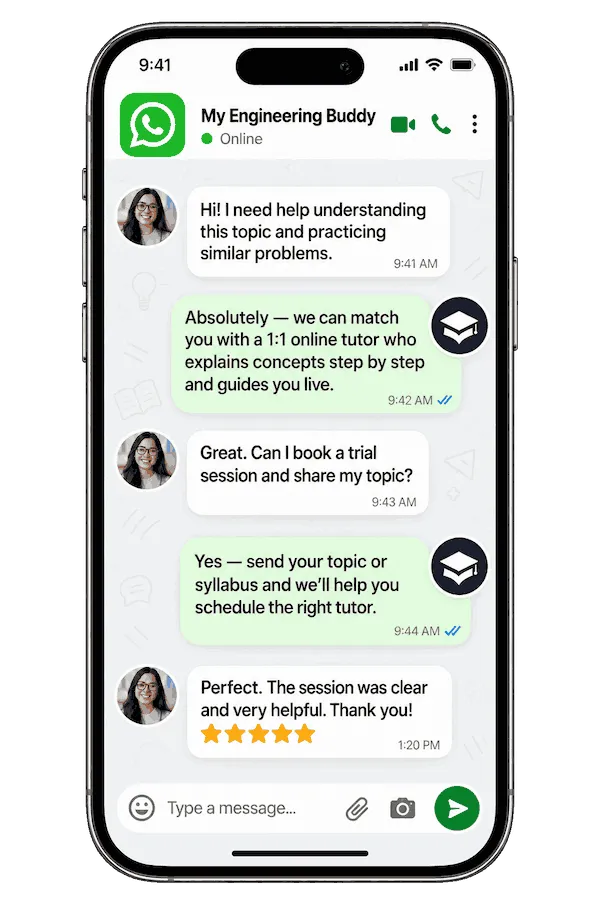
Unlike platforms where you fill out a form and wait, MEB responds in under a minute, 24/7. Tutor match takes under an hour. The $1 trial means you test before you commit. Everything runs over WhatsApp — no logins, no intake forms.
Students consistently tell us that what they value most isn’t just the explanation — it’s that the tutor already knows exactly which section of the syllabus they’re stuck on before the session even starts, because they shared their course outline in advance.
Study Plans (Pick One That Matches Your Goal)
After the first diagnostic session, your tutor builds a specific topic sequence — not a generic schedule. A catch-up plan (1–3 weeks) targets the two or three topics most likely to cost marks in an upcoming exam. An exam prep plan (4–8 weeks) covers the full syllabus in priority order, with past paper practice built in from week two. Weekly ongoing support runs alongside your semester, aligned to assignment deadlines and lecture pace. The tutor adjusts the sequence after every session based on what’s working and what isn’t.
Pricing Guide
Probability tutoring starts at $20/hr for school-level and early undergraduate work. Most sessions sit between $20 and $40/hr. Graduate-level topics — stochastic processes, Bayesian inference, measure-theoretic probability — run up to $100/hr depending on tutor seniority and topic complexity.
Rate factors include: level of the topic, how close your exam or deadline is, and tutor availability. Rates rise during peak exam periods when demand is highest — typically March through May for AP and IB, and September through November for semester-end university assessments.
For students targeting top-tier graduate programmes, professional actuarial qualifications, or research positions requiring strong probability foundations, tutors with advanced research or industry backgrounds are available at higher rates. Share your specific goal and MEB matches the tutor tier to your target.
Start with the $1 trial — 30 minutes, no registration, no commitment. WhatsApp MEB for a quick quote.
FAQ
Is Probability hard?
It’s counterintuitive more than it is technically difficult at the foundational level. Most students find conditional probability and Bayes’ theorem the first genuine stumbling block. At graduate level, measure-theoretic foundations require real analysis fluency and represent a significant jump in abstraction.
How many sessions are needed?
Students with one or two specific topics to close before an exam typically need 4–6 sessions. A full-syllabus exam prep plan from scratch usually runs 15–20 sessions over 6–8 weeks. Graduate-level support is typically ongoing through the semester.
Can you help with homework and assignments?
Yes. MEB tutoring is guided learning — you understand the work, then submit it yourself. See our Academic Integrity policy and Why MEB page for full details on what we help with and what we don’t.
Will the tutor match my exact syllabus or exam board?
Yes. Before your first session, share your course outline, exam board (AP, IB, A Level, university module code), and the specific topics you’re working on. The tutor is matched to that syllabus — not assigned from a general mathematics pool.
What happens in the first session?
The tutor runs a short diagnostic — a set of problems spanning the topics you’ve flagged — to locate precisely where reasoning breaks down. From that point, the session shifts into targeted teaching. You leave with a topic plan and a specific practice task.
Is online tutoring as effective as in-person?
For Probability, yes — and sometimes more so. Live pen-pad annotation on screen lets the tutor mark up sample space diagrams, distribution curves, and Venn diagrams in real time. Students report they can follow the reasoning more clearly than over a physical whiteboard.
What’s the difference between Probability and Statistics — and can MEB help with both?
Probability is the mathematical framework; Statistics applies it to data analysis and inference. Many courses blend them, especially at AP and undergraduate level. MEB tutors cover both — share your syllabus and the tutor is matched to the exact blend your course requires.
My course uses simulation and Python for Probability — can tutors help with that?
Yes. Several MEB Probability tutors are also proficient in SciPy and SymPy for computational probability work. Share your course tools when you message MEB and the match will account for that requirement.
Can I get Probability help at midnight?
Yes. MEB operates across multiple time zones, including coverage for US, UK, Gulf, and Australian students around the clock. WhatsApp MEB any time — the median response is under one minute, day or night.
What if I don’t like my assigned tutor?
Tell MEB via WhatsApp and a replacement is arranged — no forms, no waiting period. The $1 trial is specifically designed to let you check the fit before committing to a full schedule.
How do I get started?
Three steps: WhatsApp MEB, share your syllabus and exam date, get matched with a verified Probability tutor — usually within the hour. Your first session is the $1 trial: 30 minutes live or one homework question explained in full, from setup to final answer.
Do Probability problems in exams follow predictable patterns — and can a tutor help me exploit that?
Yes, and this is one of the highest-value things a tutor does. AP, IB, and university Probability exams recycle the same core problem structures — conditional probability setups, distribution identification, and CLT applications. A tutor who knows your exam format teaches you to recognise the structure before doing any calculation, which is where exam marks are actually won.
Trust & Quality at My Engineering Buddy
Every MEB tutor goes through a subject-specific screening process: academic credentials verified, a live demo session evaluated by MEB’s internal team, and ongoing feedback reviewed after every student rating. Tutors covering advanced Probability topics — stochastic processes, Bayesian inference, measure theory — hold postgraduate degrees in Mathematics, Statistics, or a closely related quantitative field. Rated 4.8/5 across 40,000+ verified reviews on Google.
MEB tutoring is guided learning — you understand the work, then submit it yourself. For full details on what we help with and what we don’t, read our Academic Integrity policy and Why MEB.
MEB has served 52,000+ students across the US, UK, Canada, Australia, the Gulf, and Europe since 2008 — across 2,800+ subjects. In Mathematics, that includes Probability alongside subjects like Real Analysis tutoring, Differential Equations help, and Discrete Mathematics tutoring. Read more about our approach at our tutoring methodology page.
A common pattern our tutors observe is this: students arrive having memorised Bayes’ theorem correctly but consistently applying it to the wrong conditional. Two sessions fixing that one error changes their entire performance profile.
Source: MEB internal tutor notes, 2022–2025.
Try your first session for $1 — 30 minutes of live 1:1 tutoring or one homework question explained in full. No registration. No commitment. WhatsApp MEB now and get matched within the hour.
Explore Related Subjects
Students studying Probability often also need support in:
- Combinatorics
- Mathematical Analysis
- Numerical Analysis
- Calculus
- Set Theory
- Graph Theory
- Mathematical Modeling
Next Steps
Getting started takes under five minutes.
- Share your exam board, hardest topic (conditional probability? stochastic processes?), and how far out your exam or deadline is
- Share your availability and time zone
- MEB matches you with a verified Probability tutor — usually within 24 hours, often within the hour
Before your first session, have ready:
- Your exam board and syllabus or course outline
- A recent past paper attempt or homework problem you got stuck on
- Your exam or assignment date
The tutor handles the rest. First session starts with a diagnostic so every minute of your time is used well.
Visit www.myengineeringbuddy.com for more on how MEB works.
WhatsApp to get started or email [email protected].
What Students Say About Their Learning Experience



Reviewed by Subject Expert
This page has been carefully reviewed and validated by our subject expert to ensure accuracy and relevance.

