




~1 min
Average Reply Time
~1 hour
To Be Matched With A Tutor
30 Min Trial
75% Find Their Tutor On The 1st Trial
$20-35+/hr
Premium Yet Affordable Learning
Most students hit a wall at generating functions or saddle-point asymptotics — and no YouTube video gets them unstuck.
Analytic Combinatorics Tutor Online
Analytic combinatorics applies complex analysis, generating functions, and asymptotic methods to count combinatorial structures precisely, equipping students to derive exact and approximate formulae for sequences, trees, permutations, and discrete probability models.
If you are searching for an analytic combinatorics tutor near me, MEB connects you with a 1:1 online analytic combinatorics tutor who has worked through exactly these problems — singularity analysis, transfer lemmas, symbolic method — not just someone who knows general combinatorics. Our mathematics tutoring covers the full advanced spectrum, and analytic combinatorics sits at the sharp end of it. Sessions run on Google Meet with a digital pen-pad so derivations are visible in real time. You do not submit work you do not understand.
- 1:1 online sessions matched to your course syllabus and university level
- Expert-verified tutors with graduate-level combinatorics and analysis backgrounds
- Flexible scheduling across US, UK, Canada, Australia, and Gulf time zones
- Structured learning plan built after a first diagnostic session
- Ethical homework and assignment guidance — you understand the work, then submit it yourself
How Much Does an Analytic Combinatorics Tutor Cost?
Most analytic combinatorics sessions run at $20–$40/hr. Graduate-level or research-adjacent work — singularity analysis, large-deviation theory, Flajolet–Sedgewick symbolic method at PhD depth — can reach $70–$100/hr depending on tutor specialisation. The $1 trial gets you 30 minutes of live 1:1 tutoring or one homework question worked through with full explanation.
| Level / Need | Typical Rate | What’s Included |
|---|---|---|
| Undergraduate (most levels) | $20–$40/hr | 1:1 sessions, homework guidance, worked examples |
| Graduate / Research Level | $40–$100/hr | Expert tutor, PhD-depth topics, proof review |
| $1 Trial | $1 flat | 30 min live session or 1 homework question explained |
Tutor availability tightens around end-of-semester exams and dissertation deadlines. Book early if your timeline is fixed.
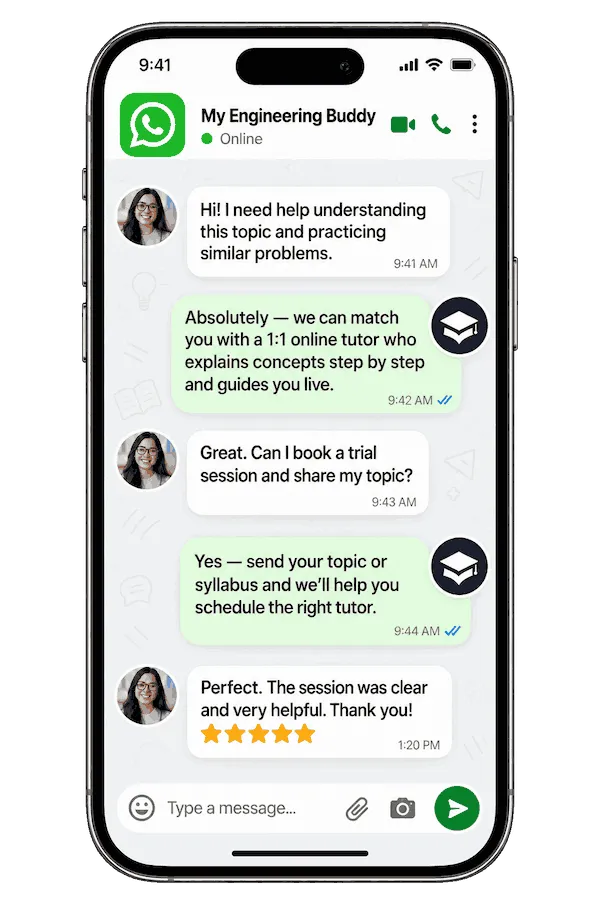
WhatsApp MEB for a quick quote — average response time under 1 minute.
52,000+ students across the US, UK, Canada, Australia, and the Gulf have used MEB since 2008 — including students in Mathematics subjects like analytic combinatorics, combinatorics, and complex analysis.
Source: My Engineering Buddy, 2008–2025.
Who This Analytic Combinatorics Tutoring Is For
Analytic combinatorics is taken seriously at institutions like MIT, Princeton, ETH Zurich, Cambridge, and Carnegie Mellon — usually as an upper-division or graduate elective. The students who reach out to MEB are not beginners to mathematics. They are people who got through real analysis and discrete math but then found the symbolic method or singularity analysis stopped making sense without guided worked examples.
- Undergraduate students in advanced discrete mathematics or combinatorics modules who need worked examples on generating functions
- Graduate students working through Flajolet and Sedgewick whose proofs stall at the transfer theorem stage
- PhD students using analytic combinatorics in algorithm analysis or theoretical computer science research
- Students 4–6 weeks from a final exam with significant gaps in asymptotic methods still to close
- Students retaking after a failed first attempt who need a structured re-entry point, not just more lecture notes
- Parents of early undergraduate students watching a child’s confidence drop alongside their grades in proof-heavy mathematics courses
- Faculty preparing course materials or graduate students seeking homework guidance before submission
You do not need to be at MIT to benefit. You need to be stuck on a specific topic and willing to work through it live. The $1 trial is a low-risk way to find out if MEB’s approach fits.
1:1 Tutoring vs Self-Study vs AI vs YouTube vs Online Courses
Self-study: works if you can reconstruct proofs independently, but analytic combinatorics has almost no margin for passive reading. AI tools: can sketch a generating function derivation but cannot diagnose where your reasoning breaks down or adapt mid-problem. YouTube: covers introductory generating functions well — stops cold when you hit Hayman’s method or Darboux’s theorem. Online courses: structured but fixed-pace, rarely reaching singularity analysis at the depth a graduate course demands. 1:1 tutoring with MEB: a tutor works through your exact problem set, corrects errors in the moment, and calibrates the pace to where your understanding actually is in analytic combinatorics specifically.
Outcomes: What You’ll Be Able To Do in Analytic Combinatorics
After structured 1:1 sessions, students move from confusion at the symbolic method to being able to apply it confidently. You will solve coefficient extraction problems using the transfer theorem without guessing at convergence conditions. You will analyze the asymptotic growth of combinatorial classes — binary trees, words, permutations with forbidden patterns — using saddle-point and Laplace methods with correct error bounds. You will explain the connection between poles and singularities of generating functions and the exponential growth of their coefficients. You will write rigorous proofs of asymptotic formulae, not just quote results. You will apply complex analysis techniques to combinatorial enumeration problems in a way that holds up under examination or peer review.
Based on feedback from 40,000+ sessions collected by MEB from 2022 to 2025, 58% of students improved by one full grade after approximately 20 hours of 1:1 tutoring in subjects like analytic combinatorics. A further 23% achieved at least a half-grade improvement.
Source: MEB session feedback data, 2022–2025.
At MEB, we’ve found that students who struggle with analytic combinatorics usually do not have a gap in algebra or calculus — they have a gap in the translation layer between combinatorial structure and analytic function. Once a tutor identifies that exact point, progress tends to be quick.
What We Cover in Analytic Combinatorics (Syllabus / Topics)

Track 1: The Symbolic Method and Generating Functions
- Ordinary generating functions (OGFs): definition, convergence, formal power series
- Exponential generating functions (EGFs) and labelled structures
- The symbolic method: unlabelled and labelled combinatorial classes
- Sequence, set, cycle, and multiset constructions
- Admissibility and grammar-based specification of combinatorial structures
- Coefficient extraction: partial fractions, algebraic functions, D-finite sequences
- Applications to trees, words, permutations, and lattice paths
Core text: Flajolet & Sedgewick, Analytic Combinatorics (Cambridge University Press, 2009) — Chapters I–IV. Also used: Stanley, Enumerative Combinatorics Vol. 1 & 2.
Track 2: Complex Analysis Tools for Asymptotic Enumeration
- Singularity analysis: poles, algebraic singularities, logarithmic singularities
- Transfer lemmas and the singularity analysis schema
- Meromorphic asymptotics: dominant pole method
- Darboux’s method and algebraic singularity expansion
- Saddle-point method: steep descent, Hayman-admissibility
- Laplace method for real integrals and its complex extension
- Large deviation estimates for combinatorial distributions
Core text: Flajolet & Sedgewick, Analytic Combinatorics — Chapters V–VIII. Supplemented by Pemantle & Wilson, Analytic Combinatorics in Several Variables (Cambridge, 2013).
Track 3: Probability, Parameters, and Limit Laws
- Bivariate generating functions and parameter marking
- Mean and variance of combinatorial parameters via GFs
- Gaussian limit laws: quasi-powers theorem
- Poisson and compound Poisson limit laws in combinatorics
- Random combinatorial structures: profile polynomials, typical shapes of random trees
- Connections to probability theory and discrete probability models
Core text: Flajolet & Sedgewick — Chapter IX. Also: Pitman, Combinatorial Stochastic Processes (Springer, 2006).
What a Typical Analytic Combinatorics Session Looks Like
The tutor opens by checking the previous session’s topic — say, the singularity analysis of a context-free grammar’s generating function — and asking you to reconstruct one step cold. Then you move to the current problem: often a coefficient extraction question where the student has correctly set up the OGF but lost the thread at the Cauchy integral or made an error in the dominant singularity identification. The tutor writes the derivation on screen using a digital pen-pad, step by step, pausing at each decision point to ask why that step follows. You then replicate the argument on your own, explaining reasoning aloud. Errors — usually at the transfer lemma application or the big-O remainder bound — get corrected immediately with the exact line flagged. The session closes with a specific practice problem: extract the asymptotic coefficient of a named generating function, show all error terms, and bring the working next session.
How MEB Tutors Help You with Analytic Combinatorics (The Learning Loop)
Diagnose: In the first session, the tutor identifies exactly where your understanding breaks — whether that is the formal definition of a combinatorial class, the distinction between OGF and EGF, or the analytic continuation step that makes singularity analysis work. Most students have a specific fault line, not a wholesale gap.
Explain: The tutor works live problems on a digital pen-pad via Google Meet — not pre-written solutions, but derivations built in front of you with commentary at each step. The symbolic method, transfer theorems, and saddle-point calculations are walked through at the pace your course demands.
Practice: You attempt problems with the tutor present. In analytic combinatorics, this matters more than in most subjects — the errors are subtle and easy to miss when working alone. Get combinatorics help with problems drawn from your exact problem sets or past exams.
Feedback: The tutor marks exactly where reasoning breaks down — not just that an answer is wrong, but which step introduced the error and why it costs marks. This is how you stop repeating the same mistake in coefficient extraction or asymptotic estimation.
Plan: After each session, the tutor sets the next topic and a concrete task. Progress through the symbolic method, complex analysis tools, and limit laws is sequenced to match your course timeline and exam date.
Sessions run on Google Meet. The tutor uses a digital pen-pad or iPad with Apple Pencil. Before your first session, share your course syllabus or problem sheet and your most recent assignment attempt. Start with the $1 trial — 30 minutes of live tutoring that also functions as your first diagnostic. Whether you need a quick catch-up before an end-of-semester exam, structured revision over 4–8 weeks, or ongoing weekly support through a research project, the tutor maps the plan after the first session.
Students consistently tell us that analytic combinatorics feels abstract until they see it applied to something they care about — like counting binary search tree shapes or analysing algorithm complexity. That first concrete connection is what the diagnostic session is designed to find.
Tutor Match Criteria (How We Pick Your Tutor)
Not every strong mathematician is equipped to teach analytic combinatorics. MEB matches on four criteria.
Subject depth: The tutor must have graduate-level exposure to the symbolic method and singularity analysis — not just general real analysis or undergraduate combinatorics. We verify this during screening.
Tools: Every tutor uses Google Meet with a digital pen-pad or iPad and Apple Pencil. Derivations are visible in real time — no typing mathematics into a chat box.
Time zone: Matched to your region — US, UK, Gulf, Canada, or Australia — so scheduling does not require compromise on session quality.
Goals: Whether you need exam-grade improvement, conceptual depth for a dissertation, or help with a specific problem set, the tutor is briefed on your target before the first session.
Unlike platforms where you fill out a form and wait, MEB responds in under a minute, 24/7. Tutor match takes under an hour. The $1 trial means you test before you commit. Everything runs over WhatsApp — no logins, no intake forms.
Pricing Guide
Fees start at $20/hr for standard undergraduate analytic combinatorics. Graduate-level work — particularly research support involving several complex variables or probabilistic combinatorics — runs $40–$100/hr depending on tutor depth and timeline urgency. Rate factors include topic complexity, how far into the Flajolet–Sedgewick programme your course sits, and tutor availability.
Availability shrinks during end-of-semester crunch periods at US and European universities. If your exam is inside four weeks, book now.
For students targeting research programmes at places like Cambridge, ETH Zurich, or MIT, tutors with active research backgrounds in analytic number theory or theoretical computer science are available at higher rates — share your specific goal and MEB will match the tier to your ambition.
Start with the $1 trial — 30 minutes, no registration, no commitment. WhatsApp MEB for a quick quote.
Analytic combinatorics sits at the intersection of formal power series, complex function theory, and discrete probability — a combination that defeats students who have mastered each field individually but never seen them applied together under exam pressure.
Source: MEB tutor observation, compiled from session notes 2022–2025.
A common pattern our tutors observe is this: the student can follow the textbook proof fine but freezes on a new problem because they do not know which singularity type to expect first. That pattern is fixable — usually in two or three focused sessions.
FAQ
Is analytic combinatorics hard?
Yes — honestly. It demands fluency in both formal combinatorial reasoning and complex analysis simultaneously. Most students find the symbolic method accessible but then struggle when asymptotic analysis requires contour integration and saddle-point estimates. Structured 1:1 sessions fix this faster than self-study alone.
How many sessions will I need?
Most students working through a single gap — say, singularity analysis or the quasi-powers theorem — need 4–8 sessions. Full-course support from symbolic method to limit laws typically runs 15–25 sessions over a semester. The diagnostic session sets the right number for your specific situation.
Can you help with homework and assignments?
MEB tutoring is guided learning — you understand the work, then submit it yourself. The tutor explains methods and works through similar examples so you can complete your own problem sets correctly. See our Academic Integrity policy and Why MEB page for full details on what we help with and what we don’t.
Will the tutor match my exact syllabus or exam board?
Yes. Analytic combinatorics is taught differently at different institutions — some follow Flajolet–Sedgewick closely, others emphasise probabilistic combinatorics or algorithmic applications. Share your syllabus and course materials before the first session and the tutor aligns to your exact programme.
What happens in the first session?
The tutor runs a diagnostic — asking you to work through a problem from your recent assignments or a standard exercise from your course. This identifies your strongest and weakest areas. The rest of the session addresses the most urgent gap, and the tutor sets a plan for subsequent sessions.
Is online tutoring as effective as in-person for a subject this technical?
For proof-based mathematics, yes — provided the tutor uses a digital pen-pad. Seeing derivations written step-by-step on screen is equivalent to a whiteboard session and often clearer, since you can slow down and revisit the recording. All MEB sessions use this setup.
What is the difference between analytic combinatorics and enumerative combinatorics?
Enumerative combinatorics counts structures using bijections, recurrences, and generating functions algebraically. Analytic combinatorics goes further — it uses complex function theory to extract precise asymptotic formulae for those counts. Flajolet and Sedgewick’s book is the standard reference for the analytic extension.
Do I need to know complex analysis before starting?
A working undergraduate-level knowledge of complex analysis — Cauchy’s theorem, residues, analytic continuation — is strongly recommended before the singularity analysis track. If your complex analysis is shaky, MEB tutors can run a short bridge module on mathematical analysis before the combinatorics work begins.
Can I get analytic combinatorics help at midnight or on weekends?
Yes. MEB operates 24/7 across time zones. If you are in the US or Gulf and need a session on a Sunday night before a Monday submission, WhatsApp MEB and you will be matched — typically within the hour. Late-night and weekend availability is one reason students in multiple regions rely on MEB.
What if I don’t like my assigned tutor?
Tell MEB via WhatsApp and a replacement is arranged, usually within 24 hours. The $1 trial exists precisely so you can assess fit before committing to a longer block of sessions. No pressure, no lengthy process — just message and it’s handled.
How does MEB handle Flajolet–Sedgewick specifically — do tutors actually know the book?
Tutors matched for analytic combinatorics are vetted for familiarity with the Flajolet–Sedgewick framework — symbolic method, singularity analysis schema, saddle-point — not just general combinatorics. If your course uses a different text, share it upfront and the tutor adjusts. The International Mathematical Union recognised the field’s depth when awarding the Fields Medal to researchers in adjacent areas; MEB tutors work at the level the subject demands.
How do I get started?
Three steps: WhatsApp MEB, share your course level and current topic, get matched with a tutor — usually within the hour. Your first session is the $1 trial: 30 minutes of live 1:1 tutoring or one homework question explained in full. No registration required.
Trust & Quality at My Engineering Buddy
Every MEB tutor goes through subject-specific screening before being assigned to a student. For analytic combinatorics, that means verifying graduate-level mathematics background, assessing ability to teach the symbolic method and complex-analytic tools at the depth a university course demands, and reviewing a live demo session before approval. Tutor performance is monitored through ongoing session feedback. Rated 4.8/5 across 40,000+ verified reviews on Google. MEB has been matching students with tutors in advanced mathematics since 2008 — 52,000+ students served across 18 years.
MEB tutoring is guided learning — you understand the work, then submit it yourself. For full details on what we help with and what we don’t, read our Academic Integrity policy and Why MEB.
MEB serves students in the US, UK, Canada, Australia, Gulf, and Europe across 2,800+ subjects. In Mathematics, MEB covers analytic combinatorics alongside graph theory tutoring, number theory help, computational complexity tutoring, and the full range of advanced pure and applied mathematics. Every subject is staffed by tutors who know it specifically — not generalists covering everything from calculus to coding. Learn more about the approach at MEB’s tutoring methodology.
MEB has covered advanced mathematics subjects — from analytic combinatorics and measure theory to algebraic topology and functional analysis — since 2008. The tutors are not generalists. They are specialists who sat these exams.
Source: My Engineering Buddy, 2008–2025.
Try your first session for $1 — 30 minutes of live 1:1 tutoring or one homework question explained in full. No registration. No commitment.
WhatsApp MEB now
and get matched within the hour.
Explore Related Subjects
Students studying analytic combinatorics often also need support in:
- Algebraic Topology
- Measure Theory
- Functional Analysis
- Abstract Algebra
- Dynamical Systems
- Topology
- Fourier Analysis
- Permutations and Combinations
Next Steps
Before your first session, have ready: your course syllabus or problem sheet, a recent assignment or past paper question you struggled with, and your exam or submission deadline. The tutor handles the rest.
- Share your exam board or university course code, the specific topic causing problems, and your current timeline
- Share your time zone and preferred session times
- MEB matches you with a verified analytic combinatorics tutor — usually within 24 hours, often within the hour
The first session opens with a diagnostic so every minute is used on what matters. Visit www.myengineeringbuddy.com for more on how MEB works.
WhatsApp to get started or email [email protected].
Reviewed by Subject Expert
This page has been carefully reviewed and validated by our subject expert to ensure accuracy and relevance.




