




~1 min
Average Reply Time
~1 hour
To Be Matched With A Tutor
30 Min Trial
75% Find Their Tutor On The 1st Trial
$20-35+/hr
Premium Yet Affordable Learning
Most Scala students hit a wall at the same point: they understand Java, but Scala’s functional idioms — case classes, pattern matching, implicits — stop making sense fast.
Scala Programming Tutor Online
Scala is a statically typed, JVM-based programming language that combines object-oriented and functional programming paradigms, used widely in data engineering, distributed systems, and back-end development with frameworks such as Apache Spark and Akka.
If you’ve searched for a Scala Programming tutor near me, MEB connects you with a verified 1:1 online computer programming tutor who knows the exact topics tripping you up — whether that’s monads, for-comprehensions, or Spark RDD transformations. MEB has served 52,000+ students since 2008, covering 2,800+ advanced subjects. Your tutor is matched to your course syllabus, your level, and your deadline.
- 1:1 online sessions tailored to your course or university module
- Expert-verified tutors with hands-on Scala and JVM experience
- Flexible time zones — US, UK, Canada, Australia, Gulf
- Structured learning plan built after a diagnostic session
- Ethical homework and assignment guidance — you understand before you submit
52,000+ students across the US, UK, Canada, Australia, and the Gulf have used MEB since 2008 — including students in Computer Programming subjects like Scala, Kotlin, and Haskell.
Source: My Engineering Buddy, 2008–2025.
How Much Does a Scala Programming Tutor Cost?
Most Scala Programming sessions run $20–$40/hr depending on level and topic complexity. Graduate-level work, Spark optimisation, or distributed systems depth can run higher. New students can start with the $1 trial before committing to a package.
| Level / Need | Typical Rate | What’s Included |
|---|---|---|
| Standard (undergraduate modules) | $20–$35/hr | 1:1 sessions, homework guidance |
| Advanced / Specialist (Spark, Akka, FP) | $35–$100/hr | Expert tutor, niche depth |
| $1 Trial | $1 flat | 30 min live session or 1 homework question |
Tutor availability tightens significantly during semester finals and project deadlines — book early if you have a hard date.
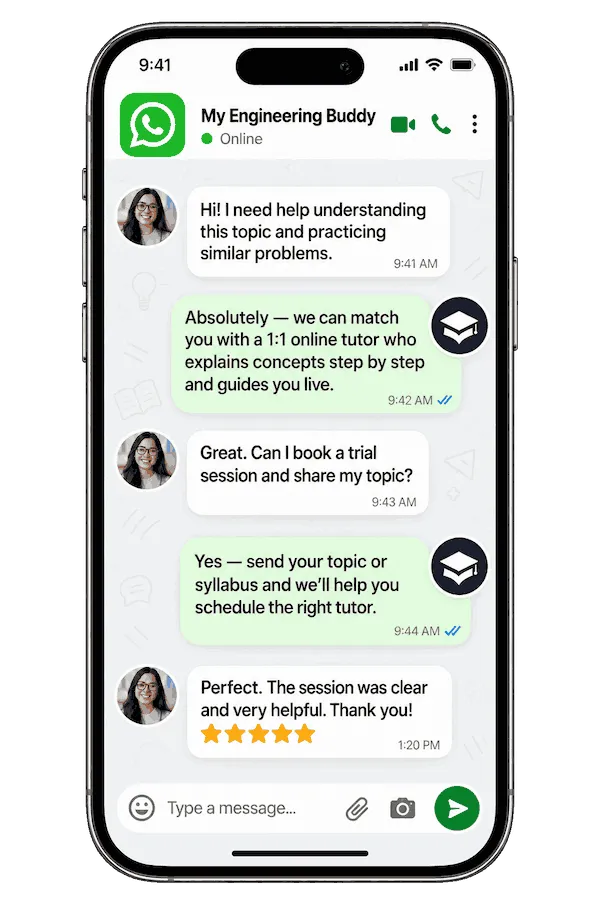
WhatsApp MEB for a quick quote — average response time under 1 minute.
Who This Scala Programming Tutoring Is For
Scala attracts students from computer science, data engineering, and software development programmes. But it’s a language with a steep entry curve — students who know Java or Python often underestimate how different Scala’s type system and functional approach really are.
- Undergraduate CS students taking a functional programming or distributed systems module
- Graduate students working with Apache Spark for data pipelines or ML workflows
- Students retaking after a failed first attempt at a Scala-based coursework submission
- Software engineers in industry learning Scala for a new role or project
- Students at universities including MIT, Carnegie Mellon, ETH Zurich, University of Edinburgh, and University of Waterloo where Scala appears in core CS curricula
- Anyone stuck on implicits, type classes, or Akka actor systems with a deadline approaching
If you’re working through a Scala assignment and the error messages make less sense than the problem itself, that’s exactly when a 1:1 Scala Programming tutor makes the difference.
1:1 Tutoring vs Self-Study vs AI vs YouTube vs Online Courses
Self-study works if you’re disciplined, but Scala’s compiler errors are notoriously opaque without a guide. AI tools explain syntax quickly but can’t watch you misread a type signature in real time. YouTube covers concepts well until you hit a specific bug in your own codebase. Online courses move at a fixed pace, and Scala courses often skip the hard parts. 1:1 tutoring with MEB is live, calibrated to your exact module and compiler version, and corrects errors in the moment — before they become habits in your code.
Outcomes: What You’ll Be Able To Do in Scala Programming
After structured 1:1 sessions, you’ll be able to write idiomatic Scala using case classes, sealed traits, and pattern matching without second-guessing the syntax. You’ll apply functional programming principles — map, flatMap, fold — across collections and understand why they matter for concurrent code. You’ll model real data problems using Scala’s type system and explain your design decisions clearly. You’ll work with Apache Spark RDDs and DataFrames, and present your code to peers or submit assignments with confidence rather than hoping the compiler agrees with you.
Based on feedback from 40,000+ sessions collected by MEB from 2022 to 2025, 58% of students improved by one full grade after approximately 20 hours of 1:1 tutoring in subjects like Scala Programming. A further 23% achieved at least a half-grade improvement.
Source: MEB session feedback data, 2022–2025.
Students consistently tell us that the moment Scala clicks — usually when pattern matching, case classes, and Option types start working together — the rest of the language follows quickly. Getting to that moment faster is what the first few sessions are designed to do.
What We Cover in Scala Programming (Syllabus / Topics)

Track 1: Scala Fundamentals and Object-Oriented Programming
- Scala syntax, vals, vars, and type inference
- Classes, objects, traits, and inheritance
- Case classes and companion objects
- Pattern matching and sealed trait hierarchies
- Collections: List, Map, Set, Vector, and their methods
- Option, Either, and Try for error handling
Core texts: Programming in Scala by Odersky, Spoon, and Venners; Scala for the Impatient by Horstmann.
Track 2: Functional Programming in Scala
- Higher-order functions, map, flatMap, filter, fold
- For-comprehensions and their desugaring
- Immutability and referential transparency
- Type classes and implicits (implicit parameters, implicit conversions)
- Monads, functors, and applicatives in practice
- Lazy evaluation and streams
Core texts: Functional Programming in Scala by Chiusano and Bjarnason; Scala with Cats by Gurnell and Warski.
Track 3: Apache Spark and Distributed Systems with Scala
- Spark architecture: drivers, executors, DAGs
- RDDs: creation, transformations, actions
- DataFrames and the Spark SQL API
- Datasets and typed transformations
- Streaming with Spark Structured Streaming
- Performance tuning: partitioning, caching, shuffles
- Writing and submitting Spark jobs in a cluster environment
Core texts: Learning Spark by Damji et al.; Spark: The Definitive Guide by Chambers and Zaharia.
At MEB, we’ve found that students who struggle with Spark almost always have an unresolved gap in functional Scala first. The tutor diagnoses this in session one and doesn’t move to Spark until the functional foundation is solid. That sequencing saves weeks.
Platforms, Tools & Textbooks We Support
Scala development spans a range of IDEs and build tools. MEB tutors are familiar with the full standard toolchain and can guide you through setup, configuration, and debugging in whichever environment your course or employer uses.
- IntelliJ IDEA with Scala plugin
- VS Code with Metals language server
- sbt (Scala Build Tool)
- Apache Spark (local mode and cluster)
- Databricks (notebook-based Spark environment)
- Akka (actor model and reactive systems)
- ScalaTest and MUnit for testing
- REPL-based learning via Ammonite
What a Typical Scala Programming Session Looks Like
The tutor opens by checking the previous session’s topic — usually something like implicit resolution or for-comprehension desugaring — and asks you to walk through what you tried. Then you and the tutor work through your current problem live: for example, fixing a type mismatch in a flatMap chain or restructuring a Spark job that’s hitting a shuffle bottleneck. The tutor uses a digital pen-pad to annotate code and diagrams directly on screen. You replicate the fix in your own environment and explain the reasoning back. The session closes with a specific task — write three pattern-matching functions or profile a Spark job’s execution plan — and the next topic is noted so the following session starts with purpose. Get Java tutoring if you need to strengthen your JVM foundations before tackling Scala at depth.
How MEB Tutors Help You with Scala Programming (The Learning Loop)
Diagnose: In the first session, the tutor identifies exactly where your understanding breaks down — whether that’s the type system, functional idioms, or a specific framework like Spark or Akka. They don’t guess; they ask you to work through a problem live.
Explain: The tutor works through the concept on screen using a digital pen-pad or iPad with Apple Pencil — showing not just what the correct code looks like, but why the compiler or runtime behaves the way it does.
Practice: You attempt the problem yourself with the tutor present. This is where most online courses fail — they can’t watch you make mistakes in real time.
Feedback: The tutor gives step-by-step correction, pointing out exactly where your reasoning diverged and how to fix it. Not just “this is wrong” — but why it cost you marks or broke the build.
Plan: Each session ends with the next topic, a specific task, and a check-in point. The tutor tracks your progress across sessions and adjusts the sequence if you need more time on a concept.
Sessions run over Google Meet. The tutor uses a digital pen-pad or iPad with Apple Pencil to annotate code directly. Before your first session, share your course outline or assignment brief and any compiler errors you can’t resolve. The first session covers your diagnostic and at least one full worked problem. Start with the $1 trial — 30 minutes of live tutoring that also serves as your first diagnostic.
Try your first session for $1 — 30 minutes of live 1:1 tutoring or one homework question explained in full. No registration. No commitment. WhatsApp MEB now and get matched within the hour.
Tutor Match Criteria (How We Pick Your Tutor)
Not every programmer who knows Scala can teach it. MEB matches on four criteria.
Subject depth: Tutors are matched to your specific level — undergraduate functional programming, graduate distributed systems, or industry Spark work. A tutor who only knows Spark basics won’t be assigned to someone debugging Akka streams.
Tools: All Scala tutors work over Google Meet with a digital pen-pad or iPad and Apple Pencil for live annotation.
Time zone: Matched to your region — US, UK, Canada, Australia, or Gulf — so you’re not booking 2am sessions.
Goals: Whether you need to pass a module, complete a Spark project, or build conceptual depth in type theory, the tutor is selected to match that specific aim. Explore Python tutoring or Rust tutoring if your course covers multiple languages alongside Scala.
Unlike platforms where you fill out a form and wait, MEB responds in under a minute, 24/7. Tutor match takes under an hour. The $1 trial means you test before you commit. Everything runs over WhatsApp — no logins, no intake forms.
Study Plans (Pick One That Matches Your Goal)
Most Scala students fall into one of three tracks. The tutor builds the specific session sequence after your diagnostic — these are starting frameworks, not rigid schedules. A catch-up plan (1–3 weeks) closes the gap before a coursework deadline or exam. An exam prep plan (4–8 weeks) builds systematic coverage of all assessed topics with past-paper practice. Weekly ongoing support keeps you aligned with your semester’s lecture schedule, so you never fall behind by more than a session.
Pricing Guide
Scala Programming tutoring runs $20–$40/hr for most undergraduate and taught postgraduate modules. Graduate research support, advanced Spark optimisation, and Akka/reactive systems work can run up to $100/hr depending on tutor expertise and timeline pressure.
Rate factors: academic level, topic complexity, how much advance notice you give, and tutor availability. Availability drops sharply during finals weeks at US and UK universities — book before that window closes.
For students targeting roles at firms like Jane Street, Two Sigma, or FAANG-tier engineering teams where Scala and functional programming are core requirements, tutors with professional software engineering or data engineering backgrounds are available at higher rates — share your specific goal and MEB will match the tier to your ambition.
Start with the $1 trial — 30 minutes, no registration, no commitment. WhatsApp MEB for a quick quote.
FAQ
Is Scala Programming hard?
Scala has a steeper learning curve than most JVM languages because it merges object-oriented and functional paradigms in a single type system. Students fluent in Java or Python still need time to get comfortable with implicits and type classes. Hard — but teachable with the right guidance.
How many sessions are needed?
Most students close a specific gap — say, pattern matching or Spark job tuning — in 4–6 sessions. Building solid functional Scala from scratch typically takes 12–20 sessions. Your tutor will estimate after the first diagnostic based on your starting point and deadline.
Can you help with Scala homework and assignments?
MEB tutoring is guided learning — you understand the work, then submit it yourself. See our Academic Integrity policy and Why MEB page for full details on what we help with and what we don’t. Tutors explain concepts, work through examples, and help you debug your thinking — not your final submission.
Will the tutor match my exact syllabus or exam board?
Yes. Share your course outline, university module code, or assignment brief when you contact MEB. Tutors are matched to your specific module — whether it’s a functional programming course at a UK university or a data engineering stream using Spark at a North American institution.
What happens in the first session?
The tutor runs a short diagnostic — asking you to work through a problem live — to locate exactly where your understanding breaks down. Then they cover at least one full topic or worked problem in the remaining time. You leave with a clear plan for the next session.
Is online Scala tutoring as effective as in-person?
For a code-heavy language like Scala, online is often better — the tutor shares your screen, annotates live, and can see your exact error output. There’s no commute cost and sessions are available 24/7. The digital pen-pad makes concept explanation as clear as a whiteboard.
Scala vs Kotlin — which should I learn first, and can MEB help with both?
If your goal is Android development, Kotlin is the natural starting point. If you’re heading into data engineering or distributed systems, Scala is more relevant. MEB covers both — get Kotlin tutoring or Scala tutoring depending on your course or career track. A tutor can advise after one session.
Can you help with Apache Spark assignments written in Scala?
Yes. Spark-specific help — RDD transformations, DataFrame APIs, job submission, performance tuning, and Structured Streaming — is one of the most common Scala tutoring requests at MEB. Tutors are matched by Spark experience level, not just general Scala knowledge.
Do you offer help with Scala for functional programming theory courses?
Yes. Courses that go deep into type classes, monads, free monads, and category theory concepts applied in Scala are well within MEB’s coverage. Tutors with academic functional programming backgrounds — not just industry Scala experience — are available for this level of work.
Can I get Scala Programming help at midnight?
Yes. MEB operates 24/7 across time zones. Whether you’re in California finishing an assignment at midnight or in Dubai starting your morning session, tutors are available. WhatsApp MEB and you’ll typically be matched within the hour, any day of the week.
How do I get started?
Three steps: WhatsApp MEB with your topic and deadline, get matched with a verified Scala tutor within the hour, then start the $1 trial — 30 minutes of live tutoring or one homework question explained in full. No registration, no commitment needed to begin.
Trust & Quality at My Engineering Buddy
Every MEB tutor goes through subject-specific vetting: a live demo session, review of their academic and professional background, and ongoing performance monitoring based on student feedback. Tutors covering advanced Scala topics — Spark, Akka, type theory — are verified for that specific depth, not just general programming competence. Rated 4.8/5 across 40,000+ verified reviews on Google. MEB has been operating since 2008, long enough to know which tutors explain implicits well and which ones skip the hard parts.
MEB tutoring is guided learning — you understand the work, then submit it yourself. For full details on what we help with and what we don’t, read our Academic Integrity policy and Why MEB.
MEB serves students across the US, UK, Canada, Australia, the Gulf, and Europe in 2,800+ subjects since 2008. Computer Programming — including Scala, Go tutoring, and F# tutoring — is one of MEB’s strongest subject areas. The platform’s tutoring methodology is documented at MEB’s tutoring methodology page for students who want to understand the diagnostic-first approach before booking.
MEB has matched students with verified tutors across 2,800+ subjects for over 17 years. In Computer Programming alone — covering languages from Scala to C++ tutoring — the tutor pool spans industry engineers, PhD researchers, and university lecturers.
Source: My Engineering Buddy, 2008–2025.
Our experience across thousands of sessions shows that the biggest predictor of progress in Scala isn’t prior programming experience — it’s whether a student gets corrective feedback on their first real attempt at functional code. That’s what session one is designed to provide.
Explore Related Subjects
Students studying Scala Programming often also need support in:
Next Steps
When you contact MEB, share your exam board or course module, the specific Scala topics giving you trouble, your current deadline, and your time zone. MEB matches you with a verified tutor — usually within 24 hours, often within the hour.
Before your first session, have ready:
- Your course outline or assignment brief
- A recent piece of code you struggled to debug, or a homework question you couldn’t complete
- Your submission or exam date
The tutor handles the rest. Visit www.myengineeringbuddy.com for more on how MEB works.
WhatsApp to get started or email [email protected].
Reviewed by Subject Expert
This page has been carefully reviewed and validated by our subject expert to ensure accuracy and relevance.




