Hire Verified & Experienced
Signals and Systems Tutors
4.8/5 40K+ session ratings collected on the MEB platform



Hire The Best Signals and Systems Tutor
Top Tutors, Top Grades. Without The Stress!
52,000+ Happy Students From Various Universities






How Much For Private 1:1 Tutoring & Hw Help?
Private 1:1 Tutoring and HW help Cost $20 – 35 per hour* on average.
Fourier transforms, convolution, Laplace analysis — and you’re three weeks from the final with two topics still not clicking.
Signals and Systems Tutor Online
Signals and Systems is a core electrical engineering course covering continuous and discrete-time signal analysis, Fourier and Laplace transforms, convolution, and linear time-invariant systems — equipping students to model and analyze real-world communication and control systems.
If you’ve searched for a Signals and Systems tutor near me, you already know the subject doesn’t respond well to passive reading. MEB connects you with a verified electrical engineering specialist who works through your exact syllabus — whether that’s an undergraduate ECE course, a graduate-level treatment, or an accelerated summer session. One session spent on the right problem set moves you further than a week of re-reading lecture notes. Get a digital signal processing tutor or Signals and Systems expert matched to your course within the hour.
- 1:1 online sessions tailored to your university course and syllabus
- Expert-verified tutors with electrical engineering and signal processing backgrounds
- Flexible scheduling across US, UK, Canada, Australia, and Gulf time zones
- Structured learning plan built after a diagnostic session in your first meeting
- Ethical homework and assignment guidance — you understand the work, then submit it yourself
52,000+ students across the US, UK, Canada, Australia, and the Gulf have used MEB since 2008 — including students in Electrical Engineering subjects like Signals and Systems, Control Systems, and Communication Systems.
Source: My Engineering Buddy, 2008–2025.
How Much Does a Signals and Systems Tutor Cost?
Most Signals and Systems sessions run $20–$40/hr depending on level and topic complexity. Graduate-level or highly specialised work can reach up to $100/hr. Not sure if it’s worth it? The $1 trial lets you test a live session before spending anything.
| Level / Need | Typical Rate | What’s Included |
|---|---|---|
| Undergraduate (most courses) | $20–$35/hr | 1:1 sessions, homework guidance |
| Advanced / Graduate Level | $35–$100/hr | Expert tutor, research-level depth |
| $1 Trial | $1 flat | 30 min live session or 1 homework question explained |
Tutor availability drops fast in the two weeks before finals. Book early if your exam is coming up.
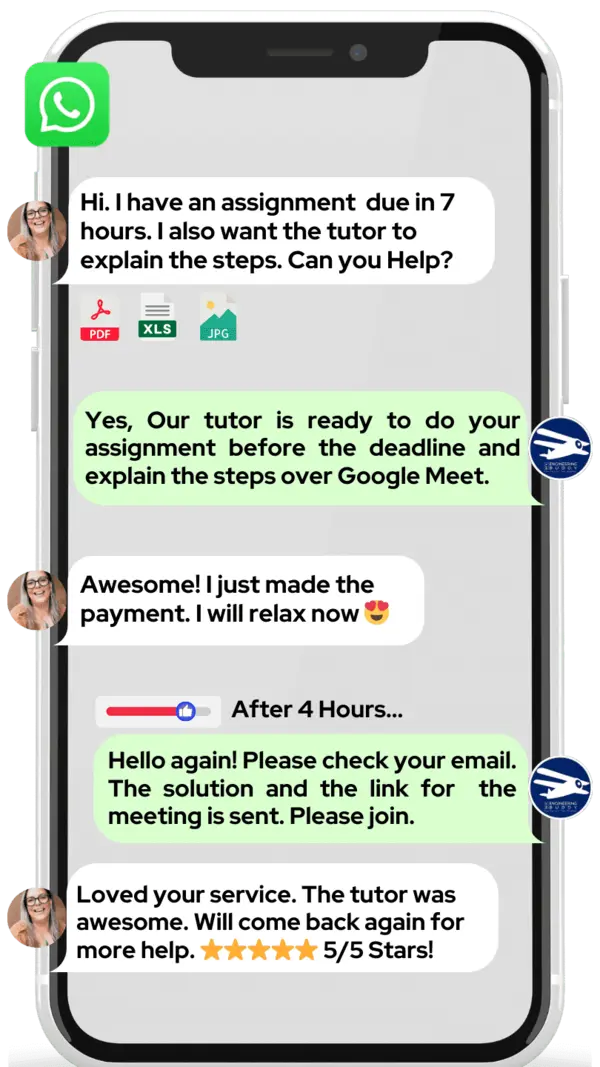
WhatsApp MEB for a quick quote — average response time under 1 minute.
Who This Signals and Systems Tutoring Is For
Signals and Systems sits in the middle of most ECE and EE degree programmes — it’s the course where abstract maths meets real engineering behaviour. Students who struggled with differential equations or complex numbers often find it punishing. Those who thought they understood it often discover the gaps when practice problems arrive.
- Undergraduate ECE or EE students working through a first or second exposure to the course
- Students retaking after a failed first attempt who need to rebuild from the foundation up
- Graduate students who need to refresh the material before an advanced DSP or communications course
- Students with a conditional progression requirement depending on this module’s grade
- Students 4–6 weeks from the final with significant topic gaps — particularly in Fourier series, Z-transforms, or stability analysis
- Parents watching a student’s confidence fall as the semester accelerates
Students from universities including MIT, Georgia Tech, University of Michigan, Imperial College London, University of Toronto, UNSW Sydney, and TU Delft have worked with MEB tutors on this exact subject.
Try the $1 trial and use the first 30 minutes as a proper diagnostic — your tutor will tell you exactly where the gaps are and what to work on first.
1:1 Tutoring vs Self-Study vs AI vs YouTube vs Online Courses
Self-study works if you’re disciplined — but Signals and Systems has enough conceptual density that most students hit a wall without feedback. AI tools give fast answers, but they can’t watch you attempt a convolution integral and spot the exact moment your reasoning breaks. YouTube handles overviews well; it stops short when you’re stuck on a specific Z-transform inversion or an ROC boundary problem. Online courses move at a fixed pace regardless of whether you’ve genuinely understood the sampling theorem. With 1:1 tutoring through MEB, the tutor is live, calibrated to your specific course and exam format, and corrects the error in real time — not after you’ve already written the wrong approach across three pages of working.
Outcomes: What You’ll Be Able To Do in Signals and Systems
After working with an MEB Signals and Systems tutor, expect to solve convolution integrals for both continuous and discrete-time systems without losing track of limits. You’ll analyze LTI system behaviour using Fourier series and the DTFT, and apply the Laplace and Z-transforms to find system transfer functions from first principles. Model frequency response and explain the physical meaning of poles and zeros on the s-plane or z-plane. Write and interpret difference equations for digital filters. Present stability arguments using the Routh-Hurwitz criterion or BIBO conditions clearly and correctly. These are the outcomes that show up in problem sets, midterms, and finals — not vague concepts, but specific things you can actually do on paper.
Based on feedback from 40,000+ sessions collected by MEB from 2022 to 2025, 58% of students improved by one full grade after approximately 20 hours of 1:1 tutoring in subjects like Signals and Systems. A further 23% achieved at least a half-grade improvement.
Source: MEB session feedback data, 2022–2025.
Students consistently tell us that Signals and Systems feels abstract until someone works a problem in front of them and forces them to explain each step back. That’s the moment it clicks — not the lecture, not the textbook, not the solved example. The live back-and-forth is what builds the understanding that holds under exam conditions.
Try your first session for $1 — 30 minutes of live 1:1 tutoring or one homework question explained in full. No registration. No commitment. WhatsApp MEB now and get matched within the hour.
What We Cover in Signals and Systems (Syllabus / Topics)

Track 1: Continuous-Time Signals and LTI Systems
- Signal classification: energy vs power signals, periodic vs aperiodic, even vs odd
- Impulse function, unit step, and ramp — definitions and properties
- Convolution integral — setup, limits, and graphical interpretation
- Differential equation representation of CT systems
- Laplace transform: definition, region of convergence, common pairs
- Transfer function derivation and pole-zero analysis on the s-plane
- BIBO stability conditions in the s-domain
- Frequency response: Bode plots and magnitude/phase interpretation
Standard texts for this track include Oppenheim & Willsky’s Signals and Systems (2nd ed.) and Haykin & Van Veen’s Signals and Systems — tutors work from whichever edition your course uses.
Track 2: Fourier Analysis
- Fourier series: trigonometric and exponential forms, Dirichlet conditions
- Fourier series coefficients — computation and symmetry properties
- Continuous-Time Fourier Transform (CTFT): definition and inverse
- CTFT properties: linearity, time-shifting, convolution, Parseval’s theorem
- Fourier transform of standard signals including rect, sinc, and impulse trains
- Sampling theorem: Nyquist rate, aliasing, and reconstruction
- Ideal vs practical filtering in the frequency domain
Lathi & Ding’s Linear Systems and Signals covers this track in detail; many courses at Georgia Tech and similar programmes use it alongside Oppenheim.
Track 3: Discrete-Time Signals and the Z-Transform
- Discrete-time signal representations: sequences, unit impulse, unit step
- Discrete-time convolution — sum setup and finite-length examples
- Difference equations and recursive system analysis
- Discrete-Time Fourier Transform (DTFT) and its properties
- Z-transform: definition, ROC, common pairs, and inverse Z-transform techniques
- Stability analysis in the z-domain: pole locations and unit circle
- DFT introduction and connection to FFT algorithms
- FIR vs IIR filter characteristics
Proakis & Manolakis’s Digital Signal Processing is the standard graduate-level text for the discrete-time track; Oppenheim & Schafer is the other common choice for courses bridging Signals and Systems into analog signal processing and DSP.
What a Typical Signals and Systems Session Looks Like
The tutor opens by checking the previous topic — often convolution or Laplace transform properties — asking the student to reproduce a key step from memory. If it’s there, they move on. If it’s not, two minutes of targeted review before continuing. The core of the session is problem-driven: the tutor works one complete example on the digital pen-pad — say, finding the Z-transform of a causal sequence, identifying the ROC, and checking stability — then hands the next problem to the student. The student attempts it on screen while the tutor watches the reasoning, not just the answer. Errors in sign handling or ROC boundary decisions get caught before they become habits. The session closes with a specific practice problem assigned, the next topic noted, and a checkpoint question the student has to be able to answer at the start of the following session.
How MEB Tutors Help You with Signals and Systems (The Learning Loop)
Diagnose: The first session is partly diagnostic. The tutor works through a short problem set covering the main topics and identifies exactly which concepts have gaps — not just “Fourier transforms” but specifically whether it’s the coefficient calculation, the symmetry properties, or the connection to the frequency domain that’s failing.
Explain: The tutor works problems live on a digital pen-pad — not slides, not a pre-recorded solution. You watch the reasoning build in real time, including the moments where a wrong path gets corrected. That’s different from a textbook worked example.
Practice: You attempt the next problem with the tutor watching. Not after the session. During it. That’s when the tutor can see whether you’ve actually understood or just followed along.
Feedback: Errors are corrected step by step. The tutor explains not just what went wrong but why a particular step matters — what marks are at stake if you miss it on the exam, and what the examiner is actually looking for in a stability argument or frequency response derivation.
Plan: Each session ends with a clear next step: which topic comes next, what to practice before the following session, and how that fits into the overall timeline to your exam or submission deadline.
Sessions run on Google Meet with a digital pen-pad or iPad and Apple Pencil. Before your first session, share your course syllabus or textbook, a recent assignment or past paper attempt, and your exam date. The first session handles the diagnostic and the first real topic — no time wasted on admin. Start with the $1 trial — 30 minutes of live tutoring that also serves as your first diagnostic.
At MEB, we’ve found that students who struggle most with Signals and Systems are almost always missing one foundational piece — usually complex exponentials or the intuition behind convolution. Once the tutor identifies that specific gap, the rest of the course starts to connect much faster than the student expected.
Tutor Match Criteria (How We Pick Your Tutor)
Match quality matters more in Signals and Systems than in most subjects — the wrong tutor works generic examples while yours uses a different notation convention entirely.
Subject depth: Tutors are matched by the specific level and track of your course — whether that’s an introductory ECE treatment, a maths-heavy graduate version, or a course emphasising discrete-time systems for embedded systems applications.
Tools: Every tutor uses Google Meet plus a digital pen-pad or iPad with Apple Pencil — essential for working transforms and signal diagrams in real time.
Time zone: Matched to your region — US, UK, Gulf, Canada, Australia. No waiting 12 hours for a reply.
Goals: Whether you need exam score recovery, conceptual depth on a specific transform, homework guidance through the semester, or research-level support for a graduate course — the match accounts for your actual goal, not a generic profile.
Unlike platforms where you fill out a form and wait, MEB responds in under a minute, 24/7. Tutor match takes under an hour. The $1 trial means you test before you commit. Everything runs over WhatsApp — no logins, no intake forms.
Study Plans (Pick One That Matches Your Goal)
After the diagnostic, your tutor builds a specific session sequence. Three common structures: a catch-up plan covering the highest-priority topics in 1–3 weeks for students with an imminent deadline; an exam prep plan running 4–8 weeks through the full syllabus with past-paper practice built in; or ongoing weekly support aligned to your semester schedule and assignment submissions. The tutor decides which fits after the first session — not before.
Pricing Guide
Signals and Systems tutoring starts at $20/hr for standard undergraduate courses. Graduate-level or research-adjacent work runs $35–$100/hr depending on tutor background and topic complexity. Rate factors include your course level, how much depth you need per session, your timeline, and tutor availability at your preferred hours.
For students targeting positions in signal processing, RF engineering, or graduate programmes at competitive universities, tutors with professional research and industry backgrounds are available at higher rates — share your specific goal and MEB will match the tier to your ambition.
Availability shrinks during the two to three weeks before semester finals. Book before that window closes.
Start with the $1 trial — 30 minutes, no registration, no commitment. WhatsApp MEB for a quick quote.
MEB has covered over 2,800 subjects since 2008, with tutors active across US, UK, Canadian, Australian, and Gulf university programmes — including the full range of electronics engineering and signal-related courses at undergraduate and graduate level.
Source: My Engineering Buddy, 2008–2025.
FAQ
Is Signals and Systems hard?
Yes — consistently one of the harder core ECE courses. The combination of continuous and discrete-time analysis, multiple transform methods, and abstract system concepts in one semester is a genuine load. Students who build the Fourier and Laplace intuition early tend to find the second half manageable. Those who don’t often hit a wall around the Z-transform.
How many sessions are needed?
Most students working through a specific topic gap — say, Z-transform inversion or stability analysis — need 3–5 sessions to gain solid footing. Full-semester support typically runs 1–2 sessions per week. Your tutor maps this after the first diagnostic.
Can you help with homework and assignments?
MEB tutoring is guided learning — you understand the work, then submit it yourself. The tutor works through the reasoning with you, not for you. See our Academic Integrity policy and Why MEB page for full details on what we help with and what we don’t.
Will the tutor match my exact syllabus or exam board?
Yes. Share your course code, textbook, and syllabus before the first session. Tutors are matched specifically — a course using Oppenheim gets a tutor familiar with that text and its notation. A course with heavy discrete-time emphasis gets matched accordingly.
What happens in the first session?
The first session is part diagnostic, part real work. The tutor runs a short problem check across the main topic areas to locate your actual gaps, then starts working on the highest-priority one immediately. You leave with a clear picture of what to fix and in what order.
Is online tutoring as effective as in-person?
For Signals and Systems specifically, yes — the digital pen-pad on Google Meet replicates whiteboard-style working better than most in-person setups. Students can review the session recording, zoom in on specific steps, and work from their own notes simultaneously. Many find it more efficient than sitting across a desk.
How do I get started?
WhatsApp MEB — share your course, your exam date, and your hardest current topic. MEB matches you with a verified tutor, usually within the hour. First session is the $1 trial: 30 minutes of live tutoring or one full homework question explained. No registration, no commitment.
Can I get Signals and Systems help at midnight?
Yes. MEB operates across time zones — US night is Gulf or Asian morning. WhatsApp responses come in under a minute around the clock. Tutors in your time zone are available for same-day or next-day sessions, including late-evening slots for students with full daytime schedules.
What if I don’t like my assigned tutor?
Say so on WhatsApp. MEB will rematch you — no paperwork, no waiting. The $1 trial exists precisely for this reason: you spend $1 to test the fit, not $40. If the first tutor isn’t right, MEB finds another one, typically within the same day.
Do Signals and Systems courses all cover the same content?
No. Some courses are continuous-time heavy with minimal discrete treatment; others go deep into DTFT and Z-transforms from week three. Graduate versions often assume familiarity with linear algebra and go further into state-space and system realisation. Share your syllabus and the tutor prepares accordingly — not for a generic version of the course.
What’s the difference between Signals and Systems and Digital Signal Processing?
Signals and Systems is the foundation — it establishes the mathematical tools (Fourier, Laplace, Z-transform) and system theory that DSP builds on. DSP focuses specifically on discrete-time processing, filter design, FFT algorithms, and implementation. Many students take Signals and Systems first, then analog communication or a dedicated DSP course. If you need help with digital communications alongside this subject, MEB covers both.
Can MEB help with MATLAB assignments in Signals and Systems?
Yes. Many Signals and Systems courses include MATLAB-based labs covering FFT computation, filter plotting, and convolution visualisation. MEB tutors with MATLAB experience can walk through the coding logic and the underlying signal theory together — so the code makes sense, not just runs.
Trust & Quality at My Engineering Buddy
Every MEB tutor goes through subject-specific vetting — not a generic background check. For Signals and Systems, that means confirming degree-level or higher qualification in electrical engineering or a directly related field, a live demo evaluation with a senior MEB reviewer, and ongoing session feedback monitoring. Rated 4.8/5 across 40,000+ verified reviews on Google.
MEB tutoring is guided learning — you understand the work, then submit it yourself. For full details on what we help with and what we don’t, read our Academic Integrity policy and Why MEB.
MEB has served 52,000+ students across the US, UK, Canada, Australia, the Gulf, and Europe since 2008 — covering 2,800+ subjects including the full Electrical Engineering curriculum: Signals and Systems, circuit analysis tutoring, electromagnetic field theory help, and network theory tutoring. Read more about how sessions are structured at MEB’s tutoring methodology page.
MEB tutors work across the full electrical engineering syllabus — from first-year circuit design help through to graduate-level wireless communication tutoring — with the same diagnostic-first approach used in every Signals and Systems session.
Source: My Engineering Buddy, 2008–2025.
Our experience across thousands of sessions shows that the students who progress fastest are the ones who come to the session with a specific problem they couldn’t solve — not a general request to “go over” a topic. The tutor can do far more with a stuck student than a passive one.
Explore Related Subjects
Students studying Signals and Systems often also need support in:
- Control Engineering
- Microwave Engineering
- Operational Amplifiers
- FPGA Design
- Semiconductor Devices
- Radar Systems
- Optical Communications
Next Steps
Getting started takes under two minutes. WhatsApp MEB with three things: your exam board or course code, the topic giving you the most trouble right now, and your exam or submission date. MEB matches you with a verified Signals and Systems tutor — usually within 24 hours, often within the hour.
Before your first session, have ready:
- Your course syllabus or textbook (Oppenheim, Lathi, Proakis, or your department’s custom notes)
- A recent homework problem or past paper question you couldn’t solve
- Your exam date or next assignment deadline
The tutor handles the rest. First session starts with a diagnostic — every minute is used on your actual gaps, not a generic overview.
Visit www.myengineeringbuddy.com for more on how MEB works.
WhatsApp to get started or email meb@myengineeringbuddy.com.
Reviewed by Subject Expert
This page has been carefully reviewed and validated by our subject expert to ensure accuracy and relevance.