




~1 min
Average Reply Time
~1 hour
To Be Matched With A Tutor
30 Min Trial
75% Find Their Tutor On The 1st Trial
$20-35+/hr
Premium Yet Affordable Learning
Hire The Best Control engineering Tutor





Most students who struggle with control engineering don’t lack ability. They lack someone who can show them why the math connects to the system behaviour — in real time.
Control Engineering Tutor Online
Control engineering applies mathematical modelling, feedback theory, and system analysis to design controllers that regulate dynamic systems — from industrial processes to robotics — equipping students to analyse stability, design compensators, and tune controllers for real-world performance.
MEB provides 1:1 online tutoring and homework help across 2,800+ advanced subjects, including control engineering. If you’ve searched for a control engineering tutor near me, MEB connects you with a verified specialist — matched to your course, your exam board, and your timetable — typically within the hour. Our tutors work through transfer functions, root locus, Bode plots, PID design, and state-space methods with you, not just for you. One session often clears what weeks of lectures left ambiguous.
- 1:1 online sessions tailored to your course syllabus and exam board
- Expert-verified tutors with control systems backgrounds — industry and academic
- Flexible time zones — US, UK, Canada, Australia, Gulf covered
- Structured learning plan built after a diagnostic session
- Ethical homework and assignment guidance — you understand the work, then submit it yourself
52,000+ students across the US, UK, Canada, Australia, and the Gulf have used MEB since 2008 — including students in Electrical Engineering subjects like control engineering, signals and systems, and instrumentation and control engineering.
Source: My Engineering Buddy, 2008–2025.
How Much Does a Control Engineering Tutor Cost?
Rates start at $20–$40/hr for most undergraduate and taught-postgraduate levels. Specialist tutors for advanced optimal control, nonlinear systems, or industrial automation work run up to $100/hr. The $1 trial gives you 30 minutes of live tutoring or a full explanation of one homework question before you commit to anything further.
| Level / Need | Typical Rate | What’s Included |
|---|---|---|
| Standard (most undergrad levels) | $20–$35/hr | 1:1 sessions, homework guidance |
| Advanced / Specialist | $35–$100/hr | Expert tutor, nonlinear/optimal control depth |
| $1 Trial | $1 flat | 30 min live session or 1 homework question |
Tutor availability tightens around end-of-semester deadlines and exam periods. Book early if your submission date is inside four weeks.
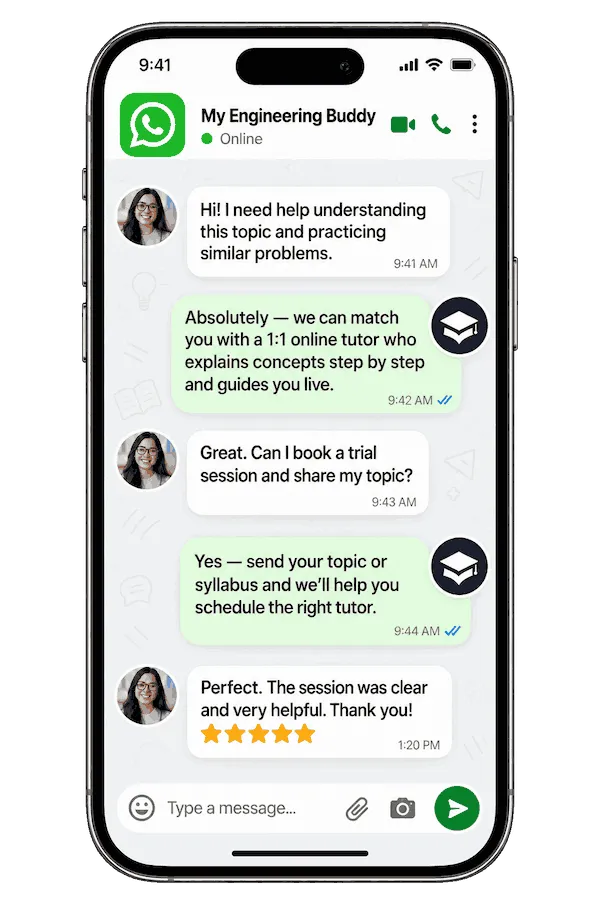
WhatsApp MEB for a quick quote — average response time under 1 minute.
Who This Control Engineering Tutoring Is For
Control engineering sits at the intersection of mathematics, physics, and real systems. Students who struggle often find that the conceptual side clicked but the mathematical formalism — Laplace transforms, frequency-domain analysis, state-space representation — became a wall. This tutoring is for anyone who has hit that wall.
- Undergraduate electrical, mechanical, and mechatronics students taking a first control systems module
- Masters students working on modern control, robust control, or digital control courses
- Students retaking after a failed first attempt at a control systems exam
- Students with a university conditional offer depending on this grade
- Engineers upskilling in PID tuning, MATLAB/Simulink modelling, or industrial automation
- Students with coursework or design project submission deadlines approaching fast
MEB has worked with students at MIT, Georgia Tech, Imperial College London, ETH Zurich, TU Delft, the University of Toronto, and UNSW — and with many more students at institutions where the course is strong but one-on-one faculty time is limited.
At MEB, we’ve found that control engineering is one of the subjects where students know what they don’t know — they can name the exact topic where they lost the thread. That specificity makes 1:1 tutoring faster and more effective here than in almost any other engineering module. Start with the $1 trial and tell your tutor exactly where you got stuck.
1:1 Tutoring vs Self-Study vs AI vs YouTube vs Online Courses
Self-study works if you’re already comfortable with the mathematical prerequisites — but most students aren’t, and no textbook tells you why your root locus sketch is wrong. AI tools explain Bode plots quickly but can’t watch you work through a problem and catch the step where your algebra diverges. YouTube is good for getting an intuition for what a PID controller does; it stops short when you’re designing one for a specific plant with given gain margins. Online courses are structured but fixed — they move at the course pace, not yours. With a 1:1 control engineering tutor from MEB, the session is calibrated to your exact course, your exam board’s notation, and the specific problem set you’re stuck on right now.
Outcomes: What You’ll Be Able To Do in Control Engineering
After structured sessions with an MEB tutor, students can model a physical system using transfer functions and block diagram algebra, analyse closed-loop stability using Routh-Hurwitz criteria without guessing at signs, sketch root locus diagrams that match expected pole movement, interpret Bode and Nyquist plots to assess gain and phase margins, design a PID or lead-lag compensator to meet a given specification, and translate continuous-time designs into discrete-time equivalents for digital implementation. These are exam-facing skills — and real engineering skills.
Based on feedback from 40,000+ sessions collected by MEB from 2022 to 2025, 58% of students improved by one full grade after approximately 20 hours of 1:1 tutoring in subjects like control engineering. A further 23% achieved at least a half-grade improvement.
Source: MEB session feedback data, 2022–2025.
Supporting a student through control engineering? MEB works directly with parents to set up sessions, track progress, and keep coursework on schedule. WhatsApp MEB — average response time is under a minute, 24/7.
What We Cover in Control Engineering (Syllabus / Topics)

Classical Control Theory
- Laplace transforms and transfer function derivation
- Block diagram reduction and signal flow graphs (Mason’s gain formula)
- Time-domain response: first and second-order system characteristics
- Stability analysis: Routh-Hurwitz criterion and characteristic equations
- Root locus construction rules and design using root locus
- Frequency-domain analysis: Bode plots, gain margin, phase margin
- Nyquist stability criterion and Nyquist plots
- PID controller design and tuning (Ziegler-Nichols and analytical methods)
Core texts: Modern Control Engineering by Ogata (5th ed.); Control Systems Engineering by Nise (7th ed.); Automatic Control Systems by Golnaraghi and Kuo.
State-Space and Modern Control
- State-space representation: state equations, output equations
- Controllability and observability tests (Kalman rank conditions)
- State feedback design and pole placement
- Observer (Luenberger observer) design
- Linear quadratic regulator (LQR) basics
- Introduction to optimal control and minimum-time problems
Core texts: Linear Control System Analysis and Design by D’Azzo and Houpis; Modern Control Systems by Dorf and Bishop (13th ed.).
Digital and Discrete-Time Control
- Sampling theorem and the z-transform
- Pulse transfer functions and discrete-time block diagrams
- Stability analysis in the z-domain (Jury criterion)
- Digital PID and discrete compensator design
- Implementation in MATLAB/Simulink and practical discretisation methods
- Introduction to programmable logic controllers (PLCs) in discrete control
Core texts: Digital Control of Dynamic Systems by Franklin, Powell, and Emami-Naeini; Discrete-Time Control Systems by Ogata (2nd ed.).
What a Typical Control Engineering Session Looks Like
The tutor opens by checking the previous topic — usually something like Bode plot construction or root locus from the prior session — and asking the student to walk through one problem from memory. From there, the session moves to the current gap: often stability margins, state feedback design, or compensator synthesis. The tutor works through a full example on a digital pen-pad, narrating every algebraic step and flagging the decision points that exam marking schemes specifically reward. The student then attempts a parallel problem with the tutor watching, and the tutor intervenes only when the approach diverges — not to give answers but to redirect the method. The session closes with a concrete problem set covering the same technique from two different angles, plus a note on which topic opens the next session.
How MEB Tutors Help You with Control Engineering (The Learning Loop)
Diagnose: In the first session, the tutor asks the student to attempt a short problem unprompted — usually a transfer function derivation or a basic Routh-Hurwitz check. The errors reveal whether the block is mathematical (algebra, partial fractions) or conceptual (misreading what stability means in context).
Explain: The tutor works live examples on a digital pen-pad — showing full derivations of root locus rules, walking through Nyquist contour arguments, or constructing a Bode magnitude plot step by step. The student sees the process, not just the answer.
Practice: The student attempts a problem while the tutor watches. No hints until the student commits to an approach. This is the step most self-study skips, and it is where the understanding becomes reliable.
Feedback: The tutor goes back through the student’s working, line by line, naming exactly where marks would be lost in an exam and why the method went wrong — not just “this step is incorrect” but “you applied the final value theorem to an unstable system, which is why the result is meaningless here.”
Plan: Each session ends with a topic map — what was covered, what remains, what the next session opens with. Students on a four-week exam push get a sequenced revision plan aligned to past paper weighting.
Sessions run on Google Meet. The tutor uses a digital pen-pad or iPad with Apple Pencil for all working. Before the first session, share your course outline or module guide, a recent past paper question you couldn’t complete, and your exam or submission date. The tutor handles the rest. Whether you need a quick catch-up before an exam, structured revision over 4–8 weeks, or ongoing weekly support through the semester, the tutor maps the session plan after the first diagnostic. Start with the $1 trial — 30 minutes of live tutoring that also serves as your first diagnostic.
Students consistently tell us that the moment control engineering clicks is when they stop treating Bode plots as a drawing exercise and start reading them as a stability argument. Our tutors know exactly when that shift hasn’t happened yet — and how to cause it. That’s what a good 1:1 session does that a lecture or a YouTube video can’t.
Tutor Match Criteria (How We Pick Your Tutor)
Not every control engineer makes a good control engineering tutor. MEB screens for both.
Subject depth: Tutors hold degrees in electrical engineering, mechanical engineering, mechatronics, or closely related fields — with specific coursework or professional experience in feedback control, MATLAB/Simulink, or industrial control systems. They are matched to your level: undergraduate classical control is not the same assignment as postgraduate robust or nonlinear control.
Tools: Every tutor works over Google Meet with a digital pen-pad or iPad and Apple Pencil. No static slides. Live working only.
Time zone: Matched to your region — US, UK, Gulf, Canada, or Australia — so sessions don’t require unsociable hours on either side.
Goals: Tutor briefed on whether the target is exam performance, assignment completion, conceptual depth for a research project, or professional upskilling.
Unlike platforms where you fill out a form and wait, MEB responds in under a minute, 24/7. Tutor match takes under an hour. The $1 trial means you test before you commit. Everything runs over WhatsApp — no logins, no intake forms.
Study Plans (Pick One That Matches Your Goal)
After the diagnostic, the tutor builds a session sequence specific to your timeline. A catch-up plan (1–3 weeks) targets the two or three topics most likely to appear on the exam — typically root locus, Bode/Nyquist stability, and PID design — and drills them with past paper problems. An exam prep plan (4–8 weeks) covers the full syllabus systematically, with topic weighting matched to the exam’s mark distribution. Weekly ongoing support aligns each session to that week’s coursework or lecture material. The tutor adjusts the sequence after every session based on what actually happened, not what was supposed to happen.
Pricing Guide
Most control engineering tutoring runs at $20–$40/hr. Graduate-level courses covering robust control, nonlinear systems, or optimal control typically fall in the $50–$100/hr range depending on tutor specialisation and session frequency.
Rate factors: course level, topic complexity, how quickly you need to start, and tutor availability. Rates for the same subject can vary by $10–$20/hr depending on these inputs.
Availability tightens every April–May and November–December when exam seasons overlap across regions. If your exam is inside six weeks, book now.
For students targeting research roles, competitive graduate programmes at institutions like MIT or ETH Zurich, or positions requiring industrial control system certification, tutors with professional automation or control systems backgrounds are available at higher rates — share your specific goal and MEB will match the tier to your ambition.
Start with the $1 trial — 30 minutes, no registration, no commitment. WhatsApp MEB for a quick quote.
Try your first session for $1 — 30 minutes of live 1:1 tutoring or one homework question explained in full. No registration. No commitment.
WhatsApp MEB now
and get matched within the hour.
FAQ
Is control engineering hard?
It is one of the more mathematically demanding undergraduate engineering modules. The core difficulty is that it requires fluency in Laplace transforms, complex numbers, and differential equations simultaneously. Students with solid maths foundations catch up quickly with the right guidance.
How many sessions do most students need?
For a specific exam gap — say, Bode plots and stability margins — three to five sessions typically close it. For full syllabus revision, eight to twelve sessions over four to six weeks is a common structure. The diagnostic in session one gives a clearer estimate.
Can you help with homework and assignments?
Yes. MEB tutoring is guided learning — you understand the work, then submit it yourself. The tutor explains the method, works a parallel example, and checks your reasoning. See our Academic Integrity policy and Why MEB page for full details on what we help with and what we don’t.
Will the tutor match my exact syllabus or exam board?
Yes. Before the first session, share your course outline, module guide, or past papers. The tutor is briefed on your specific content — whether that is an IEEE-aligned graduate course, a UK BEng module, or a professional development curriculum — and works within it.
What happens in the first session?
The tutor starts with a short diagnostic problem — usually a transfer function or stability check — to locate exactly where your understanding drops off. The rest of the session addresses the most urgent gap. You leave with a clear problem set and a session plan.
Is online tutoring as effective as in-person for control engineering?
For a mathematical subject like control engineering, yes. All derivation and diagram work is done live on a digital pen-pad over Google Meet. Students consistently report that the worked-example format is clearer on screen than whiteboard sessions in a physical room.
What is the difference between classical and modern control, and which should I focus on?
Classical control covers transfer functions, root locus, and frequency-domain methods — Bode, Nyquist, PID. Modern control introduces state-space, pole placement, observers, and LQR. Most undergraduate programmes emphasise classical first; graduate courses extend to modern. Tell your tutor your module code and they will match the focus immediately.
Can MEB help with MATLAB and Simulink for control systems?
Yes. Tutors can work through MATLAB control toolbox commands, Simulink block diagram construction, step response simulation, and root locus or Bode plotting using built-in functions. Share your assignment file or script before the session for the fastest results.
Do you offer help with industrial or PLC-based control systems?
Yes. MEB covers industrial automation and distributed control systems (DCS) alongside academic control engineering. If your course or project involves PLC ladder logic, SCADA, or DCS architecture, share the specific platform and the tutor match will reflect it.
Can I get control engineering help at short notice or at midnight?
WhatsApp MEB at any hour. Average response time is under one minute. Tutors are available across US, UK, Gulf, and Australia time zones, so there is almost always someone available within one to two hours of your request.
How do I get started?
Three steps: WhatsApp MEB, get matched to a verified control engineering tutor — usually within the hour — then start the $1 trial. Thirty minutes of live tutoring or one full homework question explained. No registration required, no commitment beyond that.
Control engineering is the subject where students most often say “I understood the lecture but I can’t do the problems.” That gap between understanding and doing is exactly what 1:1 tutoring closes — and it closes it faster than any other method.
Source: MEB tutor observation, 2008–2025.
Trust & Quality at My Engineering Buddy
Every MEB tutor goes through subject-specific vetting: a credentials check, a live demo session evaluated by a senior tutor, and ongoing review based on student feedback after sessions. For control engineering, tutors hold degrees in electrical, mechanical, or mechatronics engineering and have either taught the subject at university level or worked in control systems roles in industry. Rated 4.8/5 across 40,000+ verified reviews on Google.
MEB tutoring is guided learning — you understand the work, then submit it yourself. For full details on what we help with and what we don’t, read our Academic Integrity policy and Why MEB.
MEB has served 52,000+ students across the US, UK, Canada, Australia, the Gulf, and Europe in 2,800+ subjects since 2008. In Electrical Engineering specifically, MEB covers electrical and electronics, control systems, power systems, and dozens of adjacent subjects — with the same tutor-quality standard across all of them. Our tutoring methodology is built on the same diagnostic-first, feedback-driven model across every subject we cover.
Explore Related Subjects
Students studying control engineering often also need support in:
- Signals and Systems
- Digital Signal Processing
- Embedded Systems
- Sensors and Actuators
- FPGA Design
- Microcontrollers
- Power System Operation and Control
Next Steps
Ready to get started? Here is what to do:
- Share your exam board or course code, the topic where you are stuck, and your exam or submission date
- Share your time zone and availability — morning, evening, or weekend
- MEB matches you with a verified control engineering tutor, usually within 24 hours
- Your first session starts with a diagnostic so every minute is spent on what actually matters
Before your first session, have ready:
- Your course outline or module guide (or exam board and syllabus year)
- A recent past paper attempt or homework question you couldn’t complete
- Your exam date or submission deadline
The tutor handles the rest. Visit www.myengineeringbuddy.com for more on how MEB works.
WhatsApp to get started or email [email protected].
Reviewed by Subject Expert
This page has been carefully reviewed and validated by our subject expert to ensure accuracy and relevance.




