




~1 min
Average Reply Time
~1 hour
To Be Matched With A Tutor
30 Min Trial
75% Find Their Tutor On The 1st Trial
$20-35+/hr
Premium Yet Affordable Learning
Most students don’t fail Law Enforcement because it’s too hard — they fail because nobody explained use-of-force doctrine, Fourth Amendment limits, or arrest procedure in plain terms before the exam.
Law Enforcement Tutor Online
Law Enforcement is the academic study of policing powers, criminal justice procedure, constitutional limits on state authority, and the legal frameworks governing arrest, search, detention, and use of force across jurisdictions.
MEB offers 1:1 online tutoring and homework help in 2800+ advanced subjects, including Law Enforcement. If you’ve searched for a Law Enforcement tutor near me and found generic results, MEB gives you a verified tutor matched to your exact course — whether that’s a criminal justice module, a pre-law Law Enforcement unit, or a law programme with a policing law component. Students who work through the material with a tutor consistently leave sessions with clearer reasoning and stronger exam answers.
- 1:1 online sessions tailored to your course syllabus and exam board
- Expert-verified tutors with subject-specific knowledge in policing law and criminal justice
- Flexible time zones — US, UK, Canada, Australia, Gulf
- Structured learning plan built after a diagnostic session
- Ethical homework and assignment guidance — you understand before you submit
52,000+ students across the US, UK, Canada, Australia, and the Gulf have used MEB since 2008 — including students in Law subjects like Law Enforcement, Criminal Law, and Constitutional Law.
Source: My Engineering Buddy, 2008–2025.
How Much Does a Law Enforcement Tutor Cost?
Most Law Enforcement tutoring sessions run $20–$40/hr. Graduate-level or specialist policing law topics can reach up to $100/hr. The $1 trial gets you 30 minutes of live tutoring or one homework question explained in full — no registration, no commitment.
| Level / Need | Typical Rate | What’s Included |
|---|---|---|
| Standard (most levels) | $20–$35/hr | 1:1 sessions, homework guidance |
| Advanced / Specialist | $35–$70/hr | Expert tutor, niche policing law depth |
| $1 Trial | $1 flat | 30 min live session or 1 homework question |
Tutor availability tightens around semester finals and bar exam prep windows. Book early if your exam is within six weeks.
WhatsApp MEB for a quick quote — average response time under 1 minute.
Who This Law Enforcement Tutoring Is For
Law Enforcement draws students from criminal justice programmes, pre-law tracks, and public policy degrees. The content looks manageable on paper — until the exam asks you to apply Terry stop doctrine to a fact pattern you’ve never seen.
- Undergraduates in criminal justice or policing studies falling behind on procedural law
- Pre-law students needing a solid grip on Fourth and Fifth Amendment limits before law school
- Graduate students writing theses on use-of-force policy or police accountability frameworks
- Students retaking after a failed first attempt in a criminal justice module
- Students with a university conditional offer depending on this grade
- Parents watching a child’s confidence drop alongside their grades in criminal justice coursework
Students have come to MEB from programmes at institutions including Arizona State University, John Jay College of Criminal Justice, University of Central Florida, Florida International University, Sam Houston State University, University of Portsmouth, and Charles Sturt University.
1:1 Tutoring vs Self-Study vs AI vs YouTube vs Online Courses
Self-study works if you’re disciplined, but Law Enforcement has too many layered doctrines for passive reading to stick. AI tools give fast definitions of probable cause or Terry stops — they can’t diagnose why you keep misapplying the exclusionary rule to your specific fact patterns. YouTube is solid for an overview of stop-and-frisk history; it stops the moment you’re stuck on a jurisdiction-specific procedural question. Online courses move at a fixed pace, not yours. 1:1 tutoring with MEB is live, calibrated to your exact syllabus, and corrects your reasoning errors before they cost you marks.
Outcomes: What You’ll Be Able To Do in Law Enforcement
After working with an MEB Law Enforcement tutor, you’ll be able to analyze Fourth Amendment search-and-seizure scenarios using the correct doctrinal test, apply use-of-force frameworks such as Graham v. Connor to exam fact patterns, explain the procedural steps from arrest through arraignment without omitting Miranda requirements, write structured answers distinguishing lawful detention from unlawful arrest, and present arguments on police accountability that reference both statutory authority and constitutional limits. These are the exact skills that separate passing answers from failing ones.
Based on feedback from 40,000+ sessions collected by MEB from 2022 to 2025, 58% of students improved by one full grade after approximately 20 hours of 1:1 tutoring in subjects like Law Enforcement. A further 23% achieved at least a half-grade improvement.
Source: MEB session feedback data, 2022–2025.
At MEB, we’ve found that Law Enforcement students who struggle most are often those who memorise case names without understanding the legal test each case establishes. One session focused purely on doctrine structure — rule, application, conclusion — shifts more than weeks of rereading notes.
What We Cover in Law Enforcement (Syllabus / Topics)

Policing Powers and Constitutional Limits
- Fourth Amendment — search, seizure, and the warrant requirement
- Probable cause vs. reasonable suspicion: Terry v. Ohio and its descendants
- Exclusionary rule and the fruit-of-the-poisonous-tree doctrine
- Fifth Amendment rights — Miranda warnings, self-incrimination, custodial interrogation
- Sixth Amendment — right to counsel at critical stages
- Use-of-force doctrine: Graham v. Connor, Tennessee v. Garner, and objective reasonableness
- Qualified immunity — scope, application, and current reform debates
Core texts for this track include Kappeler and Gaines’ Community Policing: A Contemporary Perspective and del Carmen’s Criminal Procedure: Law and Practice.
Criminal Procedure and Due Process
- Arrest procedure — lawful arrest elements, warrant vs. warrantless arrest
- Booking, arraignment, and initial appearance requirements
- Bail, pretrial detention, and the Eighth Amendment
- Grand jury and preliminary hearing distinctions
- Plea bargaining — procedure, constitutional constraints, and ethics
- Criminal Procedure Code comparisons across US federal and state systems
- Double jeopardy and its exceptions
Recommended reading includes Neubauer and Fradella’s America’s Courts and the Criminal Justice System and Samaha’s Criminal Procedure.
Police Accountability, Ethics, and Policy
- Internal affairs and civilian oversight mechanisms
- Section 1983 civil liability for police misconduct
- Consent decrees and Department of Justice pattern-or-practice investigations
- Body-worn camera policy and evidentiary use
- Racial profiling — legal standards and empirical evidence
- Use-of-force reporting and the FBI’s National Use-of-Force Data Collection
Useful sources include Walker and Archbold’s The New World of Police Accountability and the International Chamber of Commerce framework comparisons for policing governance in commercial jurisdictions.
What a Typical Law Enforcement Session Looks Like
The tutor opens by checking where you got stuck last time — usually a specific doctrine like the automobile exception or inevitable discovery. From there, you work through a real exam-style fact pattern together on screen. The tutor walks you through how to spot the controlling rule, apply it step by step, and write a clean IRAC-structured answer. You then attempt the next scenario yourself while the tutor watches and corrects the moment your reasoning drifts. By the end of the session, you’ll have a named topic to review before next time and a short practice problem set so the logic doesn’t evaporate overnight.
How MEB Tutors Help You with Law Enforcement (The Learning Loop)
Diagnose: In the first session, the tutor identifies exactly which doctrines are shaky — often it’s not “Fourth Amendment” broadly but specifically the third-party doctrine or plain-view exception. That precision matters.
Explain: The tutor works through a lived example on a digital pen-pad — annotating case holdings, drawing out the doctrinal test, and showing how facts map to legal elements in real time.
Practice: You attempt a parallel fact pattern with the tutor present. No looking up answers. The errors you make under that mild pressure are the exact errors you’d make in an exam.
Feedback: Every wrong turn gets corrected on the spot — not just what the right answer is, but why your reasoning diverged and which marks that would cost you in a formal assessment.
Plan: The session closes with a clear topic sequence for the next two weeks. No vague “review chapters 4–6.” Specific cases, specific doctrines, specific exam question types.
Sessions run on Google Meet. The tutor uses a digital pen-pad or iPad with Apple Pencil for live annotation. Before your first session, have your syllabus or course outline, a recent assignment or past paper you struggled with, and your exam or deadline date. The tutor maps everything from there. Start with the $1 trial — 30 minutes of live tutoring that also functions as your first diagnostic.
Students consistently tell us that Law Enforcement clicks differently once they stop memorising rules and start practising how to apply them. The shift from “I know what probable cause is” to “I can construct a probable cause argument under pressure” usually takes two to three focused sessions.
Tutor Match Criteria (How We Pick Your Tutor)
Not every law tutor can teach Law Enforcement well. Here’s what MEB checks before the match is made.
Subject depth: The tutor must have direct experience with your course level — undergraduate criminal justice, pre-law, graduate policing studies, or professional development. Exam board or institutional syllabus alignment is confirmed before matching. Students needing Constitutional Law tutoring or Criminal Law help alongside Law Enforcement can request a tutor covering multiple related areas.
Tools: Every tutor works on Google Meet with a digital pen-pad or iPad and Apple Pencil — no static slideshows, live annotation throughout.
Time zone: Matched to your region. US students aren’t handed a tutor in an incompatible time zone and told to make it work.
Goals: Whether you need exam scores, conceptual depth on use-of-force doctrine, homework completion support, or research backing for a dissertation on police accountability — the match reflects that specific goal.
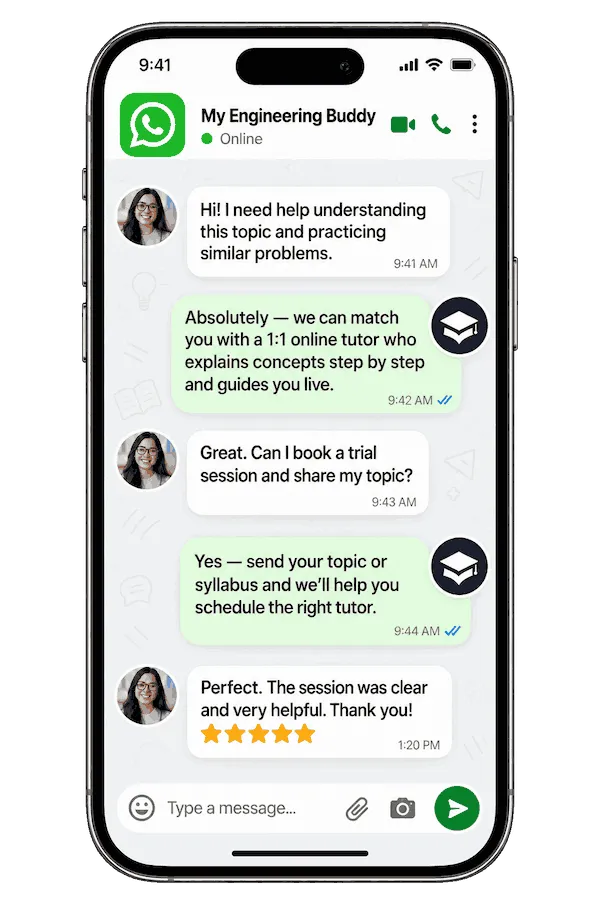
Unlike platforms where you fill out a form and wait, MEB responds in under a minute, 24/7. Tutor match takes under an hour. The $1 trial means you test before you commit. Everything runs over WhatsApp — no logins, no intake forms.
Study Plans (Pick One That Matches Your Goal)
Catch-up (1–3 weeks): for students with specific doctrinal gaps — use-of-force, Miranda doctrine, or arrest procedure — that need closing before an assessment. Exam prep (4–8 weeks): structured revision of the full syllabus, timed practice answers, and feedback on written arguments. Weekly support: ongoing sessions aligned to your semester schedule and assignment deadlines. The tutor builds the specific sequence after the diagnostic — nothing is fixed until MEB knows your starting point.
Pricing Guide
Law Enforcement tutoring runs $20–$40/hr for most undergraduate and pre-law levels. Graduate-level work, dissertation support, or highly specialist policing law topics can reach up to $100/hr. Rate factors include course level, topic complexity, your timeline, and tutor availability.
Availability tightens during semester finals and criminal justice licensing exam windows. If your exam is within four weeks, book sooner rather than later.
For students targeting top law schools or graduate criminology programmes, tutors with professional policing law or prosecutorial backgrounds are available at higher rates — share your specific goal and MEB will match the tier to your ambition.
Start with the $1 trial — 30 minutes, no registration, no commitment. WhatsApp MEB for a quick quote.
FAQ
Is Law Enforcement hard?
It’s conceptually demanding because every doctrine ties back to constitutional text and case law. Students who struggle most tend to confuse similar doctrines — Terry stops vs. full arrests, for example. Once the underlying legal tests are clear, the material becomes much more manageable.
How many sessions are needed?
Most students see clear improvement in four to six sessions. Targeted gap-closing before an exam can work in two or three. The first diagnostic session tells the tutor exactly how many sessions make sense for your situation.
Can you help with homework and assignments?
Yes. MEB tutoring is guided learning — you understand the work, then submit it yourself. The tutor explains the doctrine, works through the reasoning with you, and checks your logic. See our Academic Integrity policy and Why MEB page for full details on what we help with and what we don’t.
Will the tutor match my exact syllabus or exam board?
Yes. Before matching, MEB confirms your course level, institution, and syllabus. Whether your programme follows US federal law emphasis, a UK policing framework, or a comparative criminal justice curriculum, the tutor is selected accordingly.
What happens in the first session?
The tutor reviews your syllabus and any past work you share, identifies where the gaps are, then works through two or three key problem areas. You leave with a clear picture of what to focus on and a short practice task.
Is online tutoring as effective as in-person?
For Law Enforcement, yes — most of the work involves reading, reasoning through fact patterns, and written argument. Google Meet with digital pen-pad annotation replicates everything that makes in-person tutoring effective, with no commute and full time-zone flexibility.
Can I get Law Enforcement help at midnight or on weekends?
Yes. MEB operates 24/7. WhatsApp a request at any hour and you’ll typically get a response within a minute. Sessions can be scheduled around your time zone across the US, UK, Gulf, Canada, and Australia.
What if I don’t like my assigned tutor?
Tell MEB immediately via WhatsApp. A replacement tutor with equivalent or stronger subject credentials is matched within the hour. There’s no penalty and no lengthy process — one message is enough.
Do you cover use-of-force doctrine and Graham v. Connor specifically?
Yes. Use-of-force is one of the most exam-heavy areas in Law Enforcement. Tutors work through the objective reasonableness test, the Graham factors, Tennessee v. Garner, and how to apply both in structured written answers under time pressure.
Can a Law Enforcement tutor help with my dissertation or thesis on policing policy?
Yes. MEB tutors support graduate-level research including literature reviews, argument structure, methodology on empirical policing studies, and supervision of writing chapters on topics like qualified immunity reform or civilian oversight models.
How do I get started?
WhatsApp MEB, share your course level and hardest topic, and you’re matched with a verified tutor — usually within the hour. The first session is the $1 trial: 30 minutes live or one assignment question explained in full. Three steps: WhatsApp → matched → start trial.
Is there a difference between Law Enforcement tutoring for criminal justice majors vs. pre-law students?
Yes, and it matters. Criminal justice students focus on operational procedure, institutional policy, and sociological context. Pre-law students need tighter doctrinal precision for case law application. MEB confirms your track before matching to make sure the tutor’s emphasis fits your actual course goals.
Try your first session for $1 — 30 minutes of live 1:1 tutoring or one homework question explained in full. No registration. No commitment.
WhatsApp MEB now
and get matched within the hour.
Trust & Quality at My Engineering Buddy
Every MEB tutor goes through subject-specific screening before taking a single session. That means a live demo evaluation, credential verification, and ongoing review based on student feedback after each session. Tutors hold degrees or professional experience directly relevant to Law Enforcement — criminal justice, legal practice, policing policy, or constitutional law academia. Rated 4.8/5 across 40,000+ verified reviews on Google.
MEB tutoring is guided learning — you understand the work, then submit it yourself. For full details on what we help with and what we don’t, read our Academic Integrity policy and Why MEB.
MEB has served 52,000+ students across the US, UK, Canada, Australia, Gulf, and Europe since 2008, covering 2,800+ subjects. In Law and related areas — including Law Enforcement, Administrative Law tutoring, and Human Rights Law help — tutors are matched to the student’s exact programme, not just the broad subject category. See our tutoring methodology for how sessions are structured across all subject levels.
Explore Related Subjects
Students studying Law Enforcement often also need support in:
A common pattern our tutors observe is that Law Enforcement students come in thinking they have a knowledge problem. Most of the time it’s an application problem — they know the rules but can’t deploy them under exam conditions. That’s exactly what structured 1:1 practice fixes.
Source: MEB tutor observation summary, 2022–2025.
Next Steps
Getting started with MEB takes three things: your course details, your availability, and a willingness to try one session before committing to anything.
- Share your exam board or course syllabus, your hardest topic right now, and your exam or assignment deadline
- Share your time zone and preferred session times
- MEB matches you with a verified Law Enforcement tutor — usually within 24 hours
- Your first session starts with a diagnostic so every minute counts from the start
Before your first session, have ready: your course outline or syllabus, a recent past paper attempt or homework question you struggled with, and your exam or deadline date. The tutor handles the rest.
Visit www.myengineeringbuddy.com for more on how MEB works.
WhatsApp to get started or email [email protected].
Reviewed by Subject Expert
This page has been carefully reviewed and validated by our subject expert to ensure accuracy and relevance.




