




~1 min
Average Reply Time
~1 hour
To Be Matched With A Tutor
30 Min Trial
75% Find Their Tutor On The 1st Trial
$20-35+/hr
Premium Yet Affordable Learning
Subnetting questions feel fine until the exam — then the mask slips and the whole network falls apart.
IP Addressing Tutor Online
IP addressing is the method of assigning unique numerical identifiers to devices on a network, enabling data routing across local and wide-area networks. It covers IPv4, IPv6, subnetting, CIDR notation, and address allocation schemes.
MEB offers 1:1 online IP Addressing tutoring for students who are stuck on subnetting, VLSM, NAT, or the IPv4-to-IPv6 transition — part of our broader computer science tutoring service covering 2,800+ subjects since 2008. If you’ve searched for an IP Addressing tutor near me and want live, screen-based help rather than another video you’ll pause and rewind, you’re in the right place. Tutors work through your exact course material, not a generic syllabus.
- 1:1 online sessions tailored to your specific networking course or certification syllabus
- Expert-verified tutors with hands-on networking and computer science backgrounds
- Flexible time zones — US, UK, Canada, Australia, Gulf covered
- Structured learning plan built after a diagnostic session
- Ethical homework and assignment guidance — you understand the work before you submit
52,000+ students across the US, UK, Canada, Australia, and the Gulf have used MEB since 2008 — including students in Computer Science subjects like IP Addressing, computer networking, and network protocols.
Source: My Engineering Buddy, 2008–2025.
How Much Does an IP Addressing Tutor Cost?
Most IP Addressing sessions run $20–$40/hr. Graduate-level or certification-track work (CCNA, CompTIA Network+) can reach $60–$100/hr depending on tutor depth. The $1 trial gives you 30 minutes of live tutoring or a full explanation of one homework question — no registration required.
| Level / Need | Typical Rate | What’s Included |
|---|---|---|
| Standard (undergrad / A Level / GCSE) | $20–$35/hr | 1:1 sessions, homework guidance |
| Advanced / Certification Track | $35–$70/hr | Expert tutor, CCNA/Network+ depth |
| $1 Trial | $1 flat | 30 min live session or 1 homework question |
Tutor availability tightens during exam periods — end-of-semester networking modules and certification windows in particular. WhatsApp MEB for a quick quote — average response time under 1 minute.
Who This IP Addressing Tutoring Is For
IP Addressing trips up students at every level — not because the concept is abstract, but because subnetting is mechanical and unforgiving. One wrong mask and every answer downstream is wrong too.
- Undergraduate students in networking or computer science modules struggling with subnetting or CIDR
- Students retaking after a failed first attempt on a networking exam
- Students with a university conditional offer depending on passing their CS or networking module
- Students 4–6 weeks from an exam with significant gaps still to close
- CCNA or CompTIA Network+ candidates who need to pass the addressing section to clear certification
- Parents watching a child’s confidence drop alongside their grades in a computer science course
Students come from universities across the US, UK, Canada, and Australia — including programmes at institutions like MIT, Georgia Tech, University of Toronto, University of Manchester, UNSW, and Carnegie Mellon. MEB also supports students working toward CCNA and CompTIA Network+ certifications.
At MEB, we’ve found that subnetting errors almost always trace back to one early misunderstanding — usually around how the host and network portions of an address divide. Fix that one thing clearly, and the rest of IP addressing tends to unlock quickly.
1:1 Tutoring vs Self-Study vs AI vs YouTube vs Online Courses
Self-study works if you’re disciplined — but subnetting requires real-time feedback, not just re-reading notes. AI tools give fast answers but can’t watch you work through a mask calculation and spot where your binary conversion went wrong. YouTube explains concepts well but stops the moment your specific question isn’t in the video. Online courses move at a fixed pace and skip the worked example you actually need. With MEB, a tutor watches you subnet live, corrects the error in the moment, and adjusts the next example to your exact gap — whether that’s VLSM, wildcard masks, or IPv6 prefix notation.
Outcomes: What You’ll Be Able To Do in IP Addressing
After working with an MEB IP Addressing tutor, students can solve subnetting problems under timed exam conditions without a calculator, analyze a given network topology and assign correct address ranges to each subnet, apply CIDR notation accurately to both IPv4 and IPv6 prefixes, explain the difference between public and private address space and where NAT fits in, and present a complete addressing scheme for a multi-department network as part of a coursework or lab assignment.
Based on feedback from 40,000+ sessions collected by MEB from 2022 to 2025, 58% of students improved by one full grade after approximately 20 hours of 1:1 tutoring in subjects like IP Addressing. A further 23% achieved at least a half-grade improvement.
Source: MEB session feedback data, 2022–2025.
Supporting a student through IP Addressing? MEB works directly with parents to set up sessions, track progress, and keep coursework on schedule. WhatsApp MEB — average response time is under a minute, 24/7.
What We Cover in IP Addressing (Syllabus / Topics)

IPv4 Fundamentals and Subnetting
- Binary-to-decimal conversion and address notation
- Address classes (A, B, C) and default subnet masks
- Custom subnetting — borrowing host bits, calculating usable hosts
- Variable Length Subnet Masking (VLSM) and address conservation
- Broadcast, network, and host address identification
- Private vs public address ranges (RFC 1918)
- NAT and PAT — when and why they’re used
Recommended texts: Computer Networking: A Top-Down Approach (Kurose & Ross), Network+ Guide to Networks (West).
CIDR and Supernetting
- Classless Inter-Domain Routing — prefix notation and aggregation
- Route summarisation and supernetting calculations
- CIDR in routing tables — reading and interpreting entries
- Longest prefix match and how routers choose paths
- IANA and regional address allocation hierarchy
Recommended texts: TCP/IP Illustrated, Vol. 1 (Stevens), Routing TCP/IP (Doyle & Carroll).
IPv6 Addressing and Transition
- IPv6 address structure — 128-bit notation and abbreviation rules
- Address types: unicast, multicast, anycast, link-local, global
- Stateless Address Autoconfiguration (SLAAC) and DHCPv6
- Dual-stack, tunnelling, and NAT64 transition mechanisms
- IPv6 prefix delegation and subnetting with /64 and /48 blocks
- Comparing IPv4 and IPv6 header structures
Recommended texts: IPv6 Fundamentals (Graziani), Computer Networks (Tanenbaum & Wetherall).
Students consistently tell us that IPv6 feels intimidating until they see it alongside IPv4 on the same whiteboard. Once the parallel structure becomes visible — both have network and host portions, both use prefix notation — the transition concepts stop being abstract.
What a Typical IP Addressing Session Looks Like
The tutor opens by checking the previous topic — usually a VLSM exercise or a subnetting table the student attempted since the last session. From there, the student works through a new problem on screen: assigning address ranges to four subnets within a given /24 block, for example. The tutor uses a digital pen-pad to annotate the binary breakdown directly on screen, and the student replicates the calculation step-by-step while explaining their reasoning aloud. If the error is in the mask calculation, the tutor catches it at that step — not at the end. The session closes with a concrete practice task: two timed subnetting problems and one CIDR aggregation question to attempt before the next session. The next topic — often IPv6 prefix notation or NAT configuration — is noted and the student knows exactly what to read before returning. Sessions run over Google Meet with full screen sharing.
How MEB Tutors Help You with IP Addressing (The Learning Loop)
Diagnose: In the first session, the tutor works through a short set of subnetting and address classification problems with the student. The goal is to find exactly where the breakdown happens — binary conversion, mask arithmetic, CIDR notation, or conceptual confusion between network and host portions.
Explain: The tutor works through live examples using a digital pen-pad or iPad with Apple Pencil, showing each step of a subnet calculation on screen. No slides, no recorded videos — just a worked problem in real time that the student can interrupt at any step.
Practice: The student attempts the next problem while the tutor watches. This is not homework — this is in-session practice where the tutor can intervene the moment a wrong assumption appears in the working.
Feedback: After each attempt, the tutor explains exactly which step broke down and why that specific error costs marks in an exam context. Students learn not just the right answer but the marking logic behind it.
Plan: At the end of each session, the tutor sets the next practice task, notes which topic follows logically, and updates the student’s progression map. Nothing is left open-ended.
Sessions run over Google Meet. The tutor uses a digital pen-pad or iPad with Apple Pencil. Before the first session, share your course syllabus or exam board, a recent subnetting worksheet or lab question you struggled with, and your exam or assignment deadline. The first session covers diagnostic problems and builds the session plan from there. Whether you need a quick catch-up before an exam, structured revision over 4–8 weeks, or ongoing weekly support through the semester, the tutor maps the session plan after the first diagnostic.
Start with the $1 trial — 30 minutes of live tutoring that also serves as your first diagnostic.
Try your first session for $1 — 30 minutes of live 1:1 tutoring or one homework question explained in full. No registration. No commitment. WhatsApp MEB now and get matched within the hour.
Tutor Match Criteria (How We Pick Your Tutor)
Not every networking tutor is the right fit for IP Addressing at your level. Here’s what MEB checks.
Subject depth: Tutors are vetted on the specific topics you need — subnetting, VLSM, IPv6, CIDR, or certification-level addressing. A tutor who handles undergraduate networking modules is not automatically matched to a CCNA candidate.
Tools: All tutors use Google Meet with digital pen-pad or iPad and Apple Pencil. IP Addressing is a visual subject — binary breakdowns and subnet tables need to be drawn, not typed.
Time zone: Matched to your region — US, UK, Gulf, Canada, or Australia. No 3am sessions unless you ask for them.
Goals: Whether you need exam scores, help with routing protocols coursework, or conceptual depth for research, the tutor is matched to that goal specifically.
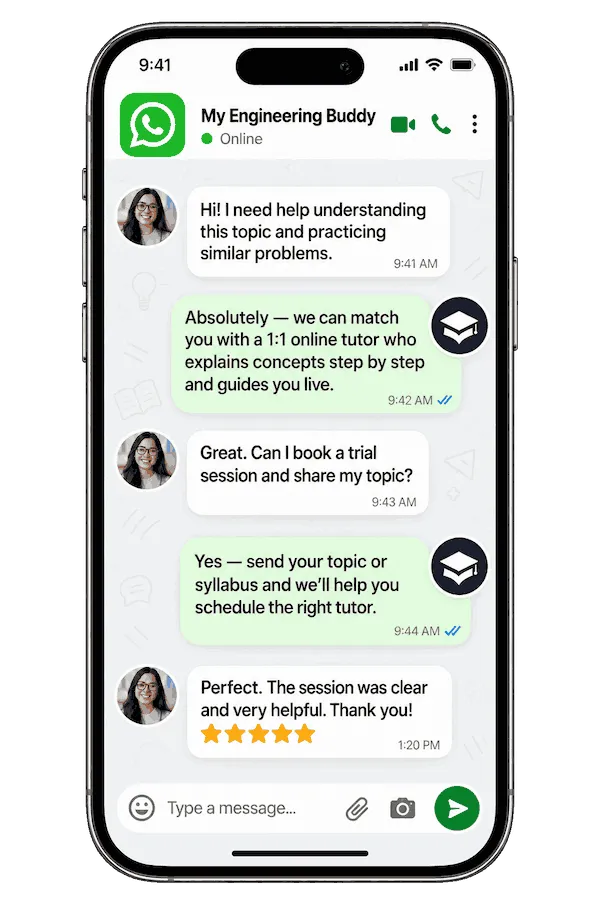
Unlike platforms where you fill out a form and wait, MEB responds in under a minute, 24/7. Tutor match takes under an hour. The $1 trial means you test before you commit. Everything runs over WhatsApp — no logins, no intake forms.
Pricing Guide
IP Addressing tutoring starts at $20/hr for standard undergraduate and school-level networking modules. Certification-track sessions (CCNA, CompTIA Network+) and graduate-level work run $40–$100/hr depending on tutor specialism and topic complexity. Rate factors include the level of the course, how close the deadline is, and tutor availability during peak exam periods — which tightens fast in April–May and November.
For students targeting roles in network engineering or preparing for advanced certifications, tutors with professional infrastructure and systems backgrounds are available at higher rates — share your specific goal and MEB will match the tier to your ambition.
Start with the $1 trial — 30 minutes, no registration, no commitment. WhatsApp MEB for a quick quote.
MEB has been operating since 2008 — long enough to have tutored students through every major networking curriculum change, from the CCNA restructure to the IPv6 adoption wave in university syllabuses.
Source: My Engineering Buddy, 2008–2025.
FAQ
Is IP Addressing hard?
Subnetting is the part most students find hard — it’s procedural and binary arithmetic is unforgiving. The concepts behind IP addressing are straightforward. Most students who struggle are missing one foundational step, not the whole topic. A single diagnostic session usually locates it.
How many sessions are needed?
Students with a specific gap — subnetting or CIDR notation — often need 3–5 sessions. Students covering the full IP addressing curriculum alongside networking exams typically need 8–15 sessions. The tutor sets a realistic estimate after the first diagnostic.
Can you help with homework and assignments?
Yes. MEB tutoring is guided learning — you understand the work, then submit it yourself. The tutor explains the method, works through an example, then watches you apply it. See our Academic Integrity policy and Why MEB page for full details on what we help with and what we don’t.
Will the tutor match my exact syllabus or exam board?
Yes. Share your course outline, university module code, or certification track (CCNA, CompTIA Network+, etc.) when you WhatsApp MEB. The tutor is matched to that specific syllabus — not a generic networking curriculum.
What happens in the first session?
The tutor runs a short diagnostic — a set of subnetting and address classification problems. This identifies exactly where your understanding breaks down. The rest of the session and the session plan that follows are built around what the diagnostic finds.
Is online tutoring as effective as in-person?
For IP Addressing, yes — and in some ways better. The tutor annotates subnet calculations directly on screen using a digital pen-pad. You can see every step drawn in real time, which is harder to replicate at a physical whiteboard from a distance.
What’s the difference between IPv4 and IPv6 tutoring — do I need both?
Depends on your syllabus. Most undergraduate networking modules cover both but weight IPv4 subnetting more heavily in assessments. Certification tracks like CCNA now expect solid IPv6 knowledge. Tell MEB which your exam covers and the tutor focuses accordingly.
Can MEB help with subnetting specifically — not just theory?
Subnetting is the most common reason students contact MEB for IP Addressing help. Sessions focus on worked calculations: borrowing bits, calculating host ranges, drawing subnet tables. Theory is covered only where it directly explains a calculation step.
Do you offer help with Wireshark or packet analysis alongside IP Addressing?
Yes. If your course involves reading packet captures to verify addressing, MEB tutors can support Wireshark tutoring alongside IP Addressing. Many networking modules combine both. Mention it when you WhatsApp MEB and the tutor match will account for it.
Can I get IP Addressing help at short notice — same day or late at night?
MEB operates 24/7. WhatsApp response time averages under one minute. Same-day tutor matching is available in most cases. If you have a lab submission or exam in the next 48 hours, say so upfront and MEB prioritises the match accordingly.
How do I get started?
WhatsApp MEB with your course name and the specific topic you’re stuck on. MEB matches you with a verified tutor — usually within the hour. The first session is the $1 trial: 30 minutes live or one homework question explained in full. Three steps: WhatsApp → matched → start trial.
Trust & Quality at My Engineering Buddy
Every MEB tutor goes through subject-specific vetting — not a generic interview. For IP Addressing, that means a live demonstration covering subnetting, CIDR, and IPv6 addressing before they teach a single student. Tutors hold degrees in computer science, electrical engineering, or network engineering, and many have professional infrastructure or systems backgrounds. Ongoing session feedback is reviewed to catch any drop in quality. Rated 4.8/5 across 40,000+ verified reviews on Google.
MEB tutoring is guided learning — you understand the work, then submit it yourself. For full details on what we help with and what we don’t, read our Academic Integrity policy and Why MEB.
MEB has served 52,000+ students across the US, UK, Canada, Australia, Gulf, and Europe in 2,800+ subjects since 2008. In Computer Science, that includes IP Addressing, cybersecurity tutoring, cloud computing help, and distributed systems tutoring. Read more about how sessions are structured at our tutoring methodology page.
A common pattern our tutors observe is that students who struggle with IP addressing have often memorised rules without understanding what each octet represents. Once the binary logic clicks — usually within one session — subnetting becomes a repeatable process rather than a guessing game.
Explore Related Subjects
Students studying IP Addressing often also need support in:
Next Steps
Before your first session, have ready: your exam board and syllabus (or course outline), a recent past paper attempt or subnetting worksheet you struggled with, and your exam or assignment deadline. The tutor handles the rest.
- Share your exam board, hardest component (subnetting, VLSM, IPv6), and current timeline
- Share your availability and time zone
- MEB matches you with a verified IP Addressing tutor — usually within 24 hours
The first session starts with a diagnostic so every minute is used well. Visit www.myengineeringbuddy.com for more on how MEB works.
WhatsApp to get started or email [email protected].
Reviewed by Subject Expert
This page has been carefully reviewed and validated by our subject expert to ensure accuracy and relevance.




