




~1 min
Average Reply Time
~1 hour
To Be Matched With A Tutor
30 Min Trial
75% Find Their Tutor On The 1st Trial
$20-35+/hr
Premium Yet Affordable Learning
Your certificates are configured. Your handshake fails. You’ve read the RFC three times and still can’t pinpoint why.
SSL/TLS Tutor Online
SSL/TLS (Secure Sockets Layer / Transport Layer Security) is a cryptographic protocol suite that authenticates servers and clients, negotiates cipher suites, and establishes encrypted communication channels over TCP/IP networks.
Finding a reliable SSL/TLS tutor near me is genuinely difficult — most computer networking tutors stop at the OSI model and wave vaguely at “encryption.” MEB’s online SSL/TLS tutors work through the full protocol: handshake sequences, certificate chains, cipher suite negotiation, and the differences between TLS 1.2 and 1.3. Whether you’re an undergraduate tackling a Computer Science security module or a graduate student debugging a PKI implementation, a tutor is matched to your exact course within the hour.
- 1:1 online sessions tailored to your course syllabus and exam board
- Expert-verified tutors with hands-on cryptography and networking backgrounds
- Flexible time zones — US, UK, Canada, Australia, and the Gulf all covered
- Structured session plan built after a diagnostic in your first session
- Ethical homework and assignment guidance — you understand the work, then submit it yourself
52,000+ students across the US, UK, Canada, Australia, and the Gulf have used MEB since 2008 — including students in Computer Science subjects like SSL/TLS, Cryptography tutoring, and Computer Networking help.
Source: My Engineering Buddy, 2008–2025.
How Much Does an SSL/TLS Tutor Cost?
Most SSL/TLS tutoring sessions run at $20–$40/hr, depending on your level and topic complexity. Graduate-level PKI design or TLS 1.3 implementation work with specialist tutors goes up to $100/hr. You can test the service for $1 before committing to any package — that’s 30 minutes of live tutoring or one full homework question explained in detail.
| Level / Need | Typical Rate | What’s Included |
|---|---|---|
| Undergraduate (most modules) | $20–$35/hr | 1:1 sessions, homework guidance |
| Graduate / Specialist (PKI, TLS 1.3) | $35–$100/hr | Expert tutor, deep protocol work |
| $1 Trial | $1 flat | 30 min live session or 1 homework question |
Tutor availability tightens during end-of-semester assessment periods. Book early if you have a fixed deadline.
WhatsApp MEB for a quick quote — average response time under 1 minute.
Who This SSL/TLS Tutoring Is For
SSL/TLS sits at the intersection of networking, cryptography, and systems programming. Students either find it deeply confusing or deceptively simple until implementation reveals otherwise. MEB works with both.
- Undergraduate CS and cybersecurity students with a network security or applied cryptography module
- Graduate students building TLS-aware applications or researching protocol vulnerabilities
- Students retaking after a failed first attempt at a networking or security exam
- Students with a university conditional offer depending on passing a security or networking unit
- Developers enrolled in continuing education who need to understand certificate chains and HTTPS configuration properly
- Parents watching a child’s confidence drop after a particularly brutal applied cryptography assignment
Students come to MEB from programmes at MIT, Carnegie Mellon, Georgia Tech, University of Toronto, Imperial College London, ETH Zürich, UNSW Sydney, and across the Gulf’s top engineering universities.
1:1 Tutoring vs Self-Study vs AI vs YouTube vs Online Courses
Self-study works if you’re disciplined — but TLS handshake sequencing is the kind of topic where you think you understand it until you try to explain it. AI tools give fast definitions but can’t watch you misread a certificate chain and correct you live. YouTube explains TLS 1.2 clearly until you hit a course-specific implementation question — then it stops. Online courses give you structure at a fixed pace, with no room to slow down on cipher suite negotiation when that’s exactly where your gap is. 1:1 cybersecurity tutoring with MEB is calibrated to your exact module — the tutor knows which TLS concepts your course tests and works through them in the order that closes your gaps fastest.
Outcomes: What You’ll Be Able To Do in SSL/TLS
After working with an MEB SSL/TLS tutor, you’ll be able to explain the full TLS 1.3 handshake sequence — including key exchange, certificate verification, and session resumption — without referring to notes. You’ll apply cipher suite selection logic to real configuration problems. You’ll analyze certificate chain errors in tools like Wireshark and identify where validation breaks down. You’ll present the difference between TLS 1.2 and TLS 1.3 clearly, including forward secrecy implications. And you’ll solve PKI and X.509 certificate questions the way your assessor expects — with precision, not approximation.
Based on feedback from 40,000+ sessions collected by MEB from 2022 to 2025, 58% of students improved by one full grade after approximately 20 hours of 1:1 tutoring in subjects like SSL/TLS. A further 23% achieved at least a half-grade improvement.
Source: MEB session feedback data, 2022–2025.

What We Cover in SSL/TLS (Syllabus / Topics)
Protocol Fundamentals and Handshake Mechanics
- SSL history and the transition to TLS 1.0, 1.1, 1.2, and 1.3
- TLS record layer: structure, content types, and fragmentation
- TLS 1.2 full handshake: ClientHello, ServerHello, Certificate, ServerHelloDone, ClientKeyExchange, Finished
- TLS 1.3 handshake: 0-RTT, 1-RTT, key schedule, and removal of RSA key exchange
- Session resumption: session IDs (TLS 1.2) vs pre-shared keys and session tickets (TLS 1.3)
- Alert protocol and error handling
- DTLS and its application to UDP-based communications
Core texts: SSL and TLS: Designing and Building Secure Systems (Rescorla), Computer Networks (Tanenbaum & Wetherall).
Cryptography Within TLS
- Symmetric encryption in TLS: AES-GCM, ChaCha20-Poly1305, and why RC4 was deprecated
- Asymmetric key exchange: RSA key transport vs Diffie-Hellman and ECDH ephemeral modes
- MAC algorithms: HMAC-SHA256, HMAC-SHA384, and AEAD replacement in TLS 1.3
- Cipher suite naming conventions and how to read them (e.g. TLS_ECDHE_RSA_WITH_AES_128_GCM_SHA256)
- Forward secrecy: what it means, which cipher suites provide it, and why it matters
- Key derivation: PRF in TLS 1.2 vs HKDF in TLS 1.3
Core texts: Serious Cryptography (Aumasson), Applied Cryptography (Schneier).
PKI, Certificates, and Real-World Configuration
- X.509 certificate structure: version, serial number, subject, issuer, extensions
- Certificate chains: root CA, intermediate CA, leaf certificates, and chain-of-trust validation
- Certificate Transparency logs and why they exist
- Common certificate errors: expired certs, mismatched CN/SAN, untrusted root, and revocation checking
- OCSP and CRL-based revocation; OCSP stapling
- Mutual TLS (mTLS): client certificate authentication and where it’s used
- TLS configuration analysis using Wireshark help and OpenSSL command-line tools
Core texts: Network Security: Private Communication in a Public World (Kaufman, Perlman, Speciner), RFC 8446 (TLS 1.3 specification).
What a Typical SSL/TLS Session Looks Like
The tutor opens by checking your previous topic — usually cipher suite selection or the TLS 1.2 handshake — asking you to walk through it from memory. If you stall at the ServerKeyExchange message, that’s where the session starts. You and the tutor work through the exchange step-by-step on a shared screen: the tutor writes out the message flow on a digital pen-pad, labels each field, and then asks you to reconstruct it. Next, you move to the live problem — maybe it’s analyzing a Wireshark capture of a failed TLS handshake or writing out why a self-signed certificate chain won’t validate in a browser. You attempt it. The tutor watches, notes exactly where your reasoning breaks, and corrects it with reference to the RFC. The session closes with one concrete task: capture a real HTTPS handshake using OpenSSL s_client and identify the cipher suite negotiated.
How MEB Tutors Help You with SSL/TLS (The Learning Loop)
Diagnose: In the first session, the tutor works out exactly where your understanding of SSL/TLS breaks down — whether that’s handshake sequencing, certificate chain validation, cipher suite logic, or the differences between TLS versions. This shapes every subsequent session.
Explain: The tutor works through live problems using a digital pen-pad or iPad with Apple Pencil — drawing out the TLS record layer, annotating handshake flows, and showing cipher suite decision trees step by step. No slides. No pre-recorded video.
Practice: You attempt the problem with the tutor present. That’s the non-negotiable part. Watching someone else solve a TLS handshake question does almost nothing. Doing it yourself, with the tutor watching, does.
At MEB, we’ve found that SSL/TLS is one of those subjects where students know the vocabulary — handshake, cipher suite, certificate — but can’t sequence the steps under exam conditions. The fix is almost always the same: slow down, draw the flow, rebuild from scratch with the RFC open.
Feedback: Every error gets corrected with an explanation of why it costs marks — not just “that’s wrong.” If you misidentify which party sends the Certificate message during a mutual TLS exchange, the tutor shows you the RFC section, explains the logic, and has you redo it.
Plan: The tutor maps the next session topic before the current one ends. You always know what’s coming, what you’re responsible for practicing, and how many sessions remain before your assessment date.
Sessions run over Google Meet. The tutor uses a digital pen-pad or iPad with Apple Pencil. Before your first session, share your course outline or exam syllabus, a recent problem you got wrong, and your exam or submission deadline. The first session covers the diagnostic and the most urgent gap — usually the TLS handshake or certificate validation logic. Start with the $1 trial — 30 minutes of live tutoring that also serves as your first diagnostic.
Students consistently tell us that the moment SSL/TLS clicks is when they stop thinking of it as a security topic and start treating it as a protocol with precise, ordered rules. Once you can trace the handshake from ClientHello to Finished without hesitation, the rest follows.
Tutor Match Criteria (How We Pick Your Tutor)
Not every networking tutor knows TLS. MEB’s matching criteria are specific.
Subject depth: The tutor must have demonstrable knowledge of TLS at your level — undergraduate protocol analysis, graduate PKI implementation, or applied cryptography research. A general networking background is not sufficient.
Tools: Every tutor uses Google Meet with a digital pen-pad or iPad and Apple Pencil — no exceptions. SSL/TLS requires drawing handshake flows and annotating certificate structures in real time.
Time zone: Matched to your region — US Eastern and Pacific, UK and Europe, Gulf Standard Time, Canadian and Australian time zones all covered.
Goals: Whether you need exam-score improvement, conceptual depth in certificate chains, homework completion support, or dissertation-level protocol research — the tutor assigned has done it before.
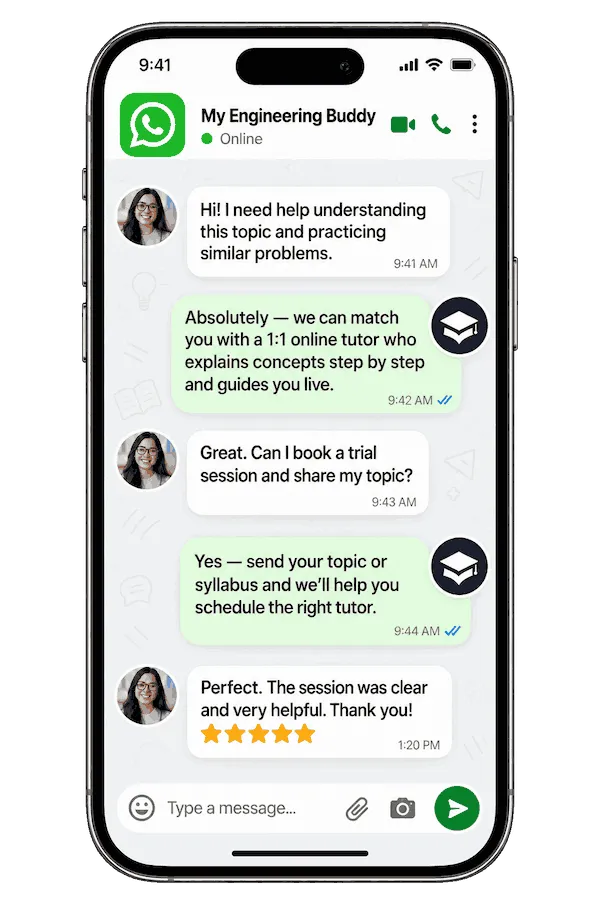
Unlike platforms where you fill out a form and wait, MEB responds in under a minute, 24/7. Tutor match takes under an hour. The $1 trial means you test before you commit. Everything runs over WhatsApp — no logins, no intake forms.
MEB has matched students to expert tutors across 2,800+ subjects since 2008 — and SSL/TLS tutor requests consistently rank among the highest-demand topics in applied cryptography and network protocols help.
Source: My Engineering Buddy, 2008–2025.
Study Plans (Pick One That Matches Your Goal)
The tutor builds the exact sequence after the diagnostic. Three common shapes: a catch-up plan (1–3 weeks) for students with an imminent deadline and significant gaps — typically covering handshake mechanics and PKI in the first week; an exam prep plan (4–8 weeks) working through every assessable TLS topic with past-paper practice built in; and weekly ongoing support aligned to your semester schedule, with sessions timed to coursework submission dates and lecture content.
Pricing Guide
SSL/TLS tutoring starts at $20–$40/hr for most undergraduate and graduate modules. Niche topics — protocol vulnerability research, custom TLS stack implementation, advanced PKI architecture — run up to $100/hr with tutors who have professional or research backgrounds in those areas.
Rate factors: your level, the specific topic complexity (handshake theory vs live implementation debugging), your timeline, and tutor availability at your hours.
For students targeting graduate programmes at CMU, MIT, ETH Zürich, or Imperial College — or roles in security engineering at major technology firms — tutors with professional cryptography and security protocol backgrounds are available at higher rates. Share your specific goal and MEB will match the tier to your ambition.
Availability drops sharply in the final four weeks of each semester. Book earlier than you think you need to. Start with the $1 trial — 30 minutes, no registration, no commitment. WhatsApp MEB for a quick quote.
Try your first session for $1 — 30 minutes of live 1:1 tutoring or one homework question explained in full. No registration. No commitment. WhatsApp MEB now and get matched within the hour.
FAQ
Is SSL/TLS hard?
Harder than it looks. The concepts — encryption, certificates, handshakes — sound familiar from general CS. The difficulty is precision: TLS requires you to know the exact message sequence, which fields appear when, and why each cryptographic choice was made. Most students underestimate it until an exam or implementation assignment.
How many sessions are needed?
Students with targeted gaps — say, certificate chain validation or cipher suite selection — often close them in 4–6 sessions. Students covering the full protocol from scratch for an exam typically need 10–15 sessions over 4–6 weeks. The tutor gives a realistic estimate after the first diagnostic session.
Can you help with homework and assignments?
Yes. MEB tutoring is guided learning — you understand the work, then submit it yourself. The tutor explains the concepts, works through similar problems with you, and checks your reasoning. See our Academic Integrity policy and Why MEB page for full details on what we help with and what we don’t.
Will the tutor match my exact syllabus or exam board?
Yes. Before matching, MEB asks for your course outline, exam board if applicable, and specific topics causing difficulty. The tutor assigned covers exactly what your module tests — TLS 1.3 internals, PKI, Wireshark-based analysis, or applied cryptography — not a generic overview.
What happens in the first session?
The tutor runs a short diagnostic — asking you to trace a TLS handshake or explain a certificate error — to locate your actual gap. That shapes the rest of the session and the study plan going forward. Bring your course outline, a recent piece of work you struggled with, and your deadline.
Is online tutoring as effective as in-person?
For SSL/TLS, yes — and arguably more so. The tutor annotates handshake flows and certificate structures on a digital pen-pad shared live on screen. You see the reasoning built in real time. That’s harder to replicate with a whiteboard in a physical room across a desk.
What is the difference between TLS 1.2 and TLS 1.3, and do I need to know both?
TLS 1.3 removes RSA key transport, simplifies the handshake to one round trip, and mandates forward secrecy. Most courses still test TLS 1.2 alongside 1.3. Your tutor will confirm which versions your syllabus covers and weight the sessions accordingly — typically both, with TLS 1.3 getting increasing emphasis.
My course uses OpenSSL for labs. Can the tutor help with that?
Yes. MEB tutors regularly help with OpenSSL command-line work — generating key pairs, creating self-signed certificates, running s_client and s_server, and interpreting output. If your lab involves configuring an HTTPS server or debugging a certificate error, bring the error output to the session.
Can I get SSL/TLS help at midnight or on weekends?
Yes. MEB operates 24/7. Tutors cover US, UK, Gulf, and Australian time zones, so a midnight session in the US Eastern time zone is a normal working hour for tutors in other regions. WhatsApp MEB any time — typical response is under a minute.
What if I don’t click with my assigned tutor?
WhatsApp MEB and say so. A replacement is arranged — usually within the same day. The $1 trial exists precisely for this reason: you find out whether the match works before spending anything significant.
How does TLS relate to HTTPS, and is that covered?
HTTPS is HTTP running over TLS. Your tutor covers the full stack: how TLS wraps the HTTP connection, what happens during the browser’s certificate validation, and how to interpret browser security indicators. This comes up frequently in web security and network security modules.
How do I get started?
Start with the $1 trial — 30 minutes of live SSL/TLS tutoring or one full homework question explained step by step. Three steps: WhatsApp MEB, get matched with a verified tutor within the hour, start your trial session.
Trust & Quality at My Engineering Buddy
Every MEB tutor goes through subject-specific vetting: a written application, a live demo session evaluated by MEB’s review team, and ongoing session feedback monitoring. For SSL/TLS, that means the tutor must demonstrate knowledge of TLS handshake mechanics, PKI, cipher suite selection, and relevant tooling — not just general networking. Rated 4.8/5 across 40,000+ verified reviews on Google.
MEB tutoring is guided learning — you understand the work, then submit it yourself. For full details on what we help with and what we don’t, read our Academic Integrity policy and Why MEB.
MEB has served 52,000+ students across the US, UK, Canada, Australia, the Gulf, and Europe since 2008 — across 2,800+ subjects. In Computer Science, that includes encryption and decryption help, penetration testing tutoring, and distributed systems help alongside SSL/TLS. Tutors are matched on subject depth, not just degree level. You can read more about how MEB selects and monitors tutors at our tutoring methodology page.
MEB’s SSL/TLS tutors hold degrees in computer science, electrical engineering, and information security — and several have professional backgrounds in TLS implementation, certificate authority operations, or network security engineering.
Source: My Engineering Buddy tutor profiles, 2008–2025.
Explore Related Subjects
Students studying SSL/TLS often also need support in:
Next Steps
Here’s what to do before your first session:
- Find your course outline or exam syllabus and note which TLS topics are assessed
- Grab a recent homework question or past-paper problem you couldn’t solve
- Note your exam date or submission deadline — the tutor will build the session plan around it
Share your time zone and availability when you message MEB. The tutor match takes under an hour. The first session opens with a diagnostic so no time is wasted. Visit www.myengineeringbuddy.com for more on how MEB works.
WhatsApp to get started or email [email protected].
Reviewed by Subject Expert
This page has been carefully reviewed and validated by our subject expert to ensure accuracy and relevance.




