




~1 min
Average Reply Time
~1 hour
To Be Matched With A Tutor
30 Min Trial
75% Find Their Tutor On The 1st Trial
$20-35+/hr
Premium Yet Affordable Learning
Hire The Best Distributed systems Tutor

Distributed systems is one of those subjects where the gap between “I read the chapter” and “I can actually reason about it” is brutal. Students who sail through data structures hit a wall at CAP theorem, Paxos, and clock synchronisation. If that’s where you are, a 1:1 distributed systems tutor online is the fastest way out.
Distributed systems Tutor Online
Distributed systems is a branch of computer science covering how independent computing nodes communicate, coordinate, and maintain consistency across networks — equipping students to design fault-tolerant, scalable architectures for real-world applications.
MEB connects you with a verified distributed systems tutor near me — wherever you’re based — for live 1:1 online sessions covering everything from consensus protocols to cloud-scale architecture. If you’re working through a computer science degree at any level, this is the subject that separates students who understand systems from those who only memorise definitions. MEB tutors have covered this material at graduate level and in production environments — they know exactly where students lose marks and why.
- 1:1 online sessions tailored to your course syllabus and exam format
- Expert-verified tutors with graduate-level and industry depth in distributed systems
- Flexible time zones — US, UK, Canada, Australia, Gulf
- Structured learning plan built after a diagnostic session
- Ethical homework and assignment guidance — you understand the work before you submit it
52,000+ students across the US, UK, Canada, Australia, and the Gulf have used MEB since 2008 — including students in Computer Science subjects like Distributed systems, Operating Systems, and Computer Networking.
Source: My Engineering Buddy, 2008–2025.
How Much Does a Distributed systems Tutor Cost?
Most distributed systems tutoring sessions run at $20–$40/hr for undergraduate and taught graduate courses. Advanced topics — Paxos, distributed transactions, Byzantine fault tolerance — or PhD-level research support can reach up to $100/hr depending on tutor expertise. Start with the $1 trial: 30 minutes of live 1:1 tutoring or one full homework question explained from scratch, no registration required.
| Level / Need | Typical Rate | What’s Included |
|---|---|---|
| Undergraduate (most courses) | $20–$35/hr | 1:1 sessions, homework guidance |
| Graduate / Advanced Topics | $35–$70/hr | Expert tutor, niche depth, research support |
| $1 Trial | $1 flat | 30 min live session or 1 homework question |
Tutor availability tightens around end-of-semester project deadlines and final exam periods. Book early if your submission date is within four weeks.
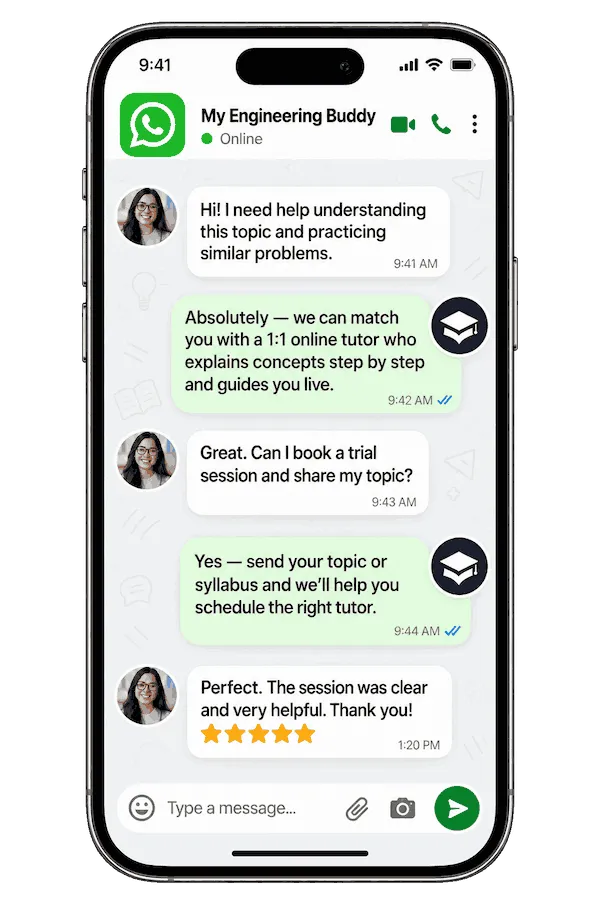
WhatsApp MEB for a quick quote — average response time under 1 minute.
Who This Distributed systems Tutoring Is For
Distributed systems is a required course in most CS degree programmes — and one of the highest-dropout-rate modules at the graduate level. It demands comfort with concurrency, network thinking, and formal reasoning simultaneously. Most students hit trouble not because they’re weak, but because the course moves fast and the concepts stack on each other.
- Undergraduate CS students facing their first distributed systems module
- Master’s students whose distributed systems coursework carries dissertation weight
- Students retaking after a failed first attempt — gaps in consensus protocols, clock models, or replication strategies are almost always the root cause
- Students with a conditional offer from Georgia Tech, CMU, ETH Zurich, the University of Toronto, or Imperial College London depending on this grade
- Engineers returning to academia for an MS who need to rebuild theoretical foundations fast
- Parents watching a child’s confidence drop alongside their grades in a course they can’t help with themselves
If you’re 4–6 weeks from your final exam and still shaky on the CAP theorem or vector clocks, that’s exactly the gap MEB tutors are built to close. Try the $1 trial before committing to anything.
1:1 Tutoring vs Self-Study vs AI vs YouTube vs Online Courses
Self-study works if you’re disciplined — but distributed systems requires you to catch your own reasoning errors, and that’s hard to do alone. AI tools give fast explanations of Raft and Paxos but can’t spot why your specific proof or architecture diagram is wrong. YouTube covers the big ideas but stops the moment you’re stuck on a real assignment question. Online courses (MIT OpenCourseWare, Coursera) offer solid structure but move at a fixed pace with no correction when you go off track. 1:1 tutoring with MEB runs at your pace, calibrated to your actual course — when you misapply the two-phase commit protocol, the tutor corrects it in the same session, not in a forum thread three days later.
Outcomes: What You’ll Be Able To Do in Distributed systems
After working through distributed systems with an MEB tutor, you’ll be able to apply the CAP theorem to real architectural trade-offs without second-guessing yourself. You’ll explain why Paxos guarantees safety and under what conditions it loses liveness. You’ll model system behaviour under partial network failure — not just define it. You’ll analyse replication strategies (primary-backup, quorum-based, chain replication) and choose the right one for a given fault model. You’ll write and reason about distributed algorithms for leader election, consensus, and distributed transactions with the confidence that comes from having worked through failures, edge cases, and mark-scheme expectations with a tutor who has seen exactly where students lose points.
Try your first session for $1 — 30 minutes of live 1:1 tutoring or one homework question explained in full. No registration. No commitment. WhatsApp MEB now and get matched within the hour.
Based on feedback from 40,000+ sessions collected by MEB from 2022 to 2025, 58% of students improved by one full grade after approximately 20 hours of 1:1 tutoring in subjects like Distributed systems. A further 23% achieved at least a half-grade improvement.
Source: MEB session feedback data, 2022–2025.
What We Cover in Distributed systems (Syllabus / Topics)

Track 1: Foundations — Models, Time, and Consistency
- System models: synchronous vs asynchronous, failure models (crash, omission, Byzantine)
- Logical clocks: Lamport timestamps, vector clocks, causal ordering
- Consistency models: linearisability, sequential consistency, eventual consistency
- CAP theorem and its practical implications for system design
- FLP impossibility result — what it means for consensus protocol design
- The PACELC model as an extension of CAP in real deployments
Core texts: Tanenbaum & Van Steen, Distributed Systems: Principles and Paradigms (3rd ed.); van Steen & Tanenbaum, available online; Coulouris et al., Distributed Systems: Concepts and Design (5th ed.).
Track 2: Consensus, Replication, and Fault Tolerance
- Distributed algorithms for leader election: ring-based, bully algorithm
- Paxos: single-decree and multi-Paxos — roles, phases, safety proof
- Raft consensus algorithm — log replication, leader election, safety guarantees
- Replication strategies: primary-backup, chain replication, quorum systems
- Two-phase commit (2PC) and three-phase commit (3PC) for distributed transactions
- Byzantine fault-tolerant protocols (PBFT) — when and why they matter
- Failure detection: heartbeat mechanisms, phi accrual failure detectors
Core texts: Lynch, Distributed Algorithms (Morgan Kaufmann); Lamport’s original Paxos papers are required reading at most graduate programmes.
Track 3: Distributed Storage, Coordination, and Cloud-Scale Systems
- Distributed file systems: GFS, HDFS — architecture and trade-offs
- Cloud computing infrastructure: how distributed systems principles underpin AWS, GCP, Azure
- Distributed databases and transactions: sharding, partitioning, MVCC
- Coordination services: ZooKeeper — distributed locking, naming, configuration
- Message queues and event streaming: Kafka architecture and delivery guarantees
- Concurrent programming models and their role in distributed system implementation
- MapReduce and its successors — batch processing at scale
Core texts: Kleppmann, Designing Data-Intensive Applications (O’Reilly) — the most widely cited practical text; Burns, Distributed Systems Design (O’Reilly).
What a Typical Distributed systems Session Looks Like
The tutor opens by checking where you got stuck on the previous topic — often that’s the Raft log replication proof or a vector clock problem from an assignment. They pull it up on screen and work through it with you using a digital pen-pad, annotating your diagram or proof step by step. Then they move into the current topic: if it’s two-phase commit, they’ll run through a worked scenario, deliberately introduce a coordinator failure mid-transaction, and ask you to trace what happens at each node. You replicate the reasoning yourself. The session closes with a specific problem — design a quorum-based replication scheme for a given fault model, or prove that a proposed algorithm violates linearisability — so you leave with something concrete to attempt before the next session.
How MEB Tutors Help You with Distributed systems (The Learning Loop)
Diagnose: In the first session, the tutor identifies which concepts are genuinely understood and which are surface-level. Common gaps: students who can define eventual consistency but can’t reason about when it breaks, or who know Paxos terminology but can’t walk through a round under a proposer failure.
Explain: The tutor works through problems live — drawing system diagrams, annotating message sequences, tracing execution paths with a digital pen-pad. No slide decks. No pre-recorded solutions. The explanation is built around your specific confusion.
At MEB, we’ve found that students who struggle with distributed systems are almost never weak on programming — they’re weak on reasoning about partial failures. The tutor’s job is to make that reasoning feel mechanical, not mysterious. Every protocol has a story; once you see the story, the formalism follows.
Practice: You attempt problems with the tutor present. This is where the real learning happens — not in watching explanations, but in catching your own wrong assumptions before they become exam errors.
Feedback: Errors are corrected step by step. The tutor shows exactly which step broke — a missed quorum condition, a clock ordering assumption that doesn’t hold in an asynchronous model — and explains why that costs marks.
Plan: After each session, the tutor sets a specific next topic and practice target. Progress is tracked across sessions. Nothing is left to chance about what gets covered before your exam or submission deadline.
Sessions run on Google Meet with a digital pen-pad or iPad and Apple Pencil. Before your first session, share your course syllabus, the topics you’re most uncertain on, and any assignment or exam date. The first session starts with a 15-minute diagnostic before moving into the first topic. Start with the $1 trial — 30 minutes of live tutoring that also serves as your first diagnostic.
Tutor Match Criteria (How We Pick Your Tutor)
Every tutor is matched before your first session — not assigned at random.
Subject depth: Tutors for distributed systems hold graduate degrees in computer science or related fields and have covered the subject at the level you’re studying — undergraduate core modules through to doctoral seminar courses. Many have industry experience with distributed infrastructure at scale.
Tools: All tutors use Google Meet plus a digital pen-pad or iPad with Apple Pencil. No shared documents without live annotation — distributed systems requires real-time diagram work.
Time zone: Matched to your region — US, UK, Gulf, Canada, Australia. No 3am sessions unless you want them.
Goals: Whether you need to close a specific gap before an exam, work through weekly assignments, or build deep conceptual understanding for research, the match reflects your goal — not a generic tutor profile.
Unlike platforms where you fill out a form and wait, MEB responds in under a minute, 24/7. Tutor match takes under an hour. The $1 trial means you test before you commit. Everything runs over WhatsApp — no logins, no intake forms.
Distributed systems is consistently rated one of the hardest graduate CS courses — not because the ideas are exotic, but because they require holding multiple failure scenarios in your head simultaneously. A tutor who has already mapped that territory makes the path shorter.
Source: My Engineering Buddy, tutor and student feedback, 2022–2025.
Study Plans (Pick One That Matches Your Goal)
Once the diagnostic is done, your tutor builds a session sequence around your actual timeline. Catch-up (1–3 weeks): students with immediate gaps — a specific protocol, proof technique, or assignment question — get intensive targeted sessions. Exam prep (4–8 weeks): structured coverage of all examinable topics with past-paper practice and mark-scheme analysis. Weekly support: ongoing sessions aligned to your semester pacing — homework one week, conceptual depth the next. The plan is specific, not templated.
Pricing Guide
Distributed systems tutoring starts at $20/hr for standard undergraduate modules and runs to $40/hr for most courses. Graduate seminars, research-level topics, and dissertation-adjacent support can reach up to $100/hr. Rate factors include course level, topic complexity, your exam timeline, and tutor availability.
Availability tightens in the last four weeks of semester. If your exam or project deadline is approaching, book now rather than when the slot is gone.
For students targeting research positions at MIT, Stanford, CMU, or ETH Zurich — or building distributed systems expertise for industry roles at companies running large-scale infrastructure — tutors with professional distributed systems engineering backgrounds are available at higher rates. Share your specific goal and MEB will match the tier to your ambition.
Start with the $1 trial — 30 minutes, no registration, no commitment. WhatsApp MEB for a quick quote.
Students consistently tell us that the hardest part of distributed systems isn’t understanding any single concept — it’s knowing how to reason under uncertainty when a node fails mid-protocol. Our tutors make that reasoning explicit and repeatable from the first session.
FAQ
Is distributed systems hard?
Yes — consistently one of the hardest required CS courses at undergraduate and graduate level. The challenge isn’t individual concepts but reasoning about concurrent, partial-failure scenarios. Students who are strong at algorithms often still struggle here without concurrent programming and systems thinking background.
How many sessions are needed?
Most students see clear improvement in 6–10 sessions of 1:1 tutoring. Students with a single specific gap — one protocol or proof type — often need 3–5 targeted sessions. The tutor gives a realistic estimate after the first diagnostic session.
Can you help with homework and assignments?
Yes. MEB tutoring is guided learning — you understand the work, then submit it yourself. The tutor walks through the reasoning with you; you produce the solution. See our Academic Integrity policy and Why MEB page for full details on what we help with and what we don’t.
Will the tutor match my exact syllabus or exam board?
Yes. Share your course outline, university, and exam format when you contact MEB. Tutors are matched to your specific syllabus — MIT 6.824, CMU 15-440, Imperial College London, ETH Zurich, or whichever programme you’re on. The approach is never generic.
What happens in the first session?
The first 15 minutes are a diagnostic — the tutor identifies your strongest and weakest areas. Then the session moves into the first targeted topic. By the end, you have a clear picture of what needs work and in what order. No time is wasted.
Is online tutoring as effective as in-person?
For distributed systems, yes — and arguably better. Protocol diagrams, message-sequence charts, and proof annotations are clearer on a shared digital canvas than on a whiteboard. MEB tutors use pen-pad tools that make system reasoning fully visible in real time.
Can I get distributed systems help at midnight?
Yes. MEB operates 24/7 across all major time zones. WhatsApp MEB at any hour — the average response time is under a minute. Session scheduling is flexible; if you need a slot before a 9am submission, that’s available.
What if I don’t like my assigned tutor?
Tell MEB via WhatsApp. A replacement tutor is matched — usually within the same day. The $1 trial exists specifically so you can assess fit before committing to a longer series of sessions. No awkward conversations, no penalty.
Do you offer group distributed systems sessions?
MEB specialises in 1:1 sessions. If you and a course-mate want to share a session and cost, contact MEB directly — this can be arranged, though the 1:1 format is recommended for subjects as logic-intensive as distributed systems, where individual reasoning gaps vary significantly.
How do I get started?
Three steps: WhatsApp MEB → share your course, topic, and timeline → get matched with a tutor and start the $1 trial. The trial is 30 minutes of live 1:1 tutoring or one homework question explained in full. No registration, no commitment.
What is the difference between Raft and Paxos, and which does my course cover?
Paxos is the foundational consensus algorithm — mathematically precise but notoriously hard to implement correctly. Raft was designed for understandability and is now standard in graduate courses at CMU, MIT, and Berkeley. Most modern courses cover both; your tutor will match whichever your syllabus emphasises and explain the trade-offs between them.
How do I approach distributed systems exam questions on consistency models?
Consistency model questions — linearisability, sequential consistency, causal consistency — are among the most common exam traps. Students lose marks by confusing the definitions or misapplying them to execution histories. MEB tutors work through past exam questions on distributed algorithms and consistency proofs, teaching a systematic approach rather than memorised answers.
Trust & Quality at My Engineering Buddy
Every MEB tutor goes through subject-specific vetting: a live demo session, a review of their academic background, and ongoing feedback monitoring after sessions begin. Tutors covering distributed systems hold graduate CS qualifications and, in many cases, have worked in production distributed infrastructure. Rated 4.8/5 across 40,000+ verified reviews on Google. MEB has been operating since 2008 — 18 years of matching students with tutors who know the material at depth, not tutors who studied it once and forgot the edge cases.
MEB tutoring is guided learning — you understand the work, then submit it yourself. For full details on what we help with and what we don’t, read our Academic Integrity policy and Why MEB.
MEB serves students in 2,800+ subjects across the US, UK, Canada, Australia, the Gulf, and Europe — from introductory Computer Science modules through to graduate-level systems research. Students working in High Performance Computing, Parallel Computing, and related systems disciplines regularly work with the same pool of tutors — the subject overlap is genuine, not just a category label.
MEB has served 52,000+ students since 2008. The tutors who cover distributed systems are the same ones students return to for follow-on modules in cloud architecture, systems programming, and graduate research. That continuity matters.
Source: My Engineering Buddy, 2008–2025.
Explore Related Subjects
Students studying Distributed systems often also need support in:
- Algorithms
- Operating Systems
- Network Protocols
- Systems Programming
- Cryptography
- Data Structures and Algorithms (DSA)
- Memory Management and Allocation
- Computer Organisation and Architecture
Next Steps
When you contact MEB, share your exam board or course name, the topics you’re most uncertain on, your current timeline, and your time zone. MEB matches you with a verified tutor — usually within 24 hours, often within the hour.
Before your first session, have ready:
- Your course syllabus or exam outline
- A recent assignment or past paper question you struggled with
- Your exam or submission deadline
The tutor handles the rest — the diagnostic, the session plan, and the topic sequence. Visit www.myengineeringbuddy.com for more on how MEB works.
WhatsApp to get started or email [email protected].
Reviewed by Subject Expert
This page has been carefully reviewed and validated by our subject expert to ensure accuracy and relevance.




