




~1 min
Average Reply Time
~1 hour
To Be Matched With A Tutor
30 Min Trial
75% Find Their Tutor On The 1st Trial
$20-35+/hr
Premium Yet Affordable Learning
Your croquis proportions are off, your line weight is flat, and your portfolio deadline is in three weeks. That’s exactly when students message MEB.
Fashion Sketching Tutor Online
Fashion sketching is the technical and artistic practice of illustrating garment designs on a stylised figure, used in fashion design to communicate silhouette, proportion, fabric drape, and construction details to clients and production teams.
MEB offers 1:1 online lessons and coaching in 2,800+ advanced subjects — including a dedicated Fashion Sketching tutor online for students and designers at every level. Whether you’re building a portfolio, improving your croquis technique, or working through a Fashion Studies course assignment, a Fashion Sketching tutor near me who works online gives you live feedback that self-study simply can’t replicate. Sessions start with a diagnostic — so no minute is wasted.
- 1:1 online sessions tailored to your course, brief, or portfolio goal
- Expert verified tutors with hands-on fashion illustration experience
- Flexible time zones — US, UK, Canada, Australia, Gulf
- Structured practice plan built after a diagnostic session
- Structured practice plans and progress tracking every step of the way
52,000+ students across the US, UK, Canada, Australia, and the Gulf have used MEB since 2008 — including students in Fashion Studies subjects like Fashion Sketching, Fashion Design, and Fashion Communication.
Source: My Engineering Buddy, 2008–2025.
How Much Does a Fashion Sketching Tutor Cost?
Most Fashion Sketching sessions run $20–$40/hr. Specialist tutors with professional fashion house or atelier backgrounds are available at higher rates. The $1 trial gets you 30 minutes of live 1:1 instruction — or a full walkthrough of one specific sketch problem.
| Level / Need | Typical Rate | What’s Included |
|---|---|---|
| Foundation / Beginner | $20–$30/hr | Croquis basics, line weight, proportion drills |
| Intermediate / Portfolio | $30–$40/hr | Fabric rendering, mood boards, collection sketches |
| Advanced / Professional | $40–$70/hr | Industry-standard flat drawings, CAD integration prep |
| $1 Trial | $1 flat | 30 min live session or one sketch problem explained |
Tutor availability tightens significantly around portfolio submission deadlines and end-of-term assessments. Book early.
WhatsApp MEB for a quick quote — average response time under 1 minute.
Who This Fashion Sketching Tutoring Is For
Fashion Sketching sessions at MEB cover everyone from first-year fashion students who’ve never drawn a croquis to working designers who need to tighten their flat technical drawings before a client presentation.
- Undergraduate and postgraduate fashion design students building a portfolio
- Students whose sketches lack confident line quality or consistent proportion
- Students with a portfolio submission deadline approaching and significant technique gaps still to close
- Parents watching a child’s confidence drop alongside their studio grades
- Designers transitioning from hand sketching to digital — needing a tutor who bridges both
- Students at institutions including Parsons, Central Saint Martins, FIDM, Savannah College of Art and Design, London College of Fashion, Istituto Marangoni, and Polimoda
If you’re aiming for a place at a competitive fashion programme or need to pass a studio assessment, the $1 trial is the lowest-risk way to find out exactly where your gaps are.
1:1 Tutoring vs Self-Study vs AI vs YouTube vs Online Courses
Self-study works if you’re disciplined, but you can’t see your own proportion errors. AI tools explain concepts but can’t critique a sketch you hold up to a screen. YouTube covers technique overviews well — stops short when your specific rendering problem needs a live eye. Online courses move at a fixed pace with no feedback on your actual work. 1:1 tutoring with MEB puts a trained illustrator on your session in real time — watching your croquis build, correcting your elbow placement, adjusting your fabric drape mid-stroke. For Fashion Sketching, where the gap between knowing and doing is entirely visual, that live correction matters more than in almost any other subject.
Outcomes: What You’ll Be Able To Do in Fashion Sketching
After consistent 1:1 work, students apply confident nine-head croquis proportions without referencing a template. They render fabric weight — chiffon drape versus denim structure — with line variation that reads clearly on a portfolio page. They present flat technical drawings that communicate seam placement, topstitching, and hardware to a production team. They explain their design intent through annotated sketches in a crit or interview. And they build a cohesive collection spread that holds together visually across six to twelve looks.
Based on feedback from 40,000+ sessions collected by MEB from 2022 to 2025, students working 1:1 on Fashion Sketching consistently report noticeably stronger line confidence, more accurate figure proportion, and faster portfolio progress than self-directed practice alone. Progress varies by starting level and practice frequency.
Source: MEB session feedback data, 2022–2025.
At MEB, we’ve found that Fashion Sketching students improve fastest when they sketch during the session — not after it. Watching the tutor annotate your own figure in real time rewires proportion instincts faster than any amount of solo practice.
What We Cover in Fashion Sketching (Syllabus / Topics)

Figure Drawing and Croquis Construction
- Nine-head and ten-head fashion figure proportions
- Balance line, weight distribution, and stance variations
- Front, back, and three-quarter pose construction
- Head, face, and hand rendering at fashion scale
- Movement poses — walking, leaning, seated figures
- Adapting the croquis for menswear, womenswear, and childrenswear
Core references: Fashion Illustration by Hand by Celia Joicey and Dennis Nothdruft; Fashion Drawing: Illustration Techniques for Fashion Designers by Michele Wesen Bryant.
Garment Rendering and Fabric Techniques
- Line weight variation to suggest silhouette and structure
- Rendering wovens, knits, leather, and sheer fabrics
- Drape and fold logic — where fabric falls under gravity and tension
- Colour application: marker, watercolour wash, and digital colour fills
- Surface texture: prints, embroidery, and embellishment indication
- Shadow and highlight placement to read as three-dimensional form
Core references: The Fashion Designer’s Sketchbook by Holly McQuillan; Complete Fashion Sketchbook by Bina Abling.
Flat Technical Drawing and Portfolio Presentation
- Flat drawings (specs): front and back views with construction detail
- Seam lines, topstitching, buttons, zippers, and hardware notation
- Consistent scale and symmetry across a garment flat
- Collection layout — arranging six to twelve looks cohesively on a spread
- Mood board integration and annotated design development pages
- Digital flats using Procreate or Adobe Illustrator as a complement to hand drawing
Core references: Patternmaking for Fashion Design by Helen Joseph-Armstrong (for construction logic); Fashion: The Ultimate Book of Costume and Style (DK) for visual reference.
Students consistently tell us that the flat drawing section is where they lose the most marks — not the creative sketches. Seam placement that’s ambiguous on paper becomes a production error in a factory. Tutors drill this from session one.
What a Typical Fashion Sketching Session Looks Like
The tutor opens by reviewing the figure your drew since last session — checking balance line and whether the nine-head proportion held. Then you move to the day’s focus: if it’s fabric rendering, you’ll work through a chiffon drape exercise together on screen, with the tutor annotating your sketch using a digital pen-pad to show exactly where your fold logic breaks down. You replicate the correction, the tutor watches, and you repeat until the instinct is embedded. If the session is flat technical drawing, you’ll build a front-view flat of a specific garment — say, a structured blazer — calling out seam placement, lapel roll, and pocket positioning as you go. The session closes with a clear practice task: three croquis in two new poses, or one complete front-and-back flat of a garment of your choice, ready to review next time.
How MEB Tutors Help You with Fashion Sketching (The Learning Loop)
Diagnose: In the first session, the tutor asks you to sketch a standing figure and a basic garment from observation. This shows proportion habits, line confidence, and where your figure goes structurally wrong — before covering any new material.
Explain: The tutor works through the correction live on screen using a digital pen-pad, drawing directly over your figure or beside it. You watch proportion being built in real time — not described in abstract.
Practice: You sketch while the tutor watches. Not after. The live feedback loop catches errors as they form rather than after thirty minutes of practice has locked in the wrong habit.
Feedback: The tutor marks exactly where proportion shifted, where line weight became uniform when it needed variation, and why a fold is reading as stiff rather than fluid. Every correction is tied to a specific visual outcome.
Plan: Each session ends with a named next topic and a specific practice task. The tutor tracks your progress across sessions and adjusts the sequence if a concept needs more time.
Sessions run on Google Meet. The tutor uses a digital pen-pad or iPad with Apple Pencil to annotate your work in real time. Before your first session, have a recent sketch or portfolio page ready to share — even if you’re not happy with it. That’s the starting point. The first session covers your figure construction baseline and sets the topic sequence for the sessions ahead. Start with the $1 trial — 30 minutes of live coaching that also serves as your first diagnostic.
Fashion Sketching students at MEB work across hand illustration, digital rendering in Procreate, and flat technical drawing for production — tutors cover all three depending on where your course or portfolio brief takes you.
Source: My Engineering Buddy, 2008–2025.
Try your first session for $1 — 30 minutes of live 1:1 tutoring or one homework question explained in full. No registration. No commitment. WhatsApp MEB now and get matched within the hour.
Tutor Match Criteria (How We Pick Your Tutor)
Not every tutor who draws well can teach Fashion Sketching. MEB matches on four criteria.
Subject depth: Tutors hold qualifications or professional experience in fashion illustration, fashion design, or a closely related discipline — and are matched to your specific course level and brief type.
Tools: Every tutor works on Google Meet with a digital pen-pad or iPad and Apple Pencil, so annotation is live and visual — not typed instructions about a visual skill.
Time zone: Matched to your region — US, UK, Canada, Australia, Gulf — so session times are workable, not a compromise.
Goals: Whether you need portfolio depth, a specific technique corrected, or ongoing support through a full academic year, the tutor is matched to that goal — not assigned generically.
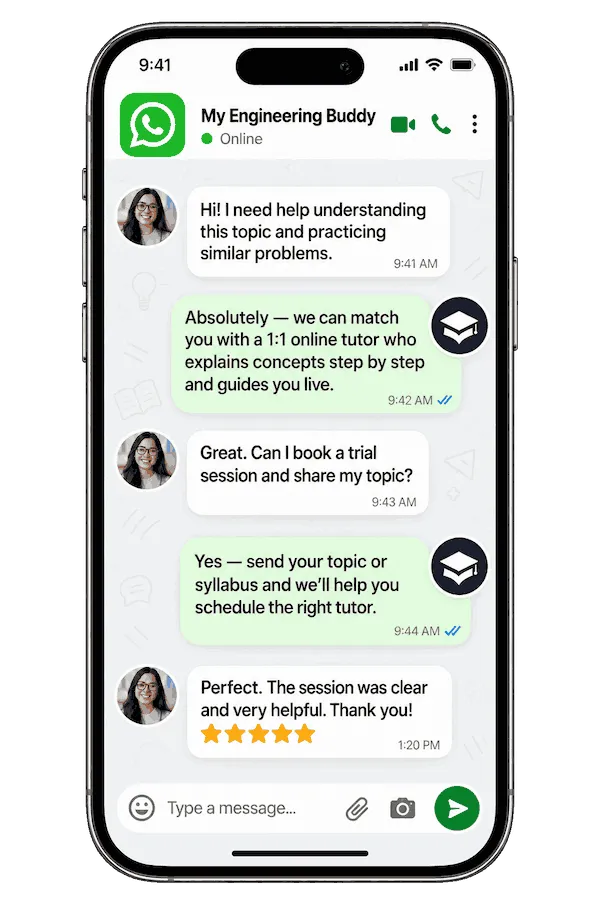
Unlike platforms where you fill out a form and wait, MEB responds in under a minute, 24/7. Tutor match takes under an hour. The $1 trial means you test before you commit. Everything runs over WhatsApp — no logins, no intake forms.
Pricing Guide
Fashion Sketching sessions run $20–$40/hr for most levels. Graduate-level portfolio work, professional retraining, or tutors with atelier or fashion house backgrounds are available at higher rates — up to $100/hr depending on the brief.
Rate factors: your current level, whether you’re working toward a course submission or professional portfolio, timeline pressure, and tutor availability.
Availability tightens sharply around portfolio deadlines and end-of-term studio assessments at major fashion programmes. If your deadline is in four weeks, don’t wait two of them.
For students targeting places at top fashion schools or professional roles at design houses, tutors with real atelier, brand, or editorial illustration backgrounds are available at premium rates — share your specific ambition and MEB will match the tier to it.
Start with the $1 trial — 30 minutes, no registration, no commitment. WhatsApp MEB for a quick quote.
FAQ
Is Fashion Sketching hard to learn?
The fundamentals — nine-head proportion, balance line, basic drape — are learnable in a few focused sessions. What takes longer is building the muscle memory for consistent line confidence and accurate fabric rendering. Most students see clear improvement within five to eight hours of 1:1 practice.
How many sessions will I need?
For a specific technique fix — proportion correction or flat drawing — four to six sessions is typical. For a full portfolio build from scratch, ten to twenty hours is realistic. The tutor maps a session sequence after the first diagnostic so you know the plan upfront.
How do you structure practice between sessions?
The tutor sets a specific practice task at the end of each session — named poses, a fabric rendering exercise, or a flat drawing of a particular garment. You bring that work to the next session for live review. Consistent between-session practice is the single biggest factor in how quickly technique improves.
Will the tutor match my current level and goals?
Yes. MEB matches tutors to your starting point — beginner croquis, intermediate rendering, advanced technical flats, or portfolio-level presentation. If your goal is a specific school’s portfolio brief or a professional project, tell MEB upfront and the match reflects that.
What happens in the first session?
You sketch a figure and a basic garment. The tutor observes your proportion habits, line weight, and construction logic — then identifies the two or three highest-impact areas to address first. The session plan is set by the end of that first hour.
Are online lessons as effective as in-person for Fashion Sketching?
Yes, with a tutor who uses a digital pen-pad. The ability to annotate directly over your sketch in real time replicates the over-the-shoulder correction of an in-person studio. Students across the US, UK, Australia, and Gulf consistently report the same quality of feedback online as they received face-to-face.
Can you help with both hand sketching and digital illustration in Procreate?
Yes. MEB tutors cover traditional hand sketching, Procreate-based digital illustration, and Adobe Illustrator flat drawing. If your course or portfolio brief requires a specific medium, mention it when you message MEB — the tutor match reflects that requirement.
I’ve never sketched a figure before. Where do I start?
The croquis construction track — nine-head proportion, balance line, basic stance — is designed for complete beginners. The first session establishes your baseline and sets a clear progression from there. No prior drawing experience is required to start.
Do you help with fashion illustration for a specific school’s portfolio brief?
Yes. Portfolio briefs from Parsons, Central Saint Martins, FIDM, and Savannah College of Art and Design each have distinct expectations around presentation, concept development, and technical drawing. Tell MEB which school and programme you’re targeting — the tutor is matched with that brief in mind.
Can I find a Fashion Sketching tutor for late-night sessions?
MEB operates across multiple time zones, 24/7. Students in the US, Gulf, and Australia regularly book sessions late evening or early morning. WhatsApp MEB with your time zone and preferred hours — a matched tutor is usually confirmed within an hour.
How do I get started?
Message MEB on WhatsApp. Share your current level, your goal — portfolio, course assessment, or technique improvement — and your time zone. MEB matches you with a verified Fashion Sketching tutor, usually within 24 hours. The first session is the $1 trial: 30 minutes live, no registration, no commitment.
Trust & Quality at My Engineering Buddy
Every MEB tutor goes through subject-specific screening before their first session — including a live demo evaluation reviewed against student feedback. Fashion Sketching tutors are assessed on figure construction accuracy, fabric rendering range, flat drawing clarity, and their ability to give corrective feedback on a student’s actual work. Rated 4.8/5 across 40,000+ verified reviews on Google.
MEB tutoring is guided learning — you understand the work, then submit it yourself. For full details on what we help with and what we don’t, read our Academic Integrity policy and Why MEB.
MEB has served 52,000+ students across the US, UK, Canada, Australia, the Gulf, and Europe since 2008 — across 2,800+ subjects. In Fashion Studies and related areas, that includes students working on Fashion Marketing Management tutoring, Textile Design help, and Fashion Merchandising tutoring — alongside Fashion Sketching. The methodology behind every session is documented at MEB’s tutoring methodology page.
A common pattern our tutors observe is that students who share a recent sketch before the first session — even one they’re embarrassed by — make faster progress than those who wait until they feel “ready.” The diagnostic only works with real work in front of it.
Explore Related Subjects
Students studying Fashion Sketching often also need support in:
Next Steps
Before your first session, have ready: your course outline or portfolio brief, a recent sketch or figure drawing you’ve attempted (even an imperfect one), and your submission or deadline date. The tutor handles everything else from there.
- Share your current level, goal, and time zone
- MEB matches you with a verified Fashion Sketching tutor — usually within 24 hours
- First session starts with a diagnostic so every minute is used well
Visit www.myengineeringbuddy.com for more on how MEB works.
WhatsApp to get started or email [email protected].
Reviewed by Subject Expert
This page has been carefully reviewed and validated by our subject expert to ensure accuracy and relevance.




