




~1 min
Average Reply Time
~1 hour
To Be Matched With A Tutor
30 Min Trial
75% Find Their Tutor On The 1st Trial
$20-35+/hr
Premium Yet Affordable Learning
Most students don’t fail Fashion Design because they lack creativity. They fail because no one ever corrected their toile construction, pattern grading, or portfolio sequencing before the deadline hit.
Fashion Design Tutor Online
Fashion Design is the study and practice of creating clothing and accessories — covering garment construction, textile selection, pattern cutting, draping, and visual communication. It equips students to translate creative concepts into technically viable, market-ready designs.
MEB provides 1:1 online tutoring and academic guidance in 2800+ advanced subjects, and Fashion Studies is one of our strongest areas. If you’ve searched for a Fashion Design tutor near me and found only generalist platforms, MEB is different — every tutor is matched to your exact course, module, and submission deadline. One session with the right tutor shifts what three weeks of self-directed work couldn’t.
- 1:1 online sessions tailored to your course syllabus and submission briefs
- Expert tutors with subject-specific knowledge in garment construction, pattern cutting, and design theory
- Flexible time zones — US, UK, Canada, Australia, Gulf
- Structured learning plan built after a diagnostic session
- Ethical academic guidance — you understand the work before you submit
52,000+ students across the US, UK, Canada, Australia, and the Gulf have used MEB since 2008 — including students in Fashion Studies subjects like Fashion Design, Fashion Communication, and Fashion Marketing Management.
Source: My Engineering Buddy, 2008–2025.
How Much Does a Fashion Design Tutor Cost?
Most Fashion Design tutoring at MEB runs $20–$40/hr, depending on your level and the complexity of what you’re working on. Graduate-level and specialist briefs can reach $100/hr. You can test the service for $1 before committing to anything longer.
| Level / Need | Typical Rate | What’s Included |
|---|---|---|
| Standard (most levels) | $20–$35/hr | 1:1 sessions, assignment guidance |
| Advanced / Specialist | $35–$70/hr | Expert tutor, niche depth |
| Graduate / Research Level | Up to $100/hr | Masters, MFA, PhD-level support |
| $1 Trial | $1 flat | 30 min live session or 1 homework question explained |
Tutor availability tightens sharply around end-of-semester portfolio deadlines and January collection briefs. Book early if your submission is within four weeks.
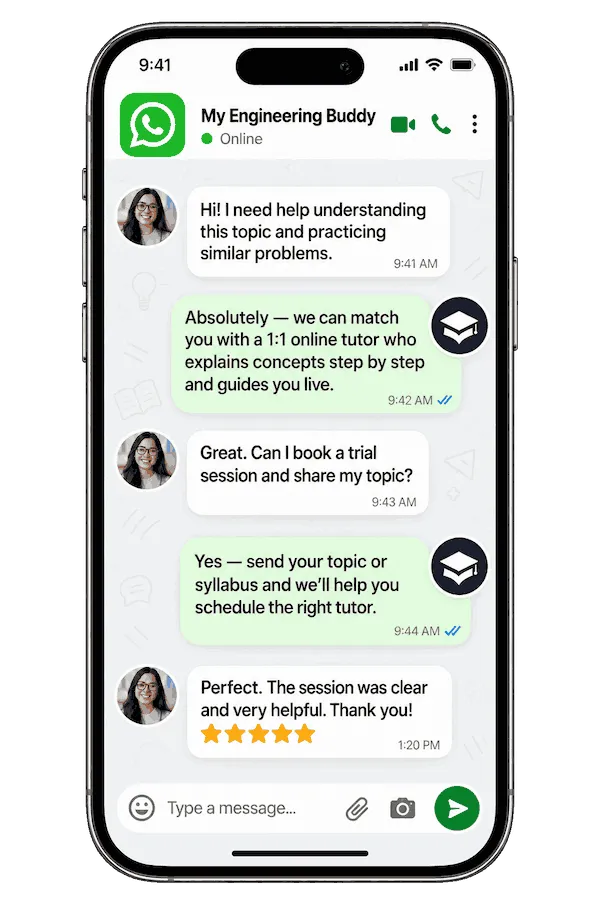
WhatsApp MEB for a quick quote — average response time under 1 minute.
Who This Fashion Design Tutoring Is For
Fashion Design spans foundation students learning flat pattern cutting for the first time through to MFA candidates presenting a full collection brief. MEB tutors work across all of these levels — and the problems they see repeat predictably.
- Undergraduate students stuck on toile development or garment construction critique
- Students with a university conditional offer depending on their portfolio grade
- Students 4–6 weeks from a major submission with unresolved draping or construction gaps
- Students retaking a module after a failed first attempt in pattern grading or design theory
- Parents watching a student’s confidence drop as their sketchbook falls behind the brief
- Graduate students at institutions such as Parsons, Central Saint Martins, SCAD, RMIT, or the Royal College of Art who need structured support on a specific module or thesis collection
- Students preparing for fashion sketching assessments or technical drawing components
Not sure if MEB covers your exact module? WhatsApp and ask — response is under a minute. And if you want to test quality before paying full rate, the $1 trial is the place to start.
At MEB, we’ve found that the students who struggle most with Fashion Design aren’t short on ideas — they’re short on technical correction. A tutor who can see your toile on screen and tell you exactly where the side seam is pulling changes the entire trajectory of a submission.
1:1 Tutoring vs Self-Study vs AI vs YouTube vs Online Courses
Self-study works if you’re disciplined and the brief is clear — but no one tells you your pattern is wrong until the crit. AI tools can explain concepts like ease allowance or dart manipulation in seconds, but they can’t look at your actual construction and diagnose what’s off. YouTube is excellent for technique overviews — draping demos, flat pattern introductions — but it stops the moment your specific fabric or brief diverges from the video. Online courses are structured but run at a fixed pace with no feedback on your individual work. 1:1 tutoring with MEB is calibrated to your exact garment, your exact brief, and your exact deadline — a tutor reviews what you’ve built and corrects it in real time, not after submission.
Outcomes: What You’ll Be Able To Do in Fashion Design
After working with an MEB Fashion Design tutor online, you’ll be able to construct a basic block and adapt it for specific silhouettes, analyse garment structure and identify where ease, seam allowance, or grain line decisions have gone wrong, present a design concept from initial sketch through to finished specification sheet, apply colour theory and fabric knowledge to a collection brief, and write a coherent design rationale that holds up in a formal critique or written submission.
Supporting a student through Fashion Design? MEB works directly with parents to set up sessions, track progress, and keep coursework on schedule. WhatsApp MEB — average response time is under a minute, 24/7.
Based on feedback from 40,000+ sessions collected by MEB from 2022 to 2025, 58% of students improved by one full grade after approximately 20 hours of 1:1 tutoring in subjects like Fashion Design. A further 23% achieved at least a half-grade improvement.
Source: MEB session feedback data, 2022–2025.
What We Cover in Fashion Design (Syllabus / Topics)

Garment Construction and Pattern Cutting
- Basic block development — bodice, sleeve, skirt, trouser
- Flat pattern cutting techniques: dart manipulation, slash and spread
- Toile construction and fitting analysis
- Seam allowances, grain line, and ease calculations
- Grading patterns across size ranges
- Fabric selection relative to construction method
- Specification sheets and technical drawings
Core references: Pattern Making for Fashion Design by Helen Joseph-Armstrong; Metric Pattern Cutting by Winifred Aldrich; The Practical Guide to Patternmaking for Fashion Designers by Lori Knowles.
Design Theory, Draping, and Visual Communication
- Principles of design: line, form, silhouette, proportion
- Draping on the stand — bias cut, cowl necklines, structured bodices
- Colour theory and its application in collection development
- Mood boards, design rationale, and concept development
- Fashion illustration and fashion sketching for presentation boards
- Fabric story and material research
Core references: Fashion Design Drawing Course by Caroline Tatham and Julian Seaman; The Fashion Design Manual by Pamela Stecker.
Fashion History, Studies, and Contextual Research
- History of Western fashion from the 19th century to contemporary
- Critical analysis of designers and their cultural contexts
- Ethical and sustainable fashion debates — fast fashion, labour supply chains
- Research methodologies for written design studies submissions
- Essay and critical writing skills for fashion theory modules
- Referencing and academic writing standards for art and design courses
Core references: Fashion: The Whole Story by Marnie Fogg; The Fashion Reader by Linda Welters and Abby Lillethun. Students also draw on resources from the UNESCO Institute for Statistics for global fashion industry data in contextual studies submissions.
What a Typical Fashion Design Session Looks Like
The tutor opens by checking where you left off — usually a specific construction problem or a design concept that wasn’t landing in your last submission. From there, you might share your sketchbook on screen, walk through a toile you’ve photographed, or work through a pattern cutting problem together while the tutor annotates directly using a digital pen-pad. If you’re preparing a portfolio or specification sheet, the tutor reviews your layout choices and gives precise feedback — not general encouragement. The session closes with a concrete task: adjust the shoulder seam on the toile, complete the next three pages of your sketchbook to the brief, or draft the design rationale paragraph that’s been stalling your progress. Next topic is noted before you disconnect.
How MEB Tutors Help You with Fashion Design (The Learning Loop)
Diagnose: In the first session, the tutor identifies where the gap actually is — whether that’s pattern construction, design concept clarity, written theory, or portfolio presentation. Students often come thinking the problem is one thing; it’s usually something adjacent.
Explain: The tutor works through the specific problem on screen — annotating a toile photograph, sketching a corrected seam line using a digital pen-pad, or walking through a design rationale structure with examples from your brief.
Practice: You attempt the next step with the tutor present. You re-draft the pattern. You write the first paragraph of the rationale. You sketch the revised silhouette. The tutor sees it happen in real time.
Feedback: Errors are corrected immediately and explained — not flagged after the fact. You understand why the dart is transferring incorrectly, not just that it is. That’s the difference between fixing one problem and fixing the underlying understanding.
Plan: Each session ends with a clear next step and a topic order built around your submission date. No guessing what to work on next.
Sessions run over Google Meet. The tutor uses a digital pen-pad or iPad with Apple Pencil to annotate construction diagrams, sketch corrections, and mark up specification sheets directly. Before your first session, have ready your course brief, any work you’ve attempted so far, and your submission deadline. The first session always starts with a diagnostic — so no time is wasted on topics you’ve already covered. Whether you need a quick catch-up before a major crit, structured revision over four to six weeks, or ongoing weekly support through the semester, the tutor maps the plan after that first diagnostic.
Start with the $1 trial — 30 minutes of live 1:1 tutoring that also serves as your first diagnostic.
Try your first session for $1 — 30 minutes of live 1:1 tutoring or one homework question explained in full. No registration. No commitment. WhatsApp MEB now and get matched within the hour.
Tutor Match Criteria (How We Pick Your Tutor)
Not every Fashion Design tutor is right for every brief. Here’s what MEB matches on.
Subject depth: Tutors are matched to your specific module — garment construction, fashion illustration, design theory, or contextual studies. A tutor who specialises in pattern cutting won’t be assigned to a fashion history essay module.
Tools: All tutors work over Google Meet with a digital pen-pad or iPad and Apple Pencil — essential for annotating sketches and construction diagrams live on screen.
Time zone: Matched to your region. US, UK, Gulf, Canada, and Australia all covered across morning and evening slots.
Goals: Whether you need to pass a construction critique, improve a written design studies grade, or build a portfolio strong enough for a competitive MFA application, the match is made on your stated goal — not a generic profile.
Unlike platforms where you fill out a form and wait, MEB responds in under a minute, 24/7. Tutor match takes under an hour. The $1 trial means you test before you commit. Everything runs over WhatsApp — no logins, no intake forms.
Study Plans (Pick One That Matches Your Goal)
MEB tutors build a session sequence after the first diagnostic — but here are the three most common plans for Fashion Design students. Catch-up (1–3 weeks): for students with a construction or design gap to close before a crit or submission. Exam and submission prep (4–8 weeks): structured sessions aligned to a specific portfolio deadline, written exam, or end-of-year assessment. Weekly support: ongoing sessions that track the semester brief by brief, keeping sketchbook and construction work on schedule. The tutor builds the exact sequence after the diagnostic.
Pricing Guide
Fashion Design tutoring starts at $20/hr for standard undergraduate and foundation level work. Graduate-level modules, MFA collection briefs, and specialist pattern grading support run higher — up to $100/hr depending on tutor expertise and project complexity.
Rate factors include your course level, the specific module or component, how close your deadline is, and tutor availability. Rates are confirmed before the first session — no surprises.
For students targeting competitive MFA programmes at institutions like Central Saint Martins, Parsons, or SCAD, tutors with professional industry or design research backgrounds are available at higher rates — share your specific goal and MEB will match the tier to your ambition.
Availability tightens around major submission windows in December and May. Start with the $1 trial — 30 minutes, no registration, no commitment. WhatsApp MEB for a quick quote.
MEB has supported Fashion Studies students — across pattern cutting, design theory, and contextual research modules — in 2,800+ subjects since 2008. Tutors are matched by module, not just by subject name.
Source: My Engineering Buddy, 2008–2025.
FAQ
Is Fashion Design hard?
It depends on where your gaps are. The technical side — pattern cutting, toile construction, grading — is precise and unforgiving. The written theory and design rationale components trip up students who underestimate the academic rigour. Most students find one side harder than the other.
How many sessions are needed?
Students with a single blocked problem — a toile that won’t fit, a portfolio layout stalling — often need two to four sessions. Students with broader gaps across construction and theory typically work with a tutor over six to twelve weeks ahead of a major submission.
Can you help with practice exercises?
MEB tutoring is guided learning — you understand the work, then submit it yourself. The tutor works through the brief with you, explains where your approach needs correction, and helps you develop the skills to complete it independently. See our Academic Integrity policy and Why MEB page for full details on what we help with and what we don’t.
Will the tutor match my exact syllabus or exam board?
Yes. MEB tutors are matched to your specific course — whether that’s a UK art and design A Level, a UAL-validated degree programme, a US university module, or an MFA brief. Share your course outline when you first WhatsApp and the match is made from there.
What happens in the first session?
The tutor runs a diagnostic — reviewing your current work, your brief, and your deadline. By the end of the first session, you’ll have a clear picture of where your gaps are and a session plan for closing them. No time is spent on topics you’ve already covered.
Is online tutoring as effective as in-person?
For Fashion Design, the main concern is that construction work is physical. In practice, photographing or filming your toile on a stand gives the tutor enough to diagnose construction problems accurately. Pattern cutting and all written and design theory components translate seamlessly to an online format.
Can you help with fashion CAD and technical software alongside design?
Yes. If your course includes digital pattern making or 3D garment visualisation, MEB tutors can support you in fashion CAD alongside your core design work. Many students find the technical software component is what falls behind first.
What’s the difference between Fashion Design and Fashion Studies at degree level?
Fashion Design programmes are predominantly studio-based — construction, draping, collection development. Fashion Studies degrees weight heavily toward theory, history, and critical writing. Most programmes blend both, but the ratio differs. Your tutor is matched to whichever component you’re working on.
Can you help if I’m preparing a portfolio for a Fashion Design degree application?
Yes. MEB tutors work with students building application portfolios for competitive programmes. Sessions focus on brief response, sketchbook development, construction documentation, and presenting your design process clearly. Share the institution’s portfolio requirements when you first contact MEB.
Do you offer group Fashion Design sessions?
No. MEB is strictly 1:1. Group sessions dilute the feedback loop that makes the difference on individual briefs — a tutor can’t review your specific toile or sketchbook meaningfully in a group format. Every session is built around your work and your deadline.
How do I get started?
Three steps: WhatsApp MEB, share your course brief and deadline, get matched with a tutor — usually within an hour. Your first session is the $1 trial — 30 minutes of live 1:1 tutoring or one assignment question explained in full. No registration required.
Trust & Quality at My Engineering Buddy
Every MEB tutor goes through a subject-specific vetting process — verified degree or professional credentials, a live demo session evaluated against a structured rubric, and ongoing review based on student feedback after every session. Rated 4.8/5 across 40,000+ verified reviews on Google. Tutors assigned to Fashion Design modules have demonstrable knowledge of the specific component they teach — a construction tutor is not assigned to a fashion theory essay, and vice versa.
MEB tutoring is guided learning — you understand the work, then submit it yourself. For full details on what we help with and what we don’t, read our Academic Integrity policy and Why MEB.
MEB has served 52,000+ students across the US, UK, Canada, Australia, Gulf, and Europe in 2,800+ subjects since 2008. Within Fashion Studies, that includes students working on fashion merchandising modules, textile design coursework, and core Fashion Design programmes. Find out more about how tutors are selected and sessions structured on our tutoring methodology page.
Students consistently tell us that the biggest shift in Fashion Design tutoring happens when feedback is specific — not “this needs more development” but “your side seam is pulling because your hip ease is 2cm under.” That level of precision is what 1:1 makes possible, and what every other format misses.
Explore Related Subjects
Students studying Fashion Design often also need support in:
Next Steps
Ready to get started? Here’s what to do:
- Share your course, module, and submission or exam deadline
- Share your time zone and available slots
- MEB matches you with a verified Fashion Design tutor — usually within the hour
- Your first session starts with a diagnostic so every minute is used on what matters
Before your first session, have ready: your course brief or syllabus, any sketchbook or construction work you’ve attempted, and your submission or deadline date. The tutor handles the rest.
Visit www.myengineeringbuddy.com for more on how MEB works.
WhatsApp to get started or email [email protected].
Reviewed by Subject Expert
This page has been carefully reviewed and validated by our subject expert to ensure accuracy and relevance.




