~1 min
Average Reply Time
~1 hour
To Be Matched With A Tutor
30 Min Trial
75% Find Their Tutor On The 1st Trial
$20-35+/hr
Premium Yet Affordable Learning
Most students who struggle with Islamic Law don’t lack effort. They lack a tutor who actually knows the difference between Hanafi and Maliki rulings — and can explain why it matters for their exam.
Islamic Law Tutor Online
Islamic Law is the body of religious and jurisprudential rulings derived from the Quran, Hadith, and classical scholarly tradition, governing worship, contracts, family, and criminal matters across four major Sunni and Shia schools of thought.
MEB offers 1:1 online tutoring and homework help in Islamic Law — covering Fiqh, Usul al-Fiqh, Sharia principles, and comparative jurisprudence at undergraduate, postgraduate, and LLM level. Whether you’re searching for an Islamic Law tutor near me or need structured help with a specific module, MEB matches you with a tutor who knows your syllabus and your exam format. Our law tutoring spans 2,800+ subjects — Islamic Law included. Sessions start at $20/hr, and you can test the match before committing.
- 1:1 online sessions tailored to your course, module, or exam board
- Expert verified tutors with specialist knowledge in Fiqh and Islamic jurisprudence
- Flexible time zones — US, UK, Canada, Australia, Gulf
- Structured learning plan built after a diagnostic session
- Ethical homework and assignment guidance — you understand before you submit
52,000+ students across the US, UK, Canada, Australia, and the Gulf have used MEB since 2008 — including students in Law subjects like Islamic Law, Jurisprudence, and International and Comparative Law.
Source: My Engineering Buddy, 2008–2025.
How Much Does an Islamic Law Tutor Cost?
Most Islamic Law tutoring sessions at MEB run $20–$40/hr. Graduate-level modules, LLM dissertation support, and highly specialist Fiqh topics can reach up to $100/hr. The $1 trial gets you 30 minutes of live tutoring or one homework question explained in full — before you commit to anything.
| Level / Need | Typical Rate | What’s Included |
|---|---|---|
| Undergraduate (most modules) | $20–$35/hr | 1:1 sessions, homework guidance |
| Postgraduate / LLM / Specialist Fiqh | $35–$70/hr | Expert tutor, dissertation support |
| $1 Trial | $1 flat | 30 min live session or 1 homework question |
Tutor availability tightens around semester deadlines — particularly November and April. Book early if your essay or exam falls within those windows.
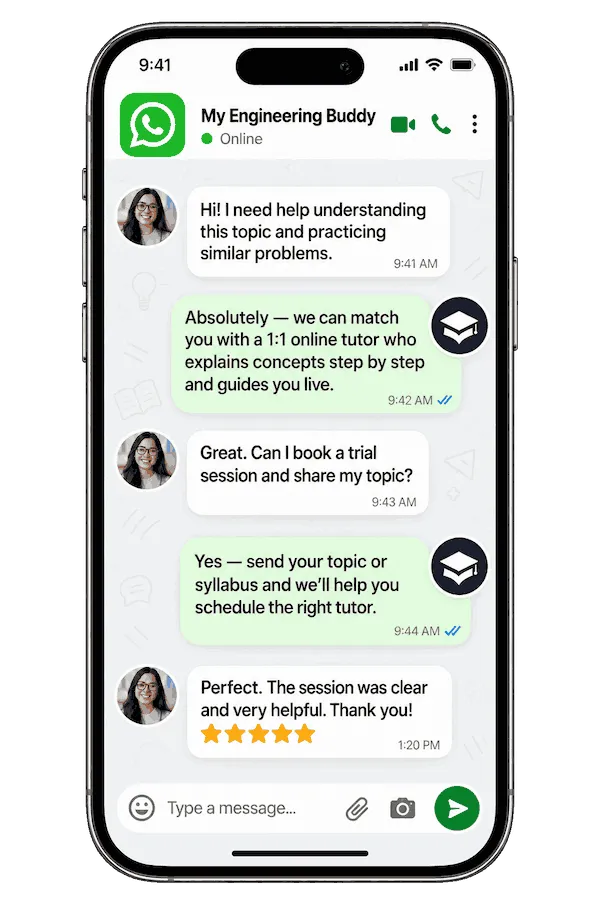
WhatsApp MEB for a quick quote — average response time under 1 minute.
Who This Islamic Law Tutoring Is For
Islamic Law sits at the intersection of theology, philosophy, and legal doctrine. Students find it harder than it looks on paper — not because the concepts are inaccessible, but because the reasoning structures are unfamiliar if you’ve trained in common law or civil law systems.
- Undergraduate law students taking an Islamic Law elective with no prior background in Fiqh
- LLM students writing dissertations on Sharia, Islamic finance law, or comparative family law
- Students retaking after a failed first attempt at an Islamic Law module exam
- Students with a university conditional offer depending on this grade
- Students needing family law tutoring who also need to understand Islamic marital and inheritance provisions
- Students in the Gulf, UK, and Canada enrolled in programmes that include Islamic jurisprudence as a compulsory component
Students from institutions including the University of London, SOAS, Georgetown Law, Leiden, and Gulf universities regularly use MEB for Islamic Law support. The $1 trial is a low-risk way to see whether the tutor match works before you book a full block of sessions.
1:1 Tutoring vs Self-Study vs AI vs YouTube vs Online Courses
Self-study works if you’re disciplined and the material is linear — Islamic Law is neither. AI tools give fast definitions but can’t tell you why a particular Hanafi ruling differs from the Shafi’i position or how that affects your essay argument. YouTube covers introductory Fiqh well; it stops when you hit a case-study problem. Online courses move at a fixed pace with no room for the specific gaps you actually have. A 1:1 Islamic Law tutor from MEB works through the exact rulings on your module, corrects your legal reasoning in real time, and adjusts the session when you’re stuck — not at the end of a week.
Outcomes: What You’ll Be Able To Do in Islamic Law
After structured 1:1 sessions, students can analyze the sources of Sharia across Quran, Sunnah, Ijma, and Qiyas and apply them to unseen fact patterns. You’ll explain the doctrinal differences between the four Sunni schools and articulate when those differences have legal or practical consequences. Students learn to write structured answers to problem questions involving Islamic family law, contract (Mu’amalat), or criminal provisions (Hudud and Ta’zir). You’ll apply Islamic legal reasoning to contemporary issues — Islamic finance, bioethics, human rights — with confidence. That’s what a well-matched tutor actually delivers.
Supporting a student through Islamic Law? MEB works directly with parents to set up sessions, track progress, and keep coursework on schedule. WhatsApp MEB — average response time is under a minute, 24/7.
Based on feedback from 40,000+ sessions collected by MEB from 2022 to 2025, 58% of students improved by one full grade after approximately 20 hours of 1:1 tutoring in subjects like Islamic Law. A further 23% achieved at least a half-grade improvement.
Source: MEB session feedback data, 2022–2025.
What We Cover in Islamic Law (Syllabus / Topics)

Track 1: Sources and Methodology of Islamic Law (Usul al-Fiqh)
- Primary sources: Quran and Sunnah — textual interpretation and hierarchy
- Secondary sources: Ijma (consensus), Qiyas (analogy), Ijtihad
- The four Sunni schools: Hanafi, Maliki, Shafi’i, Hanbali — doctrinal distinctions
- Shia jurisprudence: Ja’fari school and the role of the Imam
- Legal maxims (Qawa’id al-Fiqhiyya) and their application
- Modern reform debates: neo-Ijtihad and progressive Islamic legal thought
Core texts include Nyazee’s Theories of Islamic Law, Kamali’s Principles of Islamic Jurisprudence, and Hallaq’s A History of Islamic Legal Theories.
Track 2: Substantive Islamic Law (Fiqh)
- Personal status and family law: marriage (Nikah), divorce (Talaq, Khul), custody, inheritance
- Contract law (Mu’amalat): sale, lease, partnership — permissible and prohibited structures
- Islamic finance law: prohibition of Riba, Murabaha, Sukuk, and Musharaka structures
- Criminal law: Hudud offences, Ta’zir discretionary penalties, Qisas and Diya
- Constitutional dimensions: Sharia in state law — Gulf states, Malaysia, and mixed systems
- Property, waqf (endowments), and succession
Key texts include Ibn Rushd’s Bidayat al-Mujtahid, Schacht’s An Introduction to Islamic Law, and Vogel and Hayes’s Islamic Law and Finance.
Track 3: Islamic Law in Comparative and International Context
- Islamic law and international human rights frameworks — areas of convergence and tension
- Reception of Islamic law in Western legal systems: UK, Canada, EU
- Sharia councils and arbitration in non-Muslim-majority states
- Comparative family law: Islamic provisions alongside common law and civil law systems
- Islamic law and international humanitarian law
- Reform movements and codification in Muslim-majority states
Useful references include Baderin’s International Human Rights and Islamic Law, An-Na’im’s Toward an Islamic Reformation, and the Pew Research Center’s data on Islamic law and governance.
At MEB, we’ve found that students who struggle most with Islamic Law are often trying to memorise rulings rather than understand the reasoning behind them. Once the usul — the methodology — clicks, the substantive rules become far easier to apply in exam conditions.
What a Typical Islamic Law Session Looks Like
The tutor opens by checking where you got stuck in the previous session — often a specific ruling on Talaq procedure or the analogy used to derive a contract prohibition. You and the tutor then work through the problem together on screen: the tutor writes out the source texts, the chain of reasoning, and the school-by-school comparison using a digital pen-pad while you follow along. You’re asked to explain the Qiyas back in your own words, or draft a short paragraph of legal reasoning. The tutor corrects the argument structure — not just the answer. The session closes with a clear practice task, a named topic for next time, and a note on which past paper question maps to what you’ve just covered. Productive from the first minute. No filler.
How MEB Tutors Help You with Islamic Law (The Learning Loop)
Diagnose: In the first session, the tutor identifies whether the gap is in the sources (you can’t trace a ruling back to Quran or Hadith), the methodology (you can’t construct a Qiyas argument), or the application (you understand the doctrine but fall apart in problem questions). These are three different problems requiring three different approaches.
Explain: The tutor works through live examples using a digital pen-pad — writing out full chains of Islamic legal reasoning, mapping school differences on the same issue, and showing you exactly how an exam answer earns marks in each section.
Practice: You attempt the next problem with the tutor present. That’s the critical shift — from watching to doing, with immediate correction available.
Feedback: The tutor goes through your answer step by step, identifying where the legal argument broke down and why. Not just “this is wrong” — but where the reasoning diverged from the source and how an examiner would mark it.
Plan: At the end of each session, the tutor maps the next topic, assigns a specific reading or past question, and tracks overall progress against your deadline. No guesswork about what to do between sessions.
Sessions run on Google Meet. The tutor uses a digital pen-pad or iPad with Apple Pencil to write out legal texts and reasoning live. Before your first session, share your module outline, the specific topic or assignment you’re stuck on, and your exam or submission date. Start with the $1 trial — 30 minutes of live tutoring that also serves as your first diagnostic.
Try your first session for $1 — 30 minutes of live 1:1 tutoring or one homework question explained in full. No registration. No commitment. WhatsApp MEB now and get matched within the hour.
Tutor Match Criteria (How We Pick Your Tutor)
Not every law tutor knows Islamic jurisprudence. MEB matches on specifics.
Subject depth: The tutor must have studied Islamic Law at postgraduate level or taught it formally — not just covered it as a single elective. We check which schools of thought they can teach and whether they’re familiar with your specific module’s exam format.
Tools: Every session runs on Google Meet with a digital pen-pad or iPad and Apple Pencil — essential for writing out Arabic legal terms, source hierarchies, and structured arguments live.
Time zone: Matched to your region — US, UK, Gulf, Canada, or Australia. Gulf students in particular often need tutors available outside standard UK or US hours.
Goals: Whether you’re aiming for a first-class mark, passing a resit, completing a dissertation chapter on Islamic finance, or needing legal research help on a comparative Sharia project — the tutor is selected to match that specific objective, not a generic “Islamic Law” brief.
Unlike platforms where you fill out a form and wait, MEB responds in under a minute, 24/7. Tutor match takes under an hour. The $1 trial means you test before you commit. Everything runs over WhatsApp — no logins, no intake forms.
Study Plans (Pick One That Matches Your Goal)
The right plan depends on how much time you have and what’s at stake. Catch-up (1–3 weeks): students with specific gaps — one school of thought, one area of Fiqh, one essay component — who need targeted help before a deadline. Exam prep (4–8 weeks): structured revision across the full module syllabus, past paper practice, and timed answer work. Weekly support: ongoing sessions aligned to your semester, covering each topic as it’s taught and keeping assignments on track. The tutor builds the specific session sequence after the first diagnostic — not from a template.
Pricing Guide
Islamic Law tutoring at MEB starts at $20/hr for standard undergraduate modules. Specialist graduate-level support — LLM dissertation work, advanced Fiqh, comparative Sharia research — runs up to $100/hr. Rate factors include your level, topic complexity, session frequency, and tutor availability around peak exam periods.
For students targeting LLM programmes at institutions with strong Islamic law faculties, tutors with research or professional backgrounds in Islamic finance law and comparative jurisprudence are available at higher rates — share your specific goal and MEB will match the tier to your target.
Start with the $1 trial — 30 minutes, no registration, no commitment. WhatsApp MEB for a quick quote.
MEB has been matching students with specialist tutors since 2008. 18 years. 52,000+ students. The process is straightforward — WhatsApp, match, start. Most students are in a session within 24 hours of first contact.
Source: My Engineering Buddy, 2008–2025.
Students consistently tell us that the hardest part of Islamic Law isn’t the volume of material — it’s learning to write legal arguments in a tradition they weren’t trained in. Our tutors start there, not with a reading list.
FAQ
Is Islamic Law hard?
It’s demanding, particularly for students trained in common law or civil law systems. The reasoning structure — tracing rulings through Quran, Hadith, Ijma, and Qiyas — takes time to internalise. Most students find it manageable once the methodology is clear.
How many sessions are needed?
It depends on your starting point and deadline. Students with 4–8 weeks typically need 8–15 sessions. A single difficult essay or concept might need just 2–3 sessions. The tutor sets a realistic plan after the first diagnostic.
Can you help with homework and assignments?
Yes. MEB tutoring is guided learning — you understand the work, then submit it yourself. The tutor explains the legal reasoning, helps you structure your argument, and checks your analysis. See our Academic Integrity policy and Why MEB page for full details on what we help with and what we don’t.
Will the tutor match my exact syllabus or exam board?
Yes. Share your module outline, university, and assessment format when you make contact. MEB matches tutors to specific syllabi — not just the subject name. This applies whether you’re on a UK LLB, LLM, or a North American or Gulf programme.
What happens in the first session?
The tutor runs a diagnostic — identifying gaps in your understanding of the sources, your ability to construct Fiqh arguments, and your exam technique. The rest of the session addresses the most urgent gap. You leave with a clear plan and a specific task.
Is online tutoring as effective as in-person for Islamic Law?
Yes — often more so, because the tutor can write out Arabic source texts, legal hierarchies, and argument structures live on a shared digital pen-pad. Students in the Gulf, UK, and North America consistently report progress equivalent to face-to-face sessions.
Can I get Islamic Law help at short notice or late at night?
Yes. MEB operates 24/7. WhatsApp the team at any hour — average response time is under a minute. Tutors across multiple time zones are available, making late-night sessions for US students or early-morning sessions for Gulf students entirely normal.
What if I don’t like my assigned tutor?
Request a change — no friction, no explanation required. MEB will rematch you with a different Islamic Law tutor, usually within the same day. The $1 trial exists precisely so you can test the fit before committing to a block of sessions.
Do MEB tutors cover both Sunni and Shia jurisprudence?
Yes. MEB has tutors familiar with both Sunni schools (Hanafi, Maliki, Shafi’i, Hanbali) and Shia jurisprudence (Ja’fari). Specify your module’s focus when you make contact — the match is made on that detail, not a general “Islamic Law” brief.
Can you help with Islamic finance law specifically?
Yes. Islamic finance law — Murabaha, Sukuk, Musharaka, Riba prohibition, and related regulatory frameworks — is one of the most requested areas. Tutors with postgraduate and professional backgrounds in banking law and practice and Islamic finance are available. Share your specific topics when you get in touch.
How is Islamic Law different from general religious studies?
Islamic Law is a legal discipline, not a theology survey. The focus is on juridical reasoning — how rulings are derived, contested, and applied in legal and quasi-legal contexts. Students are assessed on legal argument, not theological belief or comparative religion. It sits firmly within law faculties, not religious studies departments.
How do I get started?
Start with the $1 trial — 30 minutes of live tutoring or one assignment question explained in full. Three steps: WhatsApp MEB, get matched with a verified Islamic Law tutor, and begin your trial session. No registration. No commitment beyond the first dollar.
Trust & Quality at My Engineering Buddy
Every MEB tutor goes through subject-specific screening that includes a live demo session evaluated against the depth of their Islamic Law knowledge — not just their academic credentials. Tutors are assessed on their familiarity with your exact module format, their ability to explain Usul al-Fiqh reasoning clearly, and their session feedback scores from previous students. Rated 4.8/5 across 40,000+ verified reviews on Google. MEB also uses ongoing session feedback to monitor tutor performance and rematch students when the fit isn’t working.
MEB tutoring is guided learning — you understand the work, then submit it yourself. For full details on what we help with and what we don’t, read our Academic Integrity policy and Why MEB.
MEB has been serving students in Law, including Islamic Law, Constitutional Law tutoring, and Human Rights Law tutoring across the US, UK, Canada, Australia, Gulf, and Europe since 2008. The platform covers 2,800+ subjects. See MEB’s tutoring methodology for how sessions are structured from diagnostic through to exam readiness.
MEB has operated since 2008 — before most online tutoring platforms existed. The approach hasn’t changed: one student, one tutor, one session at a time. 18 years of that is what 52,000+ students and a 4.8-star rating reflect.
Source: My Engineering Buddy, 2008–2025.
A common pattern our tutors observe is that Islamic Law students arrive with strong reading habits but weak exam technique. They know the scholarship. They can’t yet translate it into the structured legal argument the examiner is marking for. That gap closes quickly with practice.
Explore Related Subjects
Students studying Islamic Law often also need support in:
Next Steps
When you contact MEB, have the following ready:
- Your module name, university, and exam or submission date
- Your availability and time zone
- The specific topic, essay question, or past paper you’re struggling with
Before your first session, have ready: your course syllabus or module outline, a recent essay attempt or homework question you struggled with, and your exam or deadline date. The tutor handles the rest.
MEB matches you with a verified Islamic Law tutor — usually within 24 hours. The first session starts with a diagnostic so every minute is used well. Visit www.myengineeringbuddy.com for more on how MEB works.
WhatsApp to get started or email [email protected].
Reviewed by Subject Expert
This page has been carefully reviewed and validated by our subject expert to ensure accuracy and relevance.