




~1 min
Average Reply Time
~1 hour
To Be Matched With A Tutor
30 Min Trial
75% Find Their Tutor On The 1st Trial
$20-35+/hr
Premium Yet Affordable Learning
Hire The Best Rapid Prototyping Tutor


Most students don’t fail Rapid Prototyping because the theory is hard — they fail because nobody shows them how FDM tolerances, SLA post-processing, or DfAM constraints actually connect on a real part.
Rapid Prototyping Tutor Online
Rapid Prototyping is a set of manufacturing and design processes — including FDM, SLA, SLS, and DMLS — that produce physical parts directly from CAD data, equipping engineers to validate designs faster and reduce iteration cycles before full production.
If you’ve searched for a Rapid Prototyping tutor near me, you already know what’s missing: someone who can look at your SolidWorks geometry, your print-bed orientation decision, or your material selection rationale and tell you exactly where the logic breaks down. MEB connects you with a verified Mechanical Engineering tutor who specialises in Rapid Prototyping — from additive manufacturing fundamentals through to process selection, DfAM rules, and post-processing workflows. One outcome you can expect: you’ll stop guessing at support structures and start making decisions you can defend.
- 1:1 online sessions tailored to your exact course, project brief, or exam syllabus
- Expert-verified tutors with hands-on Rapid Prototyping and CAD/CAM knowledge
- Flexible time zones — US, UK, Canada, Australia, Gulf
- Structured learning plan built after a diagnostic session
- Ethical homework and assignment guidance — you understand the work, then submit it yourself
52,000+ students across the US, UK, Canada, Australia, and the Gulf have used MEB since 2008 — including students in Mechanical Engineering subjects like Rapid Prototyping, Computer Aided Manufacturing, and Product Design.
Source: My Engineering Buddy, 2008–2025.
How Much Does a Rapid Prototyping Tutor Cost?
Most Rapid Prototyping sessions run $20–$40/hr. Graduate-level or specialist process topics — DMLS parameter optimisation, multi-material jetting — can reach $70–$100/hr. Start with the $1 trial: 30 minutes of live 1:1 tutoring, or one assignment question explained in full.
| Level / Need | Typical Rate | What’s Included |
|---|---|---|
| Standard (undergrad modules) | $20–$40/hr | 1:1 sessions, homework guidance |
| Advanced / Specialist (grad, niche processes) | $40–$100/hr | Expert tutor, deep process knowledge |
| $1 Trial | $1 flat | 30 min live session or 1 homework question |
Tutor availability tightens around end-of-semester project deadlines. Book early if you’re within six weeks of a submission.
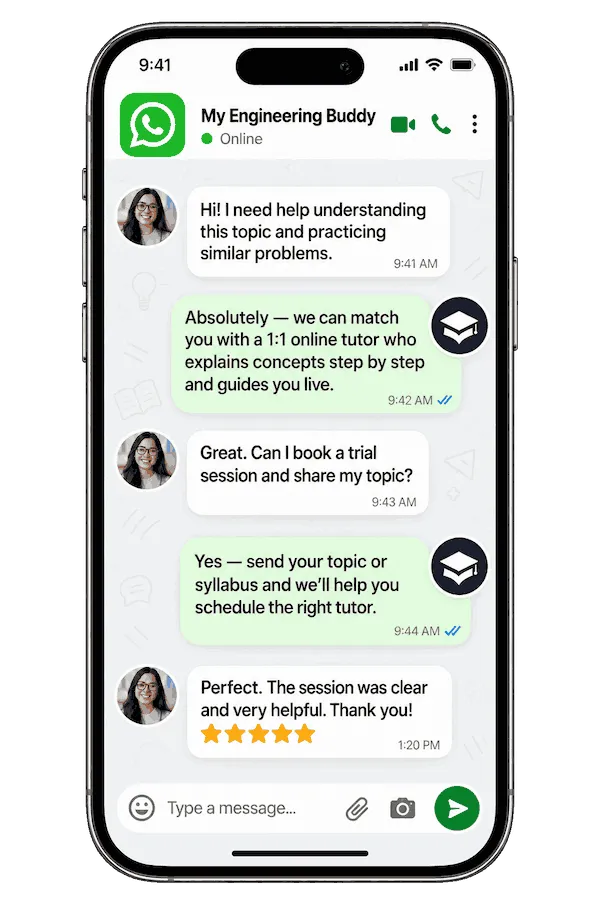
WhatsApp MEB for a quick quote — average response time under 1 minute.
Who This Rapid Prototyping Tutoring Is For
This is for engineering students who can run a printer but can’t yet explain why they chose SLA over FDM for a given application — and for those whose design-for-additive-manufacturing report came back with “justify your process selection” in red.
- Undergraduate mechanical, industrial, or aerospace engineering students tackling RP modules
- Masters and PhD students working on additive manufacturing research or thesis chapters
- Students whose coursework or project submission deadline is approaching fast
- Students who failed or underperformed in a previous RP or manufacturing module and are retaking it
- Parents watching a child’s engineering grades drop while assignment deadlines stack up
- Students at universities including MIT, Georgia Tech, Michigan, Imperial College London, TU Delft, ETH Zurich, UNSW, and the University of Toronto
At MEB, we’ve found that Rapid Prototyping students who struggle most are rarely confused about how the machine works. The gap is almost always in linking process physics — layer adhesion, shrinkage, support-structure mechanics — to design decisions on the drawing. That’s exactly what the first session targets.
1:1 Tutoring vs Self-Study vs AI vs YouTube vs Online Courses
Self-study works if you’re disciplined, but Rapid Prototyping has too many interdependent variables for trial-and-error alone. AI tools give fast explanations but can’t look at your STL file and diagnose orientation errors. YouTube is great for watching a print run — it stops the moment you need to justify your layer height to an examiner. Online courses move at a fixed pace and skip the DfAM nuances your specific brief requires. 1:1 tutoring with MEB is live, calibrated to your exact module, and corrects your reasoning in real time — not after you’ve already submitted.
Outcomes: What You’ll Be Able To Do in Rapid Prototyping
After working with an online Rapid Prototyping tutor through MEB, you’ll be able to apply DfAM principles to select the right process for a given part geometry, material, and tolerance requirement. You’ll analyze support structure placement and predict failure points before committing to a print run. You’ll model the trade-offs between FDM, SLA, and SLS in terms of surface finish, mechanical strength, and build cost. You’ll explain post-processing steps — sanding, curing, heat treatment — in the context of end-use performance. And you’ll present a defensible process justification in a design report or viva.
Based on feedback from 40,000+ sessions collected by MEB from 2022 to 2025, 58% of students improved by one full grade after approximately 20 hours of 1:1 tutoring in subjects like Rapid Prototyping. A further 23% achieved at least a half-grade improvement.
Source: MEB session feedback data, 2022–2025.
Try your first session for $1 — 30 minutes of live 1:1 tutoring or one homework question explained in full. No registration. No commitment. WhatsApp MEB now and get matched within the hour.
What We Cover in Rapid Prototyping (Syllabus / Topics)

Process Fundamentals and Technology Selection
- FDM: layer deposition, infill patterns, layer height, and print speed trade-offs
- SLA and DLP: photopolymer curing mechanics, resin selection, UV exposure parameters
- SLS and DMLS: powder bed fusion, sintering temperatures, metal AM considerations
- Material jetting, binder jetting, and sheet lamination — when each applies
- Process selection matrices: tolerance, surface finish, mechanical properties, cost
- Comparing subtractive vs additive vs hybrid manufacturing routes
Key texts: Additive Manufacturing Technologies — Gibson, Rosen & Stucker; Rapid Prototyping: Principles and Applications — Chua, Leong & Lim.
Design for Additive Manufacturing (DfAM)
- Overhang rules, minimum wall thickness, and self-supporting angle limits
- Support structure strategy: placement, breakaway vs soluble, minimisation techniques
- Topology optimisation and lattice structure design
- Part orientation on build platform — strength, surface finish, and support trade-offs
- Tolerancing and fit: how additive processes affect dimensional accuracy
- Design consolidation: replacing multi-component assemblies with single printed parts
Key texts: Design for Additive Manufacturing — Laverne & Segonds; Topology Optimisation — Bendsoe & Sigmund.
Post-Processing, Metrology, and Quality Control
- Support removal techniques and surface finishing: sanding, vapour smoothing, painting
- Thermal post-processing: annealing, HIP for metal parts
- Dimensional inspection: calipers, CMM, 3D scanning and deviation analysis
- Mechanical testing of printed parts: tensile, flexural, and fatigue considerations
- Quality standards and certification frameworks relevant to manufacturing processes
- Failure analysis: delamination, warping, porosity, and corrective action
Key texts: Mechanical Measurements and Metrology — Jain; Additive Manufacturing: Materials, Processes, Quantifications and Applications — Zhang & Jung.
What a Typical Rapid Prototyping Session Looks Like
The tutor opens by checking the previous topic — usually process selection rationale or DfAM constraint application from a previous assignment draft. Then student and tutor work through the live problem on screen: if it’s a support structure placement exercise, the tutor pulls up the STL in a shared viewer and walks through overhang angle calculations and orientation options step by step. If it’s a design report section, the tutor marks up the reasoning in real time using a digital pen-pad. The student replicates the logic on a second example — or explains the reasoning back — before the tutor accepts it. Session closes with a concrete practice task: redesign a given part to reduce support volume by 30%, or write the process justification paragraph for a new material. Next topic is noted before the call ends.
How MEB Tutors Help You with Rapid Prototyping (The Learning Loop)
Diagnose: In the first session, the tutor identifies whether the gap is conceptual (you don’t know why SLA shrinks differently from FDM), procedural (you can’t set up a build orientation workflow), or analytical (you can’t justify process choice in writing). These are three different problems — the session plan depends on which one applies.
Explain: The tutor works through live problems on screen using a digital pen-pad — annotating STL cross-sections, sketching layer adhesion mechanics, or walking through a design-for-AM checklist. Nothing is described in the abstract when it can be shown on the part.
Practice: You attempt the next problem while the tutor is present. That means you get corrected at the decision point — not two days later when the assignment is already submitted.
Feedback: The tutor explains exactly where marks were lost and why — not just “this is wrong” but “your support placement added 40% to build time and you didn’t account for removal access.” That level of specificity is what moves the grade.
Plan: At the end of each session, the tutor maps the next topic, sets a practice task, and adjusts the sequence based on how far you’ve moved. If the exam or submission is close, the plan tightens accordingly.
Sessions run on Google Meet. The tutor uses a digital pen-pad or iPad with Apple Pencil to annotate diagrams and CAD outputs live. Before your first session, have ready your course brief or assignment spec, any CAD files or print outputs you’re struggling with, and your submission or exam date. The first session is your diagnostic — it also serves as your $1 trial, so 30 minutes of real work starts immediately.
Need a quick catch-up before a project deadline, structured revision over 4–8 weeks, or ongoing weekly support through the semester? The tutor maps the session plan after the first diagnostic — whether that’s crash revision on SLS parameters or a steady week-by-week run through your RP module syllabus.
Students consistently tell us that the moment it clicks in Rapid Prototyping is when they stop thinking of the printer as a black box and start reasoning about every parameter as a design decision. That shift usually takes two or three focused sessions with the right tutor.
Tutor Match Criteria (How We Pick Your Tutor)
Not every mechanical engineering tutor knows additive manufacturing at depth. Here’s what MEB checks before matching you.
Subject depth: Tutors are matched to your specific module level — undergraduate RP fundamentals, graduate DfAM, or research-focused metal AM — not just “mechanical engineering.”
Tools: All sessions use Google Meet with digital pen-pad or iPad and Apple Pencil annotation. Tutors are comfortable working with shared CAD files and STL viewers.
Time zone: Matched to your region — US, UK, Gulf, Canada, Australia. No 3am sessions unless you want them.
Goals: Whether you need exam performance, assignment grades, conceptual depth, or research support, the tutor brief reflects that before the first session starts.
Unlike platforms where you fill out a form and wait, MEB responds in under a minute, 24/7. Tutor match takes under an hour. The $1 trial means you test before you commit. Everything runs over WhatsApp — no logins, no intake forms.
Pricing Guide
Rapid Prototyping tutoring starts at $20/hr for standard undergraduate modules. Graduate-level topics — topology optimisation, metal AM process development, multi-material jetting — typically run $60–$100/hr depending on tutor background and timeline.
Rate factors: your course level, the specific process area, how close the deadline is, and tutor availability. Rates tighten during end-of-semester crunch — early booking locks in your slot.
For students targeting roles at leading aerospace, automotive, or medical device companies — where AM process knowledge is a genuine differentiator — tutors with professional industry backgrounds are available at higher rates. Share your specific goal and MEB matches the tier to it.
Start with the $1 trial — 30 minutes, no registration, no commitment. WhatsApp MEB for a quick quote.
FAQ
Is Rapid Prototyping hard?
It’s less about mathematical difficulty and more about connecting process physics to design decisions. Students struggle most with justifying their choices analytically — not with operating the equipment. A tutor closes that gap faster than re-reading the lecture slides.
How many sessions are needed?
Most students working on a specific assignment or module need 4–8 sessions. Students covering a full RP syllabus for exams typically need 10–15 hours. The diagnostic session maps this precisely so you’re not buying sessions you don’t need.
Can you help with homework and assignments?
Yes — MEB tutoring is guided learning. You understand the work, then submit it yourself. This applies to design reports, process selection analyses, DfAM assignments, and lab write-ups. See our Academic Integrity policy and Why MEB page for full details on what we help with and what we don’t.
Will the tutor match my exact syllabus or exam board?
Yes. Share your course outline, university, and assignment brief when you WhatsApp MEB. Tutors are matched to your specific module — not a generic RP curriculum. If your module focuses on polymer AM only, or includes metal AM in depth, that shapes the match.
What happens in the first session?
The tutor runs a diagnostic — asks you to walk through a recent assignment or explain a concept in your own words. That reveals where the actual gap is. The rest of the session starts working on it. You leave with a practice task and a session plan.
Is online tutoring as effective as in-person?
For Rapid Prototyping — yes, often more so. The tutor can annotate CAD outputs and STL files directly on screen, share process selection tools, and work through design-for-AM problems live. You don’t need to be in the same room to analyse a print failure together.
Can I get Rapid Prototyping help at short notice — including late at night?
Yes. MEB operates 24/7 across time zones. WhatsApp response time averages under a minute. If a submission deadline is tomorrow morning and you’re stuck on support structure justification at midnight, message now — a tutor can be matched quickly.
What if I don’t like my assigned tutor?
Tell MEB immediately via WhatsApp. You’re reassigned without delay, no questions asked. The $1 trial exists precisely so you can assess the match before committing to a full session block. Fit matters — MEB doesn’t lock you in.
FDM vs SLA — which one should I use for my project, and will the tutor help me decide?
Yes — this is one of the most common questions tutors field. The answer depends on your tolerance requirements, surface finish specification, material properties needed, and available post-processing. The tutor walks you through a structured process selection matrix for your specific part and brief.
Can you help with topology optimisation and DfAM for metal additive manufacturing?
Yes. MEB has tutors with graduate and industry-level expertise in metal AM — DMLS, EBM, and SLM — including topology optimisation workflows in tools like Altair OptiStruct or nTopology. Share your software and brief when you message MEB.
Do you offer group Rapid Prototyping sessions?
MEB specialises in 1:1 tutoring — that’s what produces results. Group sessions aren’t available through the platform. If you and a lab partner both need help, each books separately; occasionally MEB can arrange paired sessions on request via WhatsApp.
How do I get started?
Three steps: WhatsApp MEB, describe your module or assignment, get matched with a verified Rapid Prototyping tutor — usually within the hour. Your first session is the $1 trial: 30 minutes of live tutoring or one question explained in full. No forms, no waiting.
Trust & Quality at My Engineering Buddy
Every MEB tutor goes through subject-specific vetting — not a general engineering screen. For Rapid Prototyping, that means demonstrating knowledge of additive processes, DfAM principles, and the ability to explain process selection decisions clearly. Tutors complete a live demo evaluation before they’re approved, and ongoing session feedback keeps the standard in place. Rated 4.8/5 across 40,000+ verified reviews on Google.
MEB tutoring is guided learning — you understand the work, then submit it yourself. For full details on what we help with and what we don’t, read our Academic Integrity policy and Why MEB.
MEB has served 52,000+ students across the US, UK, Canada, Australia, the Gulf, and Europe in 2,800+ subjects since 2008. Mechanical Engineering is one of our strongest subject areas — including Finite Element Analysis tutoring, Mechanics of Materials help, and Thermodynamics tutoring. See our tutoring methodology for how sessions are structured across all subjects.
MEB has operated since 2008. That’s 18 years of matching students to the right tutor — not an algorithm, not a marketplace. A person reads your WhatsApp message and finds the right match within the hour.
Source: My Engineering Buddy, 2008–2025.
Explore Related Subjects
Students studying Rapid Prototyping often also need support in:
- Product Lifecycle Management (PLM)
- Solid Mechanics
- Engineering Statics
- Computational Mechanics
- COMSOL Multiphysics
- Heat Transfer
- Engineering Dynamics
Next Steps
Before your first session, have ready: your course brief or assignment spec (or module syllabus), any CAD files or past assignment feedback you’re working from, and your submission or exam date. The tutor handles the rest.
- Share your exam board or university module code, the hardest component you’re facing, and your current timeline
- Share your availability and time zone
- MEB matches you with a verified Rapid Prototyping tutor — usually within the hour
First session starts with a diagnostic so every minute is used well.
Visit www.myengineeringbuddy.com for more on how MEB works.
WhatsApp to get started or email [email protected].
Reviewed by Subject Expert
This page has been carefully reviewed and validated by our subject expert to ensure accuracy and relevance.




