~1 min
Average Reply Time
~1 hour
To Be Matched With A Tutor
30 Min Trial
75% Find Their Tutor On The 1st Trial
$20-35+/hr
Premium Yet Affordable Learning
Hire The Best COMSOL Multiphysics Tutor










Most students don’t fail COMSOL Multiphysics because the physics is too hard — they fail because no one showed them how the solver actually works.
COMSOL Multiphysics Tutor Online
COMSOL Multiphysics is a finite element analysis and simulation software platform used to model and solve coupled physics problems — including heat transfer, fluid flow, structural mechanics, and electromagnetics — across engineering and applied science.
If you’re searching for a COMSOL Multiphysics tutor near me, MEB gives you 1:1 online tutoring and project help in COMSOL Multiphysics from engineers who use it. Whether you’re building a multiphysics model for the first time or stuck debugging a meshing error at 2 a.m., a matched tutor from MEB’s mechanical engineering tutoring pool is ready to work through it with you — live, on screen, step by step.
- 1:1 online sessions tailored to your course module, thesis chapter, or project brief
- Expert-verified tutors with hands-on COMSOL simulation experience
- Flexible time zones — US, UK, Canada, Australia, Gulf
- Structured learning plan built after a diagnostic session
- Guided project support — we explain the physics and workflow, you build the model
52,000+ students across the US, UK, Canada, Australia, and the Gulf have used MEB since 2008 — including students in Mechanical Engineering subjects like COMSOL Multiphysics, Finite Element Analysis, and Fluid Mechanics.
Source: My Engineering Buddy, 2008–2025.
How Much Does a COMSOL Multiphysics Tutor Cost?
Most COMSOL Multiphysics tutoring sessions run $20–$40/hr. Advanced simulation work — multiphysics coupling, custom physics interfaces, thesis-level projects — can reach $70–$100/hr depending on tutor background and complexity. Start with the $1 trial: 30 minutes of live tutoring or one project question explained in full.
| Level / Need | Typical Rate | What’s Included |
|---|---|---|
| Standard (undergraduate modules) | $20–$40/hr | 1:1 sessions, model setup guidance |
| Advanced / Graduate / Thesis | $40–$100/hr | Expert tutor, multiphysics coupling, research depth |
| $1 Trial | $1 flat | 30 min live session or one project question explained |
Tutor availability tightens at semester end and before thesis submission windows. Book early if you’re within six weeks of a deadline.
WhatsApp MEB for a quick quote — average response time under 1 minute.
Who This COMSOL Multiphysics Tutoring Is For
COMSOL is taught across mechanical, chemical, electrical, and biomedical engineering programmes — often with very little structured software instruction. Most students are handed the software and expected to figure it out. MEB exists for the gap between “here’s COMSOL” and “here’s a working model.”
- Undergraduate students in engineering courses using COMSOL for the first time
- Masters and PhD students building simulation models for dissertations or research papers
- Students whose thesis submission deadline is approaching with a model that won’t converge
- Students returning after a failed or incomplete simulation project who need to understand what went wrong
- Engineers in industry who need to upskill on COMSOL for new project requirements
- Students in courses at MIT, ETH Zurich, TU Delft, Imperial College London, Georgia Tech, or similar institutions where COMSOL is a required tool
At MEB, we’ve found that the single biggest barrier in COMSOL isn’t the underlying physics — it’s the interface. Students who understand heat transfer or fluid dynamics still get stuck on boundary condition setup, mesh refinement, and solver configuration. That’s what the first session targets.
1:1 Tutoring vs Self-Study vs AI vs YouTube vs Online Courses
Self-study works if you have time and patience for trial and error — COMSOL’s documentation is extensive but not beginner-friendly. AI tools explain concepts quickly but can’t debug your specific model file or tell you why your mesh is causing divergence. YouTube has solid intro tutorials that stop exactly when your real problem starts. Online courses give you a structured walkthrough of COMSOL features but can’t adapt to your specific physics problem or thesis requirement. 1:1 tutoring with MEB puts a working COMSOL engineer on screen with you — live, calibrated to your model, correcting errors as they appear in the software.
Outcomes: What You’ll Be Able To Do in COMSOL Multiphysics
After working with an MEB tutor, you’ll be able to set up geometry and physics interfaces correctly for your specific problem type — whether that’s laminar pipe flow, structural stress analysis, or coupled thermal-electric simulation. You’ll apply appropriate boundary conditions without guessing, refine your mesh strategically to balance accuracy and solve time, and interpret solver logs to diagnose convergence failures before they cost you hours. You’ll present your results with confidence — explaining what the colour maps actually mean and why the output validates or challenges your hypothesis.
Based on feedback from 40,000+ sessions collected by MEB from 2022 to 2025, 58% of students improved by one full grade after approximately 20 hours of 1:1 tutoring in subjects like COMSOL Multiphysics. A further 23% achieved at least a half-grade improvement.
Source: MEB session feedback data, 2022–2025.
What We Cover in COMSOL Multiphysics (Syllabus / Topics)

Track 1: COMSOL Fundamentals and Model Setup
- COMSOL interface navigation, model wizard, and file structure
- Geometry creation and import from CAD tools
- Defining materials and material properties
- Selecting and configuring physics interfaces (Heat Transfer, Solid Mechanics, CFD, etc.)
- Setting up boundary conditions and initial conditions correctly
- Running stationary, time-dependent, and parametric studies
- Post-processing: surface plots, streamlines, derived values, and data export
Recommended texts: COMSOL Multiphysics Reference Manual (COMSOL Inc.); Introduction to Finite Element Analysis Using COMSOL Multiphysics by Bidya Sagar Pani.
Track 2: Coupled Physics and Advanced Simulation
- Multiphysics coupling: thermal-structural, fluid-structure interaction (FSI), electromagnetics-heat
- Meshing strategies: mapped, swept, and free tetrahedral meshes; mesh refinement and convergence studies
- Solver selection: MUMPS, PARDISO, iterative solvers — when and why
- Parametric sweeps and optimisation studies
- Sensitivity analysis and uncertainty quantification in COMSOL
- Nonlinear solver settings and convergence troubleshooting
Recommended texts: Multiphysics Modeling with COMSOL by Roger Grahn and Mats Bäckström; Nonlinear Finite Element Analysis by J.N. Reddy — useful alongside nonlinear finite element analysis tutoring for context.
Track 3: Application-Specific Modules
- Heat Transfer Module: conduction, convection, radiation, phase change
- CFD Module: incompressible and compressible flow, turbulence models (k-ε, k-ω)
- Structural Mechanics Module: static stress, modal analysis, fatigue
- AC/DC and RF Modules: electromagnetic field simulation
- Chemical Reaction Engineering Module: transport and reaction coupling
- LiveLink for MATLAB and SOLIDWORKS integration
Recommended texts: Module-specific Application Libraries shipped with COMSOL; Computational Fluid Dynamics by Anderson — complements fluid dynamics tutoring when CFD module work is involved.
What a Typical COMSOL Multiphysics Session Looks Like
The tutor opens by reviewing where you left off — typically a specific convergence issue, a boundary condition that wasn’t behaving as expected, or a mesh that was taking 40 minutes to solve. You share your screen and walk through the model file together. The tutor uses a digital pen-pad to annotate directly on what you’re seeing — drawing physics diagrams, marking where the error is occurring in the geometry or solver log. You attempt the fix, explain your reasoning out loud, and the tutor corrects in real time. The session closes with a concrete task: reproduce the working model on a simplified geometry, then extend it to your actual domain before the next session.
How MEB Tutors Help You with COMSOL Multiphysics (The Learning Loop)
Diagnose: In the first session, the tutor looks at your existing model — or starts from your project brief if you have nothing yet — and identifies exactly where the understanding breaks down. Is it physics setup? Meshing logic? Solver configuration? Post-processing interpretation? The diagnosis takes 15–20 minutes and determines everything that follows.
Explain: The tutor works through the problem live — not by doing it for you, but by running through the logic on a shared screen with a digital pen-pad. They explain why COMSOL behaves the way it does at each step: why that boundary condition causes backflow, why refining the mesh at the wall changes your pressure drop reading.
Practice: You replicate the setup on a related problem while the tutor watches. This is where most of the learning happens. Doing it once under guidance is not the same as doing it again solo — this step closes that gap.
Feedback: The tutor flags errors before they compound. A wrong physics coupling at model setup will produce plausible-looking but completely wrong results — feedback in the moment prevents that from reaching your report or thesis.
Plan: Each session ends with a specific next task and a topic for the following session. If you’re on a thesis timeline, the tutor maps sessions to chapter milestones.
Sessions run over Google Meet. The tutor uses a digital pen-pad or iPad with Apple Pencil. Before the first session, share your project brief or course outline, any model files you’ve already built, and your deadline. The first session covers both diagnosis and the first working model pass.
Start with the $1 trial — 30 minutes of live tutoring that also serves as your first diagnostic.
Try your first session for $1 — 30 minutes of live 1:1 tutoring or one homework question explained in full. No registration. No commitment. WhatsApp MEB now and get matched within the hour.
Tutor Match Criteria (How We Pick Your Tutor)
Not every engineer who knows COMSOL can teach it. MEB’s matching process filters on four things.
Subject depth: Tutors are matched by the specific COMSOL module your project requires — a tutor with a background in structural FEA is not automatically the right fit for a coupled electromagnetics-heat problem.
Tools: Every tutor works over Google Meet with a digital pen-pad or iPad and Apple Pencil — annotating your model in real time, not describing it verbally.
Time zone: Matched to your region — US, UK, Gulf, Canada, Australia — so you’re not scheduling at 4 a.m.
Goals: Whether you need conceptual grounding in finite element theory, hands-on model-building support, or thesis-chapter validation, the tutor is briefed on your specific objective before session one.
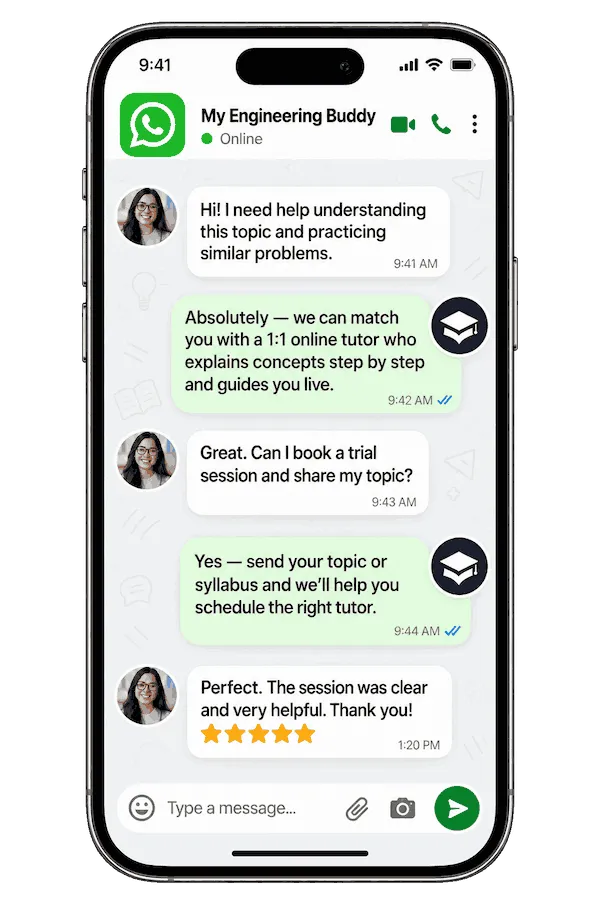
Unlike platforms where you fill out a form and wait, MEB responds in under a minute, 24/7. Tutor match takes under an hour. The $1 trial means you test before you commit. Everything runs over WhatsApp — no logins, no intake forms.
Students consistently tell us that the first session is the one that changes how they think about COMSOL. Not because the tutor taught them more features — but because the tutor showed them a mental model for why the software makes the decisions it does. That shift sticks.
Pricing Guide
COMSOL Multiphysics tutoring starts at $20/hr for standard undergraduate module support. Graduate-level simulation work, multiphysics coupling, and research-adjacent sessions typically run $40–$70/hr. Specialist tutors with industry simulation backgrounds — relevant for students targeting roles at firms like ANSYS ecosystem companies, aerospace contractors, or biomedical device manufacturers — are available at higher rates. Share your specific project or thesis goal and MEB matches the tutor tier to what you actually need.
Rate factors: level of physics complexity, number of coupled physics interfaces, timeline urgency, and tutor availability. Availability tightens in April–May and November–December when engineering thesis submissions peak globally.
Start with the $1 trial — 30 minutes, no registration, no commitment. WhatsApp MEB for a quick quote.
FAQ
Is COMSOL Multiphysics hard to learn?
COMSOL has a steep initial curve — the interface is not intuitive and the documentation assumes you already understand FEA theory. Most students find the physics familiar but the software workflow unfamiliar. A few targeted sessions close that gap faster than hours of solo experimentation.
How many sessions will I need?
Undergraduate project support: typically 4–8 sessions. Masters dissertation or PhD chapter work: 8–15 sessions depending on model complexity. A single convergence-debugging session can resolve a two-week block in two hours. The tutor maps the sequence after the first diagnostic.
Can you help with my project and portfolio work?
MEB provides guided project support — the tutor explains the physics, the workflow, and the reasoning. You build the model and submit the work yourself. See our Policies page for full details on what we help with and what we don’t.
Will the tutor match my exact syllabus or course module?
Yes. Before matching, you share your course outline, the specific COMSOL module being used (Heat Transfer, Structural Mechanics, CFD, etc.), and your project brief. The tutor is selected against that brief — not assigned generically.
What happens in the first session?
The tutor reviews your existing model or project brief, identifies the specific gap — whether that’s physics setup, meshing, solver configuration, or post-processing — and works through the first fix with you live. You leave the session with a working starting point and a clear next step.
Is online tutoring as effective as in-person for COMSOL?
For simulation software, online is often better. Screen sharing lets the tutor see exactly what you’re seeing in COMSOL. The digital pen-pad means they can annotate your model geometry in real time. There’s nothing an in-person session offers for software tutoring that a well-run Google Meet doesn’t match.
Can I get COMSOL help at midnight or over a weekend?
Yes. MEB operates 24/7 across all major time zones. Students on thesis deadlines in the Gulf, Australia, or the US frequently book weekend and late-night sessions. WhatsApp MEB and a tutor is typically matched within the hour, any day of the week.
What if my COMSOL model won’t converge — can a tutor actually fix that?
Convergence failures are one of the most common COMSOL support requests MEB receives. Tutors work through solver logs, mesh quality metrics, and physics coupling settings to identify the root cause — whether it’s an ill-conditioned matrix, an incompatible boundary condition, or a physics interface conflict.
Do you support COMSOL LiveLink integrations with MATLAB or SOLIDWORKS?
Yes. Tutors with MATLAB and SOLIDWORKS backgrounds can support LiveLink workflows — running COMSOL models from MATLAB scripts, importing CAD geometry from SOLIDWORKS, and automating parametric sweeps. Mention this when you first contact MEB so the right tutor is matched.
What if I don’t like my assigned tutor?
Tell MEB via WhatsApp. A replacement is arranged, typically within the same day. The $1 trial exists precisely so you can test the fit before committing to a longer engagement.
How do I get started?
Three steps: WhatsApp MEB with your project brief or course module → get matched with a COMSOL tutor (usually within an hour) → start the $1 trial session. No registration. No forms. The trial is 30 minutes of live tutoring or one project question explained in full.
How do I find a COMSOL Multiphysics tutor in my city?
You don’t need to. MEB’s online tutors cover every major time zone — US, UK, Canada, Australia, Gulf, Europe. For COMSOL specifically, online is the right format: screen sharing and live model annotation beat in-person whiteboard sessions for simulation work every time.
Trust & Quality at My Engineering Buddy
Every MEB tutor goes through a subject-specific vetting process — not a generic interview. For COMSOL Multiphysics, that means demonstrating working knowledge of at least two physics modules, completing a live demo session assessed by a senior MEB reviewer, and holding verified academic or industry credentials in engineering simulation. Rated 4.8/5 across 40,000+ verified reviews on Google. Ongoing session feedback triggers tutor review if quality drops. MEB has operated this process since 2008 across Finite Element Method tutoring, heat transfer tutoring, and 2,800+ other engineering and applied science subjects.
MEB provides guided learning support. All project work is produced and submitted by the student. See our Policies page for details.
MEB has served 52,000+ students since 2008 across the US, UK, Canada, Australia, the Gulf, and Europe. In Mechanical Engineering and adjacent simulation disciplines — including computational mechanics tutoring and continuum mechanics tutoring — MEB tutors bring both academic and industry simulation experience. The platform covers 2,800+ subjects. COMSOL Multiphysics sits within one of the most active subject categories on the platform.
Our experience across thousands of sessions shows that students who share their actual model file before the first session get more out of the diagnostic than those who describe the problem verbally. If you have a COMSOL file — working or broken — send it via WhatsApp before session one.
Explore Related Subjects
Students studying COMSOL Multiphysics often also need support in:
- Engineering Mechanics
- Solid Mechanics
- Fluid Statics
- Thermodynamics
- Mass Transfer
- Mechanical Vibrations
- Simulink
- Nastran
Next Steps
Before your first session, have ready: your course module outline or thesis chapter brief, a COMSOL model file (working or broken — both are useful), and your submission or exam deadline. The tutor handles the rest.
- Share your specific physics problem, COMSOL module, and current timeline
- Share your availability and time zone
- MEB matches you with a verified COMSOL tutor — usually within an hour
First session starts with a diagnostic. Every minute is used on your actual problem — not generic COMSOL orientation.
Visit www.myengineeringbuddy.com for more on how MEB works.
WhatsApp to get started or email [email protected].
Reviewed by Subject Expert
This page has been carefully reviewed and validated by our subject expert to ensure accuracy and relevance.