Contact MEB Today To Get The Best
ROS (Robot Operating System) Tutoring Online
Email: [email protected]



~1 min
Average Reply Time
~1 hour
To Be Matched With A Tutor
30 Min Trial
75% Find Their Tutor On The 1st Trial
$20-35+/hr
Premium Yet Affordable Learning
Hire The Best ROS (Robot Operating System) Tutor






Most students who fail their first ROS project aren’t weak programmers — they’ve never seen a working node graph explained live, line by line.
ROS (Robot Operating System) Tutor Online
ROS (Robot Operating System) is an open-source robotics middleware framework providing tools, libraries, and conventions for building robot software. It enables developers to create modular, reusable systems for perception, motion planning, and hardware abstraction across diverse robot platforms.
If you’re searching for a ROS (Robot Operating System) tutor near me, the good news is that location doesn’t limit you here. MEB connects you with expert tutors for Mechanical Engineering and robotics subjects including ROS — live, 1:1, over Google Meet. Whether you’re debugging a publisher-subscriber setup at 11 pm or building your first URDF model from scratch, the right tutor makes the difference between a working robot and a weekend of frustration.
- 1:1 online sessions tailored to your course, project brief, or research goals
- Expert-verified tutors with hands-on ROS experience across ROS 1 and ROS 2
- Flexible time zones — US, UK, Canada, Australia, Gulf
- Structured session plan built after an initial diagnostic
- Guided project support — we explain the logic, you build and submit the work
52,000+ students across the US, UK, Canada, Australia, and the Gulf have used MEB since 2008 — including students in Mechanical Engineering subjects like ROS (Robot Operating System), Simulink tutoring, and Nonlinear Control Systems help.
Source: My Engineering Buddy, 2008–2025.
How Much Does a ROS (Robot Operating System) Tutor Cost?
Most ROS tutoring sessions run $20–$40/hr. Specialist tutors covering ROS 2, Nav2, MoveIt, or graduate-level robotics research can reach $70–$100/hr. New students can test with the $1 trial before committing to a regular plan.
| Level / Need | Typical Rate | What’s Included |
|---|---|---|
| Standard (undergrad ROS 1/2) | $20–$40/hr | 1:1 sessions, project guidance, debug support |
| Advanced (Nav2, MoveIt, research) | $40–$100/hr | Expert tutor, niche depth, research-level support |
| $1 Trial | $1 flat | 30 min live session or one project question explained |
Tutor availability tightens at semester project deadlines — particularly in November and April. Book early if you have a fixed submission date.
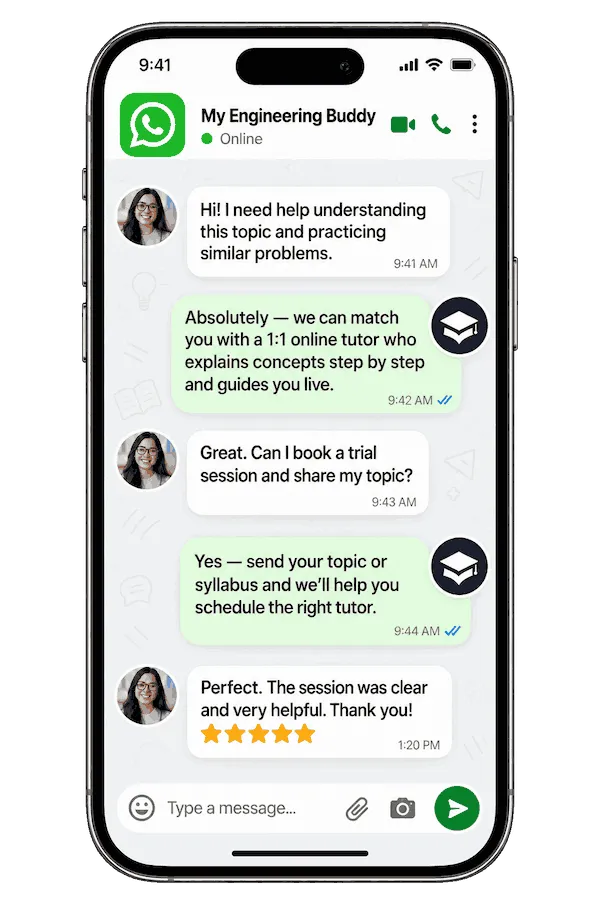
WhatsApp MEB for a quick quote — average response time under 1 minute.
Who This ROS (Robot Operating System) Tutoring Is For
ROS shows up in robotics engineering, mechatronics, and computer science programmes — and it has a steep initial curve. Most students hit the wall at the same two points: getting ROS installed and configured correctly, and then understanding why their nodes aren’t communicating. This programme is built for that gap.
- Undergraduate robotics or mechatronics students working through their first ROS project
- Masters students integrating ROS with perception pipelines or motion planning stacks
- PhD researchers needing support with ROS 2 lifecycle nodes or custom message types
- Students who submitted a broken simulation and need to understand what went wrong before the next deadline
- Engineers transitioning from ROS 1 to ROS 2 in industry or research roles
- Students at institutions like MIT, ETH Zürich, Georgia Tech, TU Delft, University of Toronto, Imperial College London, and Carnegie Mellon who use ROS as a core tool in robotics coursework
At MEB, we’ve found that most ROS confusion isn’t about programming ability — it’s about never having seen the full system diagram. Once a student understands how topics, nodes, and the ROS master (or DDS layer in ROS 2) relate to each other, the code starts making sense fast.
1:1 Tutoring vs Self-Study vs AI vs YouTube vs Online Courses
Self-study works if you have a working environment and clear docs — ROS documentation is patchy across versions. AI tools explain concepts quickly but can’t debug your specific catkin build error or watch you misuse tf2. YouTube covers installations well but goes quiet the moment your URDF throws an unexpected transform. Online courses (Udemy, Coursera) give solid structure but can’t adapt when your university project uses a non-standard robot model. With MEB’s 1:1 ROS tutoring, a tutor sees your actual workspace, your actual error log, and your actual deadline — and works through it with you directly.
Outcomes: What You’ll Be Able To Do in ROS (Robot Operating System)
After working with an MEB tutor, students consistently move from confused to capable. You’ll be able to set up a ROS 2 workspace from scratch on Ubuntu without hitting dependency dead-ends. You’ll be able to write and connect publisher and subscriber nodes that pass custom message types correctly. You’ll be able to model a robot in URDF, visualise it in RViz, and explain the joint and link structure to your supervisor. You’ll be able to apply the Nav2 stack to a simulated environment in Gazebo and tune basic navigation parameters. You’ll be able to present your node graph and topic architecture to a panel — clearly, without hand-waving the parts you didn’t understand.
“Based on feedback from 40,000+ sessions collected by MEB from 2022 to 2025, 58% of students improved by one full grade after approximately 20 hours of 1:1 tutoring in subjects like ROS (Robot Operating System). A further 23% achieved at least a half-grade improvement.”
Source: MEB session feedback data, 2022–2025.
Try your first session for $1 — 30 minutes of live 1:1 tutoring or one project question explained in full. No registration. No commitment. WhatsApp MEB now and get matched within the hour.
What We Cover in ROS (Robot Operating System) (Syllabus / Topics)

ROS Core Architecture and Communication
- ROS filesystem: packages, manifests, workspaces (catkin / colcon)
- Nodes, topics, services, and actions — design and implementation
- Publisher-subscriber patterns with custom message types
- ROS master, parameter server, and roslaunch files (ROS 1)
- DDS middleware, QoS policies, and lifecycle nodes (ROS 2)
- Debugging with rostopic, rosnode, rqt_graph, and ros2 CLI tools
- TF and TF2 — coordinate frame management and transform trees
Core references: Programming Robots with ROS (Quigley et al.), ROS Robot Programming (Pyo et al.), and the official ROS 2 documentation and tutorials.
Simulation and Visualisation
- Building robot models with URDF and Xacro
- Gazebo environment setup, plugins, and sensor simulation
- RViz configuration for visualising sensor data and robot state
- Connecting Gazebo simulations to ROS control interfaces
- Simulating LiDAR, camera, and IMU sensor streams
- Debugging transform errors between URDF joints and Gazebo links
Key references: Mastering ROS for Robotics Programming (Joseph), Gazebo official tutorials, and ROS URDF documentation.
Navigation, Perception, and Motion Planning
- ROS Navigation Stack: costmaps, global and local planners
- Nav2 stack architecture — BT Navigator, recovery behaviours, lifecycle management
- SLAM with gmapping, Cartographer, and SLAM Toolbox
- Point cloud processing with PCL and ROS sensor_msgs
- MoveIt 2 — robot arm planning, collision avoidance, and execution
- Integrating OpenCV-based vision pipelines with ROS image transport
- Writing and tuning custom behaviours with Behaviour Trees (BehaviorTree.CPP)
Key references: ROS Navigation Tuning Guide (Zheng), Nav2 documentation, and the arXiv Computer Science archive for current robotics research papers covering ROS-based systems.
Platforms, Tools & Textbooks We Support
ROS is tightly coupled to its environment. MEB tutors work with you inside your actual setup — not a generic demo. Supported environments and tools include:
- Ubuntu 20.04 / 22.04 (primary ROS 2 platforms)
- ROS Noetic (ROS 1), ROS 2 Humble, Foxy, and Iron distributions
- Gazebo Classic and Ignition Gazebo (Fortress, Garden)
- RViz and RViz2
- VSCode with ROS extension, CLion, and terminal-based workflows
- Docker-based ROS environments and remote SSH setups
- MoveIt 2, Nav2, and BehaviorTree.CPP
What a Typical ROS (Robot Operating System) Session Looks Like
The tutor opens by checking where you left off — usually a specific error message from your last build attempt or a node that wasn’t publishing on the right topic. You share your screen and walk through the issue together. The tutor uses a digital pen-pad to annotate your node graph or draw the transform chain that’s breaking your URDF-to-Gazebo link. You try the fix, it fails differently, and the tutor explains exactly why — not just what to change. By the end of the session, you’ve either resolved the issue or mapped precisely what’s blocking it. You leave with a concrete next step: a specific ROS 2 concept to read, a test to run, or a modified launch file to try before the next session.
How MEB Tutors Help You with ROS (Robot Operating System) (The Learning Loop)
Diagnose: In the first session, the tutor identifies where your understanding breaks down — whether that’s the ROS communication model, the build system, or the gap between your code and what the robot actually does in simulation. This shapes everything that follows.
Explain: The tutor works through live examples on a shared screen with a digital pen-pad — annotating your actual code, not a textbook diagram. You see the fix applied in your workspace, not a clean copy.
Practice: You attempt the next step while the tutor watches. Writing the service server yourself, configuring the costmap parameters, or restructuring your package layout. Doing it wrong once with feedback is worth more than reading about it five times.
Feedback: Every error gets explained at the root cause level — not just “change line 42.” The tutor shows you why the error appeared, what the ROS system was expecting, and how to spot the same pattern next time.
Plan: Each session ends with a clear map of what’s next. The tutor notes which topics remain, flags any prerequisite gaps (C++ memory management, Linux terminal fluency, basic control theory), and sets a realistic pace to your deadline.
Sessions run over Google Meet with a digital pen-pad or iPad and Apple Pencil for annotation. Before your first session, have your Ubuntu version, ROS distribution, and current error logs ready. The first session covers a diagnostic of your workspace and your top-priority sticking point — whether that’s a build failure, a broken transform, or a Nav2 configuration you can’t interpret. Start with the $1 trial — 30 minutes of live tutoring that also serves as your first diagnostic.
Students working through Computational Mechanics tutoring alongside ROS often find that understanding rigid body dynamics and simulation fundamentals accelerates their Gazebo work significantly.
Source: My Engineering Buddy tutor observations, 2022–2025.
Tutor Match Criteria (How We Pick Your Tutor)
ROS tutors are matched on four criteria — not just general robotics knowledge.
Subject depth: The tutor must have hands-on experience with your specific ROS distribution and the tools your project uses — Nav2, MoveIt 2, Gazebo, or custom hardware interfaces. A tutor who only knows ROS 1 is not matched to a ROS 2 project.
Tools: All sessions use Google Meet with digital pen-pad or iPad and Apple Pencil. Screen sharing is standard — the tutor annotates your actual code and workspace.
Time zone: Matched to your region. Students in the US, UK, Gulf, Canada, and Australia are matched to tutors with overlapping availability — no 3 am sessions unless you want them.
Goals: Whether your priority is passing a robotics module, completing a capstone project, or contributing to a research codebase, the tutor is briefed on your exact goal before session one.
Unlike platforms where you fill out a form and wait, MEB responds in under a minute, 24/7. Tutor match takes under an hour. The $1 trial means you test before you commit. Everything runs over WhatsApp — no logins, no intake forms.
A common pattern our tutors observe is that students come in thinking they have a coding problem when they actually have a conceptual gap — they don’t have a mental model of how ROS manages state across nodes. Fixing the concept first means the code issues resolve themselves much faster.
Pricing Guide
Standard ROS tutoring runs $20–$40/hr for undergraduate and taught Masters-level work. Niche areas — custom hardware drivers, ROS 2 real-time systems, multi-robot coordination, or PhD research support — can reach $100/hr depending on tutor background and timeline pressure.
Rate factors: ROS distribution (ROS 1 vs ROS 2), project complexity, required expertise (Nav2, MoveIt, perception pipelines), and turnaround urgency. Availability drops sharply in the final two weeks of each semester.
For students targeting competitive robotics research programmes or industry roles at firms working with autonomous systems, tutors with professional robotics engineering backgrounds are available at higher rates — share your specific goal and MEB will match the tier to your ambition.
Start with the $1 trial — 30 minutes, no registration, no commitment. WhatsApp MEB for a quick quote.
FAQ
Is ROS hard to learn?
ROS has a steeper setup curve than most engineering tools — getting the environment right on Ubuntu takes most beginners several hours. Once the architecture clicks (nodes, topics, services), the programming itself is manageable. The hardest part is usually the debugging workflow, not the code.
How many sessions will I need?
Most students working through a single ROS project module need 6–10 sessions. PhD students or those migrating an existing codebase from ROS 1 to ROS 2 often need more. The tutor sets a realistic plan after the first diagnostic session.
Can you help with projects and portfolio work?
Yes — MEB provides guided project support. The tutor explains the approach, walks through the logic, and helps you understand each step. All code and deliverables are written and submitted by you. See our Policies page for full details on what we help with and what we don’t.
Will the tutor match my exact course or project brief?
Yes. Share your syllabus, project brief, or research description when you contact MEB. Tutors are matched based on your specific ROS distribution, the tools your course requires, and your deadline. Generic robotics knowledge is not sufficient — tutor depth is verified before matching.
What happens in the first session?
The tutor reviews your current setup — ROS version, workspace structure, and the specific problem you’re stuck on. You share your screen. The tutor identifies the root cause and works through the first fix with you live. You leave with a clear next step and a session plan.
Is online tutoring as effective as in-person for ROS?
For ROS specifically, online is often better — the tutor can see your exact terminal, your actual error output, and your live workspace. That’s more useful than sitting next to you at a lab machine. Screen sharing and digital annotation replicate the whiteboard experience without the travel.
Should I learn ROS 1 or ROS 2?
ROS 1 (Noetic) reached end-of-life in May 2025. If your course or employer hasn’t specified ROS 1, start with ROS 2 Humble or Iron. MEB tutors cover both — but new students are generally pointed toward ROS 2 unless a legacy project requires otherwise.
Can I get help at midnight or on weekends?
Yes. MEB operates 24/7 across time zones. Tutors are available in the US, UK, Gulf, and Australian time zones. WhatsApp MEB at any hour — average response time is under a minute. Project deadlines don’t respect business hours, and neither does MEB.
Do I need to know C++ or Python before starting ROS?
You need working knowledge of at least one — Python is the faster entry point for ROS 2 beginners. The tutor will identify any language gaps in the first session and address them directly within the ROS context, rather than sending you off to learn programming separately.
What if I’m using a non-standard robot or custom hardware?
Share the robot model, hardware interface, or manufacturer documentation with MEB when booking. Tutors experienced with custom URDF models, ROS Control hardware interfaces, and non-standard sensor drivers are available — though rates at this level are higher. MEB will confirm tutor availability before matching.
How do I get started?
WhatsApp MEB, share your ROS version and current problem, and you’ll be matched with a verified tutor — usually within the hour. Start with the $1 trial: 30 minutes live or one project question explained in full. Three steps: WhatsApp, match, start.
What’s the difference between ROS and ROS 2, and does it matter for tutoring?
ROS 2 is not a patch update — it uses a completely different middleware (DDS instead of the ROS master), different build tools (colcon vs catkin), and different API conventions. It matters significantly for tutoring because tutors are matched to your specific version. Skills transfer between versions, but the workflows differ enough to cause real confusion if mismatched.
Trust & Quality at My Engineering Buddy
Every MEB tutor goes through subject-specific screening — not a general engineering test. For ROS tutors, this means a live demo evaluation where they work through a real robotics debugging task. Degrees in robotics, computer science, or mechanical engineering are baseline; what matters more is verified hands-on ROS experience. Rated 4.8/5 across 40,000+ verified reviews on Google. Ongoing session feedback is reviewed to maintain quality and flag any tutor-student mismatch early.
MEB provides guided learning support for all Engineering Mechanics help and robotics subjects. For ROS specifically: all project work is produced and submitted by the student. See our Academic Integrity policy and Why MEB page for full details on what we help with and what we don’t.
MEB has served 52,000+ students across the US, UK, Canada, Australia, the Gulf, and Europe since 2008 — covering 2,800+ subjects across Mechanical Engineering and related areas including Finite Element Analysis (FEA) tutoring and Nonlinear Control Systems tutoring. Read more about our approach at our tutoring methodology.
Students combining Engineering Dynamics tutoring with ROS work often find that bridging the theory-to-simulation gap is where MEB’s 1:1 approach makes the biggest difference.
Source: My Engineering Buddy tutor observations, 2022–2025.
Explore Related Subjects
Students studying ROS (Robot Operating System) often also need support in:
- Computer-Aided Manufacturing (CAM)
- Kinematics of Machines
- Dynamics of Machine
- Product Design
- Rapid Prototyping
- Pneumatics
- LS-DYNA
Next Steps
Getting started takes less than five minutes.
- Share your ROS distribution (ROS 1 or ROS 2), your project brief or course outline, and your deadline
- Share your time zone and weekly availability
- MEB matches you with a verified ROS tutor — usually within the hour
- First session starts with a diagnostic of your workspace and top-priority problem
Before your first session, have ready: your Ubuntu version and ROS distribution, your current error logs or project brief, and your submission or exam date. The tutor handles the rest.
Visit www.myengineeringbuddy.com for more on how MEB works.
WhatsApp to get started or email [email protected].
Reviewed by Subject Expert
This page has been carefully reviewed and validated by our subject expert to ensure accuracy and relevance.