~1 min
Average Reply Time
~1 hour
To Be Matched With A Tutor
30 Min Trial
75% Find Their Tutor On The 1st Trial
$20-35+/hr
Premium Yet Affordable Learning
Most students who struggle with neurochemistry aren’t bad at science — they’ve never had someone explain dopamine synthesis or the blood-brain barrier in a way that actually sticks.
Neurochemistry Tutor Online
Neurochemistry is the study of chemical processes in the nervous system — covering neurotransmitters, receptor signalling, synaptic chemistry, and brain metabolism — equipping students to analyse how molecular events drive neural function and behaviour.
MEB offers 1:1 online tutoring and academic guidance in 2800+ advanced subjects, including neurochemistry. If you’ve searched for a Neurochemistry tutor near me, you’ll find that working online with a subject-specific expert is faster, more flexible, and more effective than local alternatives. Our neuroscience tutoring covers everything from foundational biochemistry through to advanced receptor pharmacology — with tutors matched to your exact course level and syllabus.
- 1:1 online sessions tailored to your course or syllabus
- Expert-verified tutors with neurochemistry-specific knowledge
- Flexible time zones — US, UK, Canada, Australia, Gulf
- Structured learning plan built after a diagnostic session
- Ethical academic guidance — you understand before you submit
52,000+ students across the US, UK, Canada, Australia, and the Gulf have used MEB since 2008 — including students in Neuroscience subjects like Neurochemistry, Cognitive Neuroscience, and Neurophysiology.
Source: My Engineering Buddy, 2008–2025.
How Much Does a Neurochemistry Tutor Cost?
Most neurochemistry sessions run $20–$40/hr depending on level and topic complexity. Graduate-level or highly specialised work — ion channel kinetics, neuroimmunology, or advanced pharmacokinetics — can reach $100/hr. Not sure yet? Start with the $1 trial: 30 minutes of live tutoring or one homework question explained in full.
| Level / Need | Typical Rate | What’s Included |
|---|---|---|
| Undergraduate (most levels) | $20–$35/hr | 1:1 sessions, homework guidance |
| Advanced / Graduate | $35–$100/hr | Expert tutor, niche depth |
| $1 Trial | $1 flat | 30 min live session or 1 homework question |
Tutor availability tightens around end-of-semester assessment periods and exam blocks. Book early if you’re working to a hard deadline.
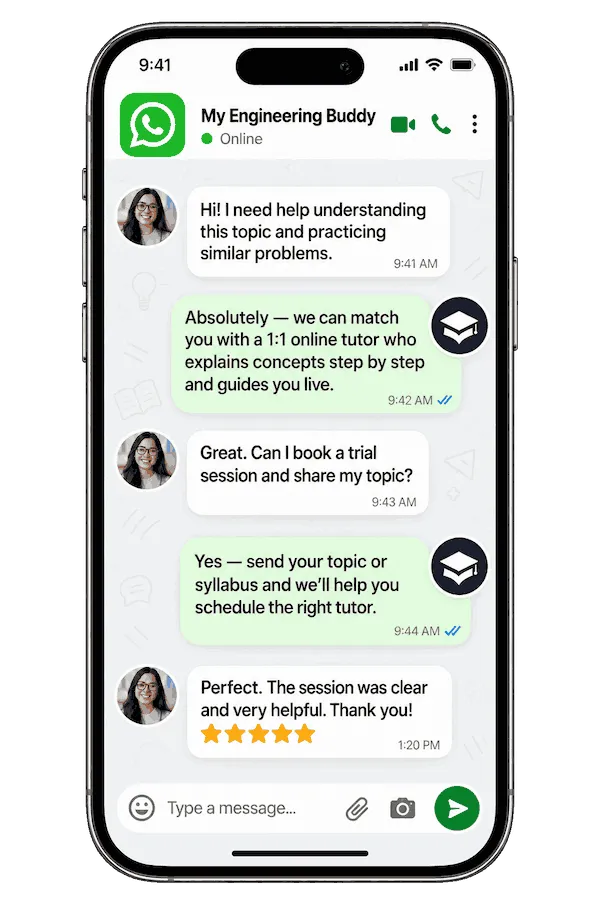
WhatsApp MEB for a quick quote — average response time under 1 minute.
Who This Neurochemistry Tutoring Is For
This is for students who know the theory exists but can’t yet connect it to problems on paper. Whether you’re working through a single confusing module or trying to hold together an entire semester’s worth of signalling pathways, 1:1 neurochemistry help makes the difference.
- Undergraduate biology, biochemistry, or neuroscience students hitting the neurochemistry module for the first time
- Graduate and PhD students who need to consolidate neurochemical mechanisms for qualifying exams or dissertation work
- Students retaking after a failed first attempt — particularly common in courses covering pharmacokinetics or synaptic modulation
- Medical and pharmacy students covering neuropharmacology as part of their programme
- Students with a coursework or lab report deadline approaching and gaps still to close
- Parents watching a child’s confidence drop alongside their grades in a neuroscience programme
Students come to MEB from programmes at universities including MIT, UCL, University of Toronto, University of Sydney, Johns Hopkins, and the University of Amsterdam. The subject is taught at undergraduate and graduate level across all these institutions — and the depth varies considerably by programme.
1:1 Tutoring vs Self-Study vs AI vs YouTube vs Online Courses
Self-study works if you’re disciplined, but neurochemistry has enough interconnected pathways that a single misconception can distort everything downstream. AI tools give fast definitions — they can’t watch you work through a GABA receptor problem and catch where your logic breaks. YouTube covers the overview well; it stops when you’re stuck on how metabotropic vs ionotropic receptors behave under different conditions. Online courses move at a fixed pace that ignores your specific exam structure. 1:1 tutoring with MEB is live, calibrated to your exact syllabus, and corrects errors the moment they appear — particularly useful when neurochemistry concepts layer on each other the way they do in second-year and above.
Outcomes: What You’ll Be Able To Do in Neurochemistry
After working with an MEB neurochemistry tutor, students can explain the full synthesis-release-reuptake cycle for major neurotransmitters, analyze receptor subtypes and their downstream second-messenger cascades, apply pharmacokinetic principles to predict drug action at the synapse, write up lab reports on electrophysiology or binding assays with accurate mechanistic reasoning, and present neurochemical arguments confidently in viva or oral examination settings. These aren’t abstract goals — they’re the exact skills that separate passing marks from strong ones in neurochemistry assessments.
Based on feedback from 40,000+ sessions collected by MEB from 2022 to 2025, 58% of students improved by one full grade after approximately 20 hours of 1:1 tutoring in subjects like Neurochemistry. A further 23% achieved at least a half-grade improvement.
Source: MEB session feedback data, 2022–2025.
Try your first session for $1 — 30 minutes of live 1:1 tutoring or one homework question explained in full. No registration. No commitment. WhatsApp MEB now and get matched within the hour.
What We Cover in Neurochemistry (Syllabus / Topics)

Neurotransmitter Systems
- Synthesis pathways: dopamine, serotonin, norepinephrine, acetylcholine, GABA, glutamate
- Vesicular storage, exocytotic release, and reuptake mechanisms
- Ionotropic vs metabotropic receptor classification and signalling
- Second messenger cascades: cAMP, IP3/DAG, MAPK pathways
- Receptor desensitisation, downregulation, and pharmacological intervention
- Drugs of abuse and their neurochemical targets
Core texts: Cooper, Bloom & Roth, The Biochemical Basis of Neuropharmacology; Nestler, Hyman & Malenka, Molecular Neuropharmacology.
Synaptic Chemistry and Neural Signalling
- Action potential propagation and voltage-gated ion channels
- Calcium-dependent neurotransmitter release at the presynaptic terminal
- Postsynaptic potential summation and synaptic integration
- Long-term potentiation (LTP) and long-term depression (LTD) — molecular basis
- Synaptic plasticity and its role in learning and memory
- Gap junctions and electrical synapses
Core texts: Kandel et al., Principles of Neural Science; Bhattacharya, Neurochemistry and Neuropharmacology.
Brain Metabolism and Neuroimmunology
- Glucose metabolism in neurons vs astrocytes — the astrocyte-neuron lactate shuttle
- Blood-brain barrier structure, function, and pharmacological relevance
- Neuroinflammation: microglia activation, cytokine signalling, and disease links
- Oxidative stress and neuroprotective mechanisms
- Neurochemical basis of conditions including Alzheimer’s, Parkinson’s, and depression
- Emerging research: gut-brain axis and neurochemical communication
Core texts: Siegel et al., Basic Neurochemistry; Bhattacharya, Neurochemistry; primary literature from JAMA Network for clinical correlations.
Students who arrive with gaps in receptor pharmacology or metabolism consistently close those gaps faster with targeted 1:1 help — especially when the tutor can map their specific course’s exam questions back to the underlying chemistry.
Source: My Engineering Buddy, tutor feedback analysis, 2022–2025.
What a Typical Neurochemistry Session Looks Like
The tutor opens by checking the previous topic — usually something like GABA receptor subunit pharmacology or dopamine pathway diagrams from the last session. Then student and tutor work through the current problem together on screen: tracing the serotonin synthesis pathway step by step, or walking through how a kinase cascade unfolds after a G-protein is activated. The tutor uses a digital pen-pad to annotate structures and pathways in real time. The student replicates the mechanism, then explains each step back in their own words. By the close, there’s a specific practice task set — usually a past exam question on receptor binding kinetics or an essay plan on neuroinflammation — and the next topic is agreed.
How MEB Tutors Help You with Neurochemistry (The Learning Loop)
Diagnose: In the first session, the tutor asks you to walk through a topic you’ve already covered — often synaptic transmission or a metabolic pathway. The gaps become obvious quickly. Most students have one or two foundational misconceptions that are blocking everything above them.
Explain: The tutor works through live examples using a digital pen-pad — drawing receptor structures, annotating synthesis steps, labelling ion channel states. No slides. No pre-made content. The explanation is built for your specific confusion.
Practice: You attempt the next problem with the tutor present. This is the part most students skip when studying alone — and the part that matters most for neurochemistry, where applying a concept is harder than recognising it.
Feedback: The tutor goes through your reasoning step by step. In neurochemistry, most marks are lost not through wrong answers but through incomplete mechanistic explanations — the tutor shows you exactly where and why.
Plan: At the end of each session, the next topic is confirmed and a short task is set. Progress is tracked session to session. If you’re covering neurophysiology tutoring alongside neurochemistry, the tutor connects the material across both.
Sessions run on Google Meet. The tutor uses a digital pen-pad or iPad with Apple Pencil. Before your first session, share your course outline or most recent lecture slides, a piece of work you found difficult, and your upcoming exam or submission date. The first session covers the diagnostic and the first real content block.
Start with the $1 trial — 30 minutes of live tutoring that also serves as your first diagnostic.
At MEB, we’ve found that neurochemistry students hit the wall at the same three places: receptor classification, the logic of second-messenger cascades, and blood-brain barrier pharmacology. A tutor who has seen that pattern hundreds of times gets to the fix faster than any textbook.
Tutor Match Criteria (How We Pick Your Tutor)
Every tutor match is done by a human, not an algorithm.
Subject depth: The tutor must have studied or taught neurochemistry specifically — not just general biology or pharmacology. We check their background against your course level and exam board. Tools: Every neurochemistry tutor uses Google Meet plus a digital pen-pad or iPad with Apple Pencil — essential for drawing pathways and receptor diagrams live. Time zone: Matched to your region — US, UK, Gulf, Canada, or Australia. Goals: Whether you need exam preparation, conceptual depth for a dissertation, or help with weekly neuroanatomy homework, the match reflects your actual objective.
Unlike platforms where you fill out a form and wait, MEB responds in under a minute, 24/7. Tutor match takes under an hour. The $1 trial means you test before you commit. Everything runs over WhatsApp — no logins, no intake forms.
Students consistently tell us that the tutor match is the part they were most sceptical about before trying MEB. Most are surprised that someone with direct neurochemistry expertise is available and matched within the hour — not a general science tutor filling in.
Study Plans (Pick One That Matches Your Goal)
The tutor builds your specific sequence after the first diagnostic. That said, most neurochemistry students fall into one of three patterns: a catch-up plan over 1–3 weeks for students behind with a deadline closing in; a structured exam prep plan over 4–8 weeks targeting specific assessment components; or weekly ongoing support aligned to semester pacing and coursework deadlines. If you’re covering adjacent material — computational neuroscience or electrophysiology tutoring — the tutor can coordinate across both tracks.
Pricing Guide
Neurochemistry tutoring runs $20–$40/hr for most undergraduate levels. Graduate-level work — dissertation support, qualifying exam preparation, advanced pharmacology — reaches $50–$100/hr depending on tutor background and topic depth. Rate factors include your level, topic complexity, how quickly you need to start, and tutor availability.
Spots fill quickly around semester-end exam blocks — particularly November–December and April–May in US and UK programmes. If you’re working to one of those windows, don’t wait.
For students targeting top-tier graduate programmes or research positions where neurochemistry depth is assessed — tutors with research and professional neuroscience backgrounds are available at higher rates. Share your specific goal and MEB will match the tier to your ambition.
Start with the $1 trial — 30 minutes, no registration, no commitment. WhatsApp MEB for a quick quote.
FAQ
Is neurochemistry hard?
Yes — and for a specific reason. The subject requires you to hold molecular detail, physiological context, and pharmacological application in mind simultaneously. Students who struggle usually lack a solid foundation in biochemistry or cell signalling. A tutor identifies and closes that gap directly.
How many sessions are needed?
Most students see clear improvement within 5–8 sessions. Closing a significant gap before a major exam typically takes 10–20 hours total. The first session includes a diagnostic that gives the tutor enough information to estimate your timeline accurately.
Can you help with homework and assignments?
Yes. MEB tutoring is guided learning — you understand the work, then submit it yourself. See our Academic Integrity policy and Why MEB page for full details on what we help with and what we don’t. Lab reports, essay questions, and problem sets are all areas where tutors provide explanation and feedback.
Will the tutor match my exact syllabus or exam board?
Yes. Before matching, MEB asks for your course outline, institution, and exam structure. Tutors are selected based on direct experience with that content — not general neuroscience familiarity. If your course uses a specific set text, the tutor will know it.
What happens in the first session?
The tutor runs a short diagnostic — asking you to explain a topic you’ve already covered. This reveals exactly where your understanding breaks down. The session then moves into the first content block. You leave with a clear plan and a specific practice task.
Is online tutoring as effective as in-person?
For neurochemistry, yes — often more so. The digital pen-pad lets tutors draw pathways, annotate structures, and work through mechanisms in real time. Students report that seeing a tutor build a diagram live is clearer than any static textbook illustration.
Can I get neurochemistry help at midnight or on weekends?
Yes. MEB operates across time zones, 24/7. WhatsApp response time averages under a minute. Tutors cover US, UK, Gulf, Canada, and Australia time zones — late-night sessions before an exam the next morning are common and fully supported.
What if I don’t get on with my assigned tutor?
Tell MEB via WhatsApp and a replacement is arranged — usually within the same day. The $1 trial exists specifically so you can test the fit before committing to a full programme. No paperwork, no delay.
Do you offer group neurochemistry sessions?
MEB’s model is 1:1 only. Group sessions dilute the diagnostic element — the tutor can’t identify your specific gap if they’re managing four students at once. Private sessions are more efficient for the depth neurochemistry requires.
How do I get started?
Three steps: WhatsApp MEB, get matched with a verified neurochemistry tutor within the hour, then start the $1 trial — 30 minutes of live tutoring or one homework question explained in full. No registration required before the first session.
What’s the difference between neurochemistry and neuropharmacology — and do MEB tutors cover both?
Neurochemistry covers the chemical processes underlying neural function. Neuropharmacology applies that knowledge to how drugs alter those processes. The two overlap heavily, and most university courses treat them together. MEB tutors who cover neurochemistry are screened for both areas — you don’t need to book separately.
My neurochemistry course requires lab reports on receptor binding assays — can tutors help with those?
Yes. Tutors can walk through the methodology, help you interpret Kd and Bmax values, and explain how to structure the mechanistic discussion section. The tutor explains the science; you write and submit the report yourself. This is one of the most common neurochemistry requests MEB receives.
Trust & Quality at My Engineering Buddy
Every MEB tutor goes through subject-specific vetting — a live demo session, degree and experience check, and ongoing review based on student feedback. Tutors covering neurochemistry must demonstrate direct knowledge of neurotransmitter systems, receptor pharmacology, and brain metabolism — not just general biology. Rated 4.8/5 across 40,000+ verified reviews on Google.
MEB tutoring is guided learning — you understand the work, then submit it yourself. For full details on what we help with and what we don’t, read our Academic Integrity policy and Why MEB.
MEB has served 52,000+ students across the US, UK, Canada, Australia, the Gulf, and Europe since 2008 — across 2,800+ subjects. In the Neuroscience category, tutors cover neurochemistry alongside related areas including computational neuroscience tutoring and neuroimaging help. Subject-specific tutor matching and a clear tutoring methodology sit behind every session — not a generic platform algorithm.
Our experience across thousands of sessions shows that neurochemistry students make the fastest progress when sessions focus on mechanism over memorisation. Knowing the name of a pathway matters less than being able to explain each step and predict what happens when one part is blocked.
Explore Related Subjects
Students studying Neurochemistry often also need support in:
Next Steps
Before your first session, have ready: your exam board and syllabus or course outline, a recent past paper attempt or homework you struggled with, and your exam or deadline date. The tutor handles the rest.
- Share your course, hardest topic, and current timeline
- Share your availability and time zone
- MEB matches you with a verified neurochemistry tutor — usually within 24 hours
The first session starts with a diagnostic so every minute is used well.
Visit www.myengineeringbuddy.com for more on how MEB works.
WhatsApp to get started or email [email protected].
Reviewed by Subject Expert
This page has been carefully reviewed and validated by our subject expert to ensure accuracy and relevance.