~1 min
Average Reply Time
~1 hour
To Be Matched With A Tutor
30 Min Trial
75% Find Their Tutor On The 1st Trial
$20-35+/hr
Premium Yet Affordable Learning
Your Mockito tests compile but your mocks are lying to you — and your code ships with gaps no one catches until production.
Mockito Tutor Online
Mockito is a Java-based open-source mocking framework used in unit testing to isolate class behaviour by replacing real dependencies with configurable mock objects, enabling developers to verify interactions and control return values without external systems.
Finding a Mockito tutor near me used to mean settling for a generalist Java coach who’d never written a real test suite. MEB connects you with tutors who work inside software engineering daily — people who have stubbed REST clients, argued over @InjectMocks vs constructor injection, and debugged argument captors at 11pm. Sessions are 1:1, live, and built around what you’re actually struggling with — whether that’s a Spring Boot project, a university assignment, or a certification prep task. One session of real, calibrated Mockito tutoring online can close a gap that three YouTube tutorials couldn’t touch.
- 1:1 online sessions tailored to your course syllabus or project stack
- Expert-verified tutors with hands-on Java testing experience
- Flexible time zones — US, UK, Canada, Australia, Gulf
- Structured learning plan built after a diagnostic session
- Guided project support — we explain, you build and submit
52,000+ students across the US, UK, Canada, Australia, and the Gulf have used MEB since 2008 — including students in Software Engineering subjects like Mockito, JUnit tutoring, and Test-Driven Development help.
Source: My Engineering Buddy, 2008–2025.
How Much Does a Mockito Tutor Cost?
Most Mockito tutoring sessions run $20–$40/hr. Graduate-level work, advanced Spring Boot integration testing, or enterprise microservices contexts can reach up to $100/hr. Before committing to a package, you can start with the $1 trial — 30 minutes live or one project question explained in full.
| Level / Need | Typical Rate | What’s Included |
|---|---|---|
| Standard (undergraduate / bootcamp) | $20–$35/hr | 1:1 sessions, project guidance, code review |
| Advanced / Specialist (grad / enterprise) | $35–$100/hr | Expert tutor, microservices, CI pipeline context |
| $1 Trial | $1 flat | 30 min live session or 1 project question explained |
Tutor slots fill fast during end-of-semester submission periods — if you have a deadline inside three weeks, book early.
WhatsApp MEB for a quick quote — average response time under 1 minute.
Who This Mockito Tutoring Is For
Most students who come to MEB for Mockito help aren’t complete beginners. They’ve read the docs. They’ve watched the tutorials. Something still isn’t clicking — usually around mock lifecycle, argument matchers, or getting tests to actually reflect real application behaviour rather than just passing in isolation.
- Undergraduate CS students with a Java testing assignment they can’t debug
- Bootcamp graduates building their first real test suite for a portfolio project
- Students with a conditional job offer or internship that requires clean, testable code
- Developers adding Mockito to an existing Spring Boot project without a team to ask
- Students retaking a software engineering module after failing the testing component
- Parents supporting a CS student whose confidence has dropped alongside their test scores
MEB tutors have supported students at Georgia Tech, University of Toronto, University of Melbourne, ETH Zurich, Imperial College London, Carnegie Mellon, and TU Delft — across undergraduate modules and graduate research projects alike.
1:1 Tutoring vs Self-Study vs AI vs YouTube vs Online Courses
Self-study works if you’re disciplined — but Mockito’s failure messages are notoriously opaque, and reading docs alone rarely closes that gap. AI tools give fast explanations but can’t watch you misconfigure a spy in real time and correct the mental model causing it. YouTube is fine for “what is a mock” — useless when your verify() call fails for reasons specific to your class structure. Online courses move at a fixed pace and skip the edge cases that actually trip you up. A 1:1 online Mockito tutor from MEB sees your exact code, diagnoses the actual problem, and corrects it before you cement a wrong pattern.
Outcomes: What You’ll Be Able To Do in Mockito
After working with an MEB Mockito tutor, you won’t just understand the syntax — you’ll understand why the framework works the way it does. Apply @Mock, @Spy, and @InjectMocks correctly across different injection strategies. Write stubs using when().thenReturn() and doReturn() for void methods without second-guessing which form fits the situation. Analyze test failures from Mockito’s error output and trace them back to configuration mistakes rather than application bugs. Explain the difference between state-based and interaction-based testing to a team or in a viva. Build a complete test suite for a Spring Boot service layer, with mocked repositories and verified method calls, that a senior engineer would actually approve.
Based on feedback from 40,000+ sessions collected by MEB from 2022 to 2025, 58% of students improved by one full grade after approximately 20 hours of 1:1 tutoring in subjects like Mockito. A further 23% achieved at least a half-grade improvement.
Source: MEB session feedback data, 2022–2025.
Students consistently tell us that the moment a Mockito concept finally clicks, it reframes how they think about testing entirely — not just in Java, but in every language they touch after. That shift rarely happens from reading alone. It happens when someone walks you through your own code and shows you exactly where your mental model broke.
What We Cover in Mockito (Syllabus / Topics)

Core Mocking and Stubbing
- Creating mocks with
@Mock,Mockito.mock(), andMockitoAnnotations.openMocks() - Stubbing return values with
when().thenReturn(),thenThrow(), andthenAnswer() - Stubbing void methods using
doReturn(),doThrow(), anddoNothing() - Argument matchers —
any(),eq(),argThat(), and matcher mixing rules - Verifying interactions with
verify(),times(),never(), andinOrder() - Using
ArgumentCaptorto inspect values passed to mocked methods - Resetting and clearing mocks between tests
Key references: Mockito in Action by Faber & Szczepanski; Practical Unit Testing with JUnit and Mockito by Kaczanowski; official Mockito documentation at mockito.org.
Spies, Partial Mocking, and Advanced Patterns
- Difference between
@Mockand@Spy— when to use each - Partial mocking with spies and its risks in tightly coupled code
@InjectMocks— constructor injection, setter injection, field injection, and failure modes- Mocking static methods and constructors with Mockito 3.4+ extensions
- Mocking final classes and methods
- Chained method stubbing and deep stubs with
RETURNS_DEEP_STUBS - Test isolation patterns and avoiding brittle over-verification
Key references: Test-Driven Development: By Example by Kent Beck; Growing Object-Oriented Software, Guided by Tests by Freeman & Pryce.
Mockito with Spring Boot and CI Pipelines
- Using
@MockBeanin Spring Boot test slices (@WebMvcTest,@DataJpaTest) - Difference between
@MockBeanand@Mockin the Spring context - Testing service layers with mocked repository dependencies
- Integrating Mockito tests in JUnit 5 with
@ExtendWith(MockitoExtension.class) - Running Mockito tests in Jenkins and CI pipelines — test report configuration
- Code coverage with JaCoCo alongside Mockito test suites
Key references: Spring Boot in Action by Craig Walls; Java Testing with Spock by Kapelonis (for comparison context).
A common pattern our tutors observe is students over-verifying — writing
verify()calls for every single method interaction when only the meaningful ones need checking. Over-verification makes tests brittle. One session on this alone regularly saves students from rewriting entire test suites after minor refactors.
What a Typical Mockito Session Looks Like
The tutor opens by checking the previous topic — usually argument matchers or injection strategy from the session before. Then you share your screen and walk through the test file causing problems: maybe @InjectMocks is silently failing because the class has no matching constructor, or a verify() call is throwing a WantedButNotInvoked exception that points nowhere helpful. The tutor uses a digital pen-pad to annotate the exact lines, explains the dependency injection chain visually, and has you rewrite the relevant section while they watch. By the end, you’ve fixed the specific test and — more importantly — you understand why it was broken. The tutor sets a short practice task: write three new tests for an adjacent service method using the same pattern, then the next topic is noted for the following session.
How MEB Tutors Help You with Mockito (The Learning Loop)
Diagnose: In the first session, the tutor identifies whether your gaps are conceptual (you don’t understand what mocking does), syntactic (you’re misusing annotations), or architectural (your classes are hard to test because of coupling issues). These require completely different fixes, and conflating them wastes time.
Explain: The tutor works through live problems on your actual code using a digital pen-pad — not a sanitised textbook example. If your service has five dependencies and you’re mocking three of them incorrectly, that’s what gets solved in the session, not a toy class from a tutorial.
Practice: You attempt the next problem with the tutor present. No leaving you to figure it out between sessions and coming back confused. The correction happens in real time, which is where the pattern actually sticks.
Feedback: The tutor goes step by step through what went wrong and why — not just “that’s incorrect” but exactly which line, which assumption caused it, and what a senior engineer would have written instead.
Plan: Each session ends with a clear next topic, a short practice task, and an updated progression map. You know exactly where you are and what the next session covers before you log off.
Sessions run over Google Meet with a digital pen-pad or iPad and Apple Pencil. Before the first session, share your course outline or project spec, one piece of code you’re stuck on, and your deadline date. The tutor does the rest. Start with the $1 trial — 30 minutes of live Mockito tutoring that also serves as your first diagnostic. Whether you need a quick catch-up before a submission, structured sessions over 4–8 weeks, or ongoing weekly support through the semester, the tutor maps the exact plan after that first session.
MEB has served 52,000+ students since 2008, with tutors active across software testing, test automation, and Mockito-specific project help — from undergraduate assignments to enterprise-level CI pipeline work.
Source: My Engineering Buddy, 2008–2025.
Tutor Match Criteria (How We Pick Your Tutor)
Not every Java developer can teach Mockito well. Here’s what MEB checks before matching you.
Subject depth: Tutors demonstrate hands-on experience with Mockito specifically — not just Java generalism. We verify they’ve worked with the version and context relevant to your project (Mockito 4+, Spring Boot, JUnit 5).
Tools: All Mockito tutors use Google Meet with a digital pen-pad or iPad and Apple Pencil — so they can annotate code live rather than just talking through it.
Time zone: Matched to your region — US Eastern and Pacific, UK, Gulf, Canada, and Australia all covered without unsociable hours.
Goals: Whether you need to pass an assignment, build a portfolio, or get code review-ready for a professional team, the tutor is briefed before session one.
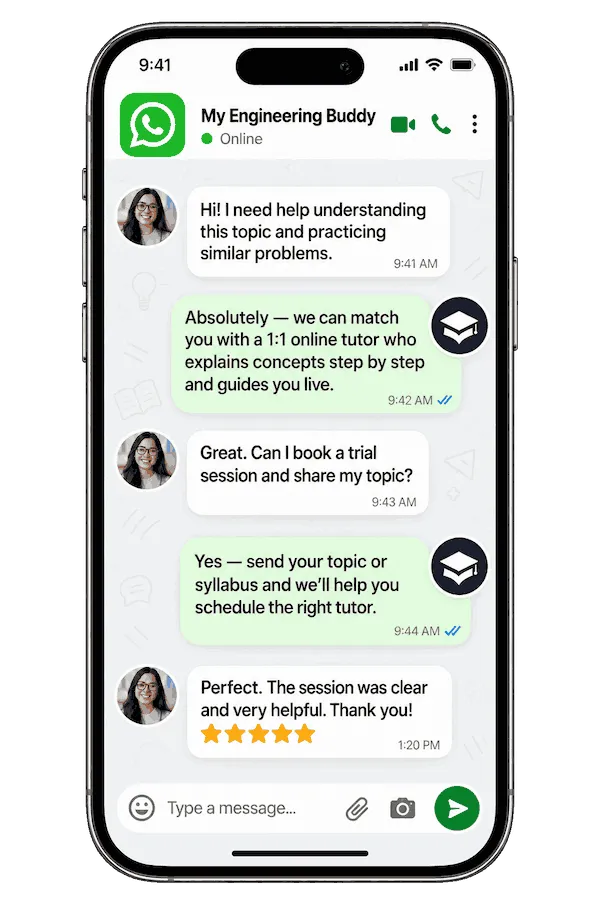
Unlike platforms where you fill out a form and wait days, MEB responds in under a minute, 24/7. Tutor match takes under an hour. The $1 trial means you test before you commit. Everything runs over WhatsApp — no logins, no intake forms.
Pricing Guide
Mockito tutoring starts at $20/hr for standard undergraduate and bootcamp work. Advanced contexts — graduate-level software architecture, microservices testing strategy, or enterprise CI integration — run up to $100/hr. Rate factors include topic complexity, your deadline pressure, and tutor availability at your required hours.
For students targeting roles at software companies where clean test coverage is a hard requirement — or graduate programmes where a testing project forms part of your thesis — tutors with professional software quality assurance backgrounds are available at higher rates. Share your specific goal and MEB matches the tier to your situation.
Demand spikes at end-of-semester submission periods. Book early if you’re inside four weeks of a deadline. Start with the $1 trial — 30 minutes, no registration, no commitment. WhatsApp MEB for a quick quote.
FAQ
Is Mockito hard to learn?
The basics — creating a mock and stubbing a return value — take an afternoon. The difficulty is in understanding what mocking actually does to your test’s validity, and avoiding patterns like over-mocking that make tests pass while missing real bugs. That’s where most students get stuck.
How many sessions will I need?
Students fixing a specific assignment gap typically need 2–4 sessions. Those building a full test suite for a project from scratch usually need 6–10. The first session diagnostic tells you clearly what the realistic number looks like for your situation.
Can you help with projects and portfolio work?
Yes. MEB provides guided project support — the tutor explains the approach, you write and submit the code yourself. MEB tutoring is guided learning: you understand the work, then submit it yourself. See our Academic Integrity policy and Why MEB page for full details on what we help with and what we don’t.
Will the tutor match my exact course or project stack?
Yes. When you WhatsApp MEB, share your Java version, testing framework (JUnit 4 or 5), and project context (Spring Boot, standalone, Android). The tutor is matched specifically to your stack — not assigned generically.
What happens in the first session?
The tutor reviews your current code or assignment brief, identifies exactly where understanding breaks down, and starts working through problems live. You leave with a clearer picture of the issue and a specific task to attempt before the next session.
Are online Mockito sessions as effective as in-person?
For code-based subjects, online is frequently better. You’re working in your own IDE, sharing your actual project, and the tutor annotates directly on screen. There’s no travel time, no lab booking — just the work.
What’s the difference between Mockito and PowerMock — and does MEB cover both?
Mockito handles standard mocking for non-final, non-static code. PowerMock extends this to static methods and constructors, but adds complexity and is often a sign of design issues. MEB tutors cover both and can advise when PowerMock is genuinely needed versus when the code should be refactored instead.
Can you help me understand why my verify() call keeps failing?
This is one of the most common Mockito questions MEB handles. The cause is almost always one of four things: the mock wasn’t called, it was called with different arguments, the method was called on a real object rather than the mock, or the stub was never activated. A tutor identifies which one in minutes.
Do you offer help for Mockito used in Android testing?
Yes. Mockito works differently in Android environments — Robolectric integration, limitations with certain Android classes, and Mockito-Android-specific configuration. MEB tutors with Android testing experience are available for these sessions specifically.
Can I get Mockito help at midnight?
Yes. MEB operates 24/7 across time zones. WhatsApp MEB at any hour — the average first response is under one minute. Tutors are matched based on your preferred session time, including late-night slots for US West Coast, Gulf, and Australian students.
How do I get started?
WhatsApp MEB, share your subject and deadline. MEB matches you with a verified tutor — usually within the hour. Your first session is the $1 trial: 30 minutes of live 1:1 Mockito tutoring or one project question explained start to finish. Three steps: WhatsApp, get matched, start.
At MEB, we’ve found that the students who improve fastest with Mockito are the ones who bring a broken test to the first session — not a question in the abstract. Real code, real error message, real fix. That’s the most efficient diagnostic session we can run, and it tells the tutor everything they need to know.
Trust & Quality at My Engineering Buddy
Every MEB tutor goes through subject-specific screening before their first session — not a generalist interview, but a live demo evaluation in their claimed area. For Mockito, that means demonstrating they can navigate real test failures, explain injection strategies clearly, and handle Spring Boot context questions without bluffing. Tutors are assessed on ongoing session feedback, and those below threshold are replaced. Rated 4.8/5 across 40,000+ verified reviews on Google.
MEB provides guided learning support. All project work is produced and submitted by the student. See our Policies page for details.
MEB has been running since 2008, serving 52,000+ students across the US, UK, Canada, Australia, the Gulf, and Europe in 2,800+ subjects. Within Software Engineering, that includes dedicated support for integration testing, unit testing help, and Spring Boot tutoring — the three areas most closely tied to Mockito in real projects. Read more about how MEB tutors are selected at our tutoring methodology page.
Mockito is consistently one of the most searched Java testing tools by developers preparing for technical interviews — alongside Selenium help and acceptance testing — according to developer community data compiled by Wolfram Alpha.
Source: Wolfram Alpha / developer search trend data.
Try your first session for $1 — 30 minutes of live 1:1 tutoring or one homework question explained in full. No registration. No commitment. WhatsApp MEB now and get matched within the hour.
Explore Related Subjects
Students studying Mockito often also need support in:
Next Steps
Before your first session, have ready: your Java version and project spec or course outline, a recent piece of code or test that isn’t working as expected, and your submission or deadline date. The tutor handles the rest.
- Share your exam board, hardest component, and current timeline
- Share your availability and time zone
- MEB matches you with a verified tutor — usually within 24 hours
The first session starts with a diagnostic so every minute is used well. Visit www.myengineeringbuddy.com for more on how MEB works.
WhatsApp to get started or email [email protected].
Reviewed by Subject Expert
This page has been carefully reviewed and validated by our subject expert to ensure accuracy and relevance.