~1 min
Average Reply Time
~1 hour
To Be Matched With A Tutor
30 Min Trial
75% Find Their Tutor On The 1st Trial
$20-35+/hr
Premium Yet Affordable Learning
Hire The Best Software Testing Tutor





Your test suite passes locally. It fails in staging. You have no idea why. A Software Testing tutor who has debugged this exact scenario is one WhatsApp message away.
Software Testing Tutor Online
Software Testing is the process of evaluating software systems to identify defects, verify functional requirements, and validate quality. It covers manual and automated techniques — including unit, integration, regression, and acceptance testing — equipping practitioners to ship reliable, production-ready software.
MEB offers 1:1 online tutoring and homework help in 2800+ advanced subjects, including Software Testing. Whether you are searching for a Software Testing tutor near me or need live help untangling a flaky Selenium script at 11 pm, MEB connects you with a verified expert — usually within an hour. Our software engineering tutoring network covers every layer of the testing stack, from writing your first JUnit test to designing an end-to-end CI/CD quality gate.
- 1:1 online sessions tailored to your course syllabus, tool stack, or project requirements
- Expert-verified tutors with hands-on Software Testing experience across industry and academia
- Flexible time zones — US, UK, Canada, Australia, Gulf covered, 24/7
- Structured learning plan built after a diagnostic session in the first hour
- Ethical homework and assignment guidance — you understand the work, then submit it yourself
52,000+ students across the US, UK, Canada, Australia, and the Gulf have used MEB since 2008 — including students in Software Engineering subjects like Software Testing, test automation, and software quality assurance.
Source: My Engineering Buddy, 2008–2025.
How Much Does a Software Testing Tutor Cost?
Most Software Testing tutoring sessions run $20–$40/hr. Graduate-level topics — performance engineering, security testing pipelines, advanced test architecture — can reach $70–$100/hr depending on tutor expertise. Start with the $1 trial before committing to anything.
| Level / Need | Typical Rate | What’s Included |
|---|---|---|
| Undergraduate / Bootcamp | $20–$35/hr | 1:1 sessions, assignment guidance, test case walkthroughs |
| Graduate / Specialist | $35–$100/hr | Expert tutor, advanced frameworks, thesis or capstone support |
| $1 Trial | $1 flat | 30 min live session or one full homework question explained |
Tutor availability tightens significantly during university exam periods and project submission weeks. Book early if your deadline is within three weeks.
WhatsApp MEB for a quick quote — average response time under 1 minute.
Who This Software Testing Tutoring Is For
Software Testing trips up students at every level. The concepts look simple on paper — write a test, run it, fix the bug — but the gap between theory and a working test suite is where most people stall.
- Undergraduate CS and software engineering students with a testing module they underestimated
- Graduate students whose thesis or capstone depends on a validated, reproducible test framework
- Bootcamp graduates trying to meet QA Engineer job requirements within weeks
- Students who failed a testing assignment and need to re-submit before the grade is finalised
- Developers moving into a QA or SDET role who need to close gaps fast
- Parents supporting a computer science student whose confidence has dropped alongside their coursework marks
MEB has worked with students at institutions including MIT, Georgia Tech, the University of Toronto, the University of Melbourne, Imperial College London, TU Delft, and Carnegie Mellon. Whether you need help for a single assignment or structured support across a full semester, there is a tutor for your exact situation.
1:1 Tutoring vs Self-Study vs AI vs YouTube vs Online Courses
Self-study works if you are disciplined and the material is well-documented — but Software Testing has too many tool-specific edge cases for most self-study plans to hold. AI tools explain concepts quickly but cannot watch you write a broken test case and tell you exactly where your assertion logic failed. YouTube covers Selenium basics well; it stops when your specific test environment throws an unexpected error. Online courses give you structure but run at a fixed pace that ignores your actual deadline. With a 1:1 test-driven development or Software Testing tutor at MEB, the session adapts live — your exact tool, your exact error, corrected in the moment.
Outcomes: What You’ll Be Able To Do in Software Testing
After working with an MEB Software Testing tutor, you will be able to design a complete test plan covering functional, boundary, and edge cases for a given module. You will apply black-box and white-box techniques to analyse requirements and write test cases that actually catch defects — not just pass. You will write and run automated tests using tools like Selenium, JUnit, or Pytest, and interpret the output to locate the root cause of failures. You will explain the difference between unit, integration, regression, and acceptance testing — and know when to use each. You will present a structured defect report that holds up in a professional code review or academic submission.
Based on feedback from 40,000+ sessions collected by MEB from 2022 to 2025, 58% of students improved by one full grade after approximately 20 hours of 1:1 tutoring in subjects like Software Testing. A further 23% achieved at least a half-grade improvement.
Source: MEB session feedback data, 2022–2025.
Try your first session for $1 — 30 minutes of live 1:1 tutoring or one homework question explained in full. No registration. No commitment. WhatsApp MEB now and get matched within the hour.
What We Cover in Software Testing (Syllabus / Topics)
Track 1: Foundations of Software Testing
- Testing principles: verification vs validation, defect lifecycle, test oracle concept
- Black-box techniques: equivalence partitioning, boundary value analysis, decision tables
- White-box techniques: statement coverage, branch coverage, path coverage
- Test case design: preconditions, steps, expected vs actual results, pass/fail criteria
- Test plans and test strategies: scope, risk, entry/exit criteria
- Defect reporting: severity, priority, reproducibility, defect tracking basics
- Static testing: reviews, walkthroughs, inspections, and static analysis tools
Core texts: Foundations of Software Testing by Burnstein; Software Testing: A Craftsman’s Approach by Jorgensen; The Art of Software Testing by Myers, Badgett & Thomas.
Track 2: Test Automation and Frameworks
- Selenium WebDriver: locators, waits, page object model, cross-browser testing
- JUnit and Mockito: unit test structure, assertions, mocking dependencies
- Pytest: fixtures, parametrize, conftest, test discovery, coverage reports
- Test automation architecture: test pyramid, selecting what to automate, ROI considerations
- CI/CD integration: running tests in Jenkins or GitLab CI/CD pipelines
- API testing: request/response validation, status codes, schema checks using Postman or REST Assured
- Reporting and dashboards: Allure, ExtentReports, interpreting test run summaries
Core texts: Selenium WebDriver 3 Practical Guide by Unmesh Gundecha; Python Testing with Pytest by Brian Okken; framework-specific documentation for JUnit 5 and Mockito.
Track 3: Advanced Testing — Performance, Security, and Quality Assurance
- Performance testing concepts: load, stress, spike, endurance — when each applies
- Apache JMeter: test plan structure, thread groups, assertions, result analysis
- Security testing basics: OWASP Top 10, injection flaws, authentication testing, OWASP methodology
- Exploratory testing and session-based test management
- Regression testing strategy: what to re-run, when, and why
- Software quality assurance processes: QA vs QC, process audits, metrics and KPIs
- Agile testing: testing in sprints, definition of done, shift-left testing mindset
Core texts: How Google Tests Software by Whittaker, Arbon & Carollo; Agile Testing by Crispin & Gregory; ISTQB Foundation Level Syllabus (current version).

What a Typical Software Testing Session Looks Like
The tutor opens by checking where you left off — usually a specific test case you wrote between sessions, or a failing assertion you could not resolve. From there, the two of you pull up your test file together: the tutor asks you to walk through your test setup and explain what you expected the method to return. When the gap appears — a missing teardown, an incorrect boundary value, a mock that was never reset — the tutor does not just fix it. They write the corrected version on a digital pen-pad while explaining each decision, then hand the logic back to you to rewrite yourself. By the last 15 minutes, you have a concrete task: write three new test cases for the next untested method, using the boundary value technique you just practised. The next session starts by running those tests.
How MEB Tutors Help You with Software Testing (The Learning Loop)
Diagnose: In the first session the tutor reviews your current test cases, your assignment brief or syllabus, and your tool setup. Most students arrive either over-testing trivial cases or missing entire equivalence classes — the tutor identifies which pattern applies to you within 20 minutes.
Explain: The tutor works through a live example on a digital pen-pad — writing a test case from scratch, narrating each decision. For automation topics, both of you share screens and work inside the same IDE. Nothing is abstract. Everything is your code or your exam question.
Practice: You attempt the next problem while the tutor watches. This is the part that matters most. Watching an explanation and being able to do it are two different things, and the gap shows up immediately in a live session.
Feedback: The tutor walks through each error step by step — not just what went wrong, but why the logic broke and what a marker or code reviewer would flag. For assignment submissions, the focus is on understanding, not answers.
Plan: At the end of every session, the tutor notes the next topic, sets a specific practice task, and flags any prerequisite gaps that need closing before the next session. You always know what you are doing before the next meeting.
Sessions run over Google Meet. The tutor uses a digital pen-pad or iPad with Apple Pencil for diagrams and annotation. Before your first session, share your syllabus or assignment brief and any test code you have already written. Start with the $1 trial — 30 minutes of live tutoring that also serves as your first diagnostic. Whether you need a quick catch-up before a submission deadline, structured revision over 4–8 weeks, or ongoing weekly support through the semester, the tutor maps the session plan after that first diagnostic.
At MEB, we’ve found that the students who improve fastest in Software Testing are not the ones who read the most theory — they are the ones who write broken tests, get corrected live, and rewrite immediately. That cycle, repeated across ten sessions, changes how you think about code quality permanently.
Tutor Match Criteria (How We Pick Your Tutor)
Not every Software Testing tutor fits every student. MEB matches on four factors.
Subject depth: The tutor must have demonstrable experience at your exact level — undergraduate testing module, graduate QA course, bootcamp capstone, or professional ISTQB preparation — not just general programming knowledge.
Tools: Sessions run on Google Meet with a digital pen-pad or iPad and Apple Pencil. The tutor must be fluent in the specific tool you are being assessed on — Selenium, JUnit, Pytest, JMeter, or whichever framework your course uses.
Time zone: Matched to your region — US Eastern, US Pacific, UK, Gulf, Canada, or Australia — so sessions happen at hours that work for your schedule, not just the tutor’s.
Goals: A student preparing an integration testing assignment needs a different tutor profile than someone targeting a QA Engineer role. MEB matches to your specific goal, not a generic “testing” category.
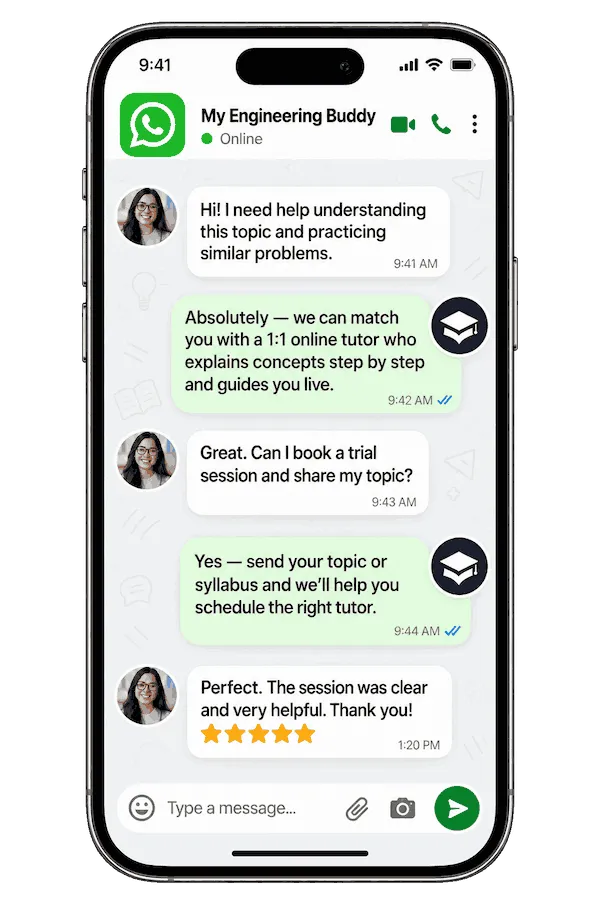
Unlike platforms where you fill out a form and wait, MEB responds in under a minute, 24/7. Tutor match takes under an hour. The $1 trial means you test before you commit. Everything runs over WhatsApp — no logins, no intake forms.
Pricing Guide
Software Testing tutoring starts at $20/hr for undergraduate and bootcamp-level topics. Graduate coursework, performance engineering, and security testing sessions typically run $50–$100/hr depending on tutor background and topic complexity.
Rate factors: your level, the specific framework or tool involved, how tight your deadline is, and tutor availability. During peak university exam and project submission periods, specialist tutors book out fast.
For students targeting QA Engineer roles at top technology firms or pursuing ISTQB Advanced Level certification, tutors with professional QA and test architecture backgrounds are available at higher rates — share your specific goal and MEB will match the tier to your ambition.
Start with the $1 trial — 30 minutes, no registration, no commitment. WhatsApp MEB for a quick quote.
Students consistently tell us that the first session with an MEB Software Testing tutor is the first time they understood what a test case is actually supposed to prove — not just what it is supposed to do.
Source: My Engineering Buddy, compiled from student session feedback.
FAQ
Is Software Testing hard?
The concepts are learnable, but the gap between theory and working code is real. Students who struggle most tend to conflate “making tests pass” with “writing good tests.” A tutor corrects that misunderstanding early, which saves weeks of misdirected effort.
How many sessions are needed?
Most students with a specific assignment or exam component need 3–5 sessions. Students building a full test automation framework from scratch typically need 8–15 sessions spread across a semester. The first diagnostic session gives a clearer estimate based on your current level.
Can you help with homework and assignments?
Yes. MEB tutoring is guided learning — you understand the work, then submit it yourself. See our Academic Integrity policy and Why MEB page for full details on what we help with and what we don’t. Your tutor explains the concept and works through examples; you write and submit your own solution.
Will the tutor match my exact syllabus or exam board?
Yes. Whether your course follows ISTQB, a university-specific curriculum, an industry bootcamp framework, or a custom syllabus, MEB matches a tutor who has worked with that exact material — not a general programming tutor who has read the textbook once.
What happens in the first session?
The tutor reviews your syllabus or assignment brief, asks you to walk through what you already understand, and identifies the specific gaps causing problems. By the end of the first session, you have a topic sequence and a practice task. Nothing is wasted.
Is online tutoring as effective as in-person?
For Software Testing, online is often better. Shared screens mean the tutor sees your exact environment — your IDE, your test runner output, your actual error messages. In-person tutoring rarely achieves that level of specificity without the same screen-sharing tools MEB uses anyway.
Can I get Software Testing help at midnight?
Yes. MEB operates 24/7. If your CI pipeline broke at 11 pm the night before a submission deadline, WhatsApp MEB and you can be in a live session within the hour. Tutor availability varies by time zone, but the response time is under a minute around the clock.
What if I don’t like my assigned tutor?
Request a different tutor over WhatsApp. MEB does not make you fill out a form or wait for an email thread. You describe what did not work, and MEB matches a replacement — usually within a few hours. The $1 trial exists specifically so you can test the fit before committing to a paid block of sessions.
What is the difference between manual and automated testing, and which should I learn first?
Manual testing builds the foundational skill of identifying what to test and why. Automation scales that skill. Most university and bootcamp courses teach manual techniques first — equivalence partitioning, boundary value analysis, test case design — before moving to Selenium or Pytest. Your tutor will confirm the right sequence for your specific course.
Do I need to know how to code to learn Software Testing?
Not for foundational and manual testing — test case design, defect reporting, and black-box techniques require no programming. Automated testing does require coding ability, typically Python or Java. If your course involves Selenium or JUnit and your coding is weak, your tutor will address both in parallel.
How do I get started?
WhatsApp MEB, share your syllabus or assignment brief, and get matched with a verified Software Testing tutor — usually within an hour. Your first session is the $1 trial: 30 minutes of live 1:1 tutoring or one full question explained. No registration, no commitment.
Trust & Quality at My Engineering Buddy
Every MEB tutor goes through a multi-stage screening process: subject knowledge verification, a live demo session evaluated by a senior MEB reviewer, and ongoing performance tracking based on student feedback after every session. Tutors covering Software Testing hold degrees in computer science, software engineering, or related fields — many have professional QA or SDET experience at technology companies. Rated 4.8/5 across 40,000+ verified reviews on Google.
MEB tutoring is guided learning — you understand the work, then submit it yourself. For full details on what we help with and what we don’t, read our Academic Integrity policy and Why MEB.
MEB has served 52,000+ students across the US, UK, Canada, Australia, the Gulf, and Europe in 2,800+ subjects since 2008. Within the Software Engineering category, the platform covers everything from unit testing tutoring and DevOps help to advanced SDLC assignment help. Every subject page connects to a tutor network that has been built and refined over 18 years. See how MEB’s tutoring methodology works.
Students consistently tell us that the hardest part of Software Testing is not learning the techniques — it is knowing which technique to apply to which situation. That judgement develops only through practice with feedback. That is exactly what a tutor provides that a textbook cannot.
Explore Related Subjects
Students studying Software Testing often also need support in:
- Test-Driven Development (TDD)
- Code Optimization
- Docker
- Azure DevOps
- SonarQube
- Postman
- System Design
- Benchmarking
Next Steps
Getting started takes about two minutes.
- Share your exam board, course module name, and the specific topic or assignment causing problems
- Share your time zone and available hours — MEB covers every major region
- MEB matches you with a verified Software Testing tutor — usually within 24 hours, often within an hour
Before your first session, have ready: your syllabus or course outline, a recent assignment or test code you struggled with, and your submission or exam date. The tutor handles the rest.
Visit www.myengineeringbuddy.com for more on how MEB works.
WhatsApp to get started or email [email protected].
Reviewed by Subject Expert
This page has been carefully reviewed and validated by our subject expert to ensure accuracy and relevance.