A-Level Chemistry Explained: How to Master It and Get Top Grades

- A-Level Chemistry spans three distinct disciplines: Physical, Inorganic, and Organic Chemistry.
- One-to-one tutoring can add approximately five months of academic progress, per EEF research.
- Online tutoring gives students access to expert help regardless of location.
- Strong exam technique is as important as subject knowledge for top grades.
- A-Level Chemistry grades directly influence university admissions and long-term career earnings.
 Remember that feeling in class? The teacher is at the board, drawing hexagonal rings with strange symbols, talking about electrophilic substitution, and you’re frantically trying to keep up. One minute you feel like you understand it, and the next, it’s like the entire conversation has switched to a foreign language. If this sounds familiar, you’re not alone. A-Level Chemistry is one of the most demanding yet rewarding subjects a student can tackle.It’s the gateway to prestigious university courses in medicine, veterinary science, engineering, and, of course, chemistry itself. But the jump from GCSE to A-Level is significant. The pace is faster, the concepts are more abstract, and the level of independent thinking required is a huge step up. This article is for the students staring at a page of mechanisms wondering where to start, for the parents watching their child’s confidence dip, and for anyone who wants to unlock their full potential in this fascinating subject.
Cracking the Code: Why Is A-Level Chemistry So Tough?
Let’s talk about a student, let’s call her Sarah. Sarah aced her GCSEs. She loved the flashes and bangs of practical chemistry and found the basic concepts intuitive. But a few months into her A-Levels, the cracks started to show.Let’s look at what this transition actually looks like in terms of cognitive load and critical thinking requirements.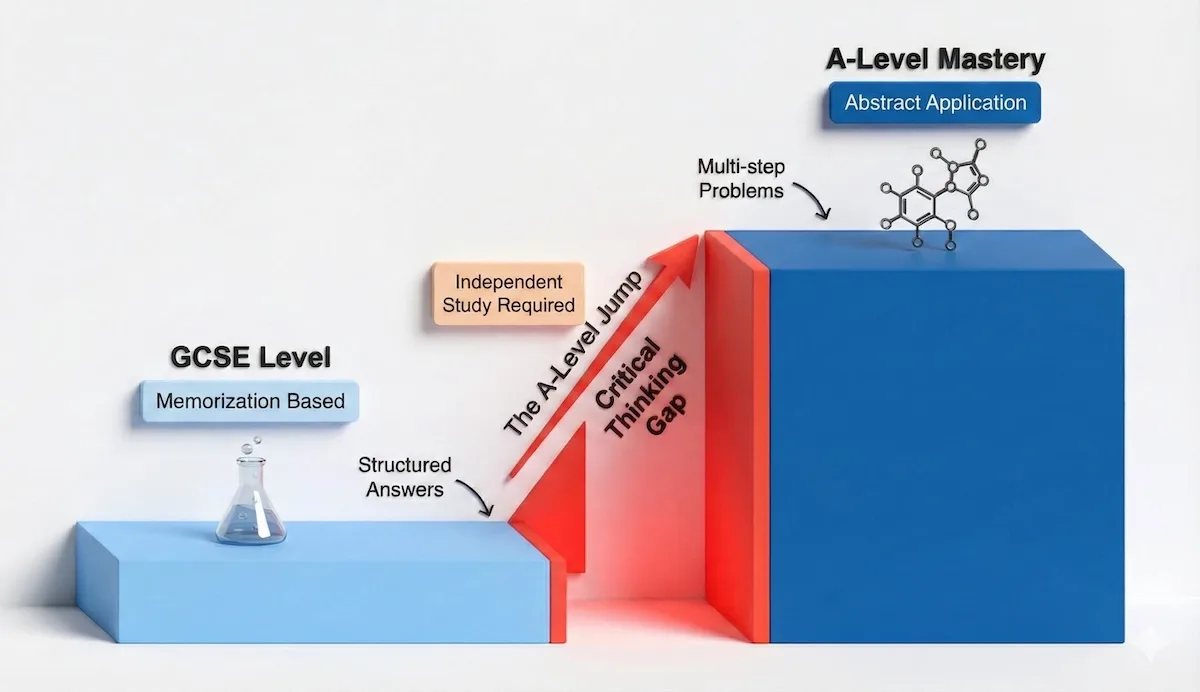
The leap from GCSE to A-Level is significant, shifting from simple memorization to complex abstract reasoning.
- Physical Chemistry: This is the “maths” part. It’s all about thermodynamics, kinetics, and quantum mechanics. It requires strong analytical and mathematical skills.
- Inorganic Chemistry: This explores the properties and reactions of the whole periodic table. It’s heavy on patterns, trends, and remembering specific details.
- Organic Chemistry: This is the study of carbon-based compounds. It’s highly visual and abstract, requiring students to think in 3D and understand reaction mechanisms.
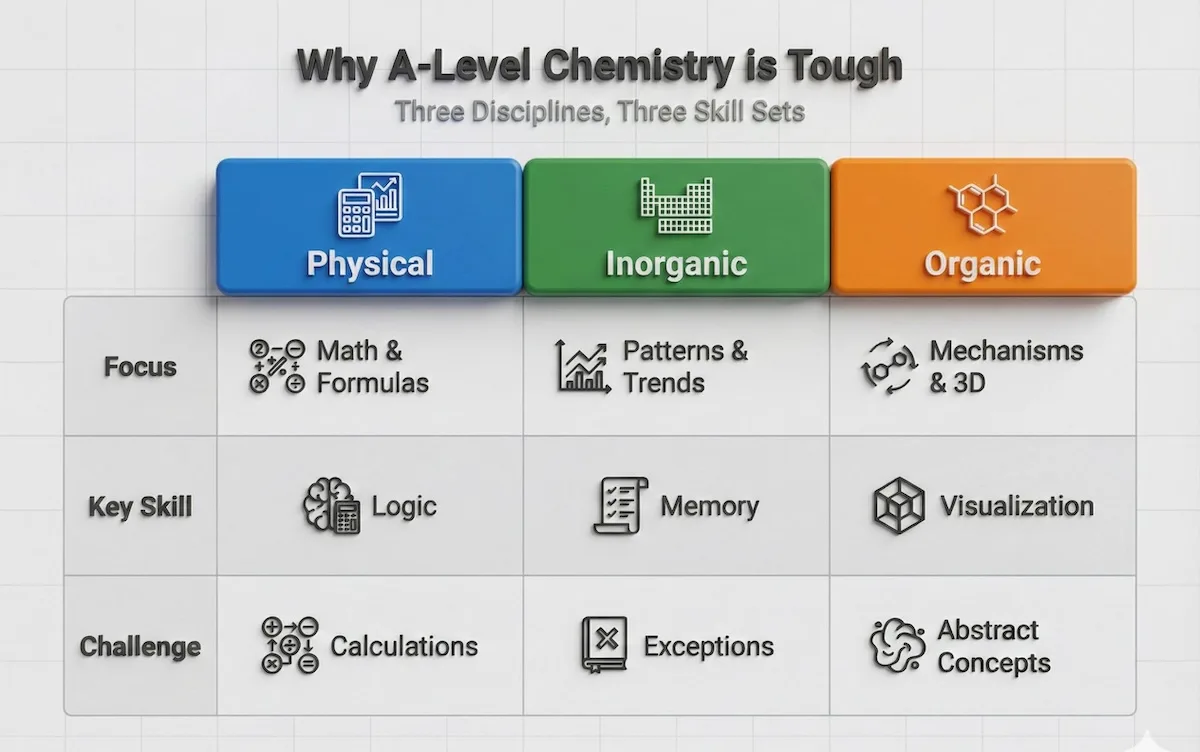
Understanding that Chemistry is three distinct subjects helps you identify exactly which skills you need to strengthen.
The Catalyst for Change: How A-Level Chemistry Tutoring Helps
Imagine trying to build a complex Lego model with a few missing pieces and instructions that are slightly blurred. That’s what learning A-Level Chemistry can feel like. A great tutor acts as your guide, helping you find the missing pieces and bringing the instructions into sharp focus.The core benefit of A-Level Chemistry tutoring is that it’s tailored specifically to you. Unlike a classroom setting, the entire session revolves around your needs, your pace, and your specific areas of confusion. A study by the influential Education Endowment Foundation (EEF) found that one-to-one tuition can be consistently effective, helping a student achieve approximately five additional months of academic progress. That’s the power of personalized attention.The data speaks for itself. The Education Endowment Foundation quantified this impact in a revealing comparison.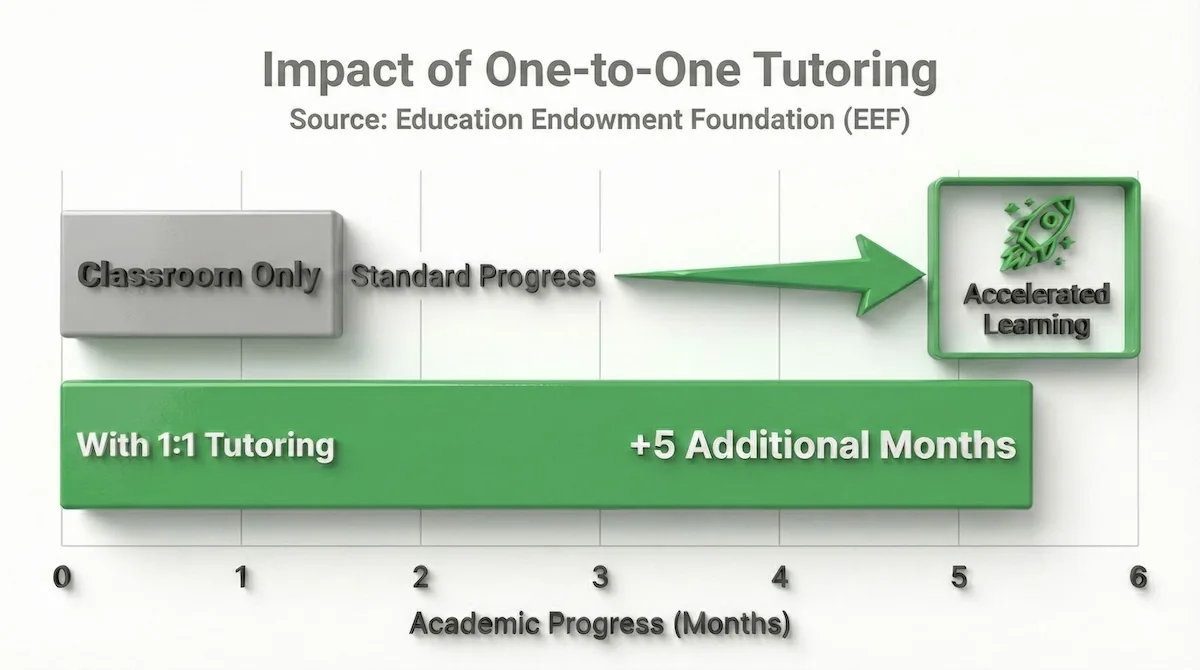
Studies show personalized tuition can accelerate learning by five months compared to classroom teaching alone.
Finding Your Perfect Match: What Defines a Great A-Level Chemistry Tutor?
When you start your search, you’ll find many options. But what separates an average tutor from a great one? A brilliant A-Level Chemistry teacher in a school setting has the skills to manage a large group, but the one-on-one dynamic of tutoring requires a slightly different skill set.An effective A-Level Chemistry tutor is more than just a subject matter expert. They are a mentor, a strategist, and a confidence builder. They don’t just teach you what to think; they teach you how to think like a chemist. They help you break down complex problems, identify patterns, and develop the critical thinking skills you need to tackle unseen exam questions.When you’re looking to hire a organic chemistry tutor or any specialist in the A-Level syllabus, you should look for a combination of three key traits.So, what does the ideal candidate look like? Here is the ‘triad’ of skills you need to hunt for when selecting a tutor.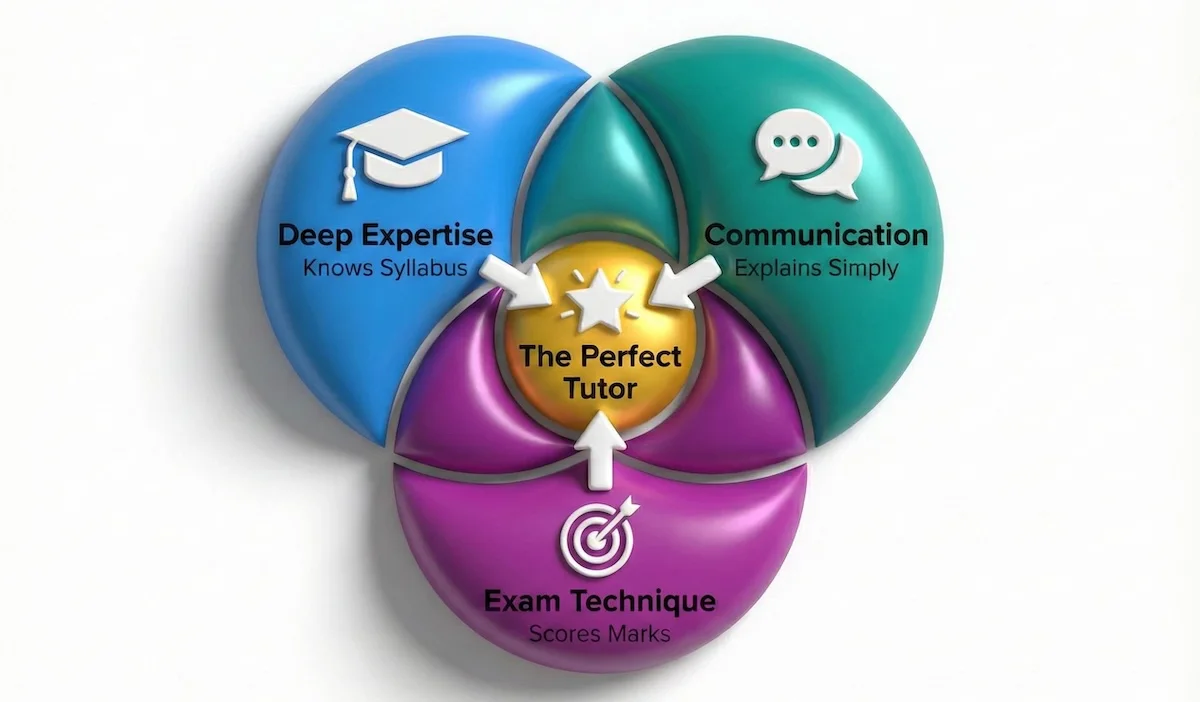
Don’t settle for less—ensure your tutor combines deep knowledge with the ability to explain it clearly and maximize your exam scores.
- Deep Subject Expertise: They should have a thorough and passionate understanding of the A-Level syllabus, including the specific requirements of your exam board.
- Excellent Communication Skills: They must be able to explain complex ideas in simple, clear, and engaging ways. Patience is non-negotiable.
- A Focus on Exam Technique: Knowing the chemistry is only half the battle. A great tutor will teach you how to interpret exam questions, manage your time effectively, and write answers that score maximum marks.
The Digital Lab: The Rise of Online A-Level Chemistry Tutoring
In today’s digital world, the idea of tutoring has expanded far beyond meeting in a local library. The growth of online A-Level Chemistry tutoring has been a game-changer for students in the USA, UK, Gulf countries, and beyond. It has democratized access to top-tier educators, meaning you’re no longer limited to the tutors available in your immediate vicinity.Modern online tutoring platforms use interactive whiteboards, screen sharing, and high-quality video calling to create a learning experience that is just as effective, and often more convenient, than in-person sessions. You can record sessions to review later, share digital resources instantly, and work with a world-class online A-Level Chemistry tutor from the comfort of your own home.This model is not just a trend; it’s a proven method. A report from Grand View Research highlights that the global online tutoring market is experiencing explosive growth, a clear indicator that students and parents recognize its value, flexibility, and effectiveness. For a subject as detailed as chemistry, having the ability to pull up diagrams, simulations, and past papers on a shared screen is an incredible advantage.Students preparing for related international qualifications may also find it useful to explore IB Chemistry HL/SL tutoring, which covers overlapping conceptual ground. For a broader look at effective study strategies, the post on best strategies for success in organic and general chemistry is worth reading.From Homework Headaches to High Fives
The weekly problem set. The lab report due on Friday. The list of practice questions that seems to get longer every day. Homework and assignments are where the real learning happens, but they can also be a major source of stress and frustration.This is where targeted A-Level Chemistry homework guidance becomes invaluable. Instead of spending hours feeling stuck, a 30- or 60-minute session with a tutor can get you over the hump. It’s not about being given the answers. It’s about having a guide who can ask the right questions to lead you to the answer yourself. “What’s the first step here?” “What information does the question give you?” “Have you considered the reaction conditions?”This guided approach is crucial for building independent problem-solving skills. Whether you need comprehensive guidance on a large project or just some quick support on a few tricky equations, a tutor provides a safety net. They ensure you’re not just completing the work, but actually understanding it, solidifying the knowledge for when it really counts—in the exam.Students who want to go further with their independent study can also explore this detailed guide on 7 tips to ace A-Level Chemistry 9701. For those whose studies extend into life sciences, the resource on unlocking biochemistry success covers closely related academic territory.An Investment in Your Future
It’s natural to consider the cost. Private tutoring is an investment of both time and money. Fees for quality tutors can range from around $20 to $40 per hour, depending on the tutor’s experience and the student’s level. However, it’s crucial to view this not as an expense, but as an investment in your future.As the Institute for Fiscal Studies (IFS) in the UK has pointed out, A-Level subject choices have a direct and significant impact on future earning potential. Excelling in a challenging subject like chemistry opens doors to some of the most competitive and financially rewarding careers. The support you get to secure a top grade can pay for itself many times over in the form of university places and future opportunities.When you consider the aforementioned EEF finding—that tutoring can add five months of academic progress—the value becomes crystal clear. You are not just paying for an hour of a tutor’s time; you are investing in efficiency, understanding, and a result that reflects your true potential.When you zoom out, the path from immediate support to long-term career success becomes a clear logical progression.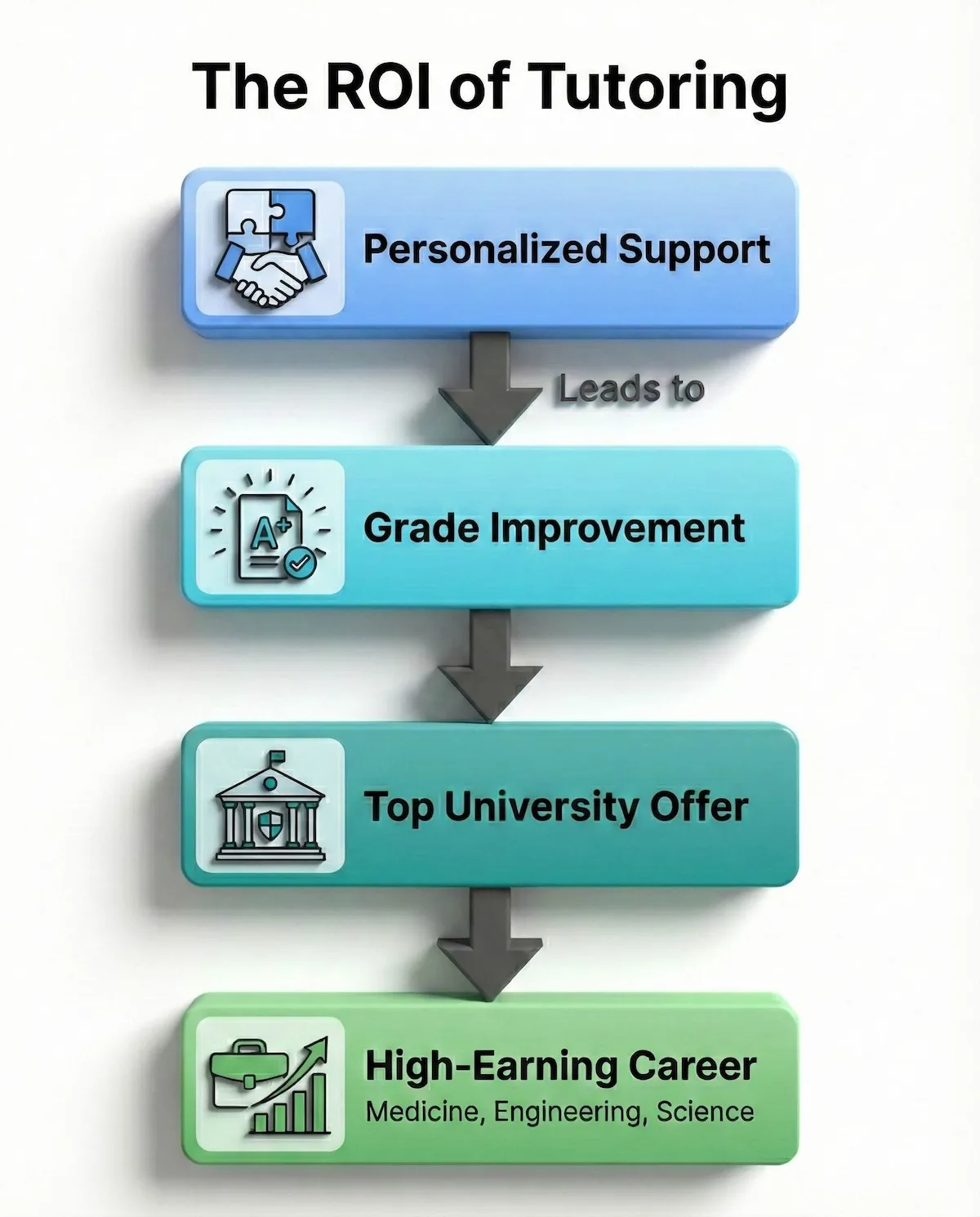
Viewing tutoring as a long-term investment helps connect today’s effort with tomorrow’s career success.
Your Formula for Success
Navigating the complexities of A-Level Chemistry doesn’t have to be a lonely or stressful journey. It’s a challenging qualification, and it’s perfectly normal to need some extra support along the way. Recognizing that need is a sign of strength, not weakness.By engaging in personalized A-Level Chemistry tutoring, you are giving yourself the best possible chance to succeed. You are choosing to turn confusion into clarity, anxiety into confidence, and hard work into high grades. The right support system, through expert A-Level Chemistry teaching, can illuminate the path forward, helping you not only to pass the exam but to develop a genuine appreciation for the beautiful, intricate world of chemistry.You can also find help with AP Chemistry if your curriculum follows the US college-board pathway rather than the UK A-Level route.Frequently Asked Questions About A-Level Chemistry
How many hours of A-Level Chemistry tutoring will a student need per week?
Most students benefit from one to two hours of focused A-Level Chemistry tutoring per week.Can an online A-Level Chemistry tutor really be as effective as an in-person tutor?
Yes, modern online tools make online A-Level Chemistry tutoring highly interactive and just as effective as in-person sessions.What if a student only needs help with A-Level Chemistry homework?
Many services offer flexible A-Level Chemistry homework guidance sessions focused specifically on a student’s assignments.How does a student know if an A-Level Chemistry tutor is a good fit?
Students should look for someone with strong subject expertise, teaching experience, and a patient, adaptable communication style.Is A-Level Chemistry tutoring just for students who are failing?
No, A-Level Chemistry tutoring is also for ambitious students aiming to turn a B into an A*.What is the main benefit of a private A-Level Chemistry tutor over a school teacher?
A private A-Level Chemistry tutor provides personalized, one-on-one attention that’s impossible in a full classroom.Related Reading
******************************
This article provides general educational guidance only. It is NOT official exam policy, professional academic advice, or guaranteed results. Always verify information with your school, official exam boards (College Board, Cambridge, IB), or qualified professionals before making decisions. Read Full Policies & Disclaimer , Contact Us To Report An Error