
ADVANCED SUBJECTS · LIVE 1:1 TUTORING
Abaqus Tutoring Online
Personalized instruction for demanding courses and technical subjects. Learn with a tutor selected for your topic, level, and learning goals.
University · Master’s & PhD · Professional Upskilling
Request tutor availability and a quote. Or email [email protected].

Since 2008
Established Tutoring Service
~1 min
Average First Response
Specialist Match
For Your Subject & Level
30-Min Trial
Try Tutoring Before a Longer Plan
Hire The Best Abaqus Tutor


Abaqus won’t debug itself. If your simulation keeps aborting, your mesh is throwing errors, or your FEA results look nothing like the expected output — you need someone who has seen exactly that failure before.
Abaqus Tutor Online
Abaqus is a finite element analysis (FEA) software suite developed by Dassault Systèmes, used to simulate structural, thermal, and mechanical behaviour of components and assemblies under real-world loading conditions.
MEB provides 1:1 online tutoring and project help in 2,800+ advanced subjects — including Abaqus, across undergraduate, postgraduate, and professional engineering programmes. If you’ve been searching for an Abaqus tutor near me, MEB connects you with a verified specialist within the hour. Our tutors have worked in FEA-heavy industries — aerospace, automotive, civil — and know where students get stuck. No guarantees on outcomes, but students who work consistently with a tutor close their knowledge gaps faster than those who work alone. MEB also covers the broader Computer-Aided Design subject family, so if your course spans tools beyond Abaqus, we can help there too.
- 1:1 online sessions tailored to your module, project brief, or coursework deadline
- Expert-verified tutors with hands-on Abaqus experience across multiple engineering disciplines
- Flexible time zones — US, UK, Canada, Australia, Gulf
- Structured session plan built after a diagnostic of your current Abaqus setup and gaps
- Guided project support — we explain the methodology, you run the simulation and submit your own work
52,000+ students across the US, UK, Canada, Australia, and the Gulf have used MEB since 2008 — including students working in Computer-Aided Design and simulation subjects like Abaqus, ANSYS, and HyperMesh.
Source: My Engineering Buddy, 2008–2025.
How Much Does an Abaqus Tutor Cost?
Abaqus tutoring at MEB starts at $20/hr for standard undergraduate-level sessions. Postgraduate, research-level, or highly specialised simulation work runs $35–$70/hr. You can test the service first — the $1 trial gives you 30 minutes of live tutoring or a full explanation of one project problem.
| Level / Need | Typical Rate | What’s Included |
|---|---|---|
| Standard (UG modules, coursework) | $20–$35/hr | 1:1 sessions, project guidance, error diagnosis |
| Advanced / Postgraduate / Research | $35–$70/hr | Expert tutor, complex simulations, thesis support |
| $1 Trial | $1 flat | 30 min live session or 1 project question explained |
Tutor availability tightens significantly around end-of-semester submission windows and dissertation deadlines. Book early if your deadline is within three weeks.
WhatsApp MEB for a quick quote — average response time under 1 minute.
Who This Abaqus Tutoring Is For
Abaqus is one of the steeper learning curves in engineering software. The interface isn’t intuitive, the error messages are cryptic, and a small setup mistake can invalidate an entire simulation run. Most students hit a wall — and that wall tends to appear at the worst possible time.
- Undergraduate engineering students with a coursework or project submission deadline approaching and simulation results that don’t converge
- Masters students working on structural, thermal, or fluid-structure interaction analyses for their dissertation
- PhD students who need Abaqus for specific modelling tasks but lack formal training in the software
- Students retaking a module after a failed first attempt — particularly where FEA was a component they didn’t fully understand
- Engineers in industry transitioning to Abaqus from another FEA tool (ANSYS, Nastran) who need practical onboarding
- Students at universities across the US, UK, Canada, Australia, and Gulf institutions where Abaqus is part of the core CAE or structural mechanics curriculum
Students working at institutions like MIT, Imperial College London, ETH Zürich, University of Toronto, UNSW, and TU Delft regularly use Abaqus as part of their FEA coursework. MEB tutors are familiar with the kinds of problems those programmes assign.
1:1 Tutoring vs Self-Study vs AI vs YouTube vs Online Courses
Self-study works if you already understand FEA theory and just need to learn the interface — most students don’t. AI tools can explain Abaqus concepts but can’t look at your actual model, read your job log, or tell you why your element distortion is causing solver failure. YouTube covers basic workflows well; it stops being useful the moment your specific model behaves unexpectedly. Online courses give you structured walkthroughs at a fixed pace with no room for the question you actually have right now. 1:1 tutoring with MEB is live and specific — the tutor sees your Abaqus file, diagnoses the error, and walks you through the fix in real time. For a tool as setup-sensitive as Abaqus, that difference is not small.
Outcomes: What You’ll Be Able To Do in Abaqus
After working with an MEB tutor, students consistently report being able to set up and run simulations independently — without needing to restart from scratch every time an error appears. Specific outcomes depend on your starting point, but the trajectory is clear.
You’ll be able to: model and mesh engineering components correctly in Abaqus/CAE, apply boundary conditions and loading scenarios that reflect real physical constraints, interpret output databases (ODB files) to extract stress, strain, and displacement results with confidence, troubleshoot convergence errors and job abort messages by reading the message file systematically, and present FEA results in a report or viva in a way that demonstrates you understand what the simulation is actually showing.
Based on feedback from 40,000+ sessions collected by MEB from 2022 to 2025, 58% of students improved by one full grade after approximately 20 hours of 1:1 tutoring in subjects like Abaqus. A further 23% achieved at least a half-grade improvement.
Source: MEB session feedback data, 2022–2025.
Students consistently tell us that the moment things click in Abaqus isn’t when they watch a tutorial — it’s when they make a specific mistake in front of a tutor who can explain exactly why that mistake happened and what it tells you about the physics underneath. That’s the moment the software stops feeling like a black box.
What We Cover in Abaqus (Syllabus / Topics)

Track 1: Abaqus/CAE — Geometry, Mesh, and Assembly
- Part creation: sketching, solid modelling, shell and wire geometry
- Section definitions and material property assignment (elastic, plastic, hyperelastic)
- Assembly module: instances, constraints, contact pair setup
- Mesh module: element type selection (C3D8R, S4R, B31), seeding, mesh controls
- Mesh quality checks: aspect ratio, distortion, Jacobian analysis
- Partition techniques for structured and swept meshing
- Understanding and fixing mesh errors before job submission
Core reference texts include Abaqus Analysis User’s Guide (Dassault Systèmes) and A First Course in the Numerical Analysis of Differential Equations by Iserles — useful for FEA mathematical foundations.
Track 2: Static, Dynamic, and Thermal Analysis
- Static general and static Riks (arc-length) analysis for nonlinear problems
- Dynamic implicit and explicit step setup — when to use each solver
- Frequency extraction and modal analysis
- Heat transfer analysis: steady-state and transient thermal simulations
- Coupled thermal-structural analysis setup
- Contact mechanics: hard contact, friction, tie constraints, surface-to-surface
- Applying distributed loads, pressure, gravity, thermal gradients, and bolt preload
Recommended texts: Finite Element Procedures by Bathe and An Introduction to the Finite Element Method by Reddy — both widely assigned in postgraduate FEA courses.
Track 3: Abaqus Scripting, Post-Processing, and Advanced Workflows
- Abaqus Python scripting (abaqus.py) for automating model creation and parametric studies
- Output requests: field output, history output, frequency and variable selection
- ODB file interrogation: reading results in Abaqus/Viewer and via scripting
- Stress and strain invariants: von Mises, principal stresses, plastic strain (PEEQ)
- Path plots, XY data extraction, contour plot customisation for report figures
- Computer-Aided Engineering integration: linking Abaqus outputs to broader CAE workflows
- User subroutines (UMAT, VUMAT) — an introduction for advanced research users
Useful references: Practical Finite Element Analysis by Nitin Gokhale and the official Abaqus Scripting User’s Guide from Dassault Systèmes.
Platforms, Tools & Textbooks We Support
Abaqus runs as a standalone desktop application. MEB tutors support all current versions of Abaqus (6.x through 2024 releases), including Abaqus/Standard, Abaqus/Explicit, and Abaqus/CFD. Sessions run on Google Meet with screen sharing so the tutor can see your model live. Tutors also support integration with:
- Abaqus/CAE (full GUI workflow)
- Abaqus Python scripting environment
- HyperMesh for pre-processing before Abaqus import
- CATIA and SolidWorks for geometry import into Abaqus
- MATLAB for post-processing and data comparison alongside Abaqus results
- Linux/Unix command-line job submission for HPC cluster environments
What a Typical Abaqus Session Looks Like
The tutor starts by checking where you left off — usually a specific step that didn’t work, such as a failed mesh or a job that aborted with an error in the message file. You share your screen via Google Meet so the tutor can see your actual model. From there, the session works through the problem directly — if it’s a contact pair setup issue causing non-convergence, the tutor walks you through why the solver is struggling and what changes to boundary conditions or step settings will fix it. The tutor uses a digital pen-pad to annotate over your screen or sketch force diagrams and mesh logic. You make the changes yourself, rerun the job, and interpret the output with the tutor present. The session closes with a specific task — a modification to test, a section of the model to mesh independently, or a results comparison to write up — and the next topic is noted so the following session doesn’t repeat ground already covered.
How MEB Tutors Help You with Abaqus (The Learning Loop)
Diagnose: In the first session, the tutor reviews your current model or project brief — checking your material definitions, step settings, mesh quality, and boundary conditions. The goal is to identify exactly where your understanding breaks down, not just fix the immediate error.
Explain: The tutor works through the underlying FEA concept live — why a particular element type behaves differently under large deformation, why your stress concentrations look wrong, why explicit analysis diverges when you use it for a quasi-static problem. Worked examples on the digital pen-pad, not abstract lecture.
Practice: You run the revised simulation or set up a simplified version of the model yourself, with the tutor watching. The act of doing it in the session — not just watching — is what builds the muscle memory for working independently.
Feedback: The tutor goes through the output with you. Where marks are lost in a coursework report (wrong contour scale, missing units, misidentified failure mode), the tutor flags it before you submit. For research work, this means your results section is defensible.
Plan: Each session ends with a clear next step — a specific Abaqus task, a section of theory to review, or a model modification to attempt. The tutor tracks your progression so nothing is revisited unnecessarily.
Sessions run on Google Meet. The tutor uses a digital pen-pad or iPad with Apple Pencil. Before your first session, share your project brief or coursework specification, a screenshot or .cae file of your current model, and your submission deadline. The first session is diagnostic — the tutor uses it to map your knowledge gaps and build the session plan. Whether you need a quick turnaround before a deadline or structured support over several weeks, the plan is built around your actual situation. Start with the $1 trial — 30 minutes of live tutoring that also serves as your first diagnostic.
Try your first session for $1 — 30 minutes of live 1:1 tutoring or one homework question explained in full. No registration. No commitment. WhatsApp MEB now and get matched within the hour.
Tutor Match Criteria (How We Pick Your Tutor)
Not every engineer who knows Abaqus can teach it. MEB vets for both.
Subject depth: Tutors are matched to your specific analysis type — structural, thermal, explicit dynamics, or scripting — not just “Abaqus” as a broad tag. A tutor working with a Masters student on fluid-structure interaction is different from one supporting an undergraduate through a basic static analysis coursework.
Tools: All tutors use Google Meet with screen share and a digital pen-pad or iPad with Apple Pencil. They can view your model live, annotate, and guide you through changes in real time.
Time zone: Matched to your region — US, UK, Gulf, Canada, Australia — so sessions run at hours that don’t require you to be awake at 3am.
Goals: Whether you need to pass a module, complete a dissertation chapter, or get to grips with Abaqus scripting for a research project, the tutor is selected for that specific goal.
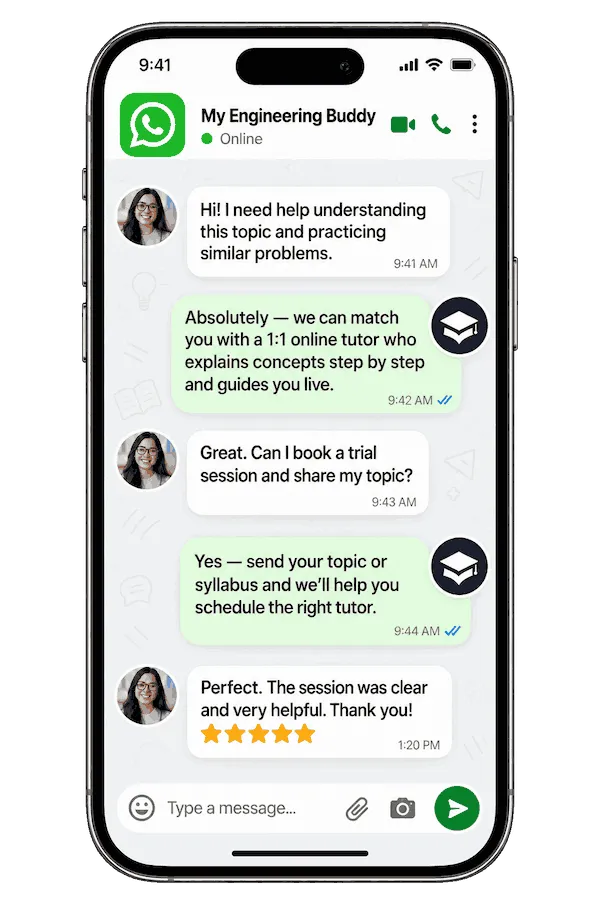
Unlike platforms where you fill out a form and wait, MEB responds in under a minute, 24/7. Tutor match takes under an hour. The $1 trial means you test before you commit. Everything runs over WhatsApp — no logins, no intake forms.
Pricing Guide
Standard Abaqus tutoring runs $20–$40/hr for most undergraduate and taught postgraduate levels. Research-intensive or highly specialised simulation work — custom user subroutines, multi-physics coupling, HPC job scripting — can run up to $100/hr depending on tutor expertise and project complexity.
Rate factors: your level, the analysis type, how close your deadline is, and tutor availability. Availability during peak submission periods (April–May, November–December) is genuinely limited — sessions fill up fast.
For students targeting roles at top aerospace, automotive, or civil engineering firms — or aiming to produce FEA work that holds up in a PhD viva — tutors with industry and research backgrounds are available at higher rates. Share your specific goal and MEB will match the tier to your ambition.
Start with the $1 trial — 30 minutes, no registration, no commitment. WhatsApp MEB for a quick quote.
MEB has been running since 2008. That’s 18 years of tutors being matched to engineering students, and 18 years of knowing which Abaqus errors are common, which are course-specific, and which mean the student needs to go back one concept further before touching the software again.
Source: My Engineering Buddy, internal platform data, 2008–2025.
FAQ
Is Abaqus hard to learn?
Yes — more so than many other FEA tools. The interface is non-intuitive, error messages are rarely self-explanatory, and small setup mistakes cause the solver to fail silently. Most engineers need structured guidance, not just a manual, to get reliable results.
How many sessions will I need?
For a single coursework problem, one to three sessions is typically enough. For a full dissertation involving multiple analysis types, expect six to fifteen sessions spread over the project duration. The tutor gives a clearer estimate after the first diagnostic session.
Can you help with my Abaqus project and coursework?
MEB provides guided project support — the tutor explains the methodology, walks through the setup, and helps you understand why things work the way they do. You run the simulation and submit your own work. See our Academic Integrity policy and Why MEB page for full details on what we help with and what we don’t.
Will the tutor match my exact course and analysis type?
Yes. MEB matches based on your specific module or project brief, not just the software name. A tutor for explicit crash simulation is different from one for steady-state thermal analysis. Share your brief when you contact us and the match is made accordingly.
What happens in the first session?
The tutor reviews your current model, error log, or project specification. You share your screen so the tutor can see exactly where things are going wrong. The session ends with a clear plan for subsequent sessions and a specific task to attempt before the next one.
Is online tutoring as effective as in-person for a software like Abaqus?
For software-based subjects, online is often more effective. You share your actual model in real time, the tutor annotates directly on your screen, and there’s no travel or room-booking overhead. Students regularly prefer it over in-person sessions once they’ve tried it.
Can I get Abaqus help at midnight or over the weekend?
Yes. MEB operates 24/7 and covers multiple time zones. If your simulation fails on a Sunday night before a Monday deadline, WhatsApp MEB and a tutor match can happen within the hour. This is one of the more common use cases.
What if I don’t like my assigned tutor?
Tell MEB via WhatsApp. A replacement is arranged quickly — usually within a few hours. The $1 trial is specifically designed so you evaluate the match before committing to further sessions. There’s no pressure to continue with a tutor who isn’t the right fit.
Do you offer group Abaqus sessions?
MEB focuses on 1:1 tutoring. Group sessions are not a standard offering. If you and a classmate want to work through the same project problem together, raise it when you contact MEB and it will consider whether that’s feasible for your specific situation.
What is the difference between Abaqus/Standard and Abaqus/Explicit, and how do I know which to use?
Abaqus/Standard uses an implicit solver — better for static, quasi-static, and low-speed dynamic problems where accuracy matters. Abaqus/Explicit uses an explicit solver — better for high-speed impact, crash, or highly nonlinear events. Choosing the wrong solver is one of the most common and costly mistakes in student projects. Your tutor will assess your problem and confirm the correct choice in the first session.
Can MEB help with Abaqus Python scripting and user subroutines like UMAT?
Yes. MEB has tutors experienced in Abaqus Python scripting for parametric studies and automated workflows, and in UMAT/VUMAT subroutines for custom material models. These are advanced topics — flag them when you contact MEB so the right specialist is matched to you.
How do I get started?
Start with the $1 trial — 30 minutes of live tutoring or one project question explained in full. Three steps: WhatsApp MEB, get matched with a verified Abaqus tutor within the hour, then begin your trial session. No registration, no commitment beyond the first dollar.
Trust & Quality at My Engineering Buddy
MEB tutors go through a multi-stage vetting process: subject knowledge assessment, a live demo session evaluation, and an ongoing review of session feedback. Tutors for Abaqus are assessed specifically on FEA methodology, not just general engineering knowledge. They hold degrees in mechanical, structural, aerospace, or civil engineering — many with postgraduate qualifications — and a significant portion have industry experience using Abaqus in professional settings. Rated 4.8/5 across 40,000+ verified reviews on Google.
MEB tutoring is guided learning — you understand the work, then submit it yourself. For full details on what we help with and what we don’t, read our Academic Integrity policy and Why MEB.
MEB has served 52,000+ students across the US, UK, Canada, Australia, Gulf, and Europe since 2008, covering 2,800+ subjects. Within Computer-Aided Design and simulation, MEB supports subjects across the full CAE stack — including ANSYS Workbench tutoring, STAR-CCM+ help, and Siemens NX tutoring. If your programme touches more than one simulation tool, MEB covers the full range. Learn more about how sessions are structured at MEB’s tutoring methodology page.
A common pattern our tutors observe is that students who arrive with a broken Abaqus model and a deadline often know more FEA theory than they think. The gap is almost always in translating that theory into the software’s specific logic — not in the engineering understanding itself. That’s a gap a good session closes quickly.
Explore Related Subjects
Students studying Abaqus often also need support in:
- ANSYS CFX
- ANSYS Fluent
- ANSYS Mechanical APDL
- Computer-Aided Manufacturing (CAM)
- Creo
- Machine Design
- Surface Modeling
Next Steps
When you contact MEB, share: your exam board or course outline (or your project brief), the specific Abaqus problem or analysis type you’re working on, your submission or exam deadline, and your time zone and availability.
- MEB matches you with a verified Abaqus tutor — usually within the hour
- First session starts with a diagnostic so every minute is focused on what you actually need
- Before your first session, have ready: your .cae file or model description, a recent error log or output you don’t understand, and your deadline date
The tutor handles the rest. Visit www.myengineeringbuddy.com for more on how MEB works.
WhatsApp to get started or email [email protected].
At MEB, we’ve found that the students who get the most out of Abaqus tutoring are the ones who come in with a specific model that’s already broken. That gives the tutor something real to work with — and the student something they actually need fixed by tomorrow.
Reviewed by Subject Expert
This page has been carefully reviewed and validated by our subject expert to ensure accuracy and relevance.



