


Hire The Best ANSYS Tutor
Top Tutors, Top Grades. Without The Stress!




52,000+ Happy Students From Various Universities






How Much For Private 1:1 Tutoring & Hw Help?
Private 1:1 Tutoring and HW help Cost $20 – 35 per hour* on average.
Your Ansys simulation keeps diverging, your mesh won’t converge, and the deadline is 72 hours away.
Ansys Tutor Online
Ansys is a commercial finite element analysis and computational fluid dynamics software suite used in structural, thermal, electromagnetic, and fluid simulation across engineering disciplines at undergraduate, graduate, and professional levels.
MEB connects you with a specialist Ansys tutor online for 1:1 project help across every major module — Mechanical, Fluent, CFX, Workbench, APDL, and more. If you’ve searched for an Ansys tutor near me, working online means access to tutors with industry and research backgrounds that simply don’t exist locally. Our computer-aided design tutoring network spans every major CAE platform, and Ansys sits at the centre of it. One session can turn a crashing simulation into a working model.
- 1:1 online sessions tailored to your course, project brief, or simulation workflow
- Expert-verified tutors with FEA, CFD, and structural analysis backgrounds
- Flexible time zones — US, UK, Canada, Australia, Gulf covered
- Structured project plan built after a diagnostic of your current model
- Guided project support — we explain the method, you build and submit the simulation
52,000+ students across the US, UK, Canada, Australia, and the Gulf have used MEB since 2008 — including students working on CAD and simulation subjects like Ansys, Abaqus, and Ansys Fluent.
Source: My Engineering Buddy, 2008–2025.
How Much Does an Ansys Tutor Cost?
Most Ansys tutoring sessions run $20–$40/hr. Complex graduate-level simulations or niche module work (electromagnetics, explicit dynamics) can reach $60–$100/hr depending on tutor expertise and project complexity. The $1 trial gets you 30 minutes of live 1:1 help or a full walkthrough of one project problem — no registration required.
| Level / Need | Typical Rate | What’s Included |
|---|---|---|
| Undergraduate project / coursework | $20–$40/hr | 1:1 sessions, simulation guidance |
| Graduate / research-level FEA or CFD | $40–$70/hr | Expert tutor, complex model review |
| Niche modules (EM, explicit dynamics) | $60–$100/hr | Specialist background, advanced setup |
| $1 Trial | $1 flat | 30 min live session or 1 project problem |
Availability tightens around semester submission windows. Book early if your project deadline falls in April–May or November–December.
WhatsApp MEB for a quick quote — average response time under 1 minute.
Who This Ansys Tutoring Is For
Most students who come to MEB for Ansys help are not beginners in engineering — they understand the physics. What trips them up is the software: wrong element types, boundary condition errors, mesh failures, or results that make no physical sense. If that’s where you are, you’re in the right place.
- Undergraduate mechanical, civil, or aerospace engineering students with a project submission in the next 2–6 weeks
- Students whose simulation has been running for days and still won’t converge
- Students who failed a previous submission and need to resubmit with a working model
- Masters or PhD students running structural, thermal, or CFD analyses for the first time in Ansys
- Students with a university conditional offer that depends on passing this module
- Engineers transitioning from other FEA tools (Abaqus, Nastran) who need to get productive in Ansys quickly
Students from universities including MIT, Georgia Tech, University of Michigan, Imperial College London, TU Delft, ETH Zürich, University of Toronto, and KAUST have worked with MEB tutors on Ansys projects. Try the $1 trial before committing to a full package.
At MEB, we’ve found that most Ansys problems aren’t physics problems — they’re workflow problems. A student who understands structural mechanics but has never set up a contact pair or defined a load step correctly will get wrong answers every time. Fixing that takes one session, not ten.
1:1 Tutoring vs Self-Study vs AI vs YouTube vs Online Courses
Self-study works if you can interpret cryptic error messages and have days to spare. AI tools explain Ansys concepts but can’t see your model, read your APDL log, or tell you why your mesh density is causing element distortion. YouTube covers geometry import and basic static structural — it stops when your contact nonlinearity diverges. Online courses are fixed-pace and rarely match your university’s specific Ansys version or project brief. 1:1 tutoring with MEB is live, in your actual model file, correcting your specific setup in real time. For Ansys, that difference is the project passing or failing.
Outcomes: What You’ll Be Able To Do in Ansys
After working with an MEB Ansys tutor, you’ll be able to set up and run a static structural analysis with correct boundary conditions and load applications, interpret von Mises stress and deformation plots without misreading scale factors, mesh a complex geometry in Workbench with appropriate element sizing and quality checks, apply pressure and velocity inlet conditions in Fluent for internal flow problems, and explain your simulation methodology clearly in a written project report. These aren’t abstract skills — they map directly to what your assessor is marking.
Based on feedback from 40,000+ sessions collected by MEB from 2022 to 2025, 58% of students improved by one full grade after approximately 20 hours of 1:1 tutoring in subjects like Ansys. A further 23% achieved at least a half-grade improvement.
Source: MEB session feedback data, 2022–2025.
What We Cover in Ansys (Topics & Simulation Tracks)

Structural & Mechanical FEA
- Static structural analysis: stress, strain, deformation
- Modal and harmonic response analysis
- Transient structural and explicit dynamics (Ansys Autodyn)
- Contact mechanics: bonded, frictional, frictionless pairs
- Material nonlinearity: plasticity, hyperelastic models
- Fatigue analysis and safety factor calculation
- APDL scripting for parametric model automation
Recommended references: Finite Element Procedures by Bathe; An Introduction to the Finite Element Method by Reddy; Ansys Mechanical APDL documentation.
Fluid Dynamics (CFD) — Fluent & CFX
- Internal and external flow setup: velocity inlets, pressure outlets
- Turbulence modelling: k-ε, k-ω, SST selection and wall treatment
- Heat transfer: conjugate heat transfer, natural and forced convection
- Multiphase flow: VOF and Eulerian models
- Mesh independence studies and convergence monitoring
- Post-processing: streamlines, pressure and temperature contours
Recommended references: An Introduction to Computational Fluid Dynamics by Versteeg & Malalasekera; Computational Fluid Dynamics by Anderson; Ansys Fluent Theory Guide.
Thermal, Electromagnetic & Multiphysics
- Steady-state and transient thermal analysis
- Coupled thermal-structural simulations
- Ansys Maxwell: magnetostatic and eddy current analysis
- Ansys Motor-CAD integration for electric machine simulation
- System Coupling for FSI (fluid-structure interaction) problems
- Workbench project schematic management across physics types
Recommended references: Fundamentals of Heat and Mass Transfer by Bergman et al.; Ansys Maxwell and Motor-CAD user guides; Engineering Electromagnetics by Hayt & Buck.
Platforms, Tools & Textbooks We Support
Ansys tutoring at MEB covers the full software ecosystem students encounter in engineering programmes. Tutors work directly in your version of the software during shared-screen sessions, so there’s no abstract instruction — you see exactly what to click and why.
- Ansys Workbench (2019 R1 through 2024 R2)
- Ansys Mechanical APDL (classic interface)
- Ansys Fluent and CFX
- Ansys Maxwell and Motor-CAD
- Ansys AQWA (offshore and hydrodynamic analysis)
- SpaceClaim and DesignModeler for geometry preparation
- HyperMesh for pre-processing before Ansys solver import
- MATLAB integration for parametric post-processing
What a Typical Ansys Session Looks Like
The tutor opens by checking where the previous session left off — usually whether the mesh quality study you were running produced acceptable skewness and aspect ratio values. You share your screen, load the Workbench project, and the tutor watches you walk through the setup. When you hit the problem — say, a contact status warning on a bolted joint or pressure oscillation in a Fluent residual plot — the tutor takes the digital pen-pad and annotates directly over your screen, explaining what the solver is actually doing and why your current settings are producing that result. You rebuild the boundary condition or refine the mesh region yourself, with the tutor watching. The session closes with a specific task: run the corrected model, capture the convergence plot, and flag the next component if the stress values still look off.
Students consistently tell us that the moment things click in Ansys is when they stop treating error messages as problems to dismiss and start reading them as the solver’s explanation of what the model is missing. That shift usually happens in a single session.
How MEB Tutors Help You with Ansys (The Learning Loop)
Diagnose: In the first session, the tutor reviews your existing model file — geometry, mesh, boundary conditions, and solver settings. They identify where the setup breaks down: wrong material definition, incorrect contact behaviour, inappropriate turbulence model for your Reynolds number regime.
Explain: The tutor works through the correction live using a digital pen-pad, annotating over your screen. They explain why a particular element type suits your geometry or why your y+ value is causing wall function errors — not just what to change, but the underlying reason.
Practice: You rebuild the corrected section yourself while the tutor watches. For APDL scripting or parametric studies, you write the commands and the tutor reviews syntax and logic in real time.
Feedback: After you rerun the simulation, the tutor walks through the results with you — stress contours, residual plots, or temperature distributions — and explains what the output means against your project criteria and where marks are typically lost in report write-ups.
Plan: Each session ends with a clear next step: which load case to add, which mesh region to refine, or which validation check to run before submission. The tutor tracks your progress across sessions and adjusts the sequence as your deadline approaches.
Sessions run over Google Meet with screen sharing. The tutor uses a digital pen-pad or iPad with Apple Pencil for annotations. Before your first session, have your Ansys project file, your project brief or marking rubric, and any error messages or solver log files ready. The first session is your diagnostic — start with the $1 trial, which also serves as that diagnostic at no real cost.
Whether you need to fix a crashing model in three sessions, run structured project support over 4–8 weeks, or book ongoing weekly help through a research semester, the tutor maps the plan after the first diagnostic.
MEB has covered over 2,800 engineering and technical subjects since 2008 — including simulation software like Ansys Workbench, Ansys Mechanical APDL, and STAR-CCM+ — with tutors who have used these tools in industry and research, not just taught them.
Source: My Engineering Buddy, 2008–2025.
Tutor Match Criteria (How We Pick Your Tutor)
Not every engineer who knows Ansys can teach it. MEB screens for both.
Subject depth: Tutors are matched to your specific Ansys module — a CFD specialist handles Fluent and CFX work; a structural FEA specialist handles Mechanical and APDL projects. No generalist assigned to a specialist problem.
Tools: Every tutor uses Google Meet with screen sharing and a digital pen-pad or iPad with Apple Pencil. They can view your model file, annotate your results, and write APDL commands live on screen.
Time zone: Matched to your region — US, UK, Gulf, Canada, or Australia. Late-night sessions before a deadline are available.
Goals: Whether you need a working simulation for a graded project, conceptual depth for a viva, or help validating a research model against experimental data, the tutor is briefed on your specific target before the first session.
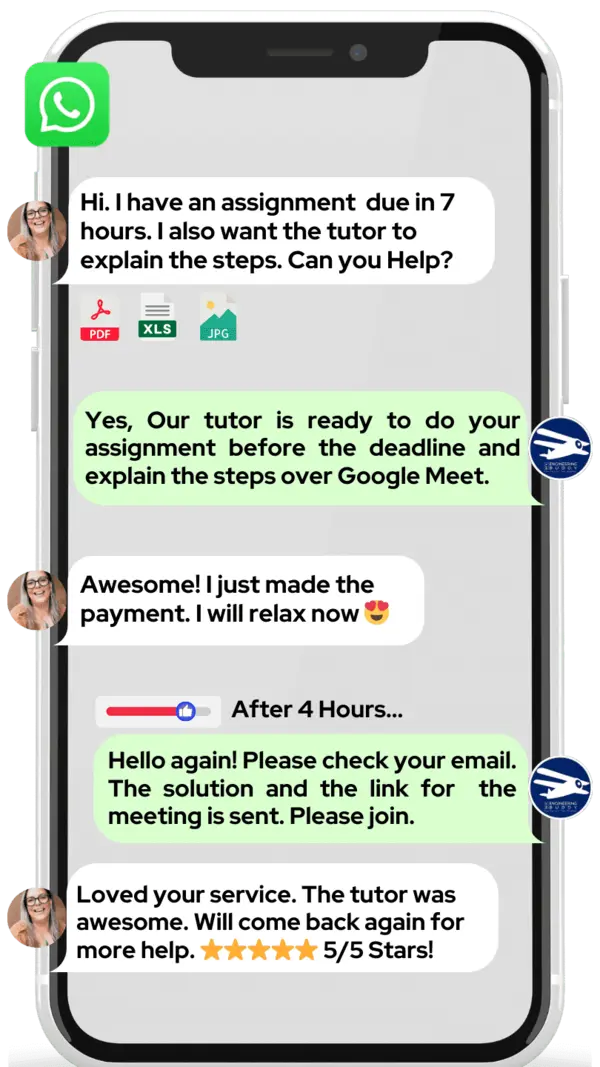
Unlike platforms where you fill out a form and wait, MEB responds in under a minute, 24/7. Tutor match takes under an hour. The $1 trial means you test the match before committing to a full package. Everything runs over WhatsApp — no logins, no intake forms.
Pricing Guide
Ansys tutoring runs $20–$40/hr for most undergraduate project work. Graduate-level simulations, FSI problems, or specialist modules like Ansys Maxwell or AQWA run $60–$100/hr. Rate factors include: Ansys module, project complexity, timeline pressure, and tutor availability at your time zone.
Availability drops sharply in the 2–3 weeks before major submission windows. Book ahead if your project date is fixed.
For students targeting roles at aerospace, automotive, or energy firms — or PhD research positions requiring validated simulation skills — tutors with relevant industry backgrounds are available at higher rates. Share your specific goal and MEB matches the tier to it.
Start with the $1 trial — 30 minutes, no registration, no commitment. WhatsApp MEB for a quick quote.
Try your first session for $1 — 30 minutes of live 1:1 tutoring or one project problem explained in full. No registration. No commitment. WhatsApp MEB now and get matched within the hour.
FAQ
Is Ansys hard to learn?
Ansys has a steep initial curve — geometry preparation, meshing strategy, and solver settings all interact. Most students plateau not on the physics but on the software workflow. A tutor accelerates that learning significantly by working directly in your model.
How many sessions will I need?
A single convergence or boundary condition problem often resolves in one session. A full project from geometry import to validated results typically takes 4–8 sessions. The tutor assesses this in the first diagnostic and gives you a realistic plan.
Can you help with projects and portfolio work?
Yes. MEB provides guided project support — the tutor explains the method and reviews your setup, and you build and submit the simulation yourself. MEB provides guided learning support. All project work is produced and submitted by the student. See our Policies page for details.
Will the tutor match my exact Ansys module and university project brief?
Yes. Share your project brief, marking rubric, and Ansys version before the first session. The tutor is matched to your specific module — CFD, structural FEA, thermal, or electromagnetics — not assigned generically.
What happens in the first session?
The tutor reviews your existing model or project brief, identifies the specific problem — mesh failure, boundary condition error, solver divergence — and works through the fix with you live. You leave with a working next step and a session plan.
Is online Ansys tutoring as effective as in-person?
For simulation software, online is often better. Screen sharing means the tutor sees your exact model, error messages, and solver output in real time. A digital pen-pad lets them annotate directly over your results — more precise than pointing at a physical screen.
What’s the difference between Ansys Mechanical and APDL — and which should I learn?
Ansys Mechanical (Workbench GUI) suits most undergraduate and coursework projects — faster to set up, visual. APDL is the scripting language underneath it, used for parametric studies and advanced automation. Your project brief usually dictates which one. The tutor advises after reviewing your task.
My Ansys simulation won’t converge — can a tutor fix that in one session?
Convergence failures have common causes: contact definition errors, mesh distortion, inappropriate time stepping, or nonlinear material instability. In most cases a tutor can identify and correct the root cause in a single session. Bring your solver output and APDL log file.
Can I get help with Ansys at midnight before my submission?
Yes. MEB operates across time zones and has tutors available late evening and overnight for US, UK, Gulf, Canada, and Australia. WhatsApp MEB at any hour — average response is under a minute.
Do you offer group Ansys sessions?
No. MEB sessions are exclusively 1:1. Group sessions slow down to the least prepared student and can’t address individual model files. Every session is calibrated to your specific simulation problem and deadline.
How do I get started?
WhatsApp MEB, share your project brief or describe your Ansys problem, and you’re matched with a tutor within the hour. The first session starts with a diagnostic. Three steps: WhatsApp → matched → start the $1 trial.
What if Ansys crashes or I can’t share my model file in the session?
Tutors are familiar with file-sharing alternatives — Google Drive for project folders, screen recording for crash reproduction, and APDL input files sent via WhatsApp. Most technical session issues are resolved in under five minutes before work begins.
Trust & Quality at My Engineering Buddy
Every MEB tutor goes through subject-specific screening before being matched with students. For Ansys, that means a live evaluation of their simulation workflow — not just a CV review. Tutors demonstrate they can diagnose a broken model, explain the fix clearly, and use the digital pen-pad effectively during a demo session. Rated 4.8/5 across 40,000+ verified reviews on Google. Ongoing session feedback is reviewed by MEB and used to adjust tutor assignments.
MEB provides guided learning support. All project work is produced and submitted by the student. For full details on what we help with and what we don’t, read our Academic Integrity policy and Why MEB.
MEB has been serving engineering students across the US, UK, Canada, Australia, Gulf, and Europe since 2008 — across 2,800+ subjects. The computer-aided engineering (CAE) tutor network includes specialists in Ansys CFX and HyperMesh pre-processing — the tools that sit alongside Ansys in most engineering programmes. Tutors are matched by module, not by subject name alone. The NIST Engineering Laboratory sets many of the simulation and measurement standards that Ansys-based projects reference; MEB tutors are familiar with these frameworks and help students apply them correctly in project reports.
Explore Related Subjects
Students studying Ansys often also need support in:
Next Steps
Before your first session, have ready: your Ansys version and project file (or project brief), the specific error message or result you can’t explain, and your submission deadline. The tutor handles the rest.
- Share your project brief, Ansys module, and deadline via WhatsApp
- Share your time zone — MEB covers US, UK, Gulf, Canada, and Australia
- MEB matches you with a verified Ansys specialist — usually within the hour
First session starts with a diagnostic so every minute is used on your actual problem, not on introductions. Visit www.myengineeringbuddy.com for more on how MEB works.
WhatsApp to get started or email meb@myengineeringbuddy.com.
Reviewed by Subject Expert
This page has been carefully reviewed and validated by our subject expert to ensure accuracy and relevance.