~1 min
Average Reply Time
~1 hour
To Be Matched With A Tutor
30 Min Trial
75% Find Their Tutor On The 1st Trial
$20-35+/hr
Premium Yet Affordable Learning
Glycolysis clicked in week one. The TCA cycle broke everything. If carbohydrate metabolism has become the point where your biochemistry grade stalls, you’re not alone — and a single well-targeted session can change that.
Carbohydrate metabolism Tutor Online
Carbohydrate metabolism is the set of biochemical pathways — including glycolysis, gluconeogenesis, glycogenesis, and the pentose phosphate pathway — by which cells break down or synthesise carbohydrates to produce ATP, metabolic intermediates, and regulatory signals.
MEB provides 1:1 online tutoring and academic guidance in biochemistry and its sub-disciplines, including carbohydrate metabolism. If you’ve searched for a carbohydrate metabolism tutor near me, MEB matches you with a verified specialist — usually within the hour. Sessions are built around your exact course, syllabus, and the topics giving you the most trouble.
- 1:1 online sessions tailored to your course syllabus and exam board
- Expert-verified tutors with subject-specific biochemistry depth
- Flexible time zones — US, UK, Canada, Australia, Gulf
- Structured learning plan built after a diagnostic session
- Ethical academic guidance — you understand before you submit
52,000+ students across the US, UK, Canada, Australia, and the Gulf have used MEB since 2008 — including students in Biochemistry subjects like Carbohydrate metabolism, Lipid Metabolism, and Metabolomics.
Source: My Engineering Buddy, 2008–2025.
How Much Does a Carbohydrate metabolism Tutor Cost?
Most carbohydrate metabolism tutoring sessions run $20–$40/hr. Graduate-level or highly specialised work can reach up to $100/hr. Before committing to hourly sessions, try the $1 trial — 30 minutes of live 1:1 tutoring or one homework question explained in full.
| Level / Need | Typical Rate | What’s Included |
|---|---|---|
| Undergraduate (most levels) | $20–$35/hr | 1:1 sessions, homework guidance |
| Graduate / Advanced | $35–$100/hr | Expert tutor, niche metabolic depth |
| $1 Trial | $1 flat | 30 min live session or 1 homework question |
Tutor availability tightens significantly in the weeks before finals and semester exams. If you’re working to a deadline, book early.
WhatsApp MEB for a quick quote — average response time under 1 minute.
Who This Carbohydrate metabolism Tutoring Is For
Carbohydrate metabolism covers a lot of ground fast — from phosphorylation cascades to hormonal regulation of blood glucose. Students fall behind at very specific points, and it’s rarely a general “I don’t understand biochemistry” problem.
- Undergraduates hitting a wall at the TCA cycle or oxidative phosphorylation
- Students retaking after a failed first attempt in a biochemistry module
- Students with a university conditional offer depending on this grade
- Graduate students who need to connect carbohydrate pathways to their research area
- Students 4–6 weeks from an exam with significant pathway gaps still to close
- Parents watching a child’s confidence drop alongside their biochemistry grades
Students at institutions including Harvard, UCL, University of Toronto, University of Sydney, and AUC in Cairo — as well as students progressing to medical and pharmacy programmes — have used MEB for clinical biochemistry tutoring and related carbohydrate metabolism support. Start your first session with the $1 trial.
1:1 Tutoring vs Self-Study vs AI vs YouTube vs Online Courses
Self-study works if you’re disciplined — but carbohydrate metabolism has enough interconnected pathways that a single misconception about substrate-level phosphorylation can quietly undermine everything downstream. AI tools give fast explanations but can’t watch you draw a pathway and catch where your logic broke. YouTube is useful for overview lectures; it stops when your specific question doesn’t match the video’s structure. Online courses are structured but move at a fixed pace with no way to pause on gluconeogenesis regulation until it clicks. 1:1 tutoring with MEB is live, calibrated to your exact course, and corrects errors in the moment — including the ones you didn’t know you were making.
Outcomes: What You’ll Be Able To Do in Carbohydrate metabolism
After working with an online carbohydrate metabolism tutor through MEB, you’ll be able to solve problems involving ATP yield calculations across glycolysis and the TCA cycle, analyse the regulatory mechanisms controlling glucokinase and phosphofructokinase-1, explain the metabolic logic behind gluconeogenesis in fasted states, apply your knowledge of the pentose phosphate pathway to questions involving NADPH and nucleotide biosynthesis, and present a coherent argument connecting insulin and glucagon signalling to glycogen metabolism. These aren’t generic outcomes — they map directly to the exam questions and coursework tasks that most students lose marks on.
Based on feedback from 40,000+ sessions collected by MEB from 2022 to 2025, 58% of students improved by one full grade after approximately 20 hours of 1:1 tutoring in subjects like Carbohydrate metabolism. A further 23% achieved at least a half-grade improvement.
Source: MEB session feedback data, 2022–2025.
Try your first session for $1 — 30 minutes of live 1:1 tutoring or one homework question explained in full. No registration. No commitment. WhatsApp MEB now and get matched within the hour.
What We Cover in Carbohydrate metabolism (Syllabus / Topics)

Core Catabolic Pathways
- Glycolysis — steps, enzymes, and energy balance (substrate-level phosphorylation)
- Pyruvate dehydrogenase complex and entry into the TCA cycle
- TCA cycle intermediates, regulation points, and anaplerotic reactions
- Oxidative phosphorylation — electron transport chain and ATP synthase mechanism
- Anaerobic metabolism and lactate production
- Pentose phosphate pathway — oxidative and non-oxidative branches, NADPH roles
Core texts: Lehninger Principles of Biochemistry (Nelson & Cox), Biochemistry (Berg, Tymoczko & Stryer). Most undergraduate carbohydrate metabolism modules map directly to these two sources.
Anabolic and Storage Pathways
- Gluconeogenesis — substrates, key bypass enzymes, and tissue specificity
- Glycogenesis and glycogenolysis — cascade regulation, phosphorylase kinase
- Glycogen storage in liver vs muscle and metabolic implications
- Regulation by insulin, glucagon, and epinephrine — second-messenger pathways
- Cori cycle and glucose-alanine cycle
Recommended reading: Harper’s Illustrated Biochemistry (Rodwell et al.) for clinical context; Biochemistry (Voet & Voet) for mechanistic depth.
Metabolic Integration and Clinical Connections
- Fed vs fasted state — metabolic switching and fuel hierarchy
- Diabetes mellitus type 1 and type 2 — metabolic consequences in carbohydrate pathways
- Inborn errors of carbohydrate metabolism (von Gierke, McArdle, galactosaemia)
- Connections to nutritional biochemistry — dietary carbohydrate and metabolic flux
- Metabolic profiling approaches covered in metabolomics tutoring
For clinical application: Clinical Biochemistry: An Illustrated Colour Text (Marshall & Bangert) is standard at many medical schools. The Nobel Prize in Physiology or Medicine archive provides historical context on several key discoveries in carbohydrate metabolism research.
What a Typical Carbohydrate metabolism Session Looks Like
The tutor opens by checking your last session topic — usually the TCA cycle or gluconeogenesis regulation — asking you to walk through a reaction or explain a control point from memory. From there, you and the tutor work through problems together on screen: the tutor uses a digital pen-pad to annotate pathway diagrams in real time, and you’re asked to replicate the reasoning or map the next steps yourself. A session on glycogen metabolism might involve drawing out the phosphorylase kinase cascade, then working through an exam-style question on the hormonal regulation of glycogenolysis in muscle versus liver. The session closes with a concrete practice task — typically two or three past-paper questions on the topic just covered — and the next topic is logged so no session starts cold.
How MEB Tutors Help You with Carbohydrate metabolism (The Learning Loop)
Diagnose: In the first session, the tutor asks you to walk through one or two pathways unprompted. The gaps in your explanation — not what you say, but where you pause or skip — tell the tutor exactly where the teaching needs to start. Most students with carbohydrate metabolism problems have three or four specific misconceptions, not a broad knowledge gap.
Explain: The tutor works through problems live on a digital pen-pad, annotating reaction mechanisms and regulatory diagrams as you watch. You don’t just see the answer — you see the reasoning at each step, including why wrong answers are wrong.
Practice: You attempt problems with the tutor present. This is where most learning happens. Struggling through a gluconeogenesis question with immediate support is more productive than re-reading the same chapter.
Feedback: The tutor goes through your attempt step by step — not just flagging errors, but explaining which mark scheme criterion each error costs you and why. In biochemistry exams, marks are frequently lost on enzyme specificity and regulatory logic, not just pathway sequence.
Plan: At the end of each session, the tutor maps the next topic, flags any prerequisite gaps flagged during the session, and sets a specific task. Progress is tracked session by session.
Sessions run over Google Meet with a digital pen-pad or iPad and Apple Pencil for live annotation. Before your first session, have your course syllabus or module guide, a past exam paper or recent homework attempt, and your exam date ready. The first session is also your diagnostic — start with the $1 trial and treat it as session one.
At MEB, we’ve found that students who struggle with carbohydrate metabolism almost always have the same underlying issue: they’ve memorised the pathway steps without understanding the metabolic logic that connects them. Once a tutor surfaces that, progress tends to be fast.
Tutor Match Criteria (How We Pick Your Tutor)
Not every biochemist is the right fit for every student. Here’s what MEB checks before the match.
Subject depth: The tutor must have graduate-level or professional training specifically in biochemistry — not just biology — with demonstrated knowledge of carbohydrate metabolism pathways at the level your course demands. Analytical methods in biochemistry and related lab-based topics are matched separately if needed.
Tools: Every tutor works on Google Meet with a digital pen-pad or iPad and Apple Pencil. Pathway diagrams and mechanism annotations are drawn live — not shared from a slide deck.
Time zone: Matched to your region — US, UK, Gulf, Canada, or Australia. No scheduling across 12-hour gaps.
Goals: Whether you need exam-score improvement, conceptual depth for a PhD qualifying exam, or help with a specific assignment, the match reflects that priority.
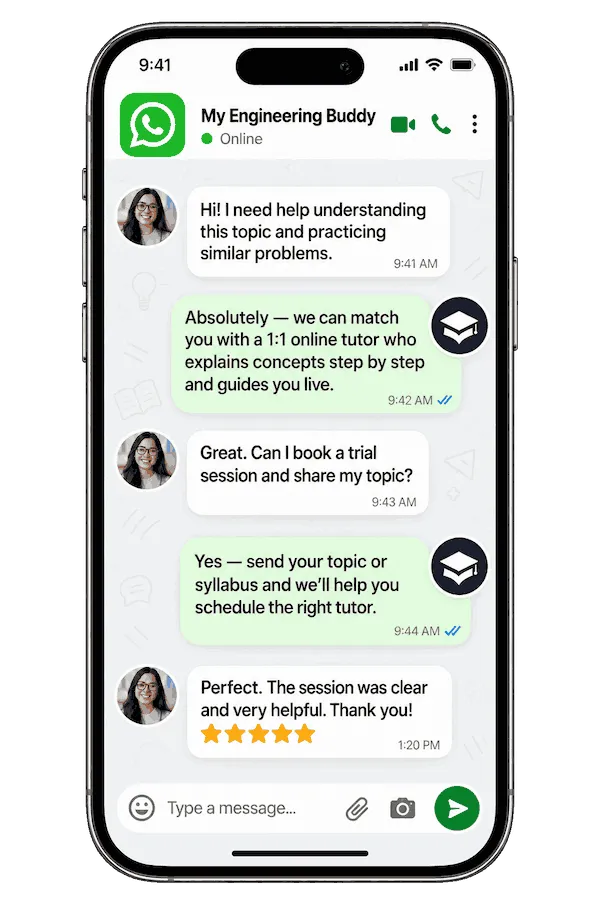
Unlike platforms where you fill out a form and wait, MEB responds in under a minute, 24/7. Tutor match takes under an hour. The $1 trial means you test before you commit. Everything runs over WhatsApp — no logins, no intake forms.
Study Plans (Pick One That Matches Your Goal)
After the diagnostic, the tutor builds a sequence. Most students fit one of three patterns: a catch-up plan covering 1–3 weeks of intensive work on specific missed pathways before an exam; a structured 4–8 week exam prep plan working through the full carbohydrate metabolism syllabus with past-paper practice built in; or ongoing weekly support aligned to your semester, tracking coursework deadlines and covering new material as it’s taught. The tutor sets the sequence — your job is to show up and attempt the problems.
Pricing Guide
Carbohydrate metabolism tutoring starts at $20/hr for standard undergraduate-level work. Graduate and PhD-level sessions, or sessions requiring a tutor with specific research expertise in metabolic biochemistry, run higher — up to $100/hr. Rate factors include topic complexity, your timeline, and tutor availability.
For students targeting medical school, pharmacy programmes, or research positions where metabolic biochemistry is a core competency, tutors with active research or clinical backgrounds are available at higher rates — share your specific goal and MEB will match the tier to your ambition.
Peak exam periods reduce tutor availability fast. Book before the rush. Start with the $1 trial — 30 minutes, no registration, no commitment. WhatsApp MEB for a quick quote.
Students consistently tell us that the first session already pays for itself — not because we make promises, but because knowing exactly where your gaps are is worth more than another hour reading the same textbook chapter.
FAQ
Is carbohydrate metabolism hard?
It’s genuinely challenging. The difficulty isn’t memorising the steps — it’s understanding why each regulation point exists and how the pathways interact under different physiological conditions. Students who treat it as a map to memorise almost always struggle in exams that test the metabolic logic.
How many sessions are needed?
Most students see measurable improvement within 5–8 sessions. A full pathway review from glycolysis through metabolic integration typically takes 12–20 hours, depending on your starting point and how much exam-strategy work is built in alongside the content.
Can you help with practice exercises?
Yes. MEB tutoring is guided learning — you understand the work, then submit it yourself. See our Academic Integrity policy and Why MEB page for full details on what we help with and what we don’t.
Will the tutor match my exact syllabus or exam board?
Yes. Share your course outline, module guide, or exam board before the first session. Tutors are matched to your specific syllabus — whether that’s a US biochemistry undergraduate module, a UK medical school pathway, or a graduate-level metabolic biochemistry course.
What happens in the first session?
The tutor runs a short diagnostic — asking you to walk through one or two pathways and explain a regulation point. This identifies your specific gaps within 15–20 minutes. The rest of the session begins teaching to those gaps directly. No time is wasted on topics you already know.
Is online tutoring as effective as in-person?
For biochemistry pathway work, yes — often more so. The digital pen-pad allows live annotation of complex diagrams that would be difficult to draw in real time on a physical whiteboard. Students report that seeing the tutor’s reasoning process annotated step-by-step is significantly clearer than static textbook figures.
Can I get carbohydrate metabolism help at midnight?
Yes. MEB operates 24/7 via WhatsApp. If you’re working through TCA cycle problems at 1am before a morning exam, message MEB — a tutor match or a specific homework explanation can be arranged quickly regardless of your time zone.
What if I don’t get along with my assigned tutor?
Request a different match. MEB doesn’t lock you into a single tutor. If the first session doesn’t feel right — communication style, depth, pacing — message MEB on WhatsApp and a replacement is arranged without any additional cost or friction.
Do you cover the clinical and disease-related aspects of carbohydrate metabolism?
Yes. Tutors cover type 1 and type 2 diabetes from a metabolic pathway perspective, inborn errors of carbohydrate metabolism including glycogen storage diseases and galactosaemia, and the biochemical basis of insulin resistance. This is particularly relevant for students on pre-med, pharmacy, and biomedical science programmes. See also clinical biochemistry help for broader clinical coverage.
What’s the difference between glycolysis and gluconeogenesis, and why do students confuse them?
Glycolysis breaks glucose down; gluconeogenesis builds it. Students confuse them because seven of the ten glycolytic steps run in reverse during gluconeogenesis — the confusion is at the three irreversible bypass steps. A tutor works through exactly these three points until the distinction is solid.
How do I get started?
Message MEB on WhatsApp — tell us your subject, course level, and exam date. You’re matched with a verified carbohydrate metabolism tutor, usually within the hour. First session is the $1 trial: 30 minutes of live tutoring, or one homework question explained in full. Three steps: WhatsApp → matched → start trial.
Trust & Quality at My Engineering Buddy
Every MEB tutor goes through a structured screening process before teaching a single session — subject knowledge assessment, a live demo session evaluated by an MEB reviewer, and ongoing feedback review from students after each session. Tutors hold graduate degrees or equivalent professional qualifications in their subject areas and are vetted specifically for the topics they teach, not just the broad discipline. Rated 4.8/5 across 40,000+ verified reviews on Google.
MEB tutoring is guided learning — you understand the work, then submit it yourself. For full details on what we help with and what we don’t, read our Academic Integrity policy and Why MEB.
MEB has been serving students in the US, UK, Canada, Australia, Gulf, and Europe since 2008 — across 2,800+ subjects. Biochemistry is one of MEB’s strongest subject areas. Students studying carbohydrate metabolism often also work with MEB on pharmaceutical biochemistry tutoring and immunochemistry help. See our tutoring methodology for how sessions are structured across all subjects.
Our experience across thousands of sessions shows that carbohydrate metabolism is one of those subjects where a student who has been struggling for weeks can turn a corner in a single session — once the regulatory logic clicks, the rest of the pathway map tends to follow.
Explore Related Subjects
Students studying Carbohydrate metabolism often also need support in:
- Analytical Methods in Biochemistry
- Lipid Metabolism
- Nutritional Biochemistry
- Metabolomics
- Pharmaceutical Biochemistry
Next Steps
Ready to get started? Here’s what to do:
- Share your course or module name, the specific pathway topics giving you trouble, and your exam or submission date
- Share your availability and time zone — MEB covers US, UK, Canada, Australia, and the Gulf
- MEB matches you with a verified carbohydrate metabolism tutor, usually within 24 hours
- First session starts with a diagnostic so every minute is used on what actually matters
Before your first session, have ready: your course syllabus or module outline, a recent past paper attempt or homework question you struggled with, and your exam or deadline date. The tutor handles the rest.
Visit www.myengineeringbuddy.com for more on how MEB works.
WhatsApp to get started or email [email protected].
Reviewed by Subject Expert
This page has been carefully reviewed and validated by our subject expert to ensure accuracy and relevance.