~1 min
Average Reply Time
~1 hour
To Be Matched With A Tutor
30 Min Trial
75% Find Their Tutor On The 1st Trial
$20-35+/hr
Premium Yet Affordable Learning
Your CircleCI pipeline is failing. The build has been red for three days. Here’s how to fix that — with a tutor who has done it before.
CircleCI Platform Tutor Online
CircleCI is a cloud-native continuous integration and continuous delivery (CI/CD) platform that automates software build, test, and deployment pipelines. It equips engineers to ship code reliably using workflows, orbs, and containerised job execution across cloud and self-hosted environments.
Finding a CircleCI Platform tutor near me used to mean sifting through freelancers with no vetting and no accountability. MEB offers 1:1 online tutoring and project help for CircleCI across 2,800+ advanced subjects — matched to your exact stack, your deployment environment, and your deadline. Whether you’re debugging a failing workflow, learning orbs for the first time, or preparing for a DevOps role that expects CircleCI fluency, a software engineering tutor at MEB can cut through the confusion fast.
- 1:1 online sessions built around your specific CircleCI config and pipeline
- Expert-verified tutors with hands-on CI/CD and DevOps experience
- Flexible time zones — US, UK, Canada, Australia, Gulf
- Structured learning plan built after a first diagnostic session
- Guided project support — we explain the approach, you build and deploy it
52,000+ students across the US, UK, Canada, Australia, and the Gulf have used MEB since 2008 — including students working on DevOps tools like CircleCI Platform, Jenkins, and GitLab CI/CD.
Source: My Engineering Buddy, 2008–2025.
How Much Does a CircleCI Platform Tutor Cost?
Most CircleCI tutoring sessions run $20–$40/hr. Advanced pipeline architecture, Kubernetes executor configuration, or enterprise-scale CircleCI setups may reach $70–$100/hr depending on the tutor’s industry background. Start with the $1 trial — 30 minutes of live help or one config problem explained fully — before committing to a rate.
| Level / Need | Typical Rate | What’s Included |
|---|---|---|
| Standard (most levels) | $20–$40/hr | 1:1 sessions, pipeline walkthroughs, project guidance |
| Advanced / Specialist | $40–$100/hr | Expert tutor, enterprise CI/CD, architecture depth |
| $1 Trial | $1 flat | 30 min live session or one config question fully explained |
Tutor slots fill fast at the start of university semesters and during DevOps bootcamp cohort periods. Book early if you’re on a tight timeline.
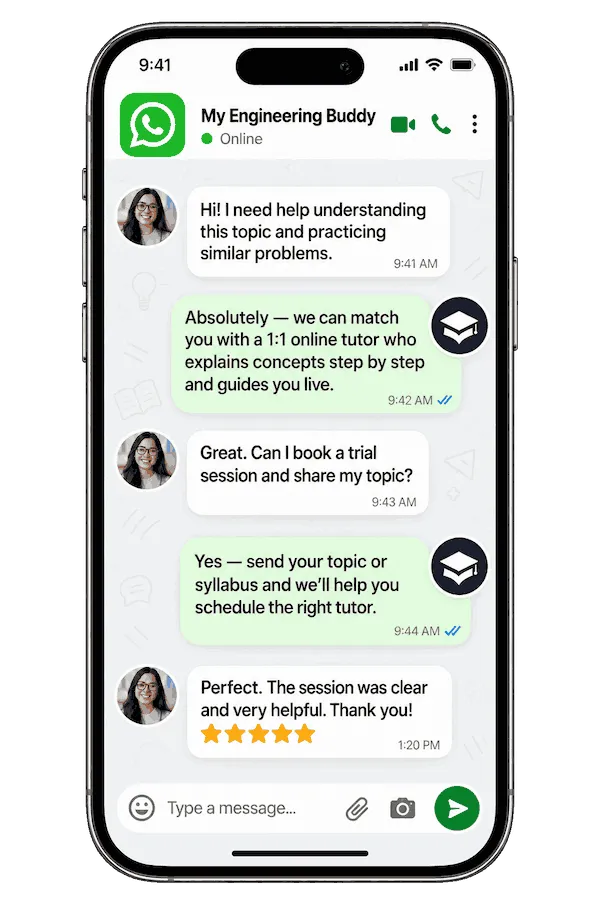
WhatsApp MEB for a quick quote — average response time under 1 minute.
Who This CircleCI Platform Tutoring Is For
CircleCI trips people up at the same points: the jump from a working local build to a clean pipeline, understanding executor types, and wiring up orbs without breaking everything. If you’re stuck at any of those points, you’re in the right place.
- Computer science or software engineering students whose course requires a working CI/CD pipeline
- Bootcamp graduates building a portfolio project that needs automated testing and deployment
- Developers transitioning into DevOps roles where CircleCI fluency is listed as a job requirement
- Students who set up a CircleCI config, watched it fail repeatedly, and are out of ideas
- Students who failed a DevOps or cloud engineering module and need to resit or resubmit a working pipeline
- Engineering teams at startups where one developer needs to own the entire CI/CD setup
Students at universities including MIT, Georgia Tech, Carnegie Mellon, University of Toronto, University of Edinburgh, TU Delft, and UNSW have used MEB for DevOps and pipeline support. The $1 trial is the fastest way to find out whether the tutor matches your stack.
1:1 Tutoring vs Self-Study vs AI vs YouTube vs Online Courses
Self-study works if you already know what you don’t know. AI tools like ChatGPT give you config snippets fast, but they can’t see your actual pipeline output or catch the environment mismatch causing your failure. YouTube covers CircleCI basics well and stops there. Online courses walk you through a preset project — not yours. With a 1:1 DevOps tutor from MEB, the session is built around your actual .circleci/config.yml, your repo, and your specific error — corrected live, step by step.
Outcomes: What You’ll Be Able To Do in CircleCI Platform
After working with an online CircleCI Platform tutor from MEB, you’ll be able to build and debug multi-job workflows from scratch, configure Docker and machine executors correctly for your test environment, apply CircleCI orbs to eliminate repetitive pipeline code, set up branch-specific deployment logic so only clean main-branch commits reach production, and explain your pipeline architecture clearly in a technical interview or coursework submission.
Supporting a student through CircleCI Platform? MEB works directly with parents to set up sessions, track progress, and keep coursework on schedule. WhatsApp MEB — average response time is under a minute, 24/7.
Based on feedback from 40,000+ sessions collected by MEB from 2022 to 2025, 58% of students improved by one full grade after approximately 20 hours of 1:1 tutoring in subjects like CircleCI Platform. A further 23% achieved at least a half-grade improvement.
Source: MEB session feedback data, 2022–2025.
What We Cover in CircleCI Platform (Syllabus / Topics)

Track 1: CircleCI Core Concepts and Configuration
- CircleCI architecture: cloud, server, and runner environments
- Writing and structuring
.circleci/config.ymlfiles - Jobs, steps, workflows, and execution order
- Docker executor vs machine executor vs macOS executor
- Environment variables and contexts for secrets management
- Caching dependencies and persisting workspaces between jobs
- Parallelism and test splitting to reduce build times
Useful references for this track: CircleCI Documentation (official), The DevOps Handbook by Kim, Humble, Debois & Willis, and Continuous Delivery by Humble & Farley.
Track 2: Orbs, Pipelines, and Integrations
- Using and authoring CircleCI orbs to reuse pipeline logic
- Pipeline triggers: push events, scheduled pipelines, API triggers
- Conditional steps and filtering by branch or tag
- Integrating with GitHub, Bitbucket, and GitLab version control
- Connecting CircleCI to AWS, GCP, and Azure deployment targets
- Slack, Jira, and notification integrations within pipelines
- Dynamic configuration and continuation orbs for monorepo pipelines
Useful references: CircleCI Orb Registry (official), Accelerate by Forsgren, Humble & Kim, and Implementing Continuous Delivery by Laster.
Track 3: Testing, Deployment, and Observability in CircleCI
- Wiring automated test suites into CircleCI jobs — unit, integration, and end-to-end
- Connecting Docker image builds and pushes within a CircleCI workflow
- Blue-green and canary deployment patterns triggered from CircleCI
- Approval jobs and manual gates before production deployment
- Test insights dashboard and identifying flaky tests
- Using Terraform and infrastructure-as-code steps inside CircleCI pipelines
- Debugging failed builds: SSH into jobs, rerunning failed workflows
Useful references: Site Reliability Engineering by Beyer et al. (Google SRE Book), Kubernetes in Action by Marko Luksa, and CircleCI Insights Documentation (official).
Platforms, Tools & Textbooks We Support
CircleCI tutoring at MEB covers the full toolchain that practitioners use alongside it. Tutors are comfortable working inside your actual environment — not a demo repo.
- CircleCI Cloud and CircleCI Server (self-hosted)
- GitHub, Bitbucket, GitLab for version control integration
- Docker and container registries (Docker Hub, ECR, GCR)
- Kubernetes and Helm for deployment orchestration
- Terraform and Ansible for infrastructure provisioning steps
- Slack, PagerDuty, and Jira for pipeline notifications and issue tracking
- Datadog, Prometheus, and Grafana for pipeline observability integration
What a Typical CircleCI Platform Session Looks Like
The tutor opens by checking what happened in the last session — usually a specific workflow that was failing or a deployment step that wasn’t triggering correctly. From there, you share your screen or paste your .circleci/config.yml directly into the session. The tutor walks through the config line by line, flags the structural or logic error — often something like a missing requires field in a workflow, a misconfigured executor image, or a secrets context that isn’t scoped right. You fix it live, push, and watch the build run. The tutor uses a digital pen-pad to annotate the pipeline diagram as you go. By the end, you have a working job and a concrete task: rewrite the next job in the workflow yourself before the following session, using the same pattern.
How MEB Tutors Help You with CircleCI Platform (The Learning Loop)
Diagnose: In the first session, the tutor asks to see your current config file and the last build output. Within minutes they identify whether the issue is structural (workflow logic), environmental (executor type, image version), or conceptual (misunderstanding of how caching or workspaces work). This replaces hours of Stack Overflow guessing.
Explain: The tutor works through the corrected version on screen with a digital pen-pad, narrating each decision. You’re not watching a pre-recorded video — the explanation is built around your specific error, your repo, your deployment target.
Practice: You replicate the fix yourself in the same session. If you make a different mistake, that’s useful data. The tutor doesn’t intervene immediately — they let you work through it for a minute first, then corrects with precision.
A common pattern our tutors observe is that CircleCI problems are rarely about CircleCI itself — they’re about unclear mental models of how jobs, workflows, and executors relate to each other. Get that map right once, and the config starts to write itself.
Feedback: After you attempt the task, the tutor explains exactly where the reasoning broke down — not just what was wrong, but why the pipeline interpreted it that way. This is the difference between fixing one config and understanding all configs.
Plan: Each session ends with a specific next topic and a task to complete before the next session. For most students that’s one new job or integration to wire up independently. Progress is tracked so nothing gets revisited unnecessarily.
Sessions run over Google Meet with a digital pen-pad or iPad and Apple Pencil for annotation. Before your first session, have your repo URL, your current .circleci/config.yml, and your last build failure log ready to share. Start with the $1 trial — 30 minutes of live tutoring that also serves as your first diagnostic.
Students consistently tell us that the moment a MEB tutor maps out their workflow visually — jobs, dependencies, executors — the config stops feeling like guesswork and starts feeling like architecture they control.
Source: MEB session feedback data, 2022–2025.
Try your first session for $1 — 30 minutes of live 1:1 tutoring or one homework question explained in full. No registration. No commitment. WhatsApp MEB now and get matched within the hour.
Tutor Match Criteria (How We Pick Your Tutor)
Not every DevOps tutor knows CircleCI specifically. MEB matches on four dimensions:
Subject depth: Tutors are matched by CI/CD platform experience — specifically CircleCI, not just general DevOps. If your project uses CircleCI’s dynamic configuration or self-hosted runners, MEB finds someone who has used those features in production.
Tools: All sessions run on Google Meet with a digital pen-pad or iPad and Apple Pencil. Tutors are equipped to annotate your config, diagram your workflow, and write corrected YAML live on screen.
Time zone: Matched to your region — US, UK, Gulf, Canada, or Australia. No waiting until morning in a different hemisphere for a reply.
Goals: Whether you need a passing pipeline for a university submission, CircleCI fluency for a job interview, or production-grade architecture for a real project, the tutor is briefed on your specific outcome before the first session.
Unlike platforms where you fill out a form and wait, MEB responds in under a minute, 24/7. Tutor match takes under an hour. The $1 trial means you test before you commit. Everything runs over WhatsApp — no logins, no intake forms.
Study Plans (Pick One That Matches Your Goal)
The tutor builds your specific session sequence after the diagnostic, but most CircleCI students fall into one of three plans. Catch-up (1–3 weeks): you have a submission deadline and a broken pipeline — sessions focus on getting the config working first, understanding it second. Structured build (4–8 weeks): you’re learning CircleCI as part of a DevOps curriculum or bootcamp — sessions follow the syllabus with a worked project running alongside. Weekly support: ongoing help aligned to sprint cycles or coursework milestones, adjusting as your pipeline grows in complexity.
Pricing Guide
CircleCI Platform tutoring starts at $20/hr for standard undergraduate and bootcamp-level pipeline work. Graduate-level cloud architecture, multi-cloud deployment pipelines, or enterprise CircleCI Server configurations run $70–$100/hr depending on tutor background.
Rate factors include the complexity of your stack, how quickly you need sessions booked, and whether you need a tutor with specific cloud platform certification alongside CircleCI experience.
Availability tightens at the start of university semesters and during major bootcamp cohort deadlines. If you’re on a fixed timeline, book as early as possible.
For students targeting senior DevOps engineer roles at companies like Google, Amazon, or Meta — or preparing for a CKA/CKS certification track that includes CI/CD requirements — tutors with professional SRE and platform engineering backgrounds are available at higher rates. Share your specific goal and MEB will match the tier to your ambition.
Start with the $1 trial — 30 minutes, no registration, no commitment. WhatsApp MEB for a quick quote.
At MEB, we’ve found that students who come in with a specific broken config learn CircleCI three times faster than those who start from a blank file. Bring your failure. That’s where the real session begins.
FAQ
Is CircleCI hard to learn?
The YAML syntax is manageable. What trips most people up is understanding how jobs, workflows, and executors interact — and why a config that looks correct still fails. A tutor who has debugged real pipelines closes that gap in one or two sessions.
How many sessions will I need?
Most students get a working pipeline in 2–4 sessions. Building genuine CircleCI fluency — orbs, dynamic config, multi-cloud deployments — typically takes 10–15 hours depending on your starting level and how complex your project is.
Can you help with projects and portfolio work?
Yes. MEB provides guided project support — the tutor explains the approach, you build and deploy it yourself. MEB provides guided learning support; all project work is produced and submitted by the student. See our Policies page for details on what we help with and what we don’t.
Will the tutor match my exact syllabus or exam board?
Yes. Before the first session, share your course outline, the specific CircleCI features your project requires, and any marking rubric if it’s for a university submission. The tutor builds the session plan around those requirements exactly.
What happens in the first session?
The tutor reviews your current config or project brief, identifies the key gaps, and works through the first fix or concept with you live. You leave the session with a working next step and a clear sequence for subsequent sessions.
Are online sessions as effective as in-person for a tool like CircleCI?
For software tools, online is often better. You share your actual terminal, your repo, your build output — the tutor sees exactly what you see. There’s nothing lost in translation that wouldn’t happen sitting side by side.
Can I get CircleCI help at midnight?
Yes. MEB operates 24/7. WhatsApp response time is under a minute at most hours. If your build is red at 11pm before a morning submission, message now — a tutor can be available within the hour.
What if I don’t like my assigned tutor?
Tell MEB via WhatsApp immediately. A replacement is arranged without delay, no explanation required. The $1 trial exists precisely so you can test the match before committing to a full session rate.
What’s the difference between CircleCI and Jenkins — and can you help with both?
CircleCI is cloud-native with managed infrastructure; Jenkins tutoring covers a self-hosted, plugin-heavy alternative. MEB has tutors experienced in both. If you’re choosing between them for a project, the tutor can help you decide based on your specific requirements.
Do you support CircleCI Server (self-hosted) as well as CircleCI Cloud?
Yes. Tutors are available for both CircleCI Cloud and CircleCI Server deployments, including runner configuration, namespace setup, and network-restricted environments that enterprise teams typically run.
How do I get started?
Message MEB on WhatsApp. You’ll be matched with a verified CircleCI tutor — usually within the hour. The first session is the $1 trial: 30 minutes of live tutoring or one pipeline problem explained in full. Three steps: WhatsApp → matched → start trial.
How do I find a CircleCI tutor in my city?
You don’t need to. All MEB sessions are online via Google Meet, matched to your time zone — US, UK, Gulf, Canada, Australia, or Europe. Location is irrelevant. Your config file and your screen are all the tutor needs.
Our experience across thousands of sessions shows that the students who improve fastest are the ones who show up with a real problem — a broken workflow, a failed deployment, a deadline in 48 hours. That urgency focuses the session in a way no textbook exercise can.
Trust & Quality at My Engineering Buddy
Every MEB tutor goes through subject-specific vetting: a live demo evaluation, a review of their technical background, and ongoing session quality checks based on student feedback. For CircleCI specifically, MEB looks for tutors with verifiable CI/CD delivery experience — not just familiarity with the docs. Rated 4.8/5 across 40,000+ verified reviews on Google. MEB has served 52,000+ students since 2008 across the US, UK, Canada, Australia, Gulf, and Europe.
MEB provides guided learning support. All project work is produced and submitted by the student. See our Policies page for details.
MEB covers 2,800+ subjects in the software engineering category — including CircleCI Platform, Azure DevOps tutoring, Travis CI help, and infrastructure-as-code tutoring. For a full picture of how MEB tutors are selected and how sessions are structured, see our tutoring methodology.
MEB has operated since 2008 — longer than CircleCI itself has existed. That institutional depth means finding a tutor who has tracked the platform from its earliest versions through to its current cloud-native architecture.
Source: My Engineering Buddy, 2008–2025.
Explore Related Subjects
Students studying CircleCI Platform often also need support in:
- Ansible
- Site Reliability Engineering (SRE)
- SonarQube
- Test-Driven Development (TDD)
- Microservices
- Monitoring
- Puppet
Next Steps
Before your first session, have ready:
- Your current
.circleci/config.ymlfile or course project brief - The last build failure log or the specific workflow step that isn’t working
- Your submission deadline or target date for having a working pipeline
The tutor handles the rest — diagnostic in session one, structured plan from session two onward.
Share your time zone and availability when you message. MEB matches you with a verified CircleCI tutor usually within 24 hours. The first session starts with a diagnostic so every minute is used well.
Visit www.myengineeringbuddy.com for more on how MEB works.
WhatsApp to get started or email [email protected].
Reviewed by Subject Expert
This page has been carefully reviewed and validated by our subject expert to ensure accuracy and relevance.