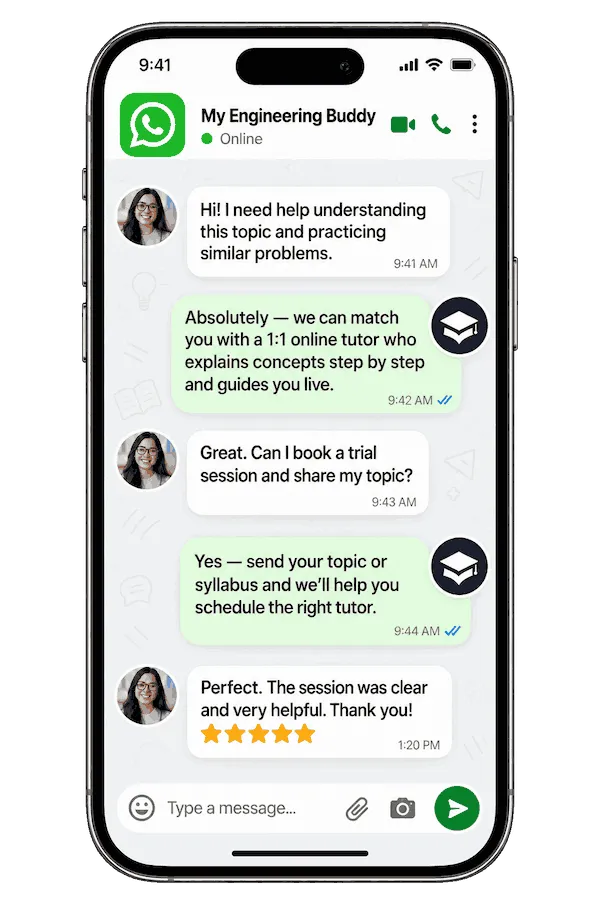
~1 min
Average Reply Time
~1 hour
To Be Matched With A Tutor
30 Min Trial
75% Find Their Tutor On The 1st Trial
$20-35+/hr
Premium Yet Affordable Learning
Most students don’t fail Computational Complexity because they’re not smart enough. They fail because nobody ever made P vs NP, reduction proofs, or NP-hardness arguments click in their specific course.
Computational Complexity Tutor Online
Computational Complexity is a branch of theoretical computer science that classifies computational problems by the resources — time, space, and randomness — required to solve them, equipping students to reason formally about what computers can and cannot efficiently compute.
If you’re searching for a Computational Complexity tutor near me, MEB delivers 1:1 online tutoring and homework help across this subject — from undergraduate complexity courses at universities in the US, UK, Canada, and Australia to graduate-level theory seminars. Our tutors work within Mathematics and computer science, covering everything from Turing machines to circuit complexity. You work through your actual problem sets. One well-explained proof changes the way you approach the next ten.
- 1:1 online sessions tailored to your course outline and specific problem sets
- Expert-verified tutors with graduate-level theoretical CS or discrete math backgrounds
- Flexible time zones — US, UK, Canada, Australia, Gulf covered
- Structured learning plan built after a diagnostic session in your first hour
- Ethical homework and assignment guidance — you understand the work, then submit it yourself
52,000+ students across the US, UK, Canada, Australia, and the Gulf have used MEB since 2008 — including students in Mathematics subjects like Computational Complexity, Discrete Mathematics, and Graph Theory.
Source: My Engineering Buddy, 2008–2025.
How Much Does a Computational Complexity Tutor Cost?
Rates start at $20–$40/hr for most undergraduate-level complexity courses. Graduate and research-level sessions — covering topics like circuit lower bounds or interactive proof systems — run up to $100/hr depending on tutor depth. The $1 trial gets you 30 minutes of live tutoring or a full explanation of one homework question, no registration needed.
| Level / Need | Typical Rate | What’s Included |
|---|---|---|
| Standard (most undergrad levels) | $20–$35/hr | 1:1 sessions, homework guidance |
| Advanced / Graduate | $35–$100/hr | Expert tutor, niche theory depth |
| $1 Trial | $1 flat | 30 min live session or 1 homework question |
Tutor availability tightens significantly around end-of-semester exam periods — book early if your finals are within six weeks.
WhatsApp MEB for a quick quote — average response time under 1 minute.
Who This Computational Complexity Tutoring Is For
Computational Complexity attracts some of the sharpest students in computer science — and still catches them off guard. The jump from writing code to writing formal proofs about what’s provably hard is steep. This tutoring is for students who’ve hit that wall.
- Undergraduate CS students whose course has moved from algorithms into complexity classes — P, NP, PSPACE, and beyond
- Graduate students working through Sipser, Arora-Barak, or Papadimitriou for the first time
- Students retaking after a failed first attempt — especially those who lost marks on NP-hardness reductions or diagonalisation arguments
- Students with a university conditional offer depending on this grade and fewer than six weeks to close the gap
- PhD students needing support on complexity prerequisites before a qualifying exam or research proposal
- Students at universities including MIT, Stanford, Carnegie Mellon, University of Toronto, University of Edinburgh, ETH Zürich, and UNSW — where complexity theory is examined at a high proof-writing standard
Students consistently tell us that Computational Complexity felt abstract until a tutor worked through a concrete reduction — say, 3-SAT to Independent Set — step by step on screen. Once that clicks, the whole class opens up. That shift usually happens within two or three sessions.
1:1 Tutoring vs Self-Study vs AI vs YouTube vs Online Courses
Self-study works if you can follow every proof in Sipser without getting stuck — most students can’t. AI tools explain definitions fast but can’t tell you why your specific reduction is wrong or incomplete. YouTube covers P vs NP at a surface level; it stops short when you need to prove NP-hardness from scratch. Online courses move at a fixed pace, which doesn’t help when you’re three lectures behind with an assignment due Friday. With a 1:1 online Computational Complexity tutor, errors in your proof strategy get caught and corrected in real time — not two days later from a TA’s written comment.
Outcomes: What You’ll Be Able To Do in Computational Complexity
After working with an MEB Computational Complexity tutor, you’ll be able to construct and verify polynomial-time reductions between NP-complete problems with correct formal justification. You’ll apply the Cook-Levin theorem to explain why SAT is NP-complete from first principles. You’ll analyze problems using time and space hierarchy theorems, placing them accurately in the complexity landscape. You’ll write rigorous proofs involving diagonalisation, padding arguments, and oracle separations. You’ll explain the significance of open problems — P vs NP, NP vs co-NP — in terms a professor or exam marker expects.
These aren’t generic outcomes. Reduction proofs and complexity class separations are exactly what universities assess on finals and graduate qualifying exams in this subject.
Based on feedback from 40,000+ sessions collected by MEB from 2022 to 2025, 58% of students improved by one full grade after approximately 20 hours of 1:1 tutoring in subjects like Computational Complexity. A further 23% achieved at least a half-grade improvement.
Source: MEB session feedback data, 2022–2025.
Try your first session for $1 — 30 minutes of live 1:1 tutoring or one homework question explained in full. No registration. No commitment. WhatsApp MEB now and get matched within the hour.
What We Cover in Computational Complexity (Syllabus / Topics)

Complexity Classes and Reductions
- P, NP, co-NP, PSPACE, EXP — definitions and formal relationships
- NP-completeness: Cook-Levin theorem and SAT as the canonical NP-complete problem
- Polynomial-time many-one reductions (Karp reductions) — construction and correctness proofs
- Reduction chains: 3-SAT → Independent Set → Vertex Cover → Clique
- NP-hardness proofs: how to construct and justify a reduction in exam format
- Co-NP and complement languages — tautologies, graph non-isomorphism
- PSPACE-completeness: QBF and Savitch’s theorem
Core texts: Sipser Introduction to the Theory of Computation; Arora and Barak Computational Complexity: A Modern Approach.
Time and Space Hierarchy Theorems
- Time hierarchy theorem — proof by diagonalisation, implications for class separations
- Space hierarchy theorem and Savitch’s theorem
- Padding arguments and their role in conditional separations
- Oracle machines and the Baker-Gill-Solovay result — why relativisation limits proof techniques
- Randomised complexity: BPP, RP, ZPP — definitions and containment relationships
- Derandomisation and the BPP vs P question
Core texts: Papadimitriou Computational Complexity; Goldreich Computational Complexity: A Conceptual Perspective.
Circuit Complexity and Advanced Topics
- Boolean circuits — size and depth measures, circuit families
- P/poly and non-uniform computation
- AC⁰, TC⁰, NC — constant-depth circuit classes and their limitations
- Interactive proof systems: IP = PSPACE
- Probabilistically checkable proofs (PCP theorem) — statement and implications for inapproximability
- Counting complexity: #P and Valiant’s theorem
Core texts: Arora and Barak Computational Complexity: A Modern Approach (Chapters 13–20); lecture notes from courses at MIT OCW.
What a Typical Computational Complexity Session Looks Like
The tutor opens by revisiting the previous topic — often checking whether the student can now articulate why 3-SAT reduces to Independent Set without looking at notes. Then the session moves to the current problem set. If the assignment involves proving a new problem NP-hard, the tutor walks through the reduction structure on a digital pen-pad: what the gadget needs to do, how to encode clauses or variables, and where the polynomial-time bound must be shown. The student then attempts the next reduction or proof step while the tutor watches for gaps in the argument. At the close, a specific practice proof is set — typically one reduction from a past assignment or textbook problem the student hasn’t seen — and the next session’s topic is named. Every minute is used on your actual course material, not worked examples from a different syllabus.
How MEB Tutors Help You with Computational Complexity (The Learning Loop)
Diagnose: In the first session, the tutor asks you to attempt a short problem — usually a basic NP-completeness argument. This isn’t a test. It shows exactly where the logic breaks: missing the polynomial-time bound, not establishing the right-to-left direction of the reduction, or confusing NP-hard with NP-complete. The gaps are noted before any teaching starts.
Explain: The tutor works through a clean example on a digital pen-pad — writing out every step of a reduction, naming each part of the argument, and showing what a full-mark proof actually looks like in your course’s notation. No skipped steps. No assumed background.
Practice: You attempt the next problem while the tutor is present. This is where most improvement happens. Real-time errors get caught before they become habits — a wrong reduction direction, an incomplete witness argument, a missing base case in an induction.
Feedback: The tutor goes through what was right, what was wrong, and — critically — why a particular step would lose marks. Complexity proofs are unforgiving. Half-right reductions score zero in most courses. The feedback is specific to your answer, not a generic rubric.
Plan: Each session closes with the next topic named and a specific homework problem assigned. The tutor tracks your progress through the complexity class hierarchy — when you can handle NP-completeness confidently, the plan advances to PSPACE, circuit complexity, or randomised classes depending on your syllabus.
Sessions run over Google Meet. The tutor uses a digital pen-pad or iPad with Apple Pencil to write out proofs live. Before your first session, share your course syllabus, the specific problem set you’re working on, and your exam date. Start with the $1 trial — 30 minutes of live tutoring that also serves as your first diagnostic. Whether you need a quick catch-up before a final, structured revision over four to eight weeks, or ongoing support through the semester, the tutor maps the session plan after that first diagnostic.
A common pattern our tutors observe is that students who can explain an algorithm fluently still freeze when asked to prove a problem is NP-hard. The two skills use different reasoning — and they need to be built separately. One session on reduction structure is usually enough to break that freeze.
Tutor Match Criteria (How We Pick Your Tutor)
Not every strong computer scientist can teach complexity theory. MEB matches on specific criteria — not just general CS or math background.
Subject depth: Tutors must demonstrate knowledge of complexity classes, reductions, and proof techniques at the level of Arora-Barak or equivalent graduate texts — not just undergraduate algorithms courses. Discrete mathematics tutoring experience is a supporting credential, not a substitute.
Tools: Every tutor uses Google Meet with a digital pen-pad or iPad and Apple Pencil. Written proofs need to be shown live, not typed into a chat window.
Time zone: Matched to your region — US Eastern/Pacific, UK/Europe, Gulf (GST), Canada, and Australia (AEST/AWST) all covered.
Goals: Whether you need exam-focused reduction practice, conceptual depth for a PhD qualifier, or homework guidance on a specific problem set, the match reflects that goal — not a one-size approach.
Unlike platforms where you fill out a form and wait, MEB responds in under a minute, 24/7. Tutor match takes under an hour. The $1 trial means you test before you commit. Everything runs over WhatsApp — no logins, no intake forms.
Pricing Guide
Most Computational Complexity sessions run $20–$40/hr at the undergraduate level. Graduate-level work — circuit complexity, interactive proofs, PCP theorem — typically runs $50–$100/hr depending on tutor depth and problem specificity.
Rate factors: course level, topic depth (undergraduate P/NP vs graduate circuit lower bounds), your deadline, and tutor availability at your required time zone.
For students targeting top research programmes at universities like MIT, ETH Zürich, or Carnegie Mellon — where complexity theory appears on PhD qualifying exams — tutors with research backgrounds in theoretical computer science are available at specialist rates. Share your specific goal and MEB will match the tier to your programme requirements.
Tutor slots fill fast in the four weeks before semester finals. Book before that window closes.
Start with the $1 trial — 30 minutes, no registration, no commitment. WhatsApp MEB for a quick quote.
FAQ
Is Computational Complexity hard?
Yes — it’s one of the most proof-heavy courses in a CS degree. The difficulty isn’t the definitions. It’s writing airtight reductions and understanding why diagonalisation arguments work. Most students need guided practice on three to five reductions before it becomes reliable.
How many sessions are needed?
Students with specific exam gaps typically need eight to twelve sessions. Those working through a full-semester course weekly need fewer sessions per topic but more consistency. The first diagnostic session sets the exact plan based on your current level and deadline.
Can you help with homework and assignments?
MEB tutoring is guided learning — you understand the work, then submit it yourself. The tutor explains proof techniques and reduction strategies so you can write the answer independently. See our Academic Integrity policy and Why MEB page for full details on what we help with and what we don’t.
Will the tutor match my exact syllabus or exam board?
Yes. Share your course outline and textbook — whether it’s Sipser, Arora-Barak, or Papadimitriou — and the tutor aligns sessions to those specific chapters, notation, and proof standards your professor uses. University courses vary significantly in depth and coverage.
What happens in the first session?
The tutor asks you to attempt a short problem to pinpoint where your reasoning breaks down. From there, the session covers your most urgent topic — usually a current assignment problem or upcoming exam question — and ends with a specific plan for the next session.
Is online tutoring as effective as in-person?
For proof-based subjects like Computational Complexity, the digital pen-pad on Google Meet replicates a whiteboard precisely. Tutors write out every step live. Students who’ve had in-person tutoring before consistently report the online format is equally effective once they see the first worked reduction written out.
What’s the difference between NP-hard and NP-complete, and why do students keep confusing them?
NP-hard means at least as hard as any NP problem — but the problem doesn’t have to be in NP itself. NP-complete means NP-hard AND in NP. The confusion costs marks on exams. A tutor covers this distinction explicitly with examples in the first or second session.
Can a tutor help me understand the P vs NP problem at the level my professor expects?
Yes. Most courses don’t ask you to solve P vs NP — they ask you to explain what it means, why it matters, and what would follow from either answer. The tutor covers the formal statement and its implications in terms your exam marking scheme expects.
Can I get Computational Complexity help at midnight?
Yes. MEB tutors operate across multiple time zones, and WhatsApp support is available around the clock. If you’re in the US or Gulf and working late on a problem set, message MEB — a tutor match usually happens within the hour regardless of the time.
What if I don’t like my assigned tutor?
Say so over WhatsApp. MEB reassigns without requiring any explanation or formal process. Most students are matched well on the first attempt because the matching is based on your specific syllabus and exam board — but swapping is always available at no cost.
How do I find a Computational Complexity tutor in my city?
You don’t need one. MEB’s online format covers every time zone. Students in New York, London, Toronto, Sydney, and Dubai all get the same access to the same pool of tutors. The digital pen-pad makes proof-writing online as clear as in-person.
How do I get started?
Message MEB on WhatsApp, share your course syllabus and current problem, and get matched with a tutor — usually within the hour. The first session is the $1 trial: 30 minutes live or one homework problem explained in full. No registration required.
Trust & Quality at My Engineering Buddy
Every MEB tutor goes through subject-specific vetting — not a general interview. For Computational Complexity, that means demonstrating the ability to construct and explain NP-hardness reductions, work through complexity class arguments, and write proofs at the level the course examines. Tutors hold degrees in computer science, mathematics, or related fields — many at master’s or PhD level — and are assessed through a live demo session before being placed with students. Rated 4.8/5 across 40,000+ verified reviews on Google.
MEB tutoring is guided learning — you understand the work, then submit it yourself. For full details on what we help with and what we don’t, read our Academic Integrity policy and Why MEB.
MEB has served 52,000+ students across the US, UK, Canada, Australia, Gulf, and Europe since 2008, covering 2,800+ subjects. Within Mathematics and theoretical computer science, the platform covers Combinatorics tutoring, Mathematical Logic help, and Computational Mathematics tutoring — subjects that share significant overlap with Computational Complexity coursework. Tutor methodology is documented at MEB’s tutoring methodology page.
Explore Related Subjects
Students studying Computational Complexity often also need support in:
- Analytic Combinatorics
- Propositional and Predicate Logic
- Number Theory
- Abstract Algebra
- Probability
- Computational Number Theory
- Logic Programming
Next Steps
Before your first session, have ready: your course syllabus or textbook (Sipser, Arora-Barak, or your professor’s notes), a recent problem set or homework you got wrong, and your exam or assignment deadline date. The tutor handles the rest.
- Share your exam board or university course code, your hardest current topic, and your timeline
- Share your time zone and availability — morning, evening, or weekend sessions all available
- MEB matches you with a verified tutor — usually within 24 hours, often within the hour
Visit www.myengineeringbuddy.com for more on how MEB works.
WhatsApp to get started or email [email protected].
At MEB, we’ve found that the students who improve fastest in Computational Complexity aren’t necessarily the ones with the strongest algorithm background. They’re the ones who do one reduction problem per day between sessions and bring every gap back to the tutor. Consistency across a few weeks beats intensity in the final three days.
Reviewed by Subject Expert
This page has been carefully reviewed and validated by our subject expert to ensure accuracy and relevance.