~1 min
Average Reply Time
~1 hour
To Be Matched With A Tutor
30 Min Trial
75% Find Their Tutor On The 1st Trial
$20-35+/hr
Premium Yet Affordable Learning
Group financial statements tripping you up? Most students lose marks on the same three eliminations — and never find out why.
Consolidation Accounting Tutor Online
Consolidation Accounting covers the preparation of group financial statements under IFRS and US GAAP, combining parent and subsidiary accounts while eliminating intercompany transactions. It equips students to present accurate, compliant consolidated statements for multi-entity corporate structures.
If you’ve searched for a Consolidation Accounting tutor near me, MEB connects you with verified subject specialists for 1:1 online tutoring — structured around your exact syllabus, your gaps, and your deadline. We cover everything from basic acquisition entries to complex NCI calculations and goodwill impairment under IFRS 3. One tutor, one student, no distractions.
- 1:1 online sessions tailored to your course or exam board
- Expert verified tutors with hands-on consolidation and financial reporting experience
- Flexible scheduling across US, UK, Canada, Australia, and Gulf time zones
- Structured learning plan built after a diagnostic session
- Ethical homework and assignment guidance — you understand the work before you submit it
52,000+ students across the US, UK, Canada, Australia, and the Gulf have used MEB since 2008 — across 2,800+ subjects, from AP Calculus to A Level Music Technology to Data Science.
Source: My Engineering Buddy, 2008–2025.
How Much Does a Consolidation Accounting Tutor Cost?
Most Consolidation Accounting tutoring sessions run $20–$40/hr. Graduate-level or professional certification work — CPA exam prep, IFRS advisory depth — can reach $60–$100/hr depending on tutor background. Not sure where you fall? Start with the $1 trial and let MEB match you to the right tier.
| Level / Need | Typical Rate | What’s Included |
|---|---|---|
| Undergraduate / Standard | $20–$35/hr | 1:1 sessions, homework guidance, consolidation workings |
| Graduate / Advanced | $35–$70/hr | IFRS 3, IFRS 10 depth, complex NCI, exam simulation |
| $1 Trial | $1 flat | 30 min live session or one full homework question explained |
Tutor availability tightens around semester end and professional exam windows. Book early if your deadline is within four weeks.
WhatsApp MEB for a quick quote — average response time under 1 minute.
Who This Consolidation Accounting Tutoring Is For
This isn’t an introductory accounting service. MEB’s Consolidation Accounting tutors work with students who already know debits and credits but are hitting a wall when subsidiary adjustments, goodwill, and NCI all land in the same question. If consolidation is where your marks are slipping, this is the fix.
- Second and third-year undergraduates in accounting, finance, or business programmes at universities including the University of Toronto, University of Melbourne, London School of Economics, NYU Stern, and HEC Paris
- Masters and postgraduate students in accounting or financial reporting
- CPA, ACCA, CIMA, and CFA candidates preparing for group accounts questions
- Students who failed a consolidation module first time and are retaking with a conditional progression offer on the line
- Students preparing consolidation-heavy coursework with a submission deadline approaching in the next four weeks
- Finance professionals building technical depth for a reporting or audit role
1:1 Tutoring vs Self-Study vs AI Tools
Self-study from textbooks works for foundational concepts, but consolidation accounting involves layered journal entries where one wrong assumption in step two corrupts every line that follows — and a textbook won’t tell you which assumption you got wrong. AI tools can explain the mechanics of a step-acquisition or a mid-year disposal clearly enough, but they cannot watch you work through a consolidation schedule in real time, spot where your NCI figure is off, and correct it before it compounds. The specific reason human instruction matters here: consolidation errors are procedural and sequential, not conceptual — a tutor catches the mistake at the moment it’s made. MEB gives you that real-time correction loop, online, calibrated to your exact course and exam board.
Outcomes: What You’ll Be Able To Do in Consolidation Accounting
After targeted sessions with an MEB Consolidation Accounting tutor, you’ll be able to prepare a complete consolidated statement of financial position from scratch, including accurate goodwill calculations under IFRS 3. You’ll apply the correct treatment for non-controlling interests under both the full goodwill and proportionate methods. You’ll model mid-year acquisitions and disposals without losing track of the pre- and post-acquisition split. You’ll analyze intercompany transactions — upstream, downstream, and mixed — and eliminate them correctly in the consolidation schedule. And you’ll explain your working line by line, which is exactly what exam markers and graduate employers expect.
Supporting a student through Consolidation Accounting? MEB works directly with parents to set up sessions, track progress, and keep coursework on schedule. WhatsApp MEB — average response time is under a minute, 24/7.
Based on feedback from 40,000+ sessions collected by MEB from 2022 to 2025, 58% of students improved by one full grade after approximately 20 hours of 1:1 tutoring in a single subject. A further 23% achieved at least a half-grade improvement.
Source: MEB session feedback data, 2022–2025.
What We Cover in Consolidation Accounting (Syllabus / Topics)

Group Financial Statements — Core Consolidation
- Consolidated statement of financial position — full consolidation method
- Consolidated statement of profit or loss and OCI
- Goodwill calculation and impairment testing under IFRS 3
- Non-controlling interests — full goodwill vs proportionate method
- Pre- and post-acquisition reserves and retained earnings split
- Intercompany eliminations — trading balances, dividends, unrealised profit
- Mid-year acquisitions and the time-apportionment of profit
Core texts: Deegan & Unerman Financial Accounting Theory; Alexander, Britton & Jorissen International Financial Reporting and Analysis; Picker et al. Applying IFRS Standards.
Advanced Group Structures and IFRS Standards
- Step acquisitions and changes in ownership interest (IFRS 10)
- Disposal of subsidiaries — full and partial disposal accounting
- Associates and joint ventures under the equity method (IAS 28, IFRS 11)
- Business combinations achieved in stages — remeasurement at acquisition date
- Foreign currency translation of overseas subsidiaries (IAS 21)
- Deferred tax arising on consolidation adjustments (IAS 12)
Key references: IFRS Foundation Illustrative Examples — IFRS 3 and IFRS 10; Mirza & Holt Wiley IFRS: Practical Implementation Guide and Workbook.
US GAAP Consolidation and Exam Board Preparation
- ASC 810 — consolidation of variable interest entities (VIEs)
- Comparison of US GAAP vs IFRS treatment of goodwill and NCI
- Push-down accounting under US GAAP
- Consolidation questions in ACCA SBR, CIMA, CPA FAR, and CFA Level 1
- GAAP tutoring and IFRS tutoring available as companion sessions
- Exam technique — structuring consolidation workings for maximum marks
Recommended texts: Hoyle, Schaefer & Doupnik Advanced Accounting (McGraw-Hill); Fischer, Taylor & Cheng Advanced Accounting (Cengage). For IFRS standards, see the ICAEW resources on group reporting.
Students consistently tell us that consolidation accounting clicked only when they stopped trying to memorise journal entries and started building the consolidation schedule step by step — goodwill first, NCI second, then reserves. That sequence is not arbitrary. At MEB, we teach it that order for a reason, and it changes how quickly the rest falls into place.
What a Typical Consolidation Accounting Session Looks Like
The tutor opens by reviewing the previous week’s intercompany elimination exercise — checking whether the unrealised profit figure was correctly removed from inventory and retained earnings. From there, you work through a new question together: today it’s a mid-year acquisition with a foreign subsidiary, which means time-apportioning revenue and translating the closing balance sheet at the closing rate. The tutor annotates the consolidation schedule live on a digital pen-pad while you follow and replicate the working in your own notes. When your NCI figure doesn’t match, the tutor walks back through the calculation and shows exactly where the rounding was applied. The session closes with a specific task — complete columns three and four of the SOFP schedule before next time — and the next topic, deferred tax on consolidation adjustments, is flagged for the following session.
How MEB Tutors Help You with Consolidation Accounting (The Learning Loop)
Diagnose: In the first session, the tutor works through a short consolidation question with you — not to test you, but to identify exactly which step breaks down. Is it the goodwill calculation? The NCI? The retained earnings split? Most students have one or two weak joints in the chain, not ten.
Explain: The tutor works through a full consolidation from scratch on the digital pen-pad — narrating every decision, every elimination, every adjustment. You see the logic, not just the answer.
Practice: You attempt the next question with the tutor present. Not after the session. Not as homework. Right there, so errors get caught before they become habits.
Feedback: The tutor goes through your working line by line, not just circling the wrong number but explaining which step produced it and why exam markers would have stopped awarding marks at that point.
Plan: Before the session ends, the tutor sets the next topic and a specific practice task. Progress is tracked across sessions, not session by session in isolation.
Sessions run over Google Meet. The tutor uses a digital pen-pad or iPad with Apple Pencil to annotate consolidation schedules in real time. Before your first session, share your course outline or exam syllabus and one recent question you struggled with — the tutor uses that to set the diagnostic. Start with the $1 trial — 30 minutes of live tutoring that also serves as your first diagnostic.
Tutor Match Criteria (How We Pick Your Tutor)
Not every accounting tutor can handle IFRS 10 step-acquisition questions. MEB matches by more than availability.
Subject depth: Tutors are matched to your exact level — undergraduate financial reporting, ACCA SBR, CPA FAR, or IFRS advisory depth. Syllabus fit is verified before the match is confirmed.
Tools: All tutors use Google Meet with a digital pen-pad or iPad and Apple Pencil for live annotation of consolidation schedules and journal entries.
Time zone: Coverage across New York, Chicago, Los Angeles, London, Dubai, Toronto, Sydney, and Melbourne. Evenings and weekends included.
Learning style: Calibrated from the first session — some students need worked examples followed by guided practice; others need to attempt first and receive correction. The tutor adjusts.
Communication: Clear English, adapted to whether you’re an undergraduate building foundations or a postgraduate with prior IFRS exposure who needs exam technique, not basic theory.
Goals: Whether your target is passing a resit, hitting a distinction in a masters module, or clearing the group accounts section of ACCA SBR, the tutor anchors sessions to that specific outcome.
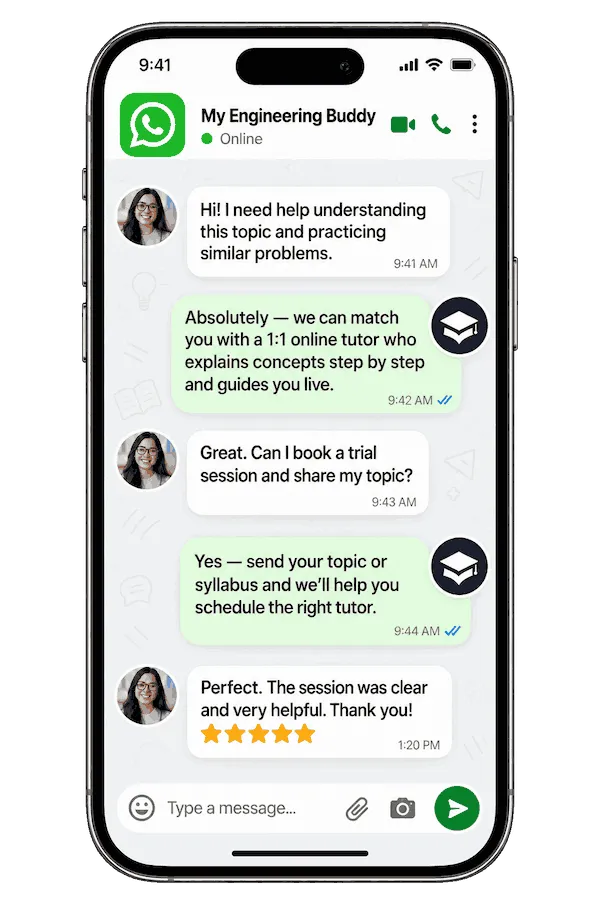
Unlike platforms where you fill out a form and wait, MEB responds in under a minute, 24/7. Tutor match takes under an hour. The $1 trial means you test before you commit. Everything runs over WhatsApp — no logins, no intake forms.
Study Plans (Pick One That Matches Your Goal)
If your exam or submission is less than three weeks away, the tutor focuses on your highest-yield gaps first — usually goodwill, NCI, and intercompany eliminations — and runs exam-condition practice in every session. For four to eight weeks of structured revision, sessions follow the syllabus sequence with weekly topic checks. Ongoing weekly support runs alongside your semester, aligned to assignment deadlines and module assessments. In every case, the tutor maps the exact session sequence after the first diagnostic.
Pricing Guide
Consolidation Accounting tutoring starts at $20/hr for standard undergraduate-level sessions. Graduate modules, professional exam preparation (ACCA, CPA, CFA), and IFRS advisory depth are typically $40–$100/hr depending on tutor background and timeline. Rate factors include level, topic complexity, how quickly you need the sessions, and tutor availability.
Availability tightens significantly around ACCA and CPA exam windows and semester end dates. If your exam is within six weeks, book now.
For students targeting Big Four advisory roles or postgraduate programmes with a strong financial reporting component, tutors with professional group reporting or audit backgrounds are available at higher rates — share your specific goal and MEB will match the tier to your target.
Start with the $1 trial — 30 minutes, no registration, no commitment. WhatsApp MEB for a quick quote.
At MEB, we’ve found that students who complete even two or three focused consolidation sessions before an exam perform noticeably better on the preparation-of-statements questions — not because they’ve memorised more, but because they’ve internalised the sequence. That sequence is the whole game in consolidation accounting.
FAQ
Is Consolidation Accounting hard?
Harder than most accounting topics at the same level. The difficulty isn’t the concepts — it’s that errors compound across a multi-step schedule. Students who struggle usually have one or two weak steps, not a complete gap. A tutor finds those steps in the first session.
How many sessions are needed?
Most students with a specific exam or assignment target see clear improvement in three to six sessions. Students covering the full consolidation syllabus from scratch — including IFRS 10 and IAS 21 — typically need eight to twelve sessions spread across a semester.
Can you help with homework and assignments?
Yes. MEB tutors explain consolidation problems step by step — the intercompany eliminations, the goodwill workings, the NCI split — so you understand the method fully before you submit the work yourself. MEB tutoring is guided learning — you understand the work, then submit it yourself. For full details on what we help with and what we don’t, read our Academic Integrity policy and Why MEB.
Will the tutor match my exact syllabus or exam board?
Yes. When you contact MEB, share your course name, university or professional body (ACCA, CPA, CFA, CIMA), and the specific topics you’re covering. MEB matches a tutor with direct experience of that syllabus — not a general accountant who happens to know some IFRS.
What happens in the first session?
The tutor works through a consolidation question with you to map exactly where your working breaks down. From that diagnostic, they build a session sequence targeting your specific gaps — goodwill, NCI, eliminations, or foreign currency translation — in priority order.
Is online tutoring as effective as in-person?
For consolidation accounting, yes. The tutor annotates schedules live on a digital pen-pad over Google Meet. You see every step in real time, ask questions as they arise, and replicate the working yourself in the same session. The feedback loop is the same as sitting across a table.
Can I get Consolidation Accounting help at midnight?
MEB operates 24/7. WhatsApp the number any time — average response is under a minute. If your time zone is Dubai, Sydney, or Vancouver and you need a session at 11 pm local time, that’s covered. Tutor availability varies by time slot, but late-night sessions are common across MEB’s network.
What if I don’t like my assigned tutor?
The $1 trial exists precisely for this. If the match isn’t right — teaching style, pace, depth — tell MEB on WhatsApp and a different tutor is matched, usually within an hour. No charge, no friction.
Do you offer group Consolidation Accounting sessions?
MEB’s standard offering is 1:1. Group sessions are occasionally arranged for study pairs or small cohorts from the same programme — ask on WhatsApp and MEB will confirm whether that’s possible for your schedule and level.
How do I get started?
Three steps: WhatsApp MEB with your subject, exam board or professional body, and deadline. MEB matches you with a verified Consolidation Accounting tutor, usually within an hour. Your first session is the $1 trial — 30 minutes live or one full question explained, no registration required.
Try your first session for $1 — 30 minutes of live 1:1 tutoring or one homework question explained in full. No registration. No commitment. WhatsApp MEB now and get matched within the hour.
Trust & Quality at My Engineering Buddy
Every MEB tutor goes through subject-specific vetting before being matched to a student. That includes a review of their academic background, a live demo session evaluated by MEB, and ongoing feedback checks after each student relationship. For Consolidation Accounting, tutors hold degrees in accounting or finance and carry either professional certification (ACCA, CPA, CFA, CIMA) or direct financial reporting experience — usually both. Rated 4.8/5 across 40,000+ verified reviews on Google.
MEB tutoring is guided learning — you understand the work, then submit it yourself. For full details on what we help with and what we don’t, read our Academic Integrity policy and Why MEB. Tutoring methodology is published at MEB’s tutoring methodology page if you want to understand how sessions are structured before booking.
MEB has served 52,000+ students in 2,800+ subjects since 2008 — across the US, UK, Canada, Australia, the Gulf, and Europe. Students working on related accounting areas frequently combine Consolidation Accounting sessions with financial reporting tutoring, advanced accounting help, and financial statement analysis tutoring.
MEB has covered everything from first-year financial accounting tutoring to postgraduate IFRS advisory depth — with tutors who have sat the same professional exams your students are preparing for.
Source: My Engineering Buddy, 2008–2025.
Explore Related Subjects
Students studying Consolidation Accounting often also need support in:
- Intermediate Accounting
- International Accounting Standards (IAS)
- Auditing
- Corporate Governance
- Transfer Pricing
- Cash Flow Analysis
- Managerial Accounting
Next Steps
Before your first session, have ready:
- Your exam board, professional body, or course outline (ACCA SBR, CPA FAR, university module guide)
- A recent consolidation question or homework you struggled with
- Your exam or submission deadline date
The tutor handles the rest — diagnostic first, then a session sequence built around your actual gaps.
Share your availability and time zone when you get in touch. MEB matches you with a verified Consolidation Accounting tutor, usually within 24 hours. Visit www.myengineeringbuddy.com for more on how the MEB process works.
WhatsApp to get started or email [email protected].
Reviewed by Subject Expert
This page has been carefully reviewed and validated by our subject expert to ensure accuracy and relevance.