




~1 min
Average Reply Time
~1 hour
To Be Matched With A Tutor
30 Min Trial
75% Find Their Tutor On The 1st Trial
$20-35+/hr
Premium Yet Affordable Learning
Hire The Best Financial Accounting Tutor










Still losing marks on journal entries and income statements — after re-reading the chapter three times?
Financial Accounting Tutor Online
Financial Accounting is the structured process of recording, classifying, and reporting a business’s financial transactions under frameworks like GAAP or IFRS. It equips students to prepare and interpret financial statements — the income statement, balance sheet, and cash flow statement — used by investors, regulators, and management.
MEB provides 1:1 online tutoring and academic guidance in 2,800+ advanced subjects, including Financial Accounting at every level from introductory undergraduate through CPA exam prep. Whether you’re searching for a Financial Accounting tutor near me or need someone available at midnight before a submission, MEB connects you with a verified expert — fast. Tutors work to your exact course, your exam board, and your current gap, not a generic syllabus.
- 1:1 online sessions tailored to your course or syllabus
- Expert accounts tutoring from verified tutors with subject-specific knowledge
- Flexible time zones — US, UK, Canada, Australia, Gulf
- Structured learning plan built after a diagnostic session
- Ethical academic guidance — you understand before you submit
52,000+ students across the US, UK, Canada, Australia, and the Gulf have used MEB since 2008 — across 2,800+ subjects, from AP Calculus to A Level Music Technology to Data Science.
Source: My Engineering Buddy, 2008–2025.
How Much Does a Financial Accounting Tutor Cost?
Most Financial Accounting tutoring sessions run $20–$40/hr. Advanced topics — consolidated statements, IFRS reconciliations, CPA-level practice — can go up to $100/hr depending on tutor experience. A $1 trial gets you 30 minutes of live 1:1 tutoring or one homework question explained in full.
| Level / Need | Typical Rate | What’s Included |
|---|---|---|
| Introductory / Undergraduate | $20–$35/hr | 1:1 sessions, homework guidance |
| Advanced / CPA / IFRS Specialist | $35–$100/hr | Expert tutor, niche depth |
| $1 Trial | $1 flat | 30 min live session or 1 homework question |
Tutor slots fill quickly around mid-terms, finals, and CPA exam windows. Book early if you’re working to a fixed deadline.
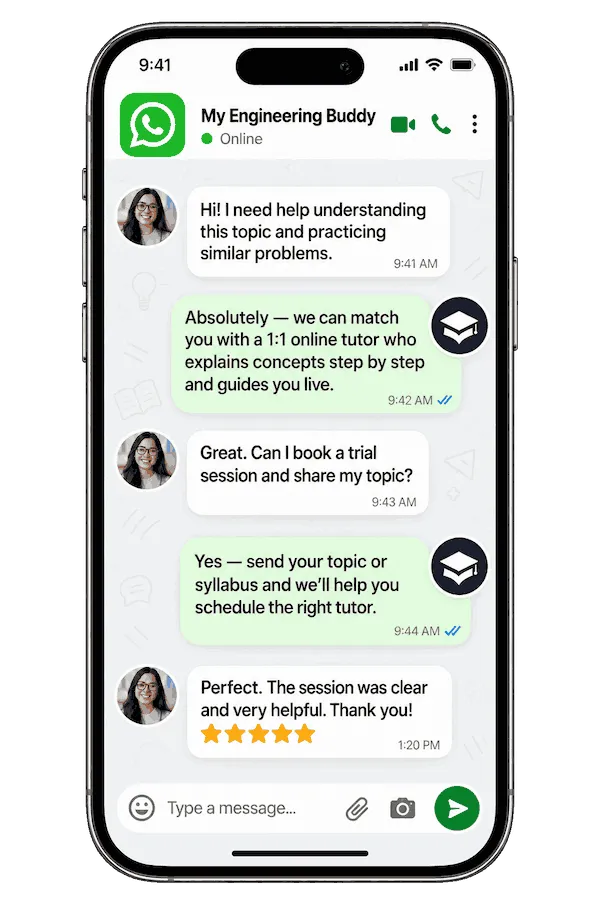
WhatsApp MEB for a quick quote — average response time under 1 minute.
Who This Financial Accounting Tutoring Is For
Financial Accounting covers a lot of ground fast. Most students hit a wall somewhere between debits and credits and consolidated group statements — and the gap compounds quickly when coursework keeps moving.
- Undergraduate students in first or second year taking introductory or intermediate accounting courses
- Students with a conditional university offer who need to pass this semester’s Financial Accounting module to secure their place
- Graduate students in MBA, MSc Finance, or MSc Accounting programs working through GAAP and IFRS applications
- Students retaking a failed Financial Accounting exam and needing targeted gap-filling rather than a full course repeat
- CPA or CMA candidates working through the financial accounting and reporting sections
- Students at universities like NYU Stern, LSE, University of Toronto, Melbourne Business School, IE Business School, or INSEAD where grading curves are steep
- Anyone 4–6 weeks from an exam with balance sheet or cash flow gaps still to close
1:1 Tutoring vs Self-Study vs AI Tools
Self-study works for motivated students — but Financial Accounting is one of those subjects where you can re-read the same chapter on revenue recognition and still misapply it on a problem set, because the feedback loop is missing. AI tools are fast and useful for definitions and worked examples, but they cannot watch you build a trial balance, spot where your logic breaks, or adapt the explanation when you’re confusing FIFO with weighted average cost for the third time in a row. That real-time correction — someone watching you work through a bank reconciliation live and catching the sign error before it cascades — is exactly where 1:1 instruction earns its place. MEB gives you that online, fitted to your exact course and timeline, without committing to a semester-long contract.
Outcomes: What You’ll Be Able To Do in Financial Accounting
After working with an MEB Financial Accounting tutor, you’ll be able to apply double-entry bookkeeping accurately across a full accounting cycle, analyze and interpret an income statement and balance sheet under both GAAP and IFRS, model cash flow statements using both the direct and indirect method, explain the rationale behind revenue recognition and lease accounting adjustments, and present a coherent set of financial statements with supporting notes for coursework or exam conditions. These aren’t abstract skills — they map directly to exam questions, graded assignments, and the kind of applied work MBA programs expect from day one.
Supporting a student through Financial Accounting? MEB works directly with parents to set up sessions, track progress, and keep coursework on schedule. WhatsApp MEB — average response time is under a minute, 24/7.
Based on feedback from 40,000+ sessions collected by MEB from 2022 to 2025, 58% of students improved by one full grade after approximately 20 hours of 1:1 tutoring in a single subject. A further 23% achieved at least a half-grade improvement.
Source: MEB session feedback data, 2022–2025.
What We Cover in Financial Accounting (Syllabus / Topics)

Track 1: Financial Accounting Foundations
- The accounting equation and double-entry system
- Chart of accounts, journals, and ledgers
- Trial balance preparation and error correction
- Adjusting entries — accruals, prepayments, depreciation
- Preparing the income statement and retained earnings statement
- Closing entries and the post-closing trial balance
Core texts for this track include Weygandt, Kimmel & Kieso’s Financial Accounting (IFRS edition) and Warren, Jones & Tayler’s Financial & Managerial Accounting. OpenStax also publishes a free peer-reviewed text at openstax.org suitable for introductory-level study.
Track 2: Intermediate Financial Accounting
- Revenue recognition under ASC 606 / IFRS 15 — five-step model
- Inventory valuation: FIFO, LIFO, weighted average, and lower of cost or net realisable value
- Long-term assets: acquisition, depreciation methods, impairment
- Lease accounting under ASC 842 / IFRS 16
- Financial instruments — classification and measurement
- Deferred tax: temporary differences and tax-effect accounting
- Cash flow analysis tutoring — indirect and direct method statements
Kieso, Weygandt & Warfield’s Intermediate Accounting (17th edition) is the standard reference. IFRS-focused programs also use Epstein & Nach’s GAAP/IFRS: Interpretation and Application.
Track 3: Financial Reporting, Standards, and Analysis
- GAAP vs IFRS — key differences and convergence areas
- Consolidated financial statements and group accounting
- Segment reporting and earnings per share disclosures
- Financial statement analysis help — ratio analysis, trend analysis, benchmarking
- Accounting for business combinations under IFRS 3 / ASC 805
- Conceptual framework — qualitative characteristics and measurement bases
Deloitte’s iGAAP manual and the IASB’s published standards are used alongside Mackenzie et al.’s Interpretation and Application of IFRS Standards. The INSEAD accounting area maintains research-level resources on financial reporting at insead.edu.
At MEB, we’ve found that most Financial Accounting errors trace back to one or two misunderstood concepts — usually from week two or three of the course. Fix those early and the rest of the material falls into place much faster than students expect.
What a Typical Financial Accounting Session Looks Like
The tutor opens by checking the previous topic — usually a specific problem type like adjusting entries or a segment of the cash flow statement that you flagged as unclear. From there, you and the tutor work through a live problem on screen: building a multi-step income statement, working a deferred tax calculation, or reconciling a bank statement line by line. The tutor writes on a digital pen-pad as they explain each step, and then you replicate the process while they watch — not as a test, but so they can see exactly where your logic diverges from the correct approach. The session ends with a concrete practice task and a note on which topic comes next, so the following session doesn’t repeat ground already covered.
How MEB Tutors Help You with Financial Accounting (The Learning Loop)
Diagnose: In the first session, the tutor asks you to work through a problem — usually a question from a recent assignment or past paper. They’re not grading you; they’re mapping where your understanding breaks down, whether that’s double-entry logic, statement presentation, or standards interpretation.
Explain: The tutor works through a fully annotated example on the digital pen-pad — showing each debit and credit, each line on the statement, each standard reference — talking through the reasoning, not just the answer.
Practice: You attempt the next problem while the tutor watches. This is where most of the learning happens. Errors caught here don’t appear on your graded work.
Feedback: The tutor goes through every error — not just marking it wrong, but explaining which concept it came from and how examiners would have penalised it. Students consistently tell us that this step alone changes how they approach Financial Accounting problems.
Plan: Each session ends with the next topic identified and a practice task set. Progress is tracked across sessions so nothing falls through the cracks.
Sessions run over Google Meet. Tutors use a digital pen-pad or iPad with Apple Pencil for live annotation. Before your first session, share your course syllabus or exam board, a recent piece of work you found difficult, and your exam or deadline date. The first session covers a diagnostic and the first targeted topic. Start with the $1 trial — 30 minutes of live tutoring that also serves as your first diagnostic.
Students consistently tell us that the moment Financial Accounting clicked for them was when a tutor showed them the same transaction from three angles — the journal entry, the ledger posting, and the financial statement impact — all in one sitting.
Tutor Match Criteria (How We Pick Your Tutor)
MEB doesn’t assign whoever is available. Every tutor match is made against your specific requirements.
Subject depth: Tutors are matched to your level — introductory undergraduate, intermediate, advanced IFRS, or CPA/CMA prep — and to the exact syllabus or exam board your course uses.
Tools: All sessions run over Google Meet. Tutors use a digital pen-pad or iPad with Apple Pencil to work through financial statements and journal entries live.
Time zone: MEB covers New York, Los Angeles, Chicago, London, Dubai, Toronto, Sydney, Melbourne, and all standard US, UK, Gulf, Canadian, Australian, and European time zones — including evenings and weekends.
Learning style: Tutors adjust their approach based on the first session — some students need worked examples first, others prefer to attempt the problem and debrief. Both work.
Communication: Clear English, adapted to the student’s level — whether that’s a first-year student encountering debits and credits for the first time or a graduate student working through IFRS 9 classification rules.
Goals: Whether your aim is passing a resit, scoring in the top quartile, completing a specific assignment, or building long-term conceptual depth, the tutor is briefed on that before session one.
Unlike platforms where you fill out a form and wait, MEB responds in under a minute, 24/7. Tutor match takes under an hour. The $1 trial means you test before you commit. Everything runs over WhatsApp — no logins, no intake forms.
Study Plans (Pick One That Matches Your Goal)
After the first diagnostic session, the tutor builds a session sequence matched to your timeline. For a catch-up over 1–3 weeks, the focus is closing the highest-priority gaps before the exam or submission. For structured exam prep over 4–8 weeks, sessions work through the full syllabus systematically with past-paper practice built in. For ongoing weekly support, sessions align to your semester schedule and coursework deadlines — so you’re never trying to catch up on three weeks of material the night before a submission.
Pricing Guide
Financial Accounting tutoring starts at $20/hr for introductory and mid-level undergraduate work. Graduate-level topics — IFRS reconciliations, consolidated group statements, CPA financial reporting sections — typically run $35–$70/hr. Highly specialised or niche requests can reach $100/hr. Rate factors include topic complexity, the tutor’s professional background, and your timeline. Slots go fast during mid-terms and finals — if you have a fixed exam date, book earlier rather than later.
For students targeting top-ranked MBA programs, CPA licensure, or roles in Big Four firms, tutors with professional audit, advisory, or financial reporting backgrounds are available at higher rates — share your specific goal and MEB will match the tier to what you’re actually aiming for.
Start with the $1 trial — 30 minutes, no registration, no commitment. WhatsApp MEB for a quick quote.
MEB has served students from 52,000+ enrolments since 2008, covering subjects from introductory bookkeeping through CPA financial reporting — tutors are matched to your level, your exam board, and your deadline.
Source: My Engineering Buddy, 2008–2025.
FAQ
Is Financial Accounting hard?
For many students, yes — especially the jump from basic bookkeeping to accrual accounting, deferred taxes, and IFRS standards. The subject rewards precision. One wrong concept early, like misapplying double-entry rules, creates cascading errors. With a tutor identifying the root cause, most students close their main gaps within 6–10 sessions.
How many sessions are needed?
It depends on your current level and deadline. Students with one or two targeted gaps often see measurable improvement in 4–6 sessions. Those starting from a weak foundation or preparing for CPA-level material typically work over 12–20 sessions. The tutor sets a realistic plan after the first diagnostic.
Can you help with practice exercises?
Yes — the tutor works through the concepts and methods with you so you understand the material fully before you submit your own work. MEB tutoring is guided learning — you understand the work, then submit it yourself. For full details on what we help with and what we don’t, read our Academic Integrity policy and Why MEB.
Will the tutor match my exact syllabus or exam board?
Yes. MEB tutors are matched to your specific course — whether that’s a US GAAP-based undergraduate module, an IFRS-focused programme in the UK, Australia, or Europe, or a CPA/CMA exam section. Share your course outline or exam board when you message MEB and the match is made accordingly.
What happens in the first session?
The tutor asks you to work through a recent problem or past exam question — not to grade you, but to identify exactly where your understanding breaks down. From that diagnostic, they build a session sequence that prioritises the gaps most likely to cost you marks, starting immediately within the same session.
Is online Financial Accounting tutoring as effective as in-person?
For most students, yes. Tutors use Google Meet with a digital pen-pad to annotate financial statements and journal entries live — the same whiteboard dynamic as in-person, without commuting. Students in the US, UK, and Australia report no meaningful difference in learning quality compared to face-to-face sessions.
Can I get Financial Accounting help at midnight?
Yes. MEB operates 24/7 across time zones. If you’re in New York, London, Dubai, or Sydney and have a submission due in the morning, message MEB on WhatsApp — average response time is under a minute, and tutors are available in most major time zones through the night.
What if I don’t like my assigned Financial Accounting tutor?
Tell MEB on WhatsApp and a different tutor is arranged — usually within the hour. There’s no process, no form to fill out. The $1 trial exists partly for this reason: you test the match before committing to a full session block.
Do you offer group Financial Accounting sessions?
MEB specialises in 1:1 sessions only. Group sessions dilute the diagnostic benefit — if three students attend, the tutor cannot watch each person work through a problem and catch individual errors in real time. One-to-one is how the learning loop works.
How do I get started?
Start with the $1 trial: 30 minutes of live 1:1 tutoring or one homework question explained in full. Three steps — WhatsApp MEB, get matched with a verified Financial Accounting tutor within the hour, then start your trial session. No registration, no commitment required.
Trust & Quality at My Engineering Buddy
Every MEB tutor goes through subject-specific screening before working with students — that includes a live demo evaluation, degree and credential verification, and review of subject knowledge at the level they’ll be teaching. Tutors are assessed on Financial Accounting specifically, not just on general accounting competence. Rated 4.8/5 across 40,000+ verified reviews on Google. Ongoing session feedback is reviewed and used to maintain tutor standards across the platform.
MEB tutoring is guided learning — you understand the work, then submit it yourself. For full details on what we help with and what we don’t, read our Academic Integrity policy and Why MEB. We guide — you submit your own work.
MEB has been running since 2008, serving 52,000+ students across the US, UK, Canada, Australia, Gulf, and Europe in 2,800+ subjects. Students working on related areas frequently use MEB for financial reporting tutoring, managerial accounting help, and intermediate accounting tutoring. Full detail on how tutors are evaluated is at our tutoring methodology page.
A common pattern our tutors observe is that students who struggled with Financial Accounting for an entire semester will often resolve the core confusion in two or three focused sessions — once the exact point of misunderstanding is found and addressed directly.
Explore Related Subjects
Students studying Financial Accounting often also need support in:
- Managerial Accounting
- Auditing
- Cost Accounting
- Taxation
- Financial Analysis
- Corporate Governance
- Budgeting
- Advanced Accounting
MEB tutors cover Financial Accounting from first-year double-entry through IFRS consolidations and CPA exam prep — matched to your level, your course, and your deadline.
Source: My Engineering Buddy, 2008–2025.
Next Steps
Before your first session, have ready: your exam board and syllabus (or course outline), a recent past paper attempt or homework you struggled with, and your exam or deadline date. The tutor handles the rest.
- Share your exam board or course, your hardest topic, and your current timeline
- Share your availability and time zone
- MEB matches you with a verified Financial Accounting tutor — usually within the hour
The first session starts with a diagnostic so every minute is spent on what actually matters. Visit GAAP tutoring or browse subjects at www.myengineeringbuddy.com for more on how MEB works.
Try your first session for $1 — 30 minutes of live 1:1 tutoring or one homework question explained in full. No registration. No commitment. WhatsApp MEB now and get matched within the hour.
WhatsApp to get started or email [email protected].
Reviewed by Subject Expert
This page has been carefully reviewed and validated by our subject expert to ensure accuracy and relevance.



