




~1 min
Average Reply Time
~1 hour
To Be Matched With A Tutor
30 Min Trial
75% Find Their Tutor On The 1st Trial
$20-35+/hr
Premium Yet Affordable Learning
Hire The Best Cost Accounting Tutor



Standard costing, variance analysis, job costing — most students lose marks in the same three places every exam.
Cost Accounting Tutor Online
Cost Accounting is the branch of accounting that records, analyzes, and reports on a business’s costs of production and operations. A skilled Cost Accounting tutor helps students apply costing methods, interpret variances, and prepare cost reports used in real management decisions.
MEB offers 1:1 online tutoring and homework help in Cost Accounting — from introductory undergraduate modules through to CMA exam preparation. If you’ve searched for a Cost Accounting tutor near me, you’re in the right place: our tutors work across every time zone, entirely online, with sessions designed around your exact syllabus and current gaps. Students who work consistently with a tutor leave with the ability to tackle variance analysis, CVP models, and process costing problems without freezing up.
- 1:1 online sessions tailored to your course syllabus and exam board
- Expert verified tutors with deep subject-specific knowledge in cost and managerial accounting
- Flexible time zones — US, UK, Canada, Australia, Gulf covered
- Structured learning plan built after a diagnostic first session
- Ethical homework and assignment guidance — you understand the work before you submit it
52,000+ students across the US, UK, Canada, Australia, and the Gulf have used MEB since 2008 — across 2,800+ subjects, from AP Calculus to A Level Music Technology to Data Science.
Source: My Engineering Buddy, 2008–2025.
How Much Does a Cost Accounting Tutor Cost?
Most Cost Accounting tutoring sessions at MEB run $20–$40 per hour, depending on the level and complexity of your course. Graduate-level or CMA-focused support can reach $70–$100/hr. There’s a $1 trial — 30 minutes of live tutoring or one homework question explained in full — no registration required.
| Level / Need | Typical Rate | What’s Included |
|---|---|---|
| Undergraduate (intro to intermediate) | $20–$35/hr | 1:1 sessions, homework guidance, past paper practice |
| Advanced / CMA / Graduate Level | $35–$100/hr | Expert tutor, exam strategy, case-based problem solving |
| $1 Trial | $1 flat | 30 min live session or one homework question explained |
Tutor availability tightens during semester finals and CMA exam windows. Book early if your deadline is within six weeks.
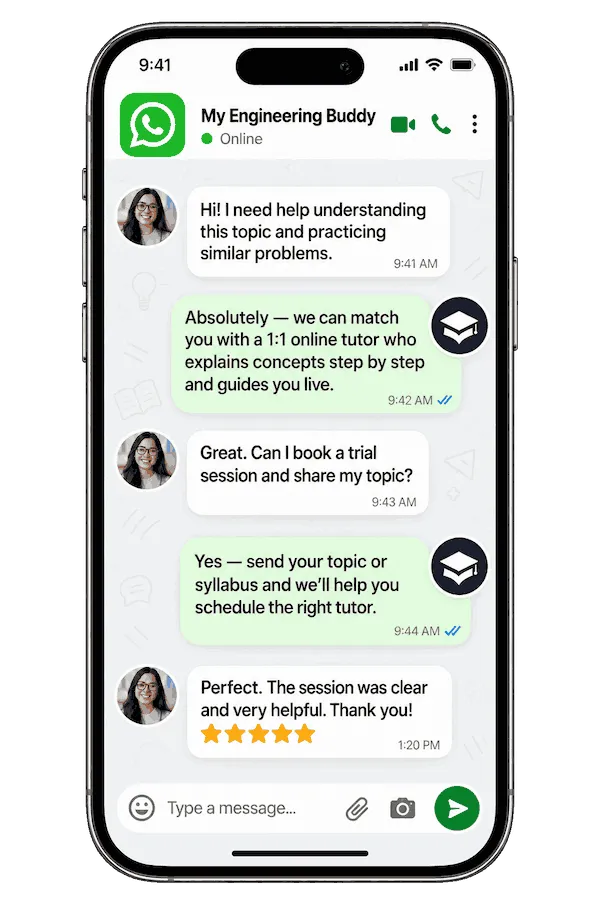
WhatsApp MEB for a quick quote — average response time under 1 minute.
Who This Cost Accounting Tutoring Is For
Cost Accounting tutoring at MEB serves students at multiple stages — from those just meeting absorption costing for the first time to professionals working toward the CMA. If the subject feels mechanical but the logic keeps slipping, that’s exactly where 1:1 support pays off.
- Undergraduate students in business, finance, or accounting programs struggling with variance analysis or job-order costing
- Graduate students covering activity-based costing or advanced cost management in MBA programmes at schools like Wharton, Rotman, or Warwick Business School
- Students sitting the CMA, CIMA, or ACCA exams who need structured, exam-focused preparation
- Students who failed their Cost Accounting module the first time and are retaking — with the same exam date now six weeks away.
- Students with a conditional university offer that depends on passing this module
- Parents supporting a student whose grades have been dropping alongside their confidence in the subject
1:1 Tutoring vs Self-Study vs AI Tools
Self-study works for motivated students, but Cost Accounting has a specific trap: you can follow a worked example line by line and still set up the variance calculation wrong on your own because no one caught where your logic broke. AI tools can explain standard costing concepts quickly, but they cannot watch you attempt a throughput accounting problem in real time, spot the moment you misallocate a fixed overhead, and correct it before the habit sets. That live diagnostic loop — identifying the exact point of failure and rebuilding from there — is what makes 1:1 Cost Accounting tutoring different. MEB delivers that online, with the full flexibility of your schedule, calibrated to your exact course or exam board.
Outcomes: What You’ll Be Able To Do in Cost Accounting
After consistent sessions with an MEB Cost Accounting tutor, students can solve multi-step variance analysis problems — including material, labour, and overhead variances — without a template to follow. You’ll be able to apply job-order, process, and activity-based costing methods to realistic scenarios and explain why each one produces a different unit cost. Students learn to model CVP relationships and use break-even analysis to support a business decision, not just complete the calculation. You’ll analyze a cost report, identify inefficiencies, and present findings in the format your course or examiner expects. Apply overhead absorption rates correctly. Write structured answers under exam conditions without losing marks to poor method presentation.
Supporting a student through Cost Accounting? MEB works directly with parents to set up sessions, track progress, and keep coursework on schedule. WhatsApp MEB — average response time is under a minute, 24/7.
Based on feedback from 40,000+ sessions collected by MEB from 2022 to 2025, 58% of students improved by one full grade after approximately 20 hours of 1:1 tutoring in a single subject. A further 23% achieved at least a half-grade improvement.
Source: MEB session feedback data, 2022–2025.
What We Cover in Cost Accounting (Syllabus / Topics)

Core Costing Methods
- Job-order costing: cost cards, overhead allocation, WIP journals
- Process costing: equivalent units, normal and abnormal losses, FIFO vs weighted average
- Activity-based costing (ABC): cost drivers, cost pools, comparison with traditional absorption
- Marginal vs absorption costing: profit reconciliation, fixed overhead treatment
- Throughput accounting: TA ratio, bottleneck identification, product mix decisions
- Service sector costing: cost per unit of service, reciprocal method for service departments
Key texts for this track include Drury’s Cost and Management Accounting, Horngren’s Cost Accounting: A Managerial Emphasis, and Kinney & Raiborn’s Cost Accounting: Foundations and Evolutions.
Variance Analysis and Standard Costing
- Setting standards: attainable, ideal, and basic standards and their behavioural effects
- Material variances: price, usage, mix, and yield
- Labour variances: rate, efficiency, idle time
- Variable and fixed overhead variances: expenditure, efficiency, volume, capacity
- Sales variances: price, volume, mix, and quantity
- Variance interpretation and operating statements under marginal and absorption costing
Recommended texts: Seal, Rohde & Garrison’s Management Accounting; Atkinson et al.’s Management Accounting: Information for Decision-Making and Strategy Execution.
Decision-Making, Budgeting, and Cost Management
- CVP analysis: break-even, margin of safety, contribution per unit, multi-product scenarios
- Relevant costing: sunk costs, opportunity costs, make-or-buy, shut-down decisions
- Limiting factor analysis and linear programming (graphical and simplex introduction)
- Budgeting: fixed, flexible, zero-based, rolling budgets; behavioural aspects
- Capital budgeting: NPV, IRR, payback, and their cost accounting applications
- Cost management techniques: target costing, life-cycle costing, kaizen costing
Texts for this track: Jiambalvo’s Managerial Accounting; Bhimani, Horngren, Datar & Rajan’s Management and Cost Accounting.
At MEB, we’ve found that students who struggle with variance analysis aren’t usually weak at maths — they’ve just never been shown how to set up the framework before plugging in numbers. Once that scaffold is in place, the calculations follow naturally.
What a Typical Cost Accounting Session Looks Like
The tutor opens by checking how the previous topic landed — usually overhead absorption or process costing equivalent units — and whether the practice problems set last time revealed any remaining gaps. From there, the session moves into live problem-solving: the student and tutor work through a multi-variance operating statement or an ABC cost driver calculation on screen together, with the tutor using a digital pen-pad to annotate each step as it’s built. The student then attempts a parallel problem independently while the tutor watches, stepping in only when the method starts to drift. The session closes with a specific problem set for the coming week and a note on which topic opens the next session — typically either limiting factor analysis or flexible budget variances, depending on where the syllabus is headed.
How MEB Tutors Help You with Cost Accounting (The Learning Loop)
Diagnose: In the first session, the tutor works through a short set of problems across two or three topic areas — not to test, but to locate exactly where the logic breaks. Most Cost Accounting errors cluster around overhead allocation sequences and variance sign conventions.
Explain: The tutor works problems live, narrating each decision point. The digital pen-pad makes the method visible — students see the overhead absorption rate being built from scratch, not just the final figure dropped into a formula.
Practice: The student attempts the next problem while the tutor watches. This is where most of the learning happens. Getting it wrong in a live session — and having it corrected immediately — is worth more than ten correct answers done alone at home.
Feedback: The tutor goes back through each error step by step, identifying not just what went wrong but why the mark scheme would penalise it. Students learn to self-check method before submission.
Plan: Every session ends with a topic sequence for the week ahead. The tutor tracks progress across sessions and adjusts the plan if a topic needs more time or if a new exam date changes the priority order.
Sessions run on Google Meet. The tutor uses a digital pen-pad or iPad with Apple Pencil to show working in real time. Before the first session, share your course syllabus or module guide, a recent assignment or past paper you found difficult, and your exam or submission deadline. The first session covers diagnostic problems and locks in the session plan from there. Start with the $1 trial — 30 minutes of live tutoring that also serves as your first diagnostic.
Tutor Match Criteria (How We Pick Your Tutor)
Every Cost Accounting tutor at MEB is matched on six criteria before the first session.
Subject depth: Tutors are vetted for the specific level and framework you’re studying — introductory undergraduate, CIMA/ACCA syllabus, CMA exam, or graduate-level cost strategy. A tutor covering standard costing at undergraduate level is different from one preparing students for Part 2 of the CMA.
Tools: All sessions use Google Meet with a digital pen-pad or iPad and Apple Pencil for annotated working. No session runs without a visual working environment.
Time zone: MEB covers New York, Los Angeles, Chicago, London, Dubai, Toronto, Sydney, Melbourne, and all major US, UK, Gulf, Canadian, Australian, and European time zones — including evenings and weekends.
Learning style: The diagnostic first session is also a calibration session. The tutor adjusts pace, depth of explanation, and problem difficulty based on what that session reveals.
Communication: Tutors explain in clear English, adjusted to the student’s level — whether that’s a first-year undergraduate meeting absorption costing for the first time or a professional accountant revisiting throughput accounting for an exam.
Goals: Whether the target is passing a retake, achieving a distinction, completing a homework set correctly, or building enough depth to support a dissertation chapter on cost management, the tutor’s approach is calibrated to that specific outcome.
Unlike platforms where you fill out a form and wait, MEB responds in under a minute, 24/7. Tutor match takes under an hour. The $1 trial means you test before you commit. Everything runs over WhatsApp — no logins, no intake forms.
Study Plans (Pick One That Matches Your Goal)
The tutor builds the exact session sequence after the diagnostic, but most students fall into one of three plans: a catch-up plan covering the highest-priority gaps over one to three weeks before an exam; a structured revision plan running four to eight weeks through the full syllabus with past paper practice built in; or ongoing weekly support aligned to semester coursework deadlines and module progression. Which plan fits depends on your exam date, current confidence level, and how many topics still need work. The tutor decides the sequence — you bring the deadline and the gaps.
Pricing Guide
Standard Cost Accounting tutoring runs $20–$40 per hour for most undergraduate and intermediate levels. Niche specialisms — CMA Part 2 strategy, CIMA Management Case Study, or graduate research support — can reach $100/hr depending on tutor background and timeline pressure.
Rate factors include course level, topic complexity (standard costing is different from transfer pricing or lifecycle costing analysis), how quickly you need to start, and tutor availability in your time zone.
Availability tightens in April–May and November–December when semester finals and professional exam sittings overlap. If your exam is within six weeks, book sooner rather than later.
For students targeting top business school programmes or professional certifications like the CMA or CIMA, tutors with industry cost management backgrounds are available at higher rates — share your specific goal and MEB will match the tier to what you need.
Start with the $1 trial — 30 minutes, no registration, no commitment. WhatsApp MEB for a quick quote.
FAQ
Is Cost Accounting hard?
It’s precise rather than conceptually difficult. Most students hit trouble with overhead allocation sequences and variance sign conventions — not because the maths is hard, but because no one has shown them the setup method clearly. A few sessions usually fix this.
How many sessions are needed?
Students with one or two specific gaps often see real improvement in three to five sessions. Students preparing for a full exam cycle or working through an entire Cost Accounting module typically benefit from eight to fifteen sessions spread over the semester or revision period.
Can you help with Cost Accounting homework and assignments?
Yes — tutors work through problems with you, explain the method, and make sure you can replicate it yourself before submission. MEB tutoring is guided learning — you understand the work, then submit it yourself. For full details on what we help with and what we don’t, read our Academic Integrity policy and Why MEB.
Will the tutor match my exact syllabus or exam board?
Yes. When you contact MEB, share your course name, institution, and exam board or certification body. The tutor is matched to that specific framework — CIMA, ACCA, CMA, or a university module — not assigned generically.
What happens in the first session?
The tutor runs a short diagnostic covering two or three topic areas to locate where your understanding breaks down. This shapes the full session plan. No time is spent on topics you already handle well — every session is focused on what actually needs work.
Is online Cost Accounting tutoring as effective as in-person?
For a calculation-heavy subject like Cost Accounting, the digital pen-pad on Google Meet replicates the whiteboard environment closely. Students in the US, UK, and Australia consistently report that online sessions feel as immediate as face-to-face — particularly when the tutor annotates working in real time.
Can I get Cost Accounting help late at night or on weekends?
Yes. MEB operates 24/7 across all major time zones. If you’re in Dubai finishing a case study at 11pm, or in Toronto reviewing variance problems on a Sunday afternoon, a tutor is available. WhatsApp MEB and you’ll have a response in under a minute.
What if I don’t get on with my assigned tutor?
Tell MEB via WhatsApp. A replacement tutor is assigned without friction. The $1 trial exists precisely so you can test the match before committing to a full session block. No forms, no escalation process needed.
Do you cover CMA and CIMA exam preparation specifically?
Yes. MEB has tutors experienced with CMA Part 1 and Part 2, CIMA Management and Strategic levels, and ACCA Performance Management. Share which paper and sitting date you’re targeting, and the tutor builds a revision plan from there. See also our CMA tutoring page.
How do I get started?
Three steps: WhatsApp MEB, get matched with a verified Cost Accounting tutor — usually within the hour — and start the $1 trial: 30 minutes of live 1:1 tutoring or one homework question explained in full. No registration. No commitment.
Trust & Quality at My Engineering Buddy
Every MEB tutor goes through subject-specific screening — a live demo evaluation, degree and qualification verification, and ongoing session feedback review. Tutors covering Cost Accounting are assessed on their ability to teach variance analysis, overhead allocation, and costing method application — not just accounting in general. Rated 4.8/5 across 40,000+ verified reviews on Google.
MEB tutoring is guided learning — you understand the work, then submit it yourself. For full details on what we help with and what we don’t, read our Academic Integrity policy and Why MEB.
MEB has served 52,000+ students across the US, UK, Canada, Australia, the Gulf, and Europe in 2,800+ subjects since 2008. Students working on related areas of accounting frequently also get help with financial accounting tutoring, budgeting homework help, and financial analysis tutoring. See our tutoring methodology for how sessions are structured across subjects.
Students consistently tell us that the moment Cost Accounting clicks is when they stop memorising formulas and start seeing the logic behind each cost flow. That shift usually happens in the third or fourth session — and it changes how they approach every question after that.
Explore Related Subjects
Students studying Cost Accounting often also need support in:
- Managerial Accounting
- Financial Management
- Financial Reporting
- Corporate Taxation
- Auditing
- Accounting Information Systems
- Transfer Pricing
Next Steps
Before your first session, have ready: your exam board and syllabus (or course outline), a recent past paper attempt or homework you struggled with, and your exam or deadline date. The tutor handles the rest.
- Share your exam board or certification, hardest topic area, and current timeline
- Share your availability and time zone — MEB covers all major regions
- MEB matches you with a verified Cost Accounting tutor, usually within the hour
The first session starts with a diagnostic so every minute is used well. Visit www.myengineeringbuddy.com for more on how the MEB process works.
Try your first session for $1 — 30 minutes of live 1:1 tutoring or one homework question explained in full. No registration. No commitment. WhatsApp MEB now and get matched within the hour.
WhatsApp to get started or email [email protected].
Reviewed by Subject Expert
This page has been carefully reviewed and validated by our subject expert to ensure accuracy and relevance.



