




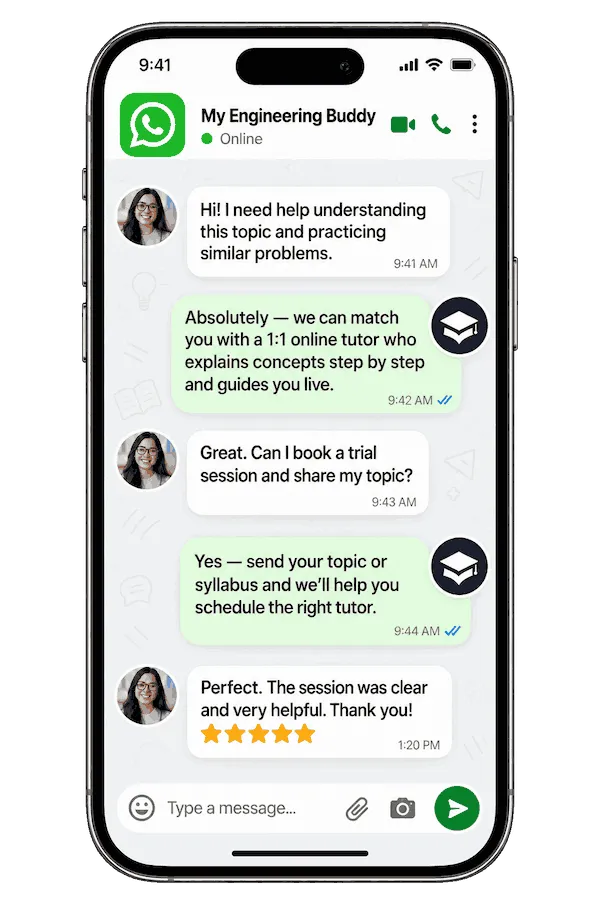
~1 min
Average Reply Time
~1 hour
To Be Matched With A Tutor
30 Min Trial
75% Find Their Tutor On The 1st Trial
$20-35+/hr
Premium Yet Affordable Learning
Most students lose marks on covalent bonding not because they don’t study — but because no one corrected their Lewis structure logic before the exam.
Covalent Bonding Tutor Online
Covalent bonding is the sharing of electron pairs between atoms to form molecules. It determines molecular shape, polarity, and reactivity — core to chemistry at GCSE, A Level, AP, IB, and undergraduate level.
MEB connects you with a 1:1 online chemistry tutor who knows exactly where covalent bonding catches students out — whether it’s VSEPR geometry, lone pair effects, or bond polarity. If you’ve been searching for a covalent bonding tutor near me, live online sessions give you the same whiteboard experience without the commute. Tutors are available across US, UK, Canada, Australia, and the Gulf, and every session is built around your specific syllabus and exam board.
- 1:1 online sessions tailored to your exact course and syllabus
- Expert-verified tutors with deep subject knowledge in chemical bonding and molecular theory
- Flexible time zones — US, UK, Canada, Australia, Gulf all covered
- Structured learning plan built after a diagnostic session
- Ethical homework and assignment guidance — you understand the work, then submit it yourself
52,000+ students across the US, UK, Canada, Australia, and the Gulf have used MEB since 2008 — including students in Chemistry subjects like Covalent Bonding, Atomic Structure, and Chemical Bonding.
Source: My Engineering Buddy, 2008–2025.
How Much Does a Covalent Bonding Tutor Cost?
Most covalent bonding tutoring sessions run $20–$40/hr depending on level and complexity. The $1 trial gets you 30 minutes of live 1:1 tutoring or one full homework question explained — no registration required.
| Level / Need | Typical Rate | What’s Included |
|---|---|---|
| GCSE / AP / IB | $20–$35/hr | 1:1 sessions, homework guidance |
| A Level / First-Year Undergraduate | $30–$50/hr | Deeper molecular theory, exam board focus |
| Advanced / Graduate | $50–$100/hr | Quantum bonding theory, specialist depth |
| $1 Trial | $1 flat | 30 min live session or 1 homework question |
Tutor availability tightens significantly in the six weeks before AP, A Level, and IB exam windows. Book early.
WhatsApp MEB for a quick quote — average response time under 1 minute.
Who This Covalent Bonding Tutoring Is For
This is for students who can define a covalent bond but fall apart on the harder questions — predicting bond angles, drawing resonance structures, or explaining why a molecule is polar when it looks symmetrical. It’s also for students starting from scratch who need the logic built correctly from the first lesson.
- GCSE, A Level, AP, IB, and first-year undergraduate chemistry students
- Students retaking after a failed first attempt in general or organic chemistry
- Students with a university conditional offer depending on their A Level or AP chemistry grade
- Students 4–6 weeks from an exam with gaps in VSEPR, hybridisation, or molecular polarity still to close
- Parents watching a child’s confidence drop alongside their chemistry marks
- Students who need homework guidance on Lewis structures, bond enthalpy, or molecular geometry problems
Students from universities and colleges including MIT, University of Toronto, University of Edinburgh, ETH Zurich, University of Melbourne, and NYU have used MEB to strengthen their chemistry foundations. The $1 trial is a low-risk way to find out if the match works.
1:1 Tutoring vs Self-Study vs AI vs YouTube vs Online Courses
Self-study works if you’re disciplined — but covalent bonding has enough edge cases that most students develop silent misconceptions no textbook can catch. AI tools explain VSEPR rules fast but can’t watch you draw a Lewis structure and spot where your electron count went wrong. YouTube is excellent for watching orbital hybridisation animated, but it stops the moment your specific problem gets unusual. Online courses move at a fixed pace and rarely address the gap between knowing the rule and applying it correctly in an exam. 1:1 tutoring with MEB is calibrated to your exact syllabus — the tutor corrects your reasoning in real time, on the exact type of question your exam board sets.
Outcomes: What You’ll Be Able To Do in Covalent Bonding
After structured 1:1 sessions, students can draw accurate Lewis structures for complex molecules including those with expanded octets, apply VSEPR theory to predict geometry and bond angles without second-guessing lone pair placement, explain why CO₂ is non-polar while SO₂ is polar using dipole moment reasoning, model sigma and pi bond formation in double and triple bonds, and analyze bond enthalpy data to predict relative bond strength and reactivity. These are the exact skills that separate a 4 from a 5 on AP Chemistry or a B from an A at A Level.
Supporting a student through Covalent Bonding? MEB works directly with parents to set up sessions, track progress, and keep coursework on schedule. WhatsApp MEB — average response time is under a minute, 24/7.
Based on feedback from 40,000+ sessions collected by MEB from 2022 to 2025, 58% of students improved by one full grade after approximately 20 hours of 1:1 tutoring in subjects like Covalent Bonding. A further 23% achieved at least a half-grade improvement.
Source: MEB session feedback data, 2022–2025.
Try your first session for $1 — 30 minutes of live 1:1 tutoring or one homework question explained in full. No registration. No commitment. WhatsApp MEB now and get matched within the hour.
What We Cover in Covalent Bonding (Syllabus / Topics)

Track 1: Foundations of Covalent Bonding
- Electron pair sharing and the octet rule
- Lewis dot structures — single, double, and triple bonds
- Formal charge calculation and minimisation
- Resonance structures and delocalisation
- Bond length, bond order, and bond energy relationships
- Exceptions to the octet rule — expanded and incomplete octets
Core texts include Atkins’ Physical Chemistry, Zumdahl & Zumdahl’s Chemistry, and Housecroft & Sharpe’s Inorganic Chemistry. The IUPAC periodic table is used as the standard reference for electronegativity values and element data.
Track 2: Molecular Shape and Polarity
- VSEPR theory — electron domain geometry vs molecular geometry
- Lone pair effects on bond angles
- Hybridisation: sp, sp², sp³, sp³d, sp³d²
- Dipole moments and vector addition for molecular polarity
- Polar vs non-polar molecules — symmetry arguments
- Intermolecular forces arising from molecular polarity
Supporting texts: Clayden’s Organic Chemistry, Silberberg’s Chemistry: The Molecular Nature of Matter and Change, and Shriver & Atkins’ Inorganic Chemistry. Students working on inorganic chemistry topics will find this track directly transferable.
Track 3: Advanced Bonding Theory
- Molecular orbital (MO) theory — bonding and antibonding orbitals
- MO diagrams for diatomic molecules (H₂, O₂, N₂, F₂)
- Bond order from MO theory and magnetic properties
- Valence bond theory and orbital overlap
- Sigma and pi bonds in conjugated systems
- Introduction to band theory for solids — bridging to solid-state chemistry
Key references: Miessler, Fischer & Tarr’s Inorganic Chemistry, Cotton & Wilkinson’s Advanced Inorganic Chemistry, and Fleming’s Molecular Orbitals and Organic Chemical Reactions.
Students who combine Lewis structure work with MO theory in their sessions consistently close the gap between mechanical rule-following and genuine molecular reasoning — the shift examiners reward at A Level and AP level.
Source: My Engineering Buddy tutor observations, 2008–2025.
What a Typical Covalent Bonding Session Looks Like
The tutor opens by checking the previous session’s topic — usually whichever Lewis structure or VSEPR problem the student found hardest. From there, the student and tutor work through new problems on screen: drawing the Lewis structure for PCl₅ or SF₆, resolving the geometry, then predicting polarity. The tutor uses a digital pen-pad to annotate directly on shared problems, marking electron pairs and bond angles as they’re discussed. The student replicates the reasoning aloud or in writing, so the tutor can hear exactly where the logic breaks. The session closes with two or three practice problems set as independent work, and the next topic — often hybridisation or MO diagrams — is flagged so the student can look at it before the next session.
At MEB, we’ve found that students who struggle with covalent bonding have usually learned the rules without ever building a mental model of why electrons pair the way they do. One session focused entirely on formal charge logic can undo months of confused memorisation.
How MEB Tutors Help You with Covalent Bonding (The Learning Loop)
Diagnose: In the first session, the tutor identifies where your understanding breaks down — often it’s not the definition of a covalent bond but the application of lone pair rules in VSEPR or the inability to count electrons correctly for expanded octet molecules. This shapes everything that follows.
Explain: The tutor works through problems live on the digital pen-pad — drawing Lewis structures step by step, annotating bond angles, and showing why formal charge matters in choosing between resonance forms. You see the reasoning, not just the answer. Students working in related areas like physical chemistry or quantum chemistry get explicit links made between bonding theory and those topics.
Practice: You attempt problems with the tutor present — not after the session, but during it. This is where errors surface. A student who confidently draws H₂O but places lone pairs on the wrong atom is corrected before that habit becomes an exam mistake.
Feedback: The tutor goes through each error step by step — not just marking it wrong but showing exactly where the electron count went off, where the geometry assumption broke, and what marks would have been lost on a real paper.
Plan: At the end of every session, the tutor sets the next topic in sequence and identifies which past paper questions to try independently. Progress is tracked across sessions so the plan adjusts as gaps close.
Sessions run on Google Meet with a digital pen-pad or iPad and Apple Pencil for annotation. Before your first session, share your exam board, the specific topics you’re struggling with, and one recent homework or past paper attempt. The first session uses this as the starting point. Start with the $1 trial — 30 minutes of live tutoring that also serves as your first diagnostic.
Tutor Match Criteria (How We Pick Your Tutor)
MEB matches you based on four factors, not just subject name.
Subject depth: Tutors are vetted specifically for chemical bonding — not just general chemistry. A tutor covering MO theory at graduate level is different from one covering GCSE Lewis structures, and the match reflects that. Students needing general chemistry support alongside bonding are matched to tutors who can move across both.
Tools: Every MEB tutor uses Google Meet with a digital pen-pad or iPad and Apple Pencil. Covalent bonding is a visual subject — the ability to draw and annotate structures live is non-negotiable.
Time zone: Matched to your region — US, UK, Gulf, Canada, or Australia. No 3am sessions unless that’s genuinely what you want.
Goals: Whether you’re targeting a 5 on AP Chemistry, trying to pass a university resit, or working toward conceptual depth for a research programme, the tutor is briefed on your specific goal before session one.
Students consistently tell us that the first session feels different from what they expected — less like being taught at, more like being asked the right question at the right moment. That’s by design. Tutors are selected as much for questioning technique as for subject knowledge.
Study Plans (Pick One That Matches Your Goal)
Catch-up (1–3 weeks): for students behind on Lewis structures, VSEPR, or polarity with an exam approaching fast. Intensive sessions, gap-focused. Exam prep (4–8 weeks): structured revision covering all bonding topics in sequence, aligned to past paper practice for AP, A Level, IB, or university finals. Weekly support: ongoing sessions through the semester, tied to coursework deadlines and module assessments. The tutor builds the specific sequence after the diagnostic — no generic plans.
Pricing Guide
Covalent bonding tutoring starts at $20/hr for GCSE and AP level. A Level, IB, and first-year undergraduate sessions typically run $30–$50/hr. Graduate-level and advanced quantum bonding theory sessions can reach up to $100/hr depending on tutor background and topic complexity.
Rate factors include level, how specialised the topic is (MO theory costs more to staff than Lewis structures), how tight your timeline is, and tutor availability in your time zone.
Tutor availability in the six weeks before AP and A Level exam windows is limited — early booking is worth it.
For students targeting top-ranked universities or competitive science programmes, MEB tutors with research or professional chemistry backgrounds are available at higher rates. Share your specific goal and MEB will match the tier to your ambition.
Start with the $1 trial — 30 minutes, no registration, no commitment. WhatsApp MEB for a quick quote.
FAQ
Is covalent bonding hard?
It starts accessible but gets harder fast. Lewis structures are straightforward. VSEPR geometry, resonance, and molecular orbital theory require a different kind of spatial and logical reasoning that trips up most students without guided practice.
How many sessions are needed?
Students with specific gaps in VSEPR or Lewis structures often see clear improvement in 3–5 sessions. Students building from foundations toward MO theory or preparing for A Level and AP exams typically need 10–20 sessions over 4–8 weeks.
Can you help with homework and assignments?
MEB tutoring is guided learning — you understand the work, then submit it yourself. If you’re stuck on a Lewis structure problem or a bond angle calculation, the tutor walks through the reasoning with you. See our Academic Integrity policy and Why MEB page for full details on what we help with and what we don’t.
Will the tutor match my exact syllabus or exam board?
Yes. Tutors are matched to your specific board — AQA, OCR, Edexcel, CIE, IB, AP College Board, or university module. Covalent bonding coverage differs meaningfully between boards, and the tutor works from the exact specification you’re assessed on.
What happens in the first session?
The tutor reviews what you’ve shared — your exam board, a recent past paper or homework attempt, and your deadline. The session runs a short diagnostic on Lewis structures and VSEPR to locate the exact gaps, then covers the highest-priority topic before the session ends.
Is online tutoring as effective as in-person?
For covalent bonding specifically, online sessions work well because the tutor annotates structures and diagrams live on a shared screen. Students report that seeing bond angles drawn in real time while the reasoning is explained aloud is clearer than working from a static textbook diagram.
Can I get covalent bonding help at midnight or on weekends?
MEB operates 24/7 across time zones. Students in the Gulf, Australia, and North America regularly book late-night and weekend sessions. Tutor availability varies, but WhatsApp response typically comes within a minute at any hour.
What if I don’t get along with my assigned tutor?
Request a change via WhatsApp. MEB matches you with a different tutor at no extra cost. The $1 trial exists specifically so you can test the match before committing to a longer plan.
What’s the difference between covalent bonding and ionic bonding — and why do students keep confusing them in exams?
Ionic bonding involves electron transfer between atoms; covalent bonding involves electron sharing. Students lose marks most often by mislabelling polar covalent bonds as ionic, or by incorrectly predicting bond type from electronegativity difference alone without considering degree of difference.
Do AP Chemistry students need to know molecular orbital theory for the exam?
AP Chemistry includes MO concepts at an introductory level — bond order, paramagnetism of O₂, and basic MO diagrams for diatomic molecules appear in free-response and multiple-choice sections. Full MO diagram construction is tested more rigorously at A Level and university level.
How do I get started?
WhatsApp MEB, share your exam board and the topic you’re stuck on, and MEB matches you with a tutor — usually within 24 hours. The $1 trial gives you 30 minutes live or one full question explained before any further commitment.
Trust & Quality at My Engineering Buddy
Every MEB tutor goes through subject-specific vetting — not a general chemistry screen, but a check on the exact level and exam board they claim to cover. Tutors complete a live demo evaluation before being matched with students, and ongoing session feedback is reviewed to catch any drop in quality. Tutors covering covalent bonding at A Level or AP level hold degrees in chemistry or chemical engineering; those covering graduate-level bonding theory typically hold postgraduate qualifications or have research backgrounds in physical or computational chemistry. Rated 4.8/5 across 40,000+ verified reviews on Google.
MEB tutoring is guided learning — you understand the work, then submit it yourself. For full details on what we help with and what we don’t, read our Academic Integrity policy and Why MEB.
MEB has been running since 2008 and serves students across the US, UK, Canada, Australia, the Gulf, and Europe in 2,800+ subjects. The Chemistry category includes specialist support in thermochemistry, stereochemistry, and chemical kinetics — subjects that connect directly to the bonding concepts covered on this page. Visit Royal Society of Chemistry for standards and resources relevant to chemistry education in the UK and internationally.
Our experience across thousands of sessions shows that covalent bonding is the single topic where a small conceptual gap in year one causes the most downstream damage — in organic mechanisms, in thermodynamics, and in spectral interpretation. Getting it right early pays back across the whole subject.
Explore Related Subjects
Students studying Covalent Bonding often also need support in:
- Chemical Equilibrium
- Chemical Equations
- Stoichiometry
- Photochemistry
- Atmospheric Chemistry
- Polymer Chemistry
- Supramolecular Chemistry
Next Steps
Before your first session, have ready: your exam board and syllabus (or course outline), a recent past paper attempt or homework you struggled with, and your exam or deadline date. The tutor handles the rest.
- Share your exam board, the hardest topic in covalent bonding, and your current timeline
- Share your availability and time zone
- MEB matches you with a verified tutor — usually within 24 hours
First session starts with a diagnostic so every minute is used well. Visit www.myengineeringbuddy.com for more on how MEB works.
WhatsApp to get started or email [email protected].
Reviewed by Subject Expert
This page has been carefully reviewed and validated by our subject expert to ensure accuracy and relevance.




