Hire Verified & Experienced
Quantum Chemistry Tutors
Email: [email protected]
4.8/5 40K+ session ratings collected on the MEB platform



Hire The Best Quantum Chemistry Tutor
Top Tutors, Top Grades. Without The Stress!

Most students who fail quantum chemistry don’t lack intelligence — they hit the Schrödinger equation without enough mathematical grounding and never recover.
Quantum Chemistry Tutor Online
Quantum chemistry applies quantum mechanics to atoms, molecules, and chemical bonding. It covers wave functions, the Schrödinger equation, orbital theory, and spectroscopy, equipping students to model molecular behaviour at the electronic level.
MEB offers 1:1 online tutoring and homework help in 2,800+ advanced subjects — including a Quantum Chemistry tutor near me matched to your exact course, university syllabus, and time zone. Whether you are working through Atkins, Levine, or a graduate-level course pack, the right tutor makes the difference between guessing at wave functions and actually understanding what the math means. If you need broader support across the field, our Chemistry tutoring page covers the full subject family.
- 1:1 online sessions tailored to your course or university syllabus
- Expert-verified tutors with subject-specific quantum chemistry knowledge
- Flexible time zones — US, UK, Canada, Australia, Gulf
- Structured learning plan built after a diagnostic session
- Ethical homework and assignment guidance — you understand before you submit
52,000+ students across the US, UK, Canada, Australia, and the Gulf have used MEB since 2008 — including students in Chemistry subjects like Quantum Chemistry, Physical Chemistry, and Computational Chemistry.
Source: My Engineering Buddy, 2008–2025.
How Much Does a Quantum Chemistry Tutor Cost?
Most quantum chemistry sessions run $20–$40/hr. Graduate-level and specialist topics — density functional theory, post-Hartree-Fock methods, relativistic quantum chemistry — can reach $70–$100/hr depending on tutor expertise. You can start with the $1 trial before committing to anything.
| Level / Need | Typical Rate | What’s Included |
|---|---|---|
| Undergraduate (most levels) | $20–$40/hr | 1:1 sessions, homework guidance |
| Graduate / Specialist | $40–$100/hr | Expert tutor, DFT, ab initio depth |
| $1 Trial | $1 flat | 30 min live session or 1 homework question |
Tutor availability tightens around end-of-semester exams and departmental qualifying exam windows. Book early if your timeline is fixed.
WhatsApp MEB for a quick quote — average response time under 1 minute.
Who This Quantum Chemistry Tutoring Is For
Quantum chemistry sits at the intersection of advanced mathematics and molecular science. Students who struggle here usually aren’t weak in chemistry — they’re under-supported in the mathematical framework underneath it.
- Second- and third-year undergraduates hitting wave mechanics for the first time
- Students retaking after a failed first attempt at a quantum chemistry module
- Graduate students preparing for qualifying exams that include quantum mechanics and spectroscopy
- Students with a university conditional offer depending on a pass in this subject
- PhD students needing to strengthen their theoretical foundation before thesis work
- Students working through courses at MIT, Caltech, University of Toronto, UCL, ETH Zürich, the University of Melbourne, or equivalent institutions
If you are 4–6 weeks from a final exam with significant gaps still to close, the $1 trial is the fastest way to find out exactly where your understanding breaks down.
1:1 Tutoring vs Self-Study vs AI vs YouTube vs Online Courses
Self-study works if your mathematical physics base is solid — but most students hit a wall at the Hamiltonian operator and stall. AI tools explain bra-ket notation cleanly but can’t watch you misapply a boundary condition in real time. YouTube covers particle-in-a-box beautifully and stops there. Online courses move at their own pace regardless of where you’re stuck. 1:1 tutoring with MEB is live, calibrated to your exact syllabus, and catches the specific reasoning error before it becomes a pattern. In quantum chemistry specifically, one misunderstood postulate propagates through every topic that follows — that’s the gap 1:1 tutoring is built to close.
Outcomes: What You’ll Be Able To Do in Quantum Chemistry
After working with an MEB quantum chemistry tutor, students can solve the time-independent Schrödinger equation for standard systems including the particle in a box, the harmonic oscillator, and the hydrogen atom. They can analyze molecular orbital diagrams, apply LCAO theory, and explain hybridisation in terms of quantum mechanical mixing rather than rote memorisation. Students learn to model electron density using approximate wave functions and apply perturbation theory to simple systems. They can interpret IR, UV-Vis, and NMR spectra using selection rules derived from symmetry and group theory. They write cleaner, more defensible exam answers — not because they’ve memorised more, but because they understand the framework.
Based on feedback from 40,000+ sessions collected by MEB from 2022 to 2025, 58% of students improved by one full grade after approximately 20 hours of 1:1 tutoring in subjects like Quantum Chemistry. A further 23% achieved at least a half-grade improvement.
Source: MEB session feedback data, 2022–2025.
Students consistently tell us that quantum chemistry clicks at a very specific moment — usually when the tutor stops deriving and asks them to reproduce the step themselves. That moment of active recall is where the subject stops feeling like magic and starts feeling like logic. At MEB, we engineer that moment deliberately, in every session.
What We Cover in Quantum Chemistry (Syllabus / Topics)

Track 1: Foundations of Quantum Mechanics
- Wave-particle duality and the de Broglie hypothesis
- The Schrödinger equation — time-dependent and time-independent forms
- Operators, eigenvalues, and the postulates of quantum mechanics
- Particle in a box: 1D, 2D, 3D; energy quantisation
- The quantum harmonic oscillator and zero-point energy
- The rigid rotor and rotational energy levels
- Angular momentum, spin, and the Pauli exclusion principle
Core texts for this track include Levine’s Quantum Chemistry (7th ed.) and McQuarrie’s Quantum Chemistry — both are standard at the undergraduate level across US, UK, and Canadian universities.
Track 2: Atomic and Molecular Structure
- The hydrogen atom: exact solution, orbitals, and quantum numbers
- Many-electron atoms: electron configurations and the variation principle
- Hartree-Fock theory and self-consistent field (SCF) methods
- Molecular orbital theory and LCAO approximation
- Hückel theory for conjugated pi systems
- Symmetry, group theory, and character tables
- Term symbols and spectroscopic selection rules
Atkins’ Physical Chemistry and Szabo & Ostlund’s Modern Quantum Chemistry are the most commonly assigned references for this material in third-year and graduate programmes. The Royal Society of Chemistry also provides resources relevant to molecular structure and spectroscopy.
Track 3: Computational and Advanced Quantum Chemistry
- Perturbation theory: first and second order corrections
- Variational method and trial wave functions
- Configuration interaction (CI) and coupled cluster theory
- Density functional theory (DFT): Hohenberg-Kohn theorems, Kohn-Sham equations
- Basis sets: STO-nG, Pople, Dunning — when to use each
- Potential energy surfaces and geometry optimisation
- Molecular spectroscopy: IR, Raman, UV-Vis, NMR from first principles
Jensen’s Introduction to Computational Chemistry and Koch & Holthausen’s A Chemist’s Guide to Density Functional Theory cover the computational track thoroughly. Students using computational chemistry tutoring alongside this track tend to close gaps faster.
A common pattern our tutors observe is that students arrive having memorised the Schrödinger equation without knowing what a wave function actually represents physically. The first session is often spent rebuilding that foundation — not because the student is weak, but because that step was skipped the first time around. Once it’s in place, everything else follows quickly.
What a Typical Quantum Chemistry Session Looks Like
The tutor opens by checking where the previous session ended — usually the harmonic oscillator or a group theory problem set — and asks the student to walk through one step of the solution unprompted. This reveals immediately whether the concept held overnight. From there, the session moves to the active sticking point: most commonly this is setting up the Hamiltonian for a new system, applying the Born-Oppenheimer approximation, or interpreting the output of a Hartree-Fock calculation. The tutor works the problem on a digital pen-pad while narrating every decision. Then the student replicates it. Not copies — replicates, with the screen blank. The session closes with one specific problem to attempt before the next session and a note on what topic comes next.
How MEB Tutors Help You with Quantum Chemistry (The Learning Loop)
Diagnose: In the first session, the tutor identifies where your understanding actually breaks down — not where you think it does. Students often believe their problem is DFT when the real gap is in operator algebra from three chapters earlier.
Explain: The tutor works through problems live using a digital pen-pad. No slides, no pre-made solutions. The derivation happens in front of you, step by step, with reasons given for every move.
Practice: You attempt the next problem with the tutor present. They don’t intervene until you’ve made a genuine attempt. That delay is deliberate — it’s where the learning happens.
Feedback: Every error gets a specific correction. Not “that’s wrong” — but “you dropped the conjugate here, and that’s why your normalisation broke.” Marks are lost at specific steps; that’s where the correction goes.
Plan: The session ends with a clear topic map: what was covered, what comes next, what to attempt before the next session. No vague homework. Specific problems from your problem set or past papers.
Sessions run on Google Meet with a digital pen-pad or iPad and Apple Pencil. Before your first session, share your course syllabus or problem set, one recent question you couldn’t solve, and your exam or assignment deadline. Start with the $1 trial — 30 minutes of live tutoring that also serves as your first diagnostic. Whether you need a quick catch-up before an exam, structured revision over 4–8 weeks, or ongoing weekly support through the semester, the tutor maps the session plan after the first diagnostic.
Since 2008, MEB tutors have helped students across 2,800+ subjects — from first-year general chemistry through to graduate-level ab initio methods — with structured 1:1 sessions that adapt to the student’s actual course content, not a generic curriculum.
Source: My Engineering Buddy, 2008–2025.
Tutor Match Criteria (How We Pick Your Tutor)
Not every chemistry tutor can teach quantum chemistry at the graduate level. MEB matches on four specific criteria.
Subject depth: Tutors are matched to your level — undergraduate wave mechanics, graduate DFT, or advanced spectroscopy — and to your specific exam board or university course structure.
Tools: Every tutor uses Google Meet with a digital pen-pad or iPad and Apple Pencil. Quantum chemistry requires handwritten derivations. Tutors who can’t show work clearly on screen are not matched.
Time zone: Matched to your region — US, UK, Gulf, Canada, Australia. No scheduling around a tutor twelve time zones away.
Goals: Exam scores, conceptual depth, homework completion, or research support for thesis work — the match accounts for what you actually need, not a generic tutoring profile.
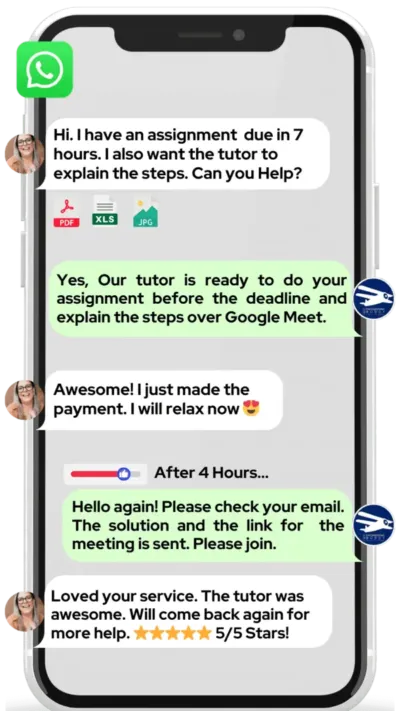
Unlike platforms where you fill out a form and wait, MEB responds in under a minute, 24/7. Tutor match takes under an hour. The $1 trial means you test before you commit. Everything runs over WhatsApp — no logins, no intake forms.
Study Plans (Pick One That Matches Your Goal)
Your tutor builds a specific session sequence after the diagnostic, but here is the general shape: a catch-up plan (1–3 weeks) closes specific topic gaps — typically the Schrödinger equation foundations and orbital theory — before a major assessment. An exam prep plan (4–8 weeks) works through past papers and problem sets systematically, with timed problem-solving practice built in from week three. Weekly support runs through the semester aligned to your lecture schedule and assignment deadlines. The tutor selects problems from your actual course materials, not generic quantum chemistry exercises.
Pricing Guide
Most undergraduate quantum chemistry sessions run $20–$40/hr. Graduate-level work — Hartree-Fock, DFT, coupled cluster theory, relativistic methods — typically falls in the $60–$100/hr range depending on the tutor’s research background and the depth required.
Rate factors include your level, the complexity of the topic, how urgent the timeline is, and tutor availability during peak exam periods. Availability tightens significantly during end-of-semester exam windows at major universities.
For students targeting programmes at research-intensive universities or PhD admissions that require strong quantum chemistry foundations, tutors with active research backgrounds in computational chemistry and quantum physics are available at higher rates — share your specific goal and MEB will match the tier to your ambition.
Start with the $1 trial — 30 minutes, no registration, no commitment. WhatsApp MEB for a quick quote.
Try your first session for $1 — 30 minutes of live 1:1 tutoring or one homework question explained in full. No registration. No commitment.
WhatsApp MEB now
and get matched within the hour.
FAQ
Is quantum chemistry hard?
Yes — it is consistently ranked among the hardest undergraduate chemistry modules. The difficulty is mathematical, not conceptual. Students with solid calculus and linear algebra tend to progress quickly once the physical interpretation of the wave function is established clearly.
How many sessions are needed?
Most students close a specific topic gap in 3–5 sessions. Exam prep over a full quantum chemistry module typically runs 10–20 sessions across 4–8 weeks. Your tutor sets a specific sequence after the first diagnostic rather than guessing at a session count.
Can you help with homework and assignments?
Yes. MEB tutoring is guided learning — you understand the work, then submit it yourself. The tutor walks through the reasoning, not the final answer. See our Academic Integrity policy and Why MEB page for full details on what we help with and what we don’t.
Will the tutor match my exact syllabus or exam board?
Yes. Tutors are matched to your specific course content — whether that is a first-year physical chemistry module, a dedicated quantum chemistry course at a US or UK university, or a graduate programme using Szabo and Ostlund. Share your course outline when you WhatsApp MEB.
What happens in the first session?
The tutor reviews one problem you couldn’t solve and one topic you think you understand. Both reveal where the real gaps are. From there, the tutor maps the session sequence. The first session is diagnostic and productive simultaneously — you don’t pay to fill in a form.
Is online tutoring as effective as in-person?
For quantum chemistry, yes — sometimes more so. The digital pen-pad lets tutors annotate derivations, mark up wave function diagrams, and work through multi-step problems in real time with the student. Every session is recorded if you want to review it afterward.
Can I get quantum chemistry help at midnight?
Yes. MEB operates 24/7 across all time zones. WhatsApp MEB at any hour and a response typically comes back within a minute. Tutors are matched across time zones so there is almost always availability, including late-night sessions before morning exams.
What if I don’t get along with my assigned tutor?
Request a different tutor over WhatsApp. No explanation required. MEB will match you with an alternative immediately. The $1 trial exists precisely so you evaluate fit before committing to a session block. Most students stick with their first match, but the option is always there.
What is the difference between quantum chemistry and quantum mechanics?
Quantum mechanics is the broader physics framework. Quantum chemistry applies that framework specifically to chemical systems — electron structure, bonding, spectroscopy, and reactivity. The mathematics overlaps significantly, but quantum chemistry focuses on molecular and atomic problems that general quantum mechanics does not address in chemical detail.
Do you offer help with DFT and ab initio methods specifically?
Yes. MEB has tutors with active research backgrounds in density functional theory, Hartree-Fock, MP2, coupled cluster, and basis set selection. This includes help interpreting Gaussian or ORCA output files, troubleshooting geometry optimisations, and understanding the theoretical basis behind the computational results your course requires.
Can you help with quantum chemistry problem sets that involve group theory and character tables?
Yes. Group theory — reducible and irreducible representations, direct products, symmetry-adapted linear combinations — is a specific area MEB tutors cover in depth. It trips up many third-year students who encounter it mid-module without adequate preparation in the mathematics of symmetry.
How do I get started?
WhatsApp MEB with your course name, your exam or deadline date, and the topic you are currently stuck on. You will be matched with a tutor within the hour. The first session starts with the $1 trial — 30 minutes live or one question explained in full, then you decide whether to continue.
Trust & Quality at My Engineering Buddy
MEB tutors are screened on subject knowledge before they teach a single session. The process includes a live demo evaluation on the specific subject — not a general chemistry assessment for a quantum chemistry tutor — plus ongoing review of session feedback. Tutors hold degrees in chemistry, chemical physics, or related fields, with many having active research or industry experience in computational and theoretical chemistry. Rated 4.8/5 across 40,000+ verified reviews on Google.
MEB tutoring is guided learning — you understand the work, then submit it yourself. For full details on what we help with and what we don’t, read our Academic Integrity policy and Why MEB.
MEB has been running since 2008 and has served 52,000+ students across the US, UK, Canada, Australia, the Gulf, and Europe in 2,800+ subjects. Within Chemistry, the platform covers everything from physical chemistry tutoring and inorganic chemistry help through to specialist graduate subjects. Tutor methodology is documented at our tutoring methodology page for anyone who wants to understand how sessions are structured before booking.
Explore Related Subjects
Students studying Quantum Chemistry often also need support in:
- Atomic Structure
- Chemical Bonding
- Thermochemistry
- Biophysical Chemistry
- Photochemistry
- Astrochemistry
- Solid State Chemistry
Next Steps
When you WhatsApp MEB, share your exam board or university, your hardest topic right now, and how many weeks you have before your next assessment. Share your time zone and available session slots. MEB matches you with a verified quantum chemistry tutor — usually within an hour, sometimes faster.
Before your first session, have ready:
- Your course syllabus or problem set from the module you are working on
- A recent past paper attempt or homework question you couldn’t solve
- Your exam date or assignment deadline
The tutor handles the rest. First session starts with a diagnostic so every minute is used well.
Visit www.myengineeringbuddy.com for more on how MEB works.
WhatsApp to get started or email [email protected].
At MEB, we’ve found that the students who improve fastest in quantum chemistry are not the ones who study longest — they are the ones who get corrective feedback within 24 hours of making an error. Weekly 1:1 sessions create that feedback loop. Monthly cramming does not.
52,000+ Happy Students From Various Universities






How Much For Private 1:1 Tutoring & Hw Help?
Private 1:1 Tutoring and HW help Cost $20 – 35 per hour* on average.
Reviewed by Subject Expert
This page has been carefully reviewed and validated by our subject expert to ensure accuracy and relevance.