~1 min
Average Reply Time
~1 hour
To Be Matched With A Tutor
30 Min Trial
75% Find Their Tutor On The 1st Trial
$20-35+/hr
Premium Yet Affordable Learning
Motors stalling mid-project. Sensor loops that won’t close. Six weeks to submission and your actuator model is still wrong.
Electromechanical Systems Tutor Online
Electromechanical systems is an engineering discipline covering the design, analysis, and control of systems that convert electrical energy into mechanical motion — or vice versa — including motors, sensors, actuators, and feedback control loops.
If you’re searching for an electromechanical systems tutor near me, MEB’s 1:1 online sessions connect you with verified engineers who know this subject at the circuit, control, and mechanical level — not just one of them. Our mechatronics tutoring platform covers every layer of electromechanical design, from DC motor modelling to closed-loop PID control. One outcome students report consistently: the gap between theory and lab closes fast.
- 1:1 online sessions matched to your course syllabus and level
- Verified tutors with hands-on electromechanical engineering backgrounds
- Flexible scheduling across US, UK, Canada, Australia, and Gulf time zones
- Structured session plan built after a diagnostic in your first meeting
- Ethical homework and assignment guidance — you understand the work, then submit it yourself
52,000+ students across the US, UK, Canada, Australia, and the Gulf have used MEB since 2008 — including students in Mechatronics subjects like Electromechanical Systems, Robotics Engineering, and System Dynamics.
Source: My Engineering Buddy, 2008–2025.
How Much Does an Electromechanical Systems Tutor Cost?
Most electromechanical systems sessions run $20–$40/hr. Graduate-level modelling, advanced control theory, or highly specialised hardware topics can reach $100/hr. The $1 trial gets you 30 minutes of live tutoring or one full homework question explained — before you commit to anything.
| Level / Need | Typical Rate | What’s Included |
|---|---|---|
| Standard (undergraduate core) | $20–$35/hr | 1:1 sessions, homework guidance |
| Advanced / Graduate-level | $35–$100/hr | Expert tutor, control systems depth |
| $1 Trial | $1 flat | 30 min live session or 1 homework question |
Tutor availability tightens around end-of-semester project deadlines. Book early if your submission date is within four weeks.
WhatsApp MEB for a quick quote — average response time under 1 minute.
Who This Electromechanical Systems Tutoring Is For
This is for engineering students who can follow a lecture but hit a wall when the equations meet real hardware — or when a simulation gives results that make no physical sense. It’s also for students whose lab reports keep losing marks in the analysis section without clear feedback on why.
- Undergraduate students in electrical, mechanical, or mechatronics engineering programmes
- Graduate students modelling electromechanical actuators or designing embedded control systems
- Students retaking a failed electromechanical systems module and need to close specific gaps fast
- Students with a university conditional offer depending on passing this course
- Students 4–6 weeks from final exams with significant theory gaps still open
- Students at MIT, Georgia Tech, ETH Zurich, Imperial College London, TU Delft, University of Michigan, and Caltech who need deeper support than office hours provide
At MEB, we’ve found that students who struggle with electromechanical systems almost always have the same gap: they understand circuits or mechanics in isolation, but not how energy transfer between the two domains creates system-level behaviour. Fix that one concept and the rest unlocks quickly.
1:1 Tutoring vs Self-Study vs AI vs YouTube vs Online Courses
Self-study works if the textbook is your comfort zone — but electromechanical systems problems usually aren’t. AI tools give fast answers but can’t tell you why your transfer function is physically wrong. YouTube handles motor basics well; it stops when your specific state-space model breaks. Online courses move at a fixed pace that rarely matches your exam schedule. With a 1:1 online electromechanical systems tutor, every session is built around your actual circuit, your actual assignment, and the exact point where your reasoning fails.
Outcomes: What You’ll Be Able To Do in Electromechanical Systems
After structured 1:1 sessions, students report being able to model a DC motor’s electromechanical dynamics from first principles, apply Kirchhoff’s laws alongside Newton’s laws in a unified equation set. They can analyze open-loop and closed-loop control responses, interpret Bode plots, and explain why a system is marginally stable. Students also develop the ability to design a basic PID controller for a motor-load system, tune gains, and verify performance in simulation before hardware testing. Presenting a lab report that links measured current, torque, and speed data to a theoretical model — with error analysis that holds up — becomes a realistic outcome rather than a stretch goal.
Based on feedback from 40,000+ sessions collected by MEB from 2022 to 2025, 58% of students improved by one full grade after approximately 20 hours of 1:1 tutoring in subjects like Electromechanical Systems. A further 23% achieved at least a half-grade improvement.
Source: MEB session feedback data, 2022–2025.
Supporting a student through Electromechanical Systems? MEB works directly with parents to set up sessions, track progress, and keep coursework on schedule. WhatsApp MEB — average response time is under a minute, 24/7.
What We Cover in Electromechanical Systems (Syllabus / Topics)

Track 1: Electrical and Magnetic Fundamentals
- DC and AC circuit analysis for electromechanical loads
- Magnetic circuits: reluctance, flux linkage, inductance
- Faraday’s law and electromagnetic induction in rotating machines
- Energy stored in magnetic fields and co-energy methods
- Eddy current and hysteresis losses in cores
- Power electronics basics: rectifiers, inverters, PWM drives
Core texts: Electric Machinery Fundamentals by Chapman; Power Electronics by Mohan, Undeland & Robbins.
Track 2: Electromechanical Actuators and Motors
- DC motors: armature dynamics, back-EMF, torque-speed curves
- Stepper motors: full-step, half-step, microstepping modes
- Brushless DC and permanent magnet synchronous motors
- Linear actuators and solenoids: force-displacement relationships
- Servo systems: position, velocity, and current control loops
- Motor sizing: load inertia matching, duty cycle, thermal rating
- Sensors: encoders, resolvers, Hall-effect, LVDT, tachometers
Core texts: Electromechanical Motion Devices by Krause, Wasynczuk & Pekarek; Electromechanical Systems, Electric Machines and Applied Mechatronics by Lyshevski.
Track 3: Control Systems and System Dynamics
- Transfer function derivation for motor-load systems
- State-space representation and matrix methods
- Time-domain response: rise time, settling time, overshoot
- Frequency-domain analysis: Bode plots, gain and phase margin
- PID controller design and tuning methods (Ziegler-Nichols, root locus)
- Digital control: z-transform, sampling, discrete PID implementation
- Stability analysis: Routh-Hurwitz, Nyquist criterion
Core texts: Modern Control Engineering by Ogata; Control Systems Engineering by Nise. See also resources at IEEE Spectrum for current developments in control and embedded systems.
What a Typical Electromechanical Systems Session Looks Like
The tutor opens by reviewing the DC motor modelling problem from the previous session — specifically whether the armature resistance term was handled correctly in the differential equation. From there, the student and tutor work through a closed-loop servo design problem on screen: the tutor writes the transfer function derivation step by step using a digital pen-pad, then asks the student to sketch the expected Bode plot before calculating it. When the student’s phase margin estimate is off, the tutor traces the error back to a sign convention issue in the open-loop gain expression — not a calculator mistake. The session closes with two practice problems on PID tuning set for independent work, and a note that next session will cover the z-transform discretisation of the same controller.
How MEB Tutors Help You with Electromechanical Systems (The Learning Loop)
Diagnose: In the first session, the tutor identifies where the student’s understanding breaks down — whether it’s the electromechanical coupling equations, block diagram algebra, or the link between Laplace domain transfer functions and physical behaviour. This shapes every session that follows.
Explain: The tutor works through live problems using a digital pen-pad or iPad with Apple Pencil on Google Meet — writing out motor dynamics equations, drawing signal flow graphs, annotating Bode plots in real time. No static slides. No pre-recorded clips.
Practice: The student attempts the next problem with the tutor present. Not after the session. Right there, on screen, where errors can be caught before they become habits.
Feedback: Every wrong step gets an explanation — not just a red mark. The tutor explains which physical principle was violated, where the algebra diverged from the model, and what the correct reasoning looks like.
Plan: After each session, the tutor notes the next topic, sets specific practice tasks, and tracks how the student’s control theory confidence is building week by week.
Sessions run on Google Meet. Before your first session, share your course syllabus or module outline, a recent assignment or past exam you struggled with, and your submission or exam date. The first session starts with the diagnostic — every minute after that is targeted. Start with the $1 trial — 30 minutes of live tutoring that also serves as your first diagnostic.
Students consistently tell us that the moment electromechanical systems clicks is when they stop treating the electrical and mechanical equations as two separate problems and start reading them as one coupled system. That shift usually happens in a single session — once someone walks them through the energy flow.
Tutor Match Criteria (How We Pick Your Tutor)
Not every engineer who understands motors can teach electromechanical systems at degree level. MEB matches based on four criteria.
Subject depth: Tutors hold relevant degrees in electrical, mechanical, or mechatronics engineering. We match to your specific module — actuator design, control systems, embedded motor drives — not just the general field.
Tools: Every session runs on Google Meet with a digital pen-pad or iPad and Apple Pencil. Equations, block diagrams, and circuit sketches are written live — not typed.
Time zone: Tutors are matched to your region. Students in the US, UK, Canada, Australia, and the Gulf all get same-timezone or near-timezone coverage.
Goals: Whether you need to pass a resit, finish a control systems project, or get to the depth required for a graduate research proposal, the tutor match reflects your actual target — not a generic one.
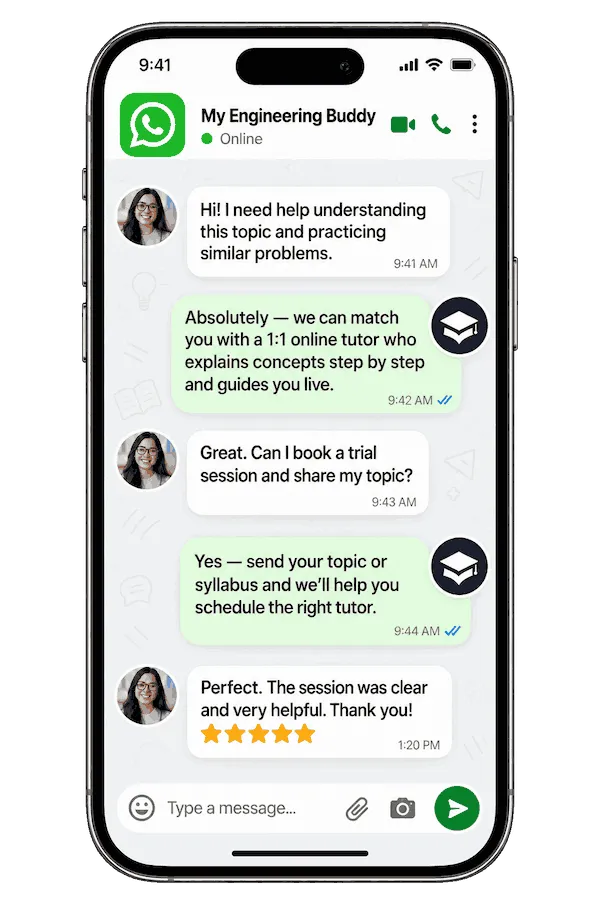
Unlike platforms where you fill out a form and wait, MEB responds in under a minute, 24/7. Tutor match takes under an hour. The $1 trial means you test before you commit. Everything runs over WhatsApp — no logins, no intake forms.
Study Plans (Pick One That Matches Your Goal)
If your exam is three weeks away and you haven’t touched transfer functions yet, that’s a catch-up plan — two or three sessions a week targeting your weakest modules first. If you have eight weeks and a clear exam date, the tutor builds a structured revision sequence across all topics with past paper practice in the final two weeks. For ongoing semester support, sessions align to your lecture schedule and assignment deadlines. The tutor maps the exact sequence after the first diagnostic.
Pricing Guide
Electromechanical systems tutoring starts at $20/hr for undergraduate core topics. Advanced control theory, graduate-level actuator modelling, or sessions covering embedded motor drive implementation typically run $35–$100/hr depending on tutor background and topic complexity. Rates also reflect timeline urgency — if you need five sessions in one week before a deadline, availability is limited and should be confirmed early.
For students targeting admission to graduate programmes at institutions like MIT, Imperial College, or TU Delft, tutors with research or industry backgrounds in electromechanical design are available at higher rates — share your specific goal and MEB will match the tier to your ambition.
Start with the $1 trial — 30 minutes, no registration, no commitment. WhatsApp MEB for a quick quote.
FAQ
Is electromechanical systems hard?
Yes, by most students’ measure. It asks you to work fluently in two physical domains — electrical and mechanical — simultaneously, then apply control theory on top. Students who struggle usually have a gap in one domain that makes the combined analysis feel impossible. Targeted 1:1 system dynamics tutoring and electromechanical work closes that gap faster than rereading the textbook.
How many sessions are needed?
Most students see measurable improvement in 6–10 sessions. Closing a full module’s worth of gaps before a final exam typically takes 15–20 hours of 1:1 work. The first diagnostic session gives a clearer estimate based on where you actually are.
Can you help with homework and assignments?
Yes — MEB tutoring is guided learning. The tutor works through the method with you so you understand the problem, then you complete and submit the work yourself. See our Academic Integrity policy and Why MEB page for full details on what we help with and what we don’t.
Will the tutor match my exact syllabus or exam board?
Yes. Before matching, MEB asks for your course outline, university, and module name. Tutors are selected based on familiarity with your specific content — not just the general subject area. This matters in electromechanical systems, where coverage varies widely between programmes.
What happens in the first session?
The tutor reviews your course material, asks you to attempt one problem live, and identifies the exact point where your understanding breaks down. That diagnostic shapes the session plan for everything that follows — no time is spent on topics you already have.
Is online tutoring as effective as in-person?
For electromechanical systems, yes — and often more so. The digital pen-pad allows the tutor to derive equations and draw circuit diagrams live on screen, which is harder to do on a physical whiteboard. Students share their own simulation outputs or lab data directly in the session.
Can you help with electromechanical systems MATLAB or Simulink modelling?
Yes. Tutors help with Simulink block diagram construction for motor models, transfer function verification, and PID controller implementation. If your course uses MATLAB for state-space analysis or frequency response plotting, bring the model file to the session. Get automation engineering help alongside control modelling if your work spans both areas.
How do I distinguish electromechanical systems from mechatronics or control systems?
Electromechanical systems focuses specifically on the energy conversion interface between electrical and mechanical domains — motors, actuators, sensors. Mechatronics is broader, adding embedded computing and system integration. Control systems is the mathematical discipline applied across all of them. Many courses overlap; your tutor will work within your exact module boundaries.
What if I don’t understand my tutor’s explanation?
Say so — immediately. Tutors at MEB are selected partly on the basis of how they handle student confusion. If an explanation isn’t landing, the tutor tries a different approach: a physical analogy, a simpler worked example, or a visual derivation. No session ends with an unresolved point if you flag it.
Can I get electromechanical systems help at midnight?
Yes. MEB operates across time zones, and WhatsApp response time is under a minute around the clock. If you need a session scheduled outside standard hours, message MEB and a tutor match is confirmed within the hour for most subjects.
How do I get started?
Message MEB on WhatsApp. Share your course name, topic, and deadline. MEB matches you with a verified electromechanical systems tutor — usually within an hour. The $1 trial starts immediately: 30 minutes of live tutoring or one full question explained, no registration required.
Try your first session for $1 — 30 minutes of live 1:1 tutoring or one homework question explained in full. No registration. No commitment. WhatsApp MEB now and get matched within the hour.
Trust & Quality at My Engineering Buddy
Every MEB tutor is screened through a live demo evaluation — not just a CV review. We check subject-specific depth in electromechanical theory, ability to explain coupled-domain problems clearly, and how they handle a student who’s genuinely stuck. Tutors hold relevant engineering degrees; many have industry or research backgrounds in motor drives, control systems, or embedded actuation. Ongoing session feedback keeps quality accountable. Rated 4.8/5 across 40,000+ verified reviews on Google.
MEB tutoring is guided learning — you understand the work, then submit it yourself. For full details on what we help with and what we don’t, read our Academic Integrity policy and Why MEB.
MEB has served 52,000+ students across the US, UK, Canada, Australia, the Gulf, and Europe in 2,800+ subjects since 2008 — including Mechatronics, Electromechanical Systems, and closely related fields like PLC tutoring and SCADA tutoring. The MEB tutoring methodology is built around the diagnostic-first principle: no generic revision, no wasted sessions.
A common pattern our tutors observe is that students who arrive with three weeks to go and a half-finished motor control assignment almost always have the same root issue: they modelled the electrical side correctly but skipped the mechanical load equation. One session fixes the model. Two more sessions build the confidence to apply it independently.
Source: MEB tutor observation across electromechanical systems sessions, 2022–2025.
Explore Related Subjects
Students studying Electromechanical Systems often also need support in:
- Arduino Uno
- Autonomous Systems
- Avionics
- Electrohydraulics & Electropneumatics
- Microelectromechanical Systems (MEMS)
- Real-Time Systems (RTOS)
- STM32
- 3D Printing & Additive Manufacturing
Next Steps
Before your first session, have ready:
- Your course outline or module syllabus
- A recent assignment or past exam paper you struggled with
- Your exam date or project submission deadline
The tutor handles the rest — starting with a diagnostic that targets every minute of the session toward your actual gaps.
Share your availability and time zone, and MEB matches you with a verified electromechanical systems tutor usually within 24 hours. Visit www.myengineeringbuddy.com for more on how MEB works.
WhatsApp to get started or email [email protected].
Reviewed by Subject Expert
This page has been carefully reviewed and validated by our subject expert to ensure accuracy and relevance.