~1 min
Average Reply Time
~1 hour
To Be Matched With A Tutor
30 Min Trial
75% Find Their Tutor On The 1st Trial
$20-35+/hr
Premium Yet Affordable Learning
Hire The Best STM32 Tutor


Stuck on STM32 interrupts at 11 pm with a lab report due tomorrow? That’s exactly when MEB tutors pick up.
STM32 Tutor Online
STM32 is a family of 32-bit ARM Cortex-M microcontrollers made by STMicroelectronics, used in embedded systems development. An STM32 tutor online helps students master GPIO control, timers, UART, SPI, I2C, HAL drivers, and bare-metal C programming for real-time applications.
If you’ve searched for an STM32 tutor near me and found no one local who actually knows the HAL library or FreeRTOS, MEB fills that gap. Our 1:1 online STM32 tutoring covers everything from your first blinking LED to DMA transfers and RTOS task scheduling — matched to your specific course, IDE, and deadline. Part of MEB’s broader mechatronics tutoring offering, STM32 sessions connect hardware-level understanding to real embedded design projects.
- 1:1 online sessions tailored to your university course or lab syllabus
- Expert verified tutors with hands-on STM32 and embedded C experience
- Flexible time zones — US, UK, Canada, Australia, Gulf
- Structured learning plan built after a diagnostic session
- Ethical homework and assignment guidance — you understand before you submit
52,000+ students across the US, UK, Canada, Australia, and the Gulf have used MEB since 2008 — including students in Mechatronics subjects like STM32, Arduino Uno, and PIC Microcontroller.
Source: My Engineering Buddy, 2008–2025.
How Much Does a STM32 Tutor Cost?
Most STM32 tutoring sessions run $20–$40/hr. Graduate-level embedded systems work or RTOS-specific sessions with specialist tutors can reach $100/hr. The $1 trial gets you 30 minutes of live 1:1 tutoring or one full question explained — no registration needed.
| Level / Need | Typical Rate | What’s Included |
|---|---|---|
| Standard (most undergrad levels) | $20–$35/hr | 1:1 sessions, HAL/LL driver guidance |
| Advanced / Specialist (RTOS, DMA, DSP) | $35–$100/hr | Expert tutor, deep embedded systems coverage |
| $1 Trial | $1 flat | 30 min live session or 1 homework question |
Tutor availability tightens during semester lab deadlines and end-of-term project submissions. Book early if you’re within four weeks of a submission.
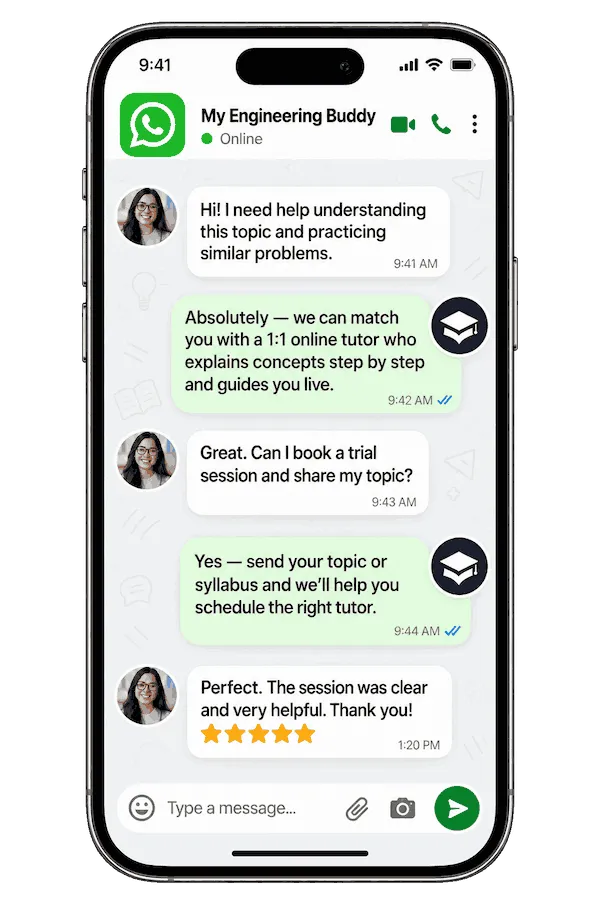
WhatsApp MEB for a quick quote — average response time under 1 minute.
Who This STM32 Tutoring Is For
This is for engineering students who are past the theory slides but struggling the moment they open STM32CubeIDE and a peripheral refuses to respond. It’s also for students whose labs are compiling but producing wrong output — and who can’t figure out why.
- Undergraduate electrical, electronics, or mechatronics students starting embedded C for the first time
- Students retaking after a failed first attempt at an embedded systems module
- Students with a university conditional offer depending on this grade
- Graduate students building firmware for a thesis project or capstone
- Students 4–6 weeks from a project submission with significant gaps in peripheral configuration
- Students at universities like MIT, Georgia Tech, University of Manchester, TU Delft, University of Toronto, RMIT, and KU Leuven working on embedded systems coursework
- Guided homework and assignment support — you build understanding, then submit your own work
1:1 Tutoring vs Self-Study vs AI vs YouTube vs Online Courses
Self-study works if you’re disciplined, but STM32 datasheets are 1,700 pages — knowing where to look is half the problem. AI tools can generate HAL code snippets, but they can’t watch your oscilloscope trace and tell you your clock divider is wrong. YouTube covers blink-an-LED setups well; it stops there. Online courses follow a fixed pace that won’t wait for your lab deadline. 1:1 tutoring with MEB is live, calibrated to your exact STM32 variant and course requirements, and corrects your actual errors in real time — not a generic walkthrough of someone else’s project.
Outcomes: What You’ll Be Able To Do in STM32
After working with an MEB STM32 tutor, you’ll be able to configure GPIO pins, timers, and UART without referencing a tutorial for every step. You’ll apply HAL library functions correctly and explain what each register setting actually does. Students learn to analyze interrupt-driven code for timing conflicts, write clean bare-metal C for embedded targets, and present working firmware in a lab demo or viva with confidence. Debugging a non-responsive I2C bus or a timer overflow error stops being a two-hour guessing session.
Based on feedback from 40,000+ sessions collected by MEB from 2022 to 2025, 58% of students improved by one full grade after approximately 20 hours of 1:1 tutoring in subjects like STM32. A further 23% achieved at least a half-grade improvement.
Source: MEB session feedback data, 2022–2025.
At MEB, we’ve found that STM32 students often hit the same wall: the HAL function compiles, the code runs, but the peripheral does nothing. Nine times out of ten, it’s a clock enable call that’s missing or a pin alternate function set to the wrong mode. Spotting that live takes two minutes with a tutor. Alone, it can cost a full evening.
What We Cover in STM32 (Syllabus / Topics)

Track 1: GPIO, Timers, and Core Peripherals
- GPIO input/output configuration, push-pull vs open-drain modes
- External interrupts (EXTI) and NVIC priority configuration
- Timer modes: PWM generation, input capture, output compare
- SysTick and delay functions in bare-metal and HAL environments
- Debouncing strategies for buttons and mechanical sensors
- ADC configuration: single-channel, multi-channel, DMA-driven conversion
Core reference: The Definitive Guide to ARM Cortex-M3 and Cortex-M4 Processors by Joseph Yiu; Mastering STM32 by Carmine Noviello.
Track 2: Communication Protocols
- UART: baud rate configuration, interrupt-driven Rx/Tx, DMA transfer
- SPI: master/slave mode, clock polarity and phase settings (CPOL/CPHA)
- I2C: address scanning, multi-master arbitration, HAL blocking and IT modes
- CAN bus basics for automotive and industrial embedded applications
- USB device class implementation using STM32 HAL middleware
- Debugging communication errors with logic analyser output and UART trace
Reference: STM32 Peripherals Cookbook by Lindsay Ward; STMicroelectronics application notes AN3116, AN4235.
Track 3: RTOS and Advanced Firmware
- FreeRTOS task creation, priorities, and scheduler behaviour on Cortex-M
- Queues, semaphores, and mutexes for inter-task communication
- DMA controller: memory-to-peripheral, circular mode, double-buffer
- Low-power modes: Sleep, Stop, Standby — wake-up sources and current draw
- Flash memory read/write and EEPROM emulation on STM32
- HAL vs Low-Layer (LL) drivers: when to use each and performance tradeoffs
- Bootloader basics and firmware update over UART or USB DFU
Reference: Mastering the FreeRTOS Real Time Kernel by Richard Barry; MIT OpenCourseWare on feedback and control systems for context on real-time control loops.
Platforms, Tools & Textbooks We Support
STM32 development runs across several IDEs and toolchains, and your tutor will match your exact setup rather than teaching a different one. Sessions cover STM32CubeIDE, STM32CubeMX for peripheral code generation, Keil MDK-ARM, and VS Code with PlatformIO. Debuggers supported include ST-Link V2/V3 and OpenOCD with GDB. Tutors can also walk through logic analyser output (Saleae, PulseView) and oscilloscope readings relevant to your lab.
- STM32CubeIDE / STM32CubeMX
- Keil MDK-ARM (uVision)
- VS Code + PlatformIO
- ST-Link V2/V3 debugger
- OpenOCD + GDB
- Saleae Logic / PulseView (logic analysis)
- FreeRTOS kernel (integrated or standalone)
What a Typical STM32 Session Looks Like
The tutor starts by checking where you left off — usually a specific peripheral that wasn’t responding or a FreeRTOS task that was blocking. You share your STM32CubeIDE project via screen share, and the tutor walks through your CubeMX configuration first, checking clock tree settings and peripheral enables before touching code. From there you work through the HAL or LL driver calls together — the tutor uses a digital pen-pad to annotate register maps and timing diagrams directly on screen. You replicate the fix or write the next function while the tutor watches. The session closes with a specific task: configure the next peripheral, write a test harness for your interrupt handler, or reproduce the timing diagram from the datasheet on your own hardware.
How MEB Tutors Help You with STM32 (The Learning Loop)
Diagnose: In the first session, the tutor reviews your existing code, CubeMX project file, and any error output or oscilloscope traces. The goal is to identify whether the issue is conceptual (misunderstanding the HAL abstraction layer), configurational (wrong clock source selected), or structural (poor task priority design in FreeRTOS).
Explain: The tutor works through a live example using your actual STM32 board variant — not a generic Nucleo demo. Peripheral register maps are annotated with a digital pen-pad. You see exactly which bit in which register controls what behaviour.
Practice: You attempt the next configuration or code section while the tutor watches. This is where most learning actually happens — not from watching, but from doing with immediate feedback available.
Feedback: The tutor identifies exactly where your reasoning broke down — whether that’s a missing RCC peripheral clock enable, a wrong GPIO alternate function, or a FreeRTOS stack size that’s too small. You learn what the error means, not just how to fix it this once.
Plan: Each session ends with a clear next topic: the next peripheral, the next RTOS concept, or the next test to run. Progress is tracked session to session.
Sessions run on Google Meet. Tutors use a digital pen-pad or iPad with Apple Pencil. Before your first session, share your STM32 board variant, your CubeMX project or schematic, and the specific behaviour you’re seeing versus what you expect. Start with the $1 trial — 30 minutes of live tutoring that also serves as your first diagnostic. Whether you need a quick catch-up before a lab submission, structured work over 4–8 weeks for a final project, or weekly support through the semester, the tutor maps the plan after that first session.
Students consistently tell us that the biggest shift happens when they stop copying HAL examples and start reading the reference manual alongside the tutor. That’s the point where STM32 stops feeling like black-box magic and starts making sense at the register level. Most students reach that point within three to four sessions.
Tutor Match Criteria (How We Pick Your Tutor)
Not every embedded systems tutor knows STM32. Here’s exactly what MEB checks before matching.
Subject depth: Tutors are verified on the specific STM32 series relevant to your course — F0, F1, F4, G0, H7 — and on the HAL vs LL distinction your syllabus uses. Real-time systems tutoring overlap is confirmed where FreeRTOS is part of your module.
Tools: Every tutor uses Google Meet with screen share and a digital pen-pad or iPad with Apple Pencil. They work in your IDE — STM32CubeIDE, Keil, or PlatformIO — not their preferred one.
Time zone: Matched to your region. Students in the US, UK, Gulf, Canada, and Australia all get tutors whose availability overlaps with reasonable study hours.
Goals: Whether you need to pass a lab, finish a thesis firmware layer, or build conceptual depth for an embedded systems viva, the tutor is briefed on your specific target before the first session.
Unlike platforms where you fill out a form and wait, MEB responds in under a minute, 24/7. Tutor match takes under an hour. The $1 trial means you test before you commit. Everything runs over WhatsApp — no logins, no intake forms.
Pricing Guide
STM32 tutoring starts at $20/hr for standard undergraduate-level work covering GPIO, timers, and UART. Sessions involving FreeRTOS, DMA, low-power design, or DSP on Cortex-M4/M7 run $35–$70/hr. For students targeting roles at embedded systems companies or postgraduate research positions, tutors with professional firmware development backgrounds are available at higher rates — share your specific goal and MEB will match the tier to your ambition.
Rate factors include your STM32 series, the complexity of your project or assignment, your timeline, and tutor availability. Availability tightens noticeably during end-of-semester lab submission windows.
Start with the $1 trial — 30 minutes, no registration, no commitment. WhatsApp MEB for a quick quote.
Try your first session for $1 — 30 minutes of live 1:1 tutoring or one homework question explained in full. No registration. No commitment.
WhatsApp MEB now
and get matched within the hour.
FAQ
Is STM32 hard to learn?
STM32 has a steep initial curve. The HAL library hides a lot, which helps beginners, but also means bugs are harder to trace. Most students hit a wall at interrupts or communication protocols. Consistent 1:1 sessions flatten that curve significantly within three to four weeks.
How many sessions will I need?
For a single lab or assignment, two to three sessions usually resolve the blocking issue. For a full embedded systems module, most students benefit from eight to twelve sessions spread over a semester. The diagnostic first session gives a clearer estimate based on your current code and gaps.
Can you help with homework and assignments?
MEB tutoring is guided learning — you understand the work, then submit it yourself. The tutor explains the peripheral behaviour, walks through the logic, and asks you to implement it. See our Academic Integrity policy and Why MEB page for full details on what we help with and what we don’t.
Will the tutor match my exact syllabus or exam board?
Yes. Before your first session, share your course outline, your STM32 board variant, and your IDE. The tutor is briefed on your module structure and focuses only on what your assessor will examine — not a generic embedded systems curriculum.
What happens in the first session?
The tutor reviews your existing code, CubeMX configuration, and any error output. You identify the most urgent gap together — a specific peripheral, a failing lab, or a concept you can’t visualise. The session then works directly on that, and a plan for subsequent sessions is sketched out.
Is online tutoring as effective as in-person for STM32?
For STM32 specifically, online works well. Screen share lets the tutor see your IDE, your code, and your CubeMX project simultaneously. The digital pen-pad handles register diagrams and timing charts. Students in MEB sessions consistently report faster progress than in-person lab demonstrators who split time across thirty students.
Can I get STM32 help at midnight?
Yes. MEB tutors are available across time zones, and WhatsApp response time is under a minute around the clock. Lab deadlines rarely respect business hours. If you’re stuck at midnight before a 9 am submission, send a message — a tutor will be available.
What if I don’t like my assigned tutor?
Request a switch via WhatsApp. MEB re-matches within the hour. There is no penalty, no form to fill out, and no awkward conversation. The goal is a tutor who works for your learning style and your specific STM32 course — not just any embedded systems tutor.
What’s the difference between HAL and LL drivers, and which should I learn first?
HAL (Hardware Abstraction Layer) is simpler and portable across STM32 series — most university courses start here. LL (Low-Layer) gives direct register access with minimal overhead, relevant for performance-critical or memory-constrained applications. Your tutor will match the approach to your specific course requirements and board.
Can MEB help with FreeRTOS on STM32 specifically?
Yes. FreeRTOS on STM32 is one of the most common advanced topics MEB covers. Tutors work through task creation, queue management, semaphore use, and interrupt-to-task notification — all in the context of your actual project or lab specification, not a standalone demo.
How do I find an STM32 tutor in my city?
You don’t need one locally. All MEB sessions run online via Google Meet. Students in Houston, London, Toronto, Sydney, Dubai, and Amsterdam all access the same pool of verified STM32 tutors. Time zone matching ensures reasonable session hours regardless of your location.
How do I get started?
Send a WhatsApp message to MEB — describe your board, your course, and your most urgent problem. You’ll be matched with a verified STM32 tutor within the hour. The first session is the $1 trial: 30 minutes live or one full question explained. Three steps: WhatsApp, match, start.
MEB covers 2,800+ subjects — from Raspberry Pi tutoring and ESP32 help to PLC programming support — with the same 1:1 model, verified tutors, and $1 entry point.
Source: My Engineering Buddy, 2008–2025.
Trust & Quality at My Engineering Buddy
Every MEB tutor goes through subject-specific vetting — not a general screening. For STM32, that means a live demo session covering peripheral configuration, HAL driver use, and real-time debugging before a tutor is accepted. Ongoing session feedback from students drives continuous review. Rated 4.8/5 across 40,000+ verified reviews on Google. Tutors hold degrees in electrical engineering, embedded systems, or mechatronics, and most have professional firmware development experience beyond academia.
MEB tutoring is guided learning — you understand the work, then submit it yourself. For full details on what we help with and what we don’t, read our Academic Integrity policy and Why MEB.
MEB has served 52,000+ students across the US, UK, Canada, Australia, the Gulf, and Europe since 2008 — covering 2,800+ subjects. In Mechatronics and embedded systems specifically, that includes automation engineering tutoring, electromechanical systems help, and robotics engineering tutoring — alongside STM32 as one of the most requested embedded platforms on the platform.
A common pattern our tutors observe is that students who struggle with STM32 aren’t weak programmers — they’re good C coders who’ve never worked at the hardware level before. The gap is mental model, not capability. Once a student sees how a peripheral clock enable maps to a physical register bit, the rest of the HAL starts making sense quickly. That shift usually happens in session two or three.
Explore Related Subjects
Students studying STM32 often also need support in:
- Autonomous Systems
- Avionics
- Microelectromechanical Systems (MEMS)
- Proteus Simulation
- SCADA
- System Dynamics
- MPLAB
Next Steps
Share your STM32 board variant, your course module or lab specification, and your hardest current problem. Tell MEB your time zone and when you’re available. A verified tutor is matched — usually within an hour, never more than 24 hours.
Before your first session, have ready:
- Your course outline or lab brief and your STM32 board variant (e.g. Nucleo-F446RE, STM32F103C8T6)
- Your current code or CubeMX project file, plus any error output or oscilloscope traces
- Your submission or exam deadline date
The tutor handles the rest. First session starts with a diagnostic so every minute is used well.
Visit www.myengineeringbuddy.com for more on how MEB works.
WhatsApp to get started or email [email protected].
Reviewed by Subject Expert
This page has been carefully reviewed and validated by our subject expert to ensure accuracy and relevance.