~1 min
Average Reply Time
~1 hour
To Be Matched With A Tutor
30 Min Trial
75% Find Their Tutor On The 1st Trial
$20-35+/hr
Premium Yet Affordable Learning
Most students don’t fail Real-Time Systems & RTOS because they can’t code — they fail because they can’t explain why a task missed its deadline.
Real-Time Systems & RTOS Tutor Online
Real-Time Systems & RTOS is the study of operating systems and software architectures that guarantee task execution within strict timing constraints, covering schedulers, interrupt handling, task prioritisation, and kernels such as FreeRTOS and VxWorks.
Finding a qualified Real-Time Systems & RTOS tutor online is harder than it sounds — most tutors know embedded C, but fewer can walk you through preemptive scheduling, priority inversion, or watchdog timer configuration at the level your course demands. MEB has matched students across Mechatronics and adjacent engineering disciplines with verified RTOS specialists since 2008. If you’ve searched for a Real-Time Systems & RTOS tutor near me, online 1:1 sessions deliver the same depth — without the commute. You get a tutor who knows your exact syllabus, your specific kernel, and where your gaps actually are.
- 1:1 online sessions tailored to your course syllabus and RTOS kernel
- Expert-verified tutors with hands-on embedded systems experience
- Flexible time zones — US, UK, Canada, Australia, Gulf
- Structured learning plan built after a diagnostic session
- Ethical homework and assignment guidance — you understand before you submit
52,000+ students across the US, UK, Canada, Australia, and the Gulf have used MEB since 2008 — including students in Mechatronics subjects like Real-Time Systems & RTOS, PLC tutoring, and Autonomous Systems help.
Source: My Engineering Buddy, 2008–2025.
How Much Does a Real-Time Systems & RTOS Tutor Cost?
Most students pay between $20 and $40 per hour for online Real-Time Systems & RTOS tutoring. Graduate-level or highly specialised RTOS work — covering proprietary kernels, safety-critical systems, or DO-178C avionics compliance — can run up to $100/hr. Not sure if it’s worth it? Start with the $1 trial: 30 minutes live or one full homework question explained.
| Level / Need | Typical Rate | What’s Included |
|---|---|---|
| Standard (undergrad / most levels) | $20–$35/hr | 1:1 sessions, homework guidance |
| Advanced / Graduate / Specialist RTOS | $35–$100/hr | Expert tutor, kernel-level depth |
| $1 Trial | $1 flat | 30 min live session or 1 homework question |
Tutor availability tightens sharply around final exam periods and project submission deadlines — book early if you’re within six weeks of either.
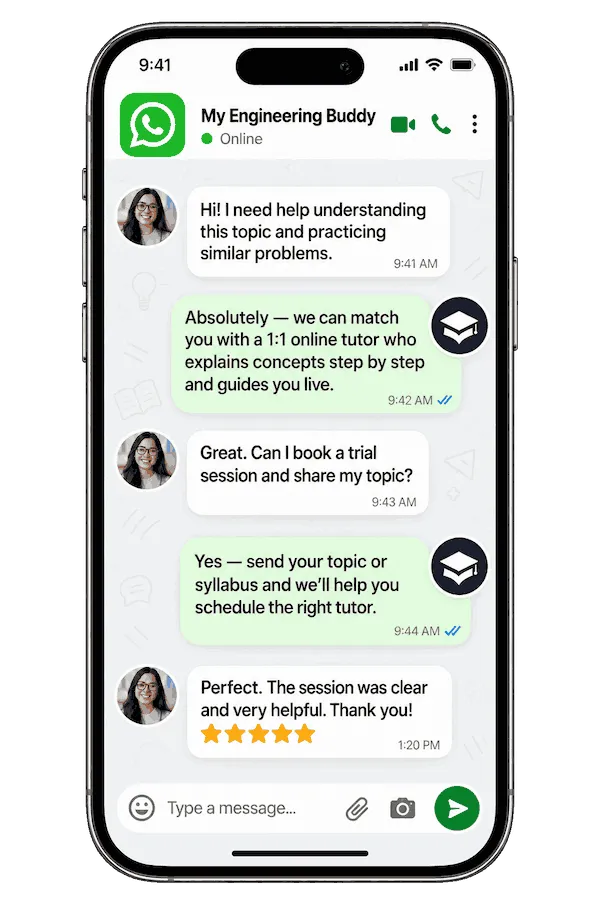
WhatsApp MEB for a quick quote — average response time under 1 minute.
Who This Real-Time Systems & RTOS Tutoring Is For
This service is built for engineering students who are past the basics but hitting a wall on timing analysis, task scheduling, or kernel configuration. If your code runs — just not on time — this is exactly where a tutor helps.
- Undergraduate students in computer engineering, electrical engineering, or embedded systems courses
- Graduate students working on RTOS-dependent thesis or research projects
- Students retaking after a failed first attempt at an RTOS or embedded OS module
- Students with a university conditional offer depending on passing this module
- Students 4–6 weeks from an exam with gaps in scheduling theory or interrupt handling
- Students at universities such as Georgia Tech, University of Michigan, TU Delft, Imperial College London, University of Toronto, ETH Zurich, and UNSW Sydney — where embedded systems modules are notoriously demanding
- Any student needing ethical homework and assignment guidance — understanding the work before submitting it
1:1 Tutoring vs Self-Study vs AI vs YouTube vs Online Courses
Self-study works if you already understand the scheduler model — but when priority inversion trips you up at 1 a.m., there’s no feedback loop. AI tools explain concepts fast but can’t watch you trace a FreeRTOS task queue and catch the exact line where your logic breaks. YouTube covers RTOS overviews well; it stops when you need to debug a missed deadline on your specific hardware. Online courses move at a fixed pace — your assignment doesn’t wait. With 1:1 Real-Time Systems & RTOS tutoring from MEB, a tutor calibrates to your exact kernel, your exact course, and corrects your errors in the moment they happen.
Outcomes: What You’ll Be Able To Do in Real-Time Systems & RTOS
After working with an MEB tutor, students can analyze task scheduling under Rate Monotonic and Earliest Deadline First algorithms and explain where and why a given task set is infeasible. They can write interrupt service routines that don’t break timing guarantees, apply priority inheritance to resolve inversion scenarios, and model system timing using response-time analysis. Students also solve FreeRTOS configuration problems — from tick rate and stack sizing to semaphore use — and present their design choices clearly in coursework reports and viva sessions.
Based on feedback from 40,000+ sessions collected by MEB from 2022 to 2025, 58% of students improved by one full grade after approximately 20 hours of 1:1 tutoring in subjects like Real-Time Systems & RTOS. A further 23% achieved at least a half-grade improvement.
Source: MEB session feedback data, 2022–2025.
At MEB, we’ve found that students who struggle with RTOS almost always have the same root problem: they understand what a scheduler does in theory but have never traced task execution step by step on paper. One session spent doing exactly that — by hand — fixes more in 30 minutes than three lectures can.
What We Cover in Real-Time Systems & RTOS (Syllabus / Topics)

Track 1: Scheduling & Timing Analysis
- Task models: periodic, aperiodic, sporadic tasks
- Rate Monotonic Scheduling (RMS) — utilisation bound and feasibility
- Earliest Deadline First (EDF) — optimality and overload behaviour
- Response-Time Analysis (RTA) for fixed-priority systems
- Priority inversion: causes, consequences, priority inheritance, and priority ceiling protocols
- Jitter analysis and worst-case execution time (WCET) estimation
- Hyperperiod calculation and schedulability testing
Core texts: Real-Time Systems by Jane W. S. Liu; Real-Time Systems Design and Analysis by Phillip Laplante.
Track 2: RTOS Kernels & Implementation
- FreeRTOS architecture: tasks, queues, semaphores, mutexes, event groups
- Tick configuration, context switching, and stack sizing
- Interrupt handling: ISR design, deferred interrupt processing, and latency
- Memory management in resource-constrained environments
- VxWorks and Zephyr RTOS — structure and API differences
- Watchdog timers and system health monitoring
- Porting RTOS to bare-metal microcontrollers (ARM Cortex-M, STM32)
Core texts: Using the FreeRTOS Real Time Kernel by Richard Barry; The Art of Designing Embedded Systems by Jack Ganssle.
Track 3: Embedded Systems Integration & Safety
- Hardware abstraction layers (HAL) and RTOS portability
- Communication protocols in real-time contexts: CAN, SPI, I2C timing requirements
- Safety-critical systems: IEC 61508, DO-178C concepts and their scheduling implications
- Multicore RTOS challenges: partitioning, cache coherency, and global scheduling
- Testing and verification: unit testing RTOS tasks, timing assertions
- Avionics tutoring context: real-time constraints in flight-critical software
Core texts: Embedded Systems: Real-Time Operating Systems for ARM Cortex-M Microcontrollers by Jonathan Valvano; Safety-Critical Computer Systems by Neil Storey.
Platforms, Tools & Textbooks We Support
Real-Time Systems & RTOS coursework runs across a specific set of platforms and toolchains. MEB tutors are familiar with all of the following and can guide you through setup, debugging, and project work directly:
- FreeRTOS (v10+) on STM32 and ESP32 tutoring
- Keil MDK and STM32CubeIDE for embedded development
- MPLAB for PIC-based RTOS development
- Zephyr RTOS and VxWorks (simulation environments)
- MATLAB/Simulink for task modelling and timing simulation
- Logic analysers and oscilloscopes for real-time signal verification
- Proteus Simulation for embedded circuit and software co-simulation
- Arduino Uno tutoring for introductory real-time task concepts
What a Typical Real-Time Systems & RTOS Session Looks Like
The tutor opens by checking where you landed on the previous session’s task — usually a scheduling feasibility problem or an ISR you were rewriting. If the FreeRTOS task queue still isn’t behaving as expected, that’s the starting point. The tutor shares their screen, walks through the task priority assignments, and uses a digital pen-pad to annotate the timeline visually — showing exactly where preemption occurs and why a lower-priority task is being starved. You then attempt a similar problem, explaining your reasoning aloud as you go. The tutor catches errors at the logic level, not just the syntax level. By the end, you have a specific configuration problem to debug before the next session and a clear note on which scheduling theorem to review.
How MEB Tutors Help You with Real-Time Systems & RTOS (The Learning Loop)
Diagnose: In the first session, the tutor identifies whether your gap is in scheduling theory, kernel API use, timing analysis, or hardware integration. These are distinct problems, and the session plan splits accordingly.
Explain: The tutor works through live problems on screen using a digital pen-pad — tracing task states, drawing Gantt charts for scheduling scenarios, and annotating FreeRTOS task graphs in real time. Nothing is left abstract.
Practice: You attempt the next problem with the tutor present. If you get stuck on preemption logic or semaphore ordering, the tutor intervenes at the exact point of confusion — not after you’ve already written the wrong solution.
Feedback: Every error gets a step-by-step explanation: why the scheduler behaved that way, what mark scheme examiners look for, and how to avoid the same mistake under exam conditions.
Plan: At the close of each session, the tutor sets a concrete task — a schedulability test, a FreeRTOS configuration exercise, or a past paper question — and notes which topic opens the next session.
Sessions run over Google Meet. The tutor uses a digital pen-pad or iPad with Apple Pencil for annotating timing diagrams. Before your first session, share your course syllabus, any assignment brief or past paper you’ve struggled with, and your exam or submission date. The first session acts as your diagnostic. Start with the $1 trial — 30 minutes of live tutoring that also serves as your first diagnostic.
Students consistently tell us that the moment Real-Time Systems & RTOS clicks is when they stop thinking of the scheduler as a black box and start reading task execution as a sequence they can predict and control. That shift usually happens faster with a tutor present than it ever does alone.
For students who can’t get 1:1 RTOS help locally, the American National Standards Institute and bodies like IEEE maintain published standards for real-time and embedded systems — MEB tutors align sessions to these frameworks where your course requires it.
Source: American National Standards Institute (ANSI).
Tutor Match Criteria (How We Pick Your Tutor)
Not every embedded systems engineer knows RTOS scheduling theory at the level a graduate course demands. Here’s exactly what MEB checks.
Subject depth: Tutors are matched by specific kernel experience — FreeRTOS, VxWorks, or Zephyr — and by whether your course sits at undergraduate, MEng, or research level. A tutor covering DO-178C safety standards is different from one covering introductory FreeRTOS labs.
Tools: Every tutor uses Google Meet and a digital pen-pad or iPad with Apple Pencil — essential for drawing timing diagrams and task-state transitions live.
Time zone: Matched to your region — US, UK, Gulf, Canada, or Australia — so session times work without 3 a.m. compromises.
Goals: Whether you need to pass an exam, finish a project, or close gaps in scheduling theory, the tutor match reflects that specific target.
Unlike platforms where you fill out a form and wait, MEB responds in under a minute, 24/7. Tutor match takes under an hour. The $1 trial means you test before you commit. Everything runs over WhatsApp — no logins, no intake forms.
Study Plans (Pick One That Matches Your Goal)
Catch-up (1–3 weeks): for students behind on scheduling theory, kernel labs, or missing foundational ISR concepts before an exam. Exam prep (4–8 weeks): structured revision across all syllabus tracks, past papers, and timing analysis practice. Weekly support: ongoing, aligned to your semester — covers each module topic as your lecturer introduces it. After the $1 trial diagnostic, your tutor builds the exact session sequence that fits your timeline.
Pricing Guide
Standard undergraduate Real-Time Systems & RTOS tutoring runs $20–$40/hr. Graduate-level work — particularly covering safety-critical systems, multicore scheduling, or proprietary RTOS platforms — is priced up to $100/hr depending on tutor expertise and timeline.
Rate factors include your level, the specific kernel or standard your course uses, how quickly you need sessions, and tutor availability. Peak exam periods fill fast — particularly in April–May and November–December.
For students targeting competitive MEng programmes, research positions, or safety-critical industry roles, tutors with professional embedded systems backgrounds are available at higher rates — share your specific goal and MEB will match the tier to your ambition.
Start with the $1 trial — 30 minutes, no registration, no commitment. WhatsApp MEB for a quick quote.
FAQ
Is Real-Time Systems & RTOS hard?
It’s one of the steeper modules in embedded and computer engineering. The concepts aren’t abstract — they’re precise. Scheduling feasibility, priority inversion, and ISR design all have specific rules. Students who struggle usually haven’t had them explained step by step with worked examples.
How many sessions are needed?
Most students see a clear improvement in 8–12 sessions. Students with large gaps — particularly in scheduling theory — typically need 15–20 hours to work through everything systematically. The diagnostic in session one sets the actual number.
Can you help with homework and assignments?
Yes. MEB tutoring is guided learning — you understand the work, then submit it yourself. See our Academic Integrity policy and Why MEB page for full details on what we help with and what we don’t.
Will the tutor match my exact syllabus or exam board?
Yes. Before matching, MEB checks your course outline, your specific RTOS kernel, and your university module descriptor. Tutors are assigned based on that match — not just general embedded systems knowledge.
What happens in the first session?
The tutor runs a short diagnostic — usually a scheduling problem and a kernel configuration question — to locate your exact gaps. From there, the session plan is built around what you actually need, not a generic syllabus order.
Is online tutoring as effective as in-person?
For RTOS specifically, often more so. The tutor can annotate timing diagrams, share FreeRTOS project files, and trace task execution on screen in ways a whiteboard can’t replicate. Students in Australia, Gulf, and North America consistently report the same session quality as face-to-face.
Can I get Real-Time Systems & RTOS help at midnight?
Yes. MEB operates 24/7 across time zones. WhatsApp response time averages under a minute. If your assignment is due at 9 a.m. and it’s midnight in Toronto or Dubai, you can still get matched and start within the hour.
What if I don’t like my assigned tutor?
Request a different match. There’s no charge, no form, no explanation needed. WhatsApp MEB and a new tutor is assigned — usually within the hour. The $1 trial exists precisely so you can test the match before committing to a full session block.
FreeRTOS vs bare-metal — can tutors help me decide which my project needs?
Yes. This is one of the most common questions in embedded coursework. Tutors walk through timing requirements, resource constraints, and project scope to help you make — and justify — the right architectural choice for your specific brief.
Do you cover RTOS for safety-critical or DO-178C contexts?
Yes, for graduate-level and advanced undergraduate students. Tutors familiar with DO-178C, IEC 61508, and ARINC 653 partitioning are available at higher rates. Share your specific standard and the tutor match reflects that requirement.
How do I get started?
Start with the $1 trial — 30 minutes of live tutoring or one full homework question explained. WhatsApp MEB, get matched within the hour, and begin your first session. Three steps: message, match, start.
Trust & Quality at My Engineering Buddy
Every MEB tutor goes through subject-specific screening that includes a live demo session evaluated by senior staff. Tutors covering Real-Time Systems & RTOS hold degrees in computer engineering, electrical engineering, or related embedded systems fields — and are assessed on their ability to explain scheduling proofs, debug kernel configurations, and adapt explanations to the student’s level in real time. Ongoing session feedback feeds back into tutor assignment. Rated 4.8/5 across 40,000+ verified reviews on Google.
MEB tutoring is guided learning — you understand the work, then submit it yourself. For full details on what we help with and what we don’t, read our Academic Integrity policy and Why MEB.
MEB has served 52,000+ students across the US, UK, Canada, Australia, Gulf, and Europe in 2,800+ subjects since 2008. Within Mechatronics and embedded engineering, that includes students needing STM32 tutoring, Robotics Engineering help, and SCADA tutoring — all areas that overlap directly with real-time systems design. See our tutoring methodology for how sessions are structured.
MEB has covered Real-Time Systems & RTOS alongside embedded systems subjects including PIC Microcontroller help and Electromechanical Systems tutoring — verifiable across 18 years of student records.
Source: My Engineering Buddy, 2008–2025.
Explore Related Subjects
Students studying Real-Time Systems & RTOS often also need support in:
- Automation Engineering
- Automation Studio by Famic Technologies
- Electrohydraulics & Electropneumatics
- Microelectromechanical Systems (MEMS)
- System Dynamics
- FluidSim
- ESP8266
- 3D Printing & Additive Manufacturing
Next Steps
Before your first session, have ready: your course syllabus or module descriptor, a recent assignment or past paper question you struggled with, and your exam or submission deadline. The tutor handles the rest.
- Share your exam board or university module, your hardest topic, and your current timeline
- Share your availability and time zone
- MEB matches you with a verified RTOS tutor — usually within the hour
Your first session starts with a diagnostic so every minute is used on what you actually need — not what a generic syllabus assumes you need.
Visit www.myengineeringbuddy.com for more on how MEB works.
Try your first session for $1 — 30 minutes of live 1:1 tutoring or one homework question explained in full. No registration. No commitment. WhatsApp MEB now and get matched within the hour.
WhatsApp to get started or email [email protected].
Reviewed by Subject Expert
This page has been carefully reviewed and validated by our subject expert to ensure accuracy and relevance.