~1 min
Average Reply Time
~1 hour
To Be Matched With A Tutor
30 Min Trial
75% Find Their Tutor On The 1st Trial
$20-35+/hr
Premium Yet Affordable Learning
Hire The Best Arduino Uno Tutor



Most students who fail their Arduino Uno lab report have never once been told why their code compiled but their circuit did nothing.
Arduino Uno Tutor Online
Arduino Uno is an open-source microcontroller board built on the ATmega328P chip, used in embedded systems courses to program digital/analogue I/O, PWM signals, serial communication, and sensor integration across academic and engineering projects.
If you’ve searched for an Arduino Uno tutor near me, you’ve already recognised the gap between reading documentation and making hardware actually respond. MEB connects you with a verified mechatronics tutor who has worked with the Uno board at course level — someone who can sit with you on Google Meet, step through your sketch line by line, and explain exactly where the logic breaks. Our positioning is straightforward: 1:1 online tutoring and homework help in 2,800+ advanced subjects, including Arduino Uno.
- 1:1 online sessions tailored to your course syllabus and lab assignments
- Expert-verified tutors with hands-on embedded systems experience
- Flexible time zones — US, UK, Canada, Australia, Gulf
- Structured learning plan built after a first diagnostic session
- Ethical homework and assignment guidance — you understand before you submit
52,000+ students across the US, UK, Canada, Australia, and the Gulf have used MEB since 2008 — including students in Mechatronics subjects like Arduino Uno, Raspberry Pi tutoring, and PLC programming.
Source: My Engineering Buddy, 2008–2025.
How Much Does an Arduino Uno Tutor Cost?
Most Arduino Uno sessions run $20–$40/hr depending on level and topic complexity. Graduate-level embedded systems or RTOS integration can reach $70–$100/hr. You can start with the $1 trial — 30 minutes of live tutoring or one homework question explained in full — before committing to anything.
| Level / Need | Typical Rate | What’s Included |
|---|---|---|
| Standard (most undergrad levels) | $20–$35/hr | 1:1 sessions, code review, homework guidance |
| Advanced / Specialist (RTOS, comms protocols) | $35–$70/hr | Expert tutor, niche embedded depth |
| $1 Trial | $1 flat | 30 min live session or one full homework explanation |
Tutor availability tightens during semester submission weeks and end-of-term lab deadlines. Book early if you have a fixed date.
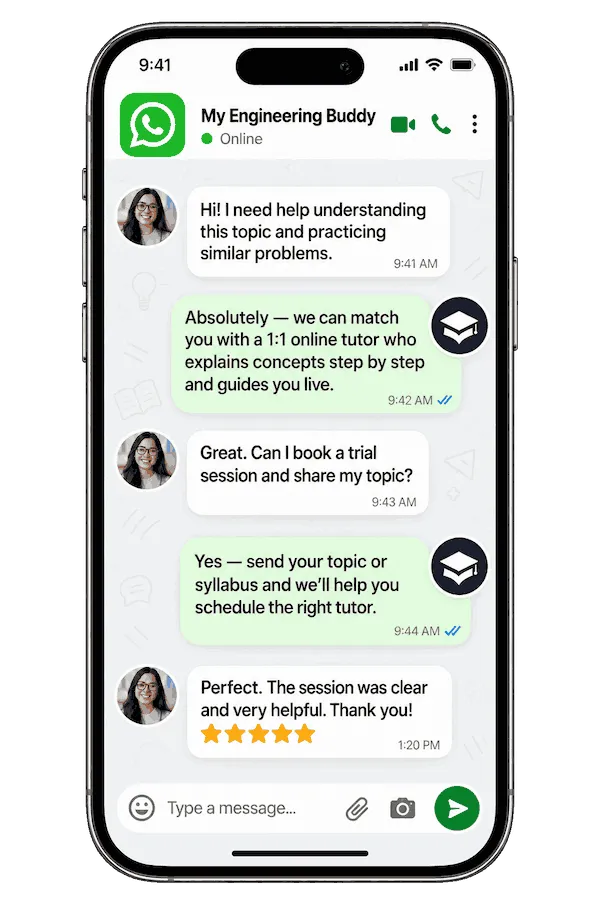
WhatsApp MEB for a quick quote — average response time under 1 minute.
Who This Arduino Uno Tutoring Is For
Arduino Uno sits at the crossroads of programming and physical hardware — which means the failure modes are twice as numerous. Students often know enough C++ to feel confident, then hit a wall the moment a sensor misbehaves or an interrupt fires at the wrong time.
- Undergraduate engineering students in embedded systems, mechatronics, or electronics modules
- Students retaking after a failed first attempt at a lab or project submission
- Students with a coursework or lab submission deadline approaching and significant gaps still to close
- Graduate students integrating Arduino Uno into larger research rigs or prototypes
- Self-taught makers who need structured guidance to move beyond blinking LEDs
- Students at universities including Georgia Tech, University of Michigan, TU Delft, Imperial College London, University of Toronto, UNSW Sydney, and ETH Zurich taking embedded systems units
Need to pass a lab report, debug a circuit, or understand I²C communication before your viva? MEB tutors have seen the exact same errors across thousands of sessions.
1:1 Tutoring vs Self-Study vs AI vs YouTube vs Online Courses
Self-study works if you’re disciplined — but Arduino Uno errors are often hardware-software interaction problems that documentation alone won’t resolve. AI tools generate plausible-looking code that can be subtly wrong in ways that only show up when you flash the board. YouTube covers basic wiring well but stops the moment your specific sensor returns garbage values. Online courses give you structured progression at a fixed pace with no one to ask when your sketch compiles cleanly but the servo doesn’t move. 1:1 tutoring with MEB is live, calibrated to your exact lab brief, and corrects errors — in both your code and your wiring logic — in real time. For Arduino Uno specifically, where a single missing pull-up resistor can waste three hours, having a tutor on screen with you is the fastest path through.
Outcomes: What You’ll Be Able To Do in Arduino Uno
After targeted 1:1 sessions, students typically move from confusion to clarity on specific, measurable skills. You’ll be able to write and debug sketches that read analogue sensor data, apply PWM to control motor speed, implement serial communication via UART between the Uno and a host computer, configure hardware interrupts correctly, and explain your circuit and code choices in a lab report without guessing. These aren’t vague goals — they map directly to the assessment criteria in most embedded systems modules.
Supporting a student through Arduino Uno? MEB works directly with parents to set up sessions, track progress, and keep coursework on schedule. WhatsApp MEB — average response time is under a minute, 24/7.
Based on feedback from 40,000+ sessions collected by MEB from 2022 to 2025, 58% of students improved by one full grade after approximately 20 hours of 1:1 tutoring in subjects like Arduino Uno. A further 23% achieved at least a half-grade improvement.
Source: MEB session feedback data, 2022–2025.
At MEB, we’ve found that Arduino Uno students who bring their actual lab brief — not a generic tutorial — to the first session close gaps three times faster. The tutor can pinpoint exactly which assessment criteria the student is missing, rather than covering ground the student already knows.
What We Cover in Arduino Uno (Syllabus / Topics)

Track 1: Core Hardware and I/O Programming
- ATmega328P architecture — registers, memory map, clock speed
- Digital I/O: pinMode, digitalWrite, digitalRead with pull-up/pull-down resistors
- Analogue input: analogRead, ADC resolution, voltage dividers
- PWM output: analogWrite, duty cycle, frequency control for motors and LEDs
- Debouncing switches in hardware and software
- Timing functions: millis() vs delay() — why delay() breaks real-time behaviour
Recommended references: Arduino Cookbook by Michael Margolis (O’Reilly); Programming Arduino: Getting Started with Sketches by Simon Monk.
Track 2: Communication Protocols and Sensor Integration
- UART serial communication — Serial.begin(), Serial.print(), baud rates
- I²C protocol — Wire library, master/slave addressing, SDA/SCL wiring
- SPI protocol — clock polarity, chip select, MOSI/MISO lines
- Common sensors: DHT11/DHT22 (temperature/humidity), HC-SR04 (ultrasonic), MPU-6050 (IMU)
- Library management in the Arduino IDE — installation, version conflicts
- Troubleshooting: why a sensor returns -1, NaN, or garbage on the serial monitor
Recommended references: Making Things Talk by Tom Igoe (O’Reilly); Exploring Arduino by Jeremy Blum (Wiley).
Track 3: Interrupts, Timers, and System Integration
- Hardware interrupts: attachInterrupt(), ISR design rules, volatile variables
- Timer/counter configuration — Timer0, Timer1, Timer2 and their conflicts with built-in functions
- Interfacing with motor drivers: L298N, L293D — H-bridge control logic
- Servo control via the Servo library vs direct PWM
- Basic finite state machine (FSM) design for embedded control loops
- Power considerations: current limits, voltage regulators, powering peripherals safely
- Integration with Proteus simulation for pre-build circuit testing
Recommended references: AVR Programming by Elliot Williams (Make: Community); The Art of Electronics by Horowitz and Hill (Cambridge University Press).
Platforms, Tools & Textbooks We Support
Arduino Uno projects live inside a specific software and hardware ecosystem. MEB tutors are comfortable working across all of the following alongside you in a shared screen session:
- Arduino IDE (1.x and 2.x) — sketch editor, serial monitor, board/library manager
- PlatformIO (VS Code extension) — for students moving beyond the standard IDE
- Proteus Design Suite — for circuit simulation before physical build
- Tinkercad Circuits — browser-based simulation used in many introductory modules
- MATLAB/Simulink — for students connecting Arduino to control system models
- GitHub — version control for multi-file Arduino projects
- Fritzing — breadboard and schematic documentation for lab reports
What a Typical Arduino Uno Session Looks Like
The tutor opens by checking last session’s topic — say, why your I²C sensor was returning all zeros. From there, you share your screen in Google Meet and pull up your current sketch. The tutor uses a digital pen-pad to annotate the code and the wiring diagram side by side, pointing out where the SDA line was left floating. You fix it, reflash the board, and the serial monitor starts returning real temperature values. Then the tutor introduces hardware interrupts — writes a simple ISR on screen, explains the volatile keyword, and asks you to write the next one yourself while they watch. The session closes with a specific task: implement a state machine that uses that interrupt to toggle between two operating modes, ready to review next time.
How MEB Tutors Help You with Arduino Uno (The Learning Loop)
Diagnose: In the first session the tutor asks you to walk through a sketch you wrote yourself or a problem you’re currently stuck on. This reveals whether the gap is in C++ syntax, circuit understanding, or the logic connecting the two — three very different problems that need different fixes.
Explain: The tutor works through a live example on the pen-pad — say, a working interrupt-driven encoder read — showing each line’s purpose and the hardware reasoning behind it. Not a lecture. A worked solution you can follow step by step.
Practice: You write the next version. The tutor watches in real time and says nothing until you’re stuck — then asks a question rather than giving the answer. This is where the learning locks in.
Feedback: Every error gets an explanation — not just “wrong” but why the compiler behaved that way, why the pin didn’t fire, why the timing was off. Marks in lab reports are almost always lost on explanation, not execution.
Plan: Before the session ends, the tutor logs what was covered, what’s still open, and what you should attempt before next time. No ambiguity about where you are or what comes next.
Sessions run on Google Meet. The tutor uses a digital pen-pad or iPad with Apple Pencil to annotate circuits and code. Before your first session, have your course brief, a sketch you’re currently working on, and your submission deadline ready. The first session is both diagnostic and productive — you leave having fixed something real. Start with the $1 trial — 30 minutes of live tutoring that also serves as your first diagnostic.
Students consistently tell us that the moment things clicked on Arduino Uno was when a tutor explained not just what the code does, but what the microcontroller is actually doing at the register level while the code runs. That context changes everything.
MEB tutors work across embedded systems tools including the Arduino IDE, PlatformIO, and Tinkercad — so sessions stay inside the exact environment your course uses, not a generic coding sandbox.
Source: My Engineering Buddy, 2008–2025.
Tutor Match Criteria (How We Pick Your Tutor)
Not every tutor who knows embedded systems is the right match for your specific Arduino Uno brief. Here’s what MEB checks:
Subject depth: The tutor must have demonstrable experience with the ATmega328P ecosystem — not just general C++ or electronics knowledge. MEB verifies this at the screening stage.
Tools: Every tutor runs sessions via Google Meet with a digital pen-pad or iPad and Apple Pencil. No whiteboard-only tutors for a subject that requires annotating code and circuits simultaneously.
Time zone: Matched to your region — US, UK, Gulf, Canada, or Australia — so session times are sustainable, not 2 a.m. compromises.
Goals: Whether you need to pass a single lab report, build a complete embedded system for a final project, or understand interrupts deeply enough to explain them in an oral exam, the tutor is matched to that specific goal.
Unlike platforms where you fill out a form and wait, MEB responds in under a minute, 24/7. Tutor match takes under an hour. The $1 trial means you test before you commit. Everything runs over WhatsApp — no logins, no intake forms.
Study Plans (Pick One That Matches Your Goal)
After the diagnostic session, the tutor builds a specific sequence. The most common structures for Arduino Uno students: a catch-up plan (1–3 weeks) for students with an imminent lab deadline and clear gaps in either code or circuit understanding; an exam prep plan (4–8 weeks) working through full embedded systems module content systematically; or ongoing weekly support aligned to semester pacing and coursework deadlines. The tutor decides the sequence — not a pre-set template — based on what the diagnostic actually shows.
Pricing Guide
Arduino Uno tutoring starts at $20/hr for standard undergraduate-level support and runs to $40/hr for more advanced sessions covering communication protocols, timer configuration, or system integration. Graduate-level work or research-rig integration can reach $100/hr depending on tutor expertise and project complexity.
Rate factors: course level, topic depth, how close the deadline is, and tutor availability. Availability tightens sharply during semester end-of-term weeks when lab submissions cluster.
For students targeting top engineering programmes or industry placements where a working embedded portfolio matters, MEB has tutors with professional electronics and firmware backgrounds available at higher rates — share your specific goal and MEB will match the tier to what you actually need.
Start with the $1 trial — 30 minutes, no registration, no commitment. WhatsApp MEB for a quick quote.
FAQ
Is Arduino Uno hard to learn?
It’s manageable if you have some programming background, but the hardware-software interaction trips most students. Knowing why your code is logically correct but your circuit still fails is the hard part — and that’s exactly where a tutor shortens the learning curve.
How many sessions will I need?
Most students close a specific gap — a lab assignment, a malfunctioning sensor, a misunderstood protocol — in 3–6 sessions. Students working through a full embedded systems module typically benefit from 10–20 hours of 1:1 support spread across a semester.
Can you help with Arduino Uno homework and assignments?
Yes — MEB tutoring is guided learning. You understand the work, then submit it yourself. See our Academic Integrity policy and Why MEB page for full details on what we help with and what we don’t.
Will the tutor match my exact syllabus or exam board?
Yes. Share your course outline, lab brief, or module descriptor when you contact MEB. The tutor is matched to your specific assessment structure — not a generic Arduino introduction — so session time is never wasted on content your course doesn’t cover.
What happens in the first session?
The tutor runs a short diagnostic — asks you to walk through a sketch or describe where you’re stuck. From there, the session moves directly into working on your actual problem. You leave the first session having fixed or understood something concrete, not just having introduced yourself.
Is online Arduino Uno tutoring as effective as in-person?
For code and circuit work, yes. Screen sharing plus a digital pen-pad lets the tutor annotate your exact sketch and wiring diagram in real time. Most students find it more focused than in-person sessions because there’s no physical setup delay and the tutor can highlight code line by line instantly.
Can I get Arduino Uno help late at night or on weekends?
Yes. MEB operates 24/7 across time zones. Students in the Gulf, Australia, and the US West Coast regularly book late-evening sessions. WhatsApp MEB at any hour — average response time is under a minute regardless of when you message.
What if I don’t get on with my assigned tutor?
Tell MEB via WhatsApp. A replacement tutor is matched, usually within the same day. The $1 trial exists precisely so you can test the fit before committing to a full schedule of sessions.
Do I need to own an Arduino Uno board to get help?
No — if your course allows simulation, MEB tutors can work with you entirely in Tinkercad Circuits or Proteus. If your assignment requires a physical board, the tutor can still guide your code, wiring logic, and debugging process remotely while you run the hardware on your end.
What’s the difference between Arduino Uno and ESP32 or Raspberry Pi for my project?
Arduino Uno uses a simpler 8-bit AVR microcontroller — ideal for real-time hardware control with minimal overhead. ESP32 tutoring covers a dual-core 32-bit chip with built-in Wi-Fi and Bluetooth. Raspberry Pi is a full Linux computer better suited to data processing than tight hardware timing. Your course brief usually specifies which to use — a tutor can help you understand why.
How do I get started with MEB?
Three steps: WhatsApp MEB, get matched to a verified Arduino Uno tutor within the hour, then start your $1 trial — 30 minutes of live tutoring or one homework question explained in full. No registration, no commitment beyond the first dollar.
Can MEB help me with Arduino Uno and a specific communication protocol like I²C or SPI?
Yes — protocol debugging is one of the most common Arduino Uno requests MEB receives. Tutors work through Wire library configuration, addressing errors, clock stretching issues, and SPI mode mismatches. Bring your serial monitor output and wiring diagram to the first session and the tutor will diagnose the problem directly.
Trust & Quality at My Engineering Buddy
Every MEB tutor goes through subject-specific screening before taking a session. For Arduino Uno, that means demonstrating knowledge of AVR architecture, C/C++ for embedded systems, and common peripheral integration — not just passing a general coding test. Tutors complete a live demo evaluation and are reviewed after every session. Rated 4.8/5 across 40,000+ verified reviews on Google.
MEB tutoring is guided learning — you understand the work, then submit it yourself. For full details on what we help with and what we don’t, read our Academic Integrity policy and Why MEB.
MEB has served 52,000+ students across the US, UK, Canada, Australia, the Gulf, and Europe since 2008 — across 2,800+ subjects. In Mechatronics and embedded systems specifically, that includes students working on PIC microcontroller tutoring, PLC tutoring, and robotics engineering help. The depth of tutor pool in this area is one of the reasons embedded systems students stay with MEB across multiple modules. Learn more about how tutors are selected at MEB’s tutoring methodology.
A common pattern our tutors observe is that Arduino Uno students who struggle most are those who learned from YouTube tutorials in isolation — they know individual functions but have never been shown how a complete embedded system is reasoned through from requirements to working code. One session changes that.
Explore Related Subjects
Students studying Arduino Uno often also need support in:
- Automation Engineering
- Autonomous Systems
- Electromechanical Systems
- Microelectromechanical Systems (MEMS)
- Real-Time Systems (RTOS)
- STM32
- System Dynamics
Next Steps
Before your first session, have ready: your course module outline or lab brief, a recent sketch or homework question you struggled with, and your submission or exam deadline date. The tutor handles the rest.
- Share your exam board or module name, the hardest component, and your current timeline
- Share your availability and time zone
- MEB matches you with a verified Arduino Uno tutor — usually within the hour
The first session starts with a diagnostic so every minute is productive. Visit www.myengineeringbuddy.com for more on how MEB works.
WhatsApp to get started or email [email protected].
Try your first session for $1 — 30 minutes of live 1:1 tutoring or one homework question explained in full. No registration. No commitment. WhatsApp MEB now and get matched within the hour.
Reviewed by Subject Expert
This page has been carefully reviewed and validated by our subject expert to ensure accuracy and relevance.