Hire Verified & Experienced
Finite Element Analysis (FEA) Tutors
4.8/5 40K+ session ratings collected on the MEB platform



Hire The Best Finite Element Analysis (FEA) Tutor
Top Tutors, Top Grades. Without The Stress!
52,000+ Happy Students From Various Universities






How Much For Private 1:1 Tutoring & Hw Help?
Private 1:1 Tutoring and HW help Cost $20 – 35 per hour* on average.
FEA assignments fail at mesh generation and boundary conditions — most students get those wrong before they run a single solver.
Finite Element Analysis (FEA) Tutor Online
Finite Element Analysis (FEA) is a numerical simulation method that divides complex structures into discrete elements to solve stress, heat transfer, and deformation problems. Taught at undergraduate and graduate level in mechanical, civil, and aerospace engineering programmes.
Looking for an FEA tutor near me — or someone who can jump on a call tonight? MEB connects you with a 1:1 Mechanical Engineering tutor who specialises in FEA, covering everything from element formulation to solver interpretation. No generic tutors. No waiting. One tutor, your syllabus, your timeline.
- 1:1 online sessions tailored to your course syllabus and FEA software
- Expert-verified tutors with hands-on FEA and simulation experience
- Flexible time zones — US, UK, Canada, Australia, Gulf
- Structured learning plan built after a first diagnostic session
- Ethical homework and assignment guidance — you understand the work before you submit
52,000+ students across the US, UK, Canada, Australia, and the Gulf have used MEB since 2008 — including students in Mechanical Engineering subjects like Finite Element Analysis, Nonlinear Finite Element Analysis, and Computational Mechanics.
Source: My Engineering Buddy, 2008–2025.
How Much Does a Finite Element Analysis (FEA) Tutor Cost?
Most FEA tutoring sessions run $20–$40/hr. Graduate-level work in nonlinear analysis or solver customisation can reach $100/hr depending on tutor background. Try the $1 trial first — 30 minutes live or one full assignment question explained — before committing to a package.
| Level / Need | Typical Rate | What’s Included |
|---|---|---|
| Undergraduate FEA | $20–$35/hr | 1:1 sessions, homework guidance, mesh and solver walkthroughs |
| Graduate / Specialist | $40–$100/hr | Expert tutor, nonlinear / dynamic analysis, ABAQUS or ANSYS depth |
| $1 Trial | $1 flat | 30 min live session or one homework question explained in full |
Tutor availability tightens during end-of-semester project deadlines. Book early if your submission is within two weeks.
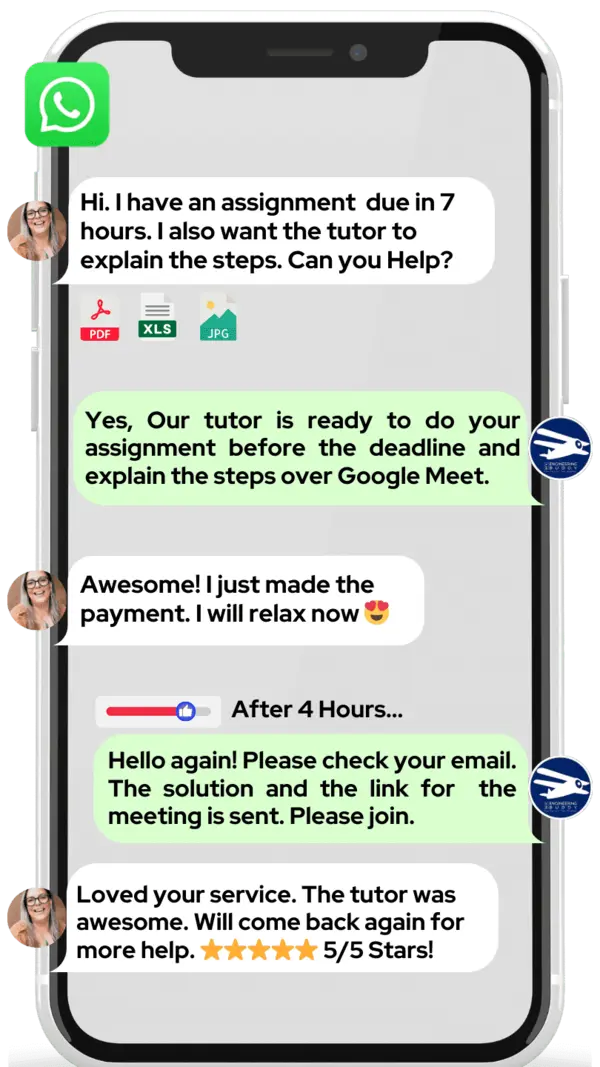
WhatsApp MEB for a quick quote — average response time under 1 minute.
Who This Finite Element Analysis (FEA) Tutoring Is For
FEA sits at the intersection of mechanics theory, numerical methods, and engineering software. Most students hit a wall when their model runs but gives physically wrong results — and they don’t know where to look. This tutoring is for anyone at that point.
- Undergraduate mechanical, civil, or aerospace engineering students covering FEA for the first time
- Graduate students using ANSYS, ABAQUS, or COMSOL for thesis simulations
- Students who failed a first attempt and need to rebuild from element formulation up
- Students with a project submission in 2–4 weeks and significant gaps in mesh quality or boundary condition setup
- Students with a conditional university offer depending on their final FEA grade
- Engineers or researchers needing guided project support on a specific simulation problem
Students at universities including MIT, Georgia Tech, Imperial College London, TU Delft, ETH Zurich, University of Michigan, and UNSW Sydney all work with MEB on FEA modules. Start with the $1 trial to see if it’s the right fit before booking further sessions.
1:1 Tutoring vs Self-Study vs AI vs YouTube vs Online Courses
Self-study works if you’re disciplined, but FEA errors are silent — you won’t know your mesh is wrong until results diverge. AI tools explain theory fast but can’t watch you set up a boundary condition and catch the mistake live. YouTube is excellent for overviews of element types yet stops cold when your specific ANSYS model throws an error code. Online courses are structured but fixed-pace with no one to ask when your convergence fails. 1:1 tutoring with MEB is live, calibrated to your exact solver and assignment, and corrects errors the moment they happen — which in FEA is the only way to actually learn.
Outcomes: What You’ll Be Able To Do in Finite Element Analysis (FEA)
After targeted 1:1 sessions, students consistently report a shift from running simulations blindly to understanding what each result actually means. You’ll be able to model structural components under static and dynamic loading, apply correct boundary conditions and material properties without guessing, analyse stress concentration and deformation outputs with confidence, explain mesh convergence studies to a supervisor or examiner, and present simulation results as part of a complete engineering report.
These aren’t abstract outcomes. They map directly to what FEA coursework and project submissions actually test.
Based on feedback from 40,000+ sessions collected by MEB from 2022 to 2025, 58% of students improved by one full grade after approximately 20 hours of 1:1 tutoring in subjects like Finite Element Analysis (FEA). A further 23% achieved at least a half-grade improvement.
Source: MEB session feedback data, 2022–2025.
Try your first session for $1 — 30 minutes of live 1:1 tutoring or one homework question explained in full. No registration. No commitment. WhatsApp MEB now and get matched within the hour.
What We Cover in Finite Element Analysis (FEA) (Syllabus / Topics)
MEB tutors cover FEA across three tracks. Most undergraduate modules run through Tracks 1 and 2. Graduate and research students typically need Track 3.

Track 1: FEA Theory and Mathematical Foundations
- Weighted residual and Galerkin methods
- Element stiffness matrix derivation
- Global assembly and system of equations
- Shape functions for 1D, 2D, and 3D elements
- Isoparametric elements and Jacobian transformation
- Numerical integration — Gauss quadrature
- Convergence criteria and error estimation
Recommended texts: Finite Element Procedures by Bathe; A First Course in the Finite Element Method by Logan; The Finite Element Method by Zienkiewicz and Taylor.
Track 2: Structural and Thermal FEA Applications
- Linear static analysis — stress, strain, displacement
- Plane stress vs plane strain formulation
- Beam, shell, and solid element selection
- Thermal conduction and heat flux boundary conditions
- Modal analysis and natural frequency extraction
- Mesh generation strategy and quality checks — aspect ratio, skewness
- Post-processing: von Mises stress, displacement plots, reaction forces
Recommended texts: Concepts and Applications of Finite Element Analysis by Cook et al.; Finite Element Analysis: Theory and Application with ANSYS by Moaveni.
Track 3: Nonlinear and Advanced FEA
- Material nonlinearity — plasticity, hyperelasticity, creep
- Geometric nonlinearity and large deformation analysis
- Contact mechanics and frictional interfaces
- Transient dynamic analysis and explicit vs implicit solvers
- Buckling and stability analysis
- Coupled field analysis — thermomechanical, fluid-structure interaction
Recommended texts: Nonlinear Finite Element Analysis of Solids and Structures by de Borst et al.; Computational Methods for Plasticity by de Souza Neto et al. Students working on nonlinear finite element analysis problems will find this track maps directly to their coursework.
Platforms, Tools & Textbooks We Support
FEA is inseparable from its software. MEB tutors work across the main commercial and open-source platforms used in engineering programmes worldwide. Sessions can focus on theory, software operation, or both — depending on where you’re stuck.
- ANSYS Mechanical and ANSYS Workbench
- ABAQUS / CAE (Standard and Explicit)
- COMSOL Multiphysics
- Nastran (MSC and NX)
- LS-DYNA for crash and impact analysis
- OpenFOAM for coupled CFD-FEA workflows
- MATLAB for FEA code development and element assembly exercises
At MEB, we’ve found that students who struggle with FEA results almost always have a gap in boundary condition logic — not in solver knowledge. Fixing the conceptual understanding first, then returning to the software, cuts troubleshooting time by more than half in most sessions.
What a Typical Finite Element Analysis (FEA) Session Looks Like
The tutor opens by revisiting the last topic — often mesh convergence from the previous session or a specific error the student hit in ANSYS or ABAQUS. From there, you work through a live problem on screen: defining material properties, applying loads and constraints, running the solver, and reading the output. The tutor uses a digital pen-pad to annotate the model directly, pointing out where the boundary condition is physically wrong, not just numerically off. You replicate the setup or explain your reasoning aloud — whichever reveals the gap faster. The session closes with a specific task: re-run the analysis with corrected constraints, or write the convergence study section of your report. Next topic is noted so the following session picks up without dead time. For students working on solid mechanics problems alongside FEA, the tutor can connect both in a single session.
How MEB Tutors Help You with Finite Element Analysis (FEA) (The Learning Loop)
Diagnose: In the first session, the tutor identifies whether the problem is theoretical (weak on element formulation or matrix assembly), practical (incorrect software inputs), or interpretive (misreading stress or displacement results). Most students have all three at once — the tutor prioritises.
Explain: The tutor works through a representative problem live using a digital pen-pad — deriving the stiffness matrix by hand if needed, then showing the same logic in ANSYS or ABAQUS. Theory and software stay connected throughout.
Practice: You attempt a parallel problem with the tutor present. In FEA, this means building a model from scratch or correcting a broken one — not reading notes.
Feedback: The tutor catches errors in real time: wrong element type, over-constrained model, misapplied pressure load. You learn why the result was wrong, not just what the correct answer is.
Plan: After each session, the tutor logs what was covered, what still needs work, and what to attempt before the next meeting. Progress is tracked against your assignment or exam deadline.
Sessions run on Google Meet with screen sharing. Bring your model file, assignment brief, and any error messages or result plots you don’t understand. Start with the $1 trial — 30 minutes of live FEA tutoring that also serves as your first diagnostic.
Students consistently tell us that FEA clicked only when someone explained why the stiffness matrix behaves the way it does — not just how to assemble it. Theory and software have to be taught together, or neither sticks.
Source: My Engineering Buddy tutor feedback, 2022–2025.
Tutor Match Criteria (How We Pick Your Tutor)
Not every engineering tutor is an FEA tutor. MEB matches on four criteria specifically.
Subject depth: The tutor must have verifiable experience with FEA at the level you’re studying — undergraduate linear analysis, graduate nonlinear modelling, or software-specific project work.
Tools: Matched to your software — ANSYS, ABAQUS, COMSOL, or Nastran — not just “FEA in general.” Sessions use Google Meet plus a digital pen-pad or iPad with Apple Pencil.
Time zone: Matched to US, UK, Gulf, Canada, or Australia — no 3 AM sessions.
Goals: Whether you need to pass a module exam, complete a simulation project, or understand FEA deeply enough to supervise others, the match reflects that. See Finite Element Method (FEM) tutoring if your module focuses on mathematical formulation rather than applied simulation.
Unlike platforms where you fill out a form and wait, MEB responds in under a minute, 24/7. Tutor match takes under an hour. The $1 trial means you test before you commit. Everything runs over WhatsApp — no logins, no intake forms.
Study Plans (Pick One That Matches Your Goal)
The tutor builds the session sequence after the first diagnostic, but most FEA students fall into one of three plans. Catch-up (1–3 weeks): close a specific gap — mesh quality, boundary conditions, or solver settings — before a submission. Exam prep (4–8 weeks): systematic revision of theory and software, timed practice, past paper walkthroughs. Weekly support: ongoing sessions aligned to your semester, covering each new topic as your module progresses. For students doing Mechanics of Materials in parallel, the tutor can sequence both subjects to avoid overlap and reinforce shared concepts.
Pricing Guide
Standard FEA tutoring runs $20–$40/hr and covers undergraduate and taught-master’s level content. Rate factors include topic complexity (nonlinear analysis costs more than linear static), your timeline, and tutor availability. Peak demand hits at end-of-semester project deadlines — availability shrinks fast, so don’t wait.
For students targeting placements at aerospace or automotive firms, or PhD programmes at research-intensive universities, tutors with professional simulation backgrounds — ANSYS Fluent, ABAQUS Explicit, crash analysis in LS-DYNA — are available at higher rates. Share your specific project goal and MEB will match the right tier.
Start with the $1 trial — 30 minutes, no registration, no commitment. WhatsApp MEB for a quick quote.
Our experience across thousands of sessions shows that students who spend the first two weeks on theory alone — without touching the software — consistently fall behind. The faster you connect the equations to the model, the faster the whole subject makes sense. MEB structures sessions to keep both in parallel from day one.
FAQ
Is Finite Element Analysis hard?
FEA is genuinely difficult. It combines linear algebra, numerical methods, solid mechanics, and software operation simultaneously. Most students struggle because a gap in any one area breaks the whole model. The difficulty is real — but it’s learnable in structured steps.
How many sessions will I need?
Students covering one FEA module typically need 8–15 sessions. A specific assignment rescue can take 2–4. Graduate-level nonlinear simulation projects often run 15–25 sessions. The first diagnostic sets a realistic number based on your current level and deadline.
Can you help with FEA homework and assignments?
MEB tutoring is guided learning — you understand the work, then submit it yourself. The tutor walks you through the problem-solving process, explains where your approach is wrong, and helps you reach the correct method independently. See our Academic Integrity policy and Why MEB page for full details on what we help with and what we don’t.
Will the tutor match my exact syllabus or exam board?
Yes. Before matching, MEB asks for your course name, university, textbook, and software. The tutor is selected based on that specific profile — not a generic “FEA tutor” match. If your module uses ABAQUS, your tutor uses ABAQUS.
What happens in the first session?
The tutor runs a diagnostic: asks you to explain a recent problem or walk through a model you built. From that, they identify where the gap is — theory, software, or interpretation — and set the session plan for the next 4–8 weeks.
Is online FEA tutoring as effective as in-person?
For FEA specifically, online is often better. Screen sharing lets the tutor see your exact model, error messages, and result plots. The digital pen-pad adds annotation directly on your geometry. You can’t do that in a library or classroom.
Can I get FEA help late at night or on weekends?
MEB operates 24/7. Students in the US, Gulf, and Australia regularly book sessions outside standard office hours. WhatsApp MEB at any time — response is typically under a minute regardless of the hour.
What if I don’t understand my simulation results at all?
That is the single most common starting point for FEA students. The tutor begins with result interpretation — what stress contours mean physically, why displacement looks wrong, how to read reaction forces — before going back to fix the model setup.
What’s the difference between FEA and FEM — do you cover both?
FEM (Finite Element Method) is the mathematical framework; FEA (Finite Element Analysis) is its application to engineering problems. Most university modules blend both. MEB tutors cover the theory and the application together. If your module is FEM-heavy, see the dedicated Continuum Mechanics tutoring page for supporting theory.
Do you support ANSYS Student and free FEA tools?
Yes. MEB tutors work with ANSYS Student, the free tier of ABAQUS for students, and open-source tools including Code_Aster and FEniCS. If your university provides a specific licence, the tutor adapts to that version.
How do I get started?
Start with the $1 trial: 30 minutes of live FEA tutoring or one assignment question explained in full. Three steps: WhatsApp MEB, get matched within the hour, start your trial session. No forms, no waiting.
How do I find an FEA tutor if I’m not sure what I need help with?
Send MEB your assignment brief or a screenshot of the result that’s confusing you. The team reviews it and suggests the right tutor profile. The first diagnostic session then sets the direction. You don’t need to know what’s wrong before you contact us.
Trust & Quality at My Engineering Buddy
Every MEB tutor goes through subject-specific screening before their first session. For FEA, that means demonstrating competency in element formulation, software operation in at least one major platform, and the ability to explain convergence failure to a student who has never seen it before. Tutors complete a live demo evaluation and are reviewed after every session. Rated 4.8/5 across 40,000+ verified reviews on Google. MEB has been running since 2008 — 18 years of tutor selection means the weak ones don’t stay long.
MEB tutoring is guided learning — you understand the work, then submit it yourself. For full details on what we help with and what we don’t, read our Academic Integrity policy and Why MEB.
MEB serves students across the US, UK, Canada, Australia, Gulf, and Europe in 2,800+ subjects. In Mechanical Engineering, that includes FEA alongside Engineering Mechanics tutoring, Solid Mechanics help, and simulation-focused subjects including Computational Mechanics. See our tutoring methodology for how sessions are structured from diagnostic to exam.
A common pattern our tutors observe is that FEA students who arrive with a “software problem” almost always have a mechanics problem underneath it. Fixing the physics understanding first means the software errors resolve themselves.
Source: My Engineering Buddy tutor feedback, 2022–2025.
Explore Related Subjects
Students studying Finite Element Analysis (FEA) often also need support in:
- Engineering Statics
- Strength of Materials
- Mechanical Vibrations
- Heat Transfer
- Fluid Mechanics
- Engineering Dynamics
- Thermodynamics
Next Steps
Before your first session, have ready: your course name and university, the FEA software your module uses (ANSYS, ABAQUS, COMSOL, or other), a recent assignment or model that gave you trouble, and your submission or exam date. The tutor handles the rest.
- Share your syllabus, software, and current gaps via WhatsApp
- Share your time zone and available hours
- MEB matches you with a verified FEA tutor — usually within an hour
Visit www.myengineeringbuddy.com for more on how MEB works.
WhatsApp to get started or email meb@myengineeringbuddy.com.
Reviewed by Subject Expert
This page has been carefully reviewed and validated by our subject expert to ensure accuracy and relevance.