




~1 min
Average Reply Time
~1 hour
To Be Matched With A Tutor
30 Min Trial
75% Find Their Tutor On The 1st Trial
$20-35+/hr
Premium Yet Affordable Learning
Hire The Best Continuum Mechanics Tutor


Stress tensors, strain fields, constitutive relations — and your lecturer moves on before you’ve finished writing. That’s where most students fall behind in Continuum Mechanics.
Continuum Mechanics Tutor Online
Continuum Mechanics is a branch of mechanics that models the behaviour of solids and fluids as continuous media, using tensor analysis, stress-strain relationships, and conservation laws to analyse deformation and flow.
MEB offers 1:1 online tutoring and homework help in 2,800+ advanced subjects, including a full roster of Mechanical Engineering tutoring subjects. If you’ve searched for a Continuum Mechanics tutor near me and found mostly generic results, MEB matches you with a specialist — someone who has taught tensor calculus, constitutive modelling, and finite deformation theory at graduate level. Sessions are live, corrective, and built around your exact course.
- 1:1 online sessions tailored to your university course and syllabus
- Expert-verified tutors with graduate-level subject knowledge
- Flexible time zones — US, UK, Canada, Australia, Gulf
- Structured learning plan built after a diagnostic session
- Ethical homework and assignment guidance — you understand the work before you submit
52,000+ students across the US, UK, Canada, Australia, and the Gulf have used MEB since 2008 — including students in Mechanical Engineering subjects like Continuum Mechanics, Solid Mechanics tutoring, and Mechanics of Materials help.
Source: My Engineering Buddy, 2008–2025.
How Much Does a Continuum Mechanics Tutor Cost?
Most Continuum Mechanics sessions run $20–$40/hr. Graduate-level and specialist topics — nonlinear elasticity, large-deformation plasticity, advanced tensor formulations — can reach up to $100/hr depending on tutor expertise. Not sure yet? Start with the $1 trial and see how the session goes before committing to a package.
| Level / Need | Typical Rate | What’s Included |
|---|---|---|
| Undergraduate (most levels) | $20–$40/hr | 1:1 sessions, homework guidance |
| Graduate / Specialist | $40–$100/hr | Expert tutor, advanced topic depth |
| $1 Trial | $1 flat | 30 min live session or 1 homework question |
Tutor availability tightens around end-of-semester exam windows and graduate coursework deadlines — book early if you’re within six weeks of a submission.
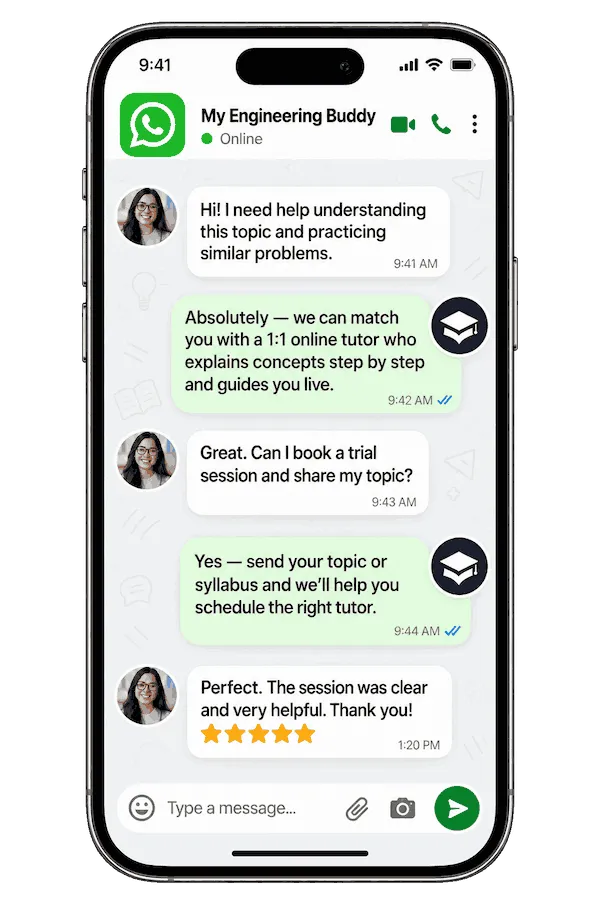
WhatsApp MEB for a quick quote — average response time under 1 minute.
Who This Continuum Mechanics Tutoring Is For
Continuum Mechanics sits at the intersection of advanced mathematics and physical intuition. It’s taken by undergraduate and graduate students in mechanical, civil, aerospace, and materials engineering — and it has a reputation for being one of the harder required courses.
- Undergraduate engineers hitting the tensor calculus wall for the first time
- Masters and PhD students whose research requires solid or fluid continuum models
- Students retaking after a failed first attempt — the gap-closing is faster with 1:1 guidance than with another pass through the textbook alone
- Students at MIT, Stanford, Imperial College London, ETH Zurich, TU Delft, Caltech, and Georgia Tech where Continuum Mechanics is a core or elective requirement
- Students 4–6 weeks from finals with specific chapters — constitutive theory, finite strain kinematics, or balance laws — still unresolved
- Those needing structured Finite Element Analysis help alongside continuum theory
At MEB, we’ve found that students who struggle with Continuum Mechanics usually aren’t weak at mechanics — they’re caught between abstract tensor notation and the physical meaning behind it. Bridging that gap in the first two sessions changes everything that follows.
1:1 Tutoring vs Self-Study vs AI vs YouTube vs Online Courses
Self-study works if you’re disciplined, but Continuum Mechanics derivations have hidden steps that textbooks skip. AI tools give fast symbol-by-symbol answers but can’t diagnose whether you understand the physics or just the algebra. YouTube covers the broad strokes of tensor notation but stops cold when you’re stuck on your specific boundary value problem. Online courses move at a fixed pace — they won’t wait while you work through the Cauchy stress theorem. 1:1 tutoring with MEB is live, calibrated to your exact syllabus, and corrects errors in the moment — including the ones you didn’t know you were making.
Outcomes: What You’ll Be Able To Do in Continuum Mechanics
After a structured run of sessions, you’ll be able to apply the Cauchy stress tensor to analyse stress states in deformed bodies, model large-deformation kinematics using the deformation gradient and Green-Lagrange strain tensor, derive and apply constitutive equations for elastic and viscoelastic materials, solve boundary value problems in both Lagrangian and Eulerian frameworks, and explain the physical meaning of balance laws — mass, momentum, and energy — in integral and differential form.
Based on feedback from 40,000+ sessions collected by MEB from 2022 to 2025, 58% of students improved by one full grade after approximately 20 hours of 1:1 tutoring in subjects like Continuum Mechanics. A further 23% achieved at least a half-grade improvement.
Source: MEB session feedback data, 2022–2025.
Try your first session for $1 — 30 minutes of live 1:1 tutoring or one homework question explained in full. No registration. No commitment. WhatsApp MEB now and get matched within the hour.
What We Cover in Continuum Mechanics (Syllabus / Topics)

Track 1: Mathematical Foundations and Kinematics
- Index notation, Einstein summation convention, Kronecker delta and Levi-Civita symbol
- Tensor algebra and tensor calculus — gradient, divergence, curl in tensor form
- Deformation gradient tensor F, Jacobian, and polar decomposition
- Lagrangian vs Eulerian descriptions of motion
- Green-Lagrange and Euler-Almansi strain tensors
- Velocity gradient, rate of deformation, and spin tensors
- Compatibility conditions for strain fields
Core texts: Gurtin’s An Introduction to Continuum Mechanics, Holzapfel’s Nonlinear Solid Mechanics, and Malvern’s Introduction to the Mechanics of a Continuous Medium.
Track 2: Stress Theory and Balance Laws
- Cauchy stress tensor, traction vector, and Cauchy’s theorem
- First and second Piola-Kirchhoff stress tensors
- Principal stresses, invariants, and Mohr’s circle in 3D
- Conservation of mass — continuity equation in Lagrangian and Eulerian forms
- Linear and angular momentum balance — equations of motion
- Energy balance and the first law of thermodynamics for continuous media
- Entropy inequality and the Clausius-Duhem inequality
Core texts: Chadwick’s Continuum Mechanics, Ogden’s Non-Linear Elastic Deformations, and Bonet and Wood’s Nonlinear Continuum Mechanics for Finite Element Analysis.
Track 3: Constitutive Theory and Applications
- Principles of material objectivity and material symmetry
- Linear elasticity — generalised Hooke’s law, anisotropy, isotropy
- Hyperelastic material models — Neo-Hookean, Mooney-Rivlin, Ogden
- Viscoelasticity — creep, stress relaxation, and standard linear solid
- Plasticity — yield criteria (von Mises, Tresca), hardening rules
- Introduction to fluid mechanics from a continuum standpoint — Newtonian fluids and the Navier-Stokes equations
- Coupled thermo-mechanical problems and heat conduction in deformable bodies
Core texts: Truesdell and Noll’s The Non-Linear Field Theories of Mechanics, Spencer’s Continuum Mechanics, and Lai, Rubin, and Krempl’s Introduction to Continuum Mechanics.
What a Typical Continuum Mechanics Session Looks Like
The tutor opens by checking where you finished last time — usually a specific derivation, such as the polar decomposition of the deformation gradient or the proof of Cauchy’s stress theorem. From there, you move into the session’s main problem: working through a boundary value problem in finite elasticity or deriving the Navier-Stokes equations from the general momentum balance. The tutor writes each step on a digital pen-pad so you can follow the index notation in real time — and then you replicate the argument or explain the physical reasoning back. If your course uses Computational Mechanics alongside theory, the tutor can connect the continuum formulation to its discrete approximation. The session closes with a specific practice derivation set and the next topic flagged — usually the constitutive model or the weak form needed for your next assignment.
How MEB Tutors Help You with Continuum Mechanics (The Learning Loop)
Diagnose: In the first session, the tutor works through two or three problems with you — typically one kinematic, one stress-related, one constitutive — and maps exactly where the notation breaks down or where physical meaning gets lost. This takes about 20 minutes and shapes every session after it.
Explain: The tutor works every derivation live on a digital pen-pad, showing the full index-notation expansion that most textbooks compress into one line. You see every step. Nothing is hand-waved. For topics like the Clausius-Duhem inequality or objectivity of constitutive relations, this approach makes an abstract principle concrete.
Practice: You attempt the next problem while the tutor watches. Not after the session — during it. This is where the real gaps show up: sign errors in tensor contraction, confusion between material and spatial coordinates, incorrect application of boundary conditions.
Feedback: The tutor corrects each error at the step where it occurred, not just at the wrong final answer. You learn exactly why a particular index substitution was invalid or why the Piola-Kirchhoff stress cannot be used directly in Cauchy’s equation of motion.
Plan: At the end of each session, the tutor sets the next derivation task and identifies which track — kinematics, stress theory, or constitutive modelling — needs more time before your exam or submission deadline.
Sessions run on Google Meet. The tutor uses a digital pen-pad or iPad with Apple Pencil. Before your first session, share your course syllabus or lecture notes, a recent problem set you struggled with, and your exam or assignment date. The first session is both your diagnostic and your first real tutoring hour. Start with the $1 trial — 30 minutes of live tutoring that also serves as your diagnostic.
Students consistently tell us that the moment Continuum Mechanics clicks is when the tensor notation stops feeling like abstract symbol manipulation and starts feeling like a precise language for describing physical reality. That shift usually happens in sessions three to five.
Tutor Match Criteria (How We Pick Your Tutor)
Not every strong engineer can teach Continuum Mechanics at graduate level. MEB’s matching process checks four things specifically.
Subject depth: The tutor must have coursework or research experience in Continuum Mechanics — not just adjacent mechanics subjects. Graduate degree holders with thesis work in solid mechanics, biomechanics, or computational mechanics are prioritised for advanced enquiries.
Tools: Every tutor works on Google Meet with a digital pen-pad or iPad and Apple Pencil. Tensor derivations done verbally without visual support don’t work. Non-negotiable.
Time zone: Matched to your region — US, UK, Gulf, Canada, or Australia. Late-night availability is common; specify your slot when you message.
Goals: Whether you need exam score recovery, conceptual depth for a research foundation, or structured Nonlinear Finite Element Analysis tutoring alongside theory, the tutor is matched to that specific objective — not assigned generically.
Unlike platforms where you fill out a form and wait, MEB responds in under a minute, 24/7. Tutor match takes under an hour. The $1 trial means you test before you commit. Everything runs over WhatsApp — no logins, no intake forms.
Study Plans (Pick One That Matches Your Goal)
The tutor builds a specific sequence after the diagnostic, but here’s how most students structure their time: a catch-up plan runs 1–3 weeks and targets the two or three topics blocking progress — usually kinematics or stress theory. An exam prep plan runs 4–8 weeks and systematically works through all three tracks with past-paper practice. Ongoing weekly support runs alongside the semester, aligned to lecture pace and assignment deadlines. The tutor adjusts pacing after every session.
Pricing Guide
Continuum Mechanics tutoring starts at $20/hr for undergraduate-level work. Graduate and research-level sessions — covering nonlinear constitutive theory, large-deformation plasticity, or coupled thermo-mechanical formulations — typically run $40–$100/hr depending on tutor background and topic complexity. Rate factors include your level, how specialised the topic is, how soon your deadline falls, and tutor availability.
For students targeting top research programmes, professional engineering roles, or PhD qualifying exams, tutors with active research backgrounds in computational or solid mechanics are available at the higher end of the rate range — share your specific goal and MEB will match the tier to your need.
Availability tightens during graduate coursework deadlines and end-of-semester exam windows. Book as early as you can.
Start with the $1 trial — 30 minutes, no registration, no commitment. WhatsApp MEB for a quick quote.
MEB has served students in 2,800+ subjects — including Fluid Mechanics tutoring, Engineering Mechanics help, and Continuum Mechanics — across the US, UK, Canada, Australia, Gulf, and Europe since 2008.
Source: My Engineering Buddy, 2008–2025.
FAQ
Is Continuum Mechanics hard?
Yes — it’s widely regarded as one of the more demanding graduate-level mechanics courses. The difficulty is largely notational: tensor calculus looks more opaque than it is. With a tutor who can unpack the index notation step by step, most students find it manageable within a few sessions.
How many sessions are needed?
Students with specific gaps — one or two topics blocking progress — often need 4–6 sessions. Students building from a weak foundation across the full course typically benefit from 15–25 hours spread over a semester. The diagnostic session sets the plan.
Can you help with homework and assignments?
MEB tutoring is guided learning — you understand the work, then submit it yourself. The tutor walks through the method, explains the underlying theory, and checks your reasoning. See our Academic Integrity policy and Why MEB page for full details on what we help with and what we don’t.
Will the tutor match my exact syllabus or exam board?
Yes. Continuum Mechanics syllabi vary between institutions — some emphasise finite deformation, others lead with fluid applications or thermodynamics. Share your course outline when you message MEB and the tutor is matched to your specific curriculum, not a generic version of the subject.
What happens in the first session?
The tutor runs a short diagnostic — usually two or three problems from your current module — to find where notation breaks down or where physical intuition is missing. From that point, every subsequent session is targeted. Bring your syllabus, a recent problem set, and your deadline.
Is online tutoring as effective as in-person?
For Continuum Mechanics specifically, online is often better. The tutor’s digital pen-pad on Google Meet lets you see tensor derivations written out clearly in real time — cleaner than most whiteboards, and you can scroll back through the working. Most students adapt within the first 10 minutes.
Do I need to know index notation before starting?
No. Many students arrive having seen only basic vector calculus. The tutor covers Einstein summation, Kronecker delta, and Levi-Civita notation in the first session if needed — it’s a standard starting point, not a prerequisite you need to arrive with.
What’s the difference between Continuum Mechanics and Solid Mechanics?
Solid Mechanics focuses on structural behaviour — stress, strain, and deformation in solid bodies. Continuum Mechanics is the general theoretical framework that underpins both solid and fluid mechanics, treating matter as a continuous medium. Most graduate Continuum Mechanics courses cover both solids and fluids within a unified tensor-based formalism.
Can you help if my course uses software like ABAQUS or COMSOL alongside theory?
Yes. If your course connects continuum theory to numerical implementation, MEB tutors can cover both sides. For dedicated simulation support, see COMSOL Multiphysics tutoring. Theory and software are often taught in parallel at graduate level and the tutor can bridge both.
Can I get Continuum Mechanics help at midnight?
Yes. MEB operates 24/7 across time zones. WhatsApp MEB at any hour — the average response time is under a minute. Tutors are matched based on your availability, not a fixed office schedule. Late-night sessions before deadline days are common.
How do I get started?
Three steps: WhatsApp MEB, get matched with a verified Continuum Mechanics tutor — usually within an hour — and start your $1 trial: 30 minutes of live 1:1 tutoring or one full homework question explained from method to final answer.
A common pattern our tutors observe is that students who re-derive the balance laws themselves — rather than just reading the textbook’s version — retain the material and perform significantly better in exams. Passive reading of Continuum Mechanics almost never works.
Trust & Quality at My Engineering Buddy
Every MEB tutor goes through subject-specific screening: a credential check, a live demo evaluation by a senior tutor, and ongoing performance review based on student feedback after each session. Continuum Mechanics tutors hold graduate degrees — most at Masters or PhD level — in mechanical, civil, aerospace, or materials engineering, with demonstrated experience teaching tensor-based mechanics. Rated 4.8/5 across 40,000+ verified reviews on Google.
MEB tutoring is guided learning — you understand the work, then submit it yourself. For full details on what we help with and what we don’t, read our Academic Integrity policy and Why MEB.
MEB has been running since 2008 and serves students across the US, UK, Canada, Australia, Gulf, and Europe in 2,800+ subjects. Mechanical Engineering is one of MEB’s strongest subject areas — from foundational courses to graduate-level research support. Students in Strength of Materials tutoring, Finite Element Method help, and Continuum Mechanics are among the most frequent enquiries. See how MEB structures its sessions at our tutoring methodology page.
MEB has worked with students on Engineering Dynamics tutoring, Solid Mechanics help, and Continuum Mechanics across 18 years — with the same tutor-matching process and the same no-registration WhatsApp start.
Source: My Engineering Buddy, 2008–2025.
Explore Related Subjects
Students studying Continuum Mechanics often also need support in:
Next Steps
When you message MEB, share your exam board or university course code, the specific topics giving you the most trouble, and your exam or submission deadline. Include your time zone so the tutor match is immediate.
Before your first session, have ready:
- Your course syllabus or lecture notes
- A recent problem set or assignment you struggled with
- Your exam or deadline date
MEB matches you with a verified Continuum Mechanics tutor — usually within 24 hours, often faster. The first session opens with a diagnostic so every minute counts from the start.
Visit www.myengineeringbuddy.com for more on how MEB works.
WhatsApp to get started or email [email protected].
Reviewed by Subject Expert
This page has been carefully reviewed and validated by our subject expert to ensure accuracy and relevance.




