




~1 min
Average Reply Time
~1 hour
To Be Matched With A Tutor
30 Min Trial
75% Find Their Tutor On The 1st Trial
$20-35+/hr
Premium Yet Affordable Learning
Deadlocks at 2 a.m., a race condition you can’t reproduce, and a submission due in 48 hours. That’s when students search for a concurrent programming tutor — and MEB has been the answer for over 17 years.
Concurrent Programming Tutor Online
Concurrent programming is the discipline of writing software where multiple computations run simultaneously, requiring students to manage threads, synchronisation, race conditions, and deadlock prevention across languages such as Java, C++, Go, and Python.
MEB offers 1:1 online tutoring and homework help in 2800+ advanced subjects, including concurrent programming. If you’ve searched for a concurrent programming tutor near me, you’re in the right place — sessions run over Google Meet with a verified expert who knows your exact course structure. One tutor. Your syllabus. Your pace. Students consistently leave their first session able to explain what was blocking them for days.
- 1:1 online sessions tailored to your course syllabus — Java concurrency, POSIX threads, Go goroutines, or whatever your programme uses
- Expert-verified tutors with undergraduate and graduate CS backgrounds, screened with live demo sessions
- Flexible time zones — US, UK, Canada, Australia, Gulf covered
- Structured learning plan built after a diagnostic session in your first hour
- Ethical homework and assignment guidance — you understand the work, then submit it yourself
52,000+ students across the US, UK, Canada, Australia, and the Gulf have used MEB since 2008 — including students in Computer Science subjects like Concurrent Programming, Operating Systems, and Distributed Systems.
Source: My Engineering Buddy, 2008–2025.
How Much Does a Concurrent Programming Tutor Cost?
Most concurrent programming tutoring sessions run $20–$40/hr. Graduate-level topics — lock-free data structures, transactional memory, formal verification of concurrent systems — can reach up to $100/hr depending on tutor specialisation. Not sure where you fit? Start with the $1 trial and MEB will match you to the right tier.
| Level / Need | Typical Rate | What’s Included |
|---|---|---|
| Undergraduate (most levels) | $20–$35/hr | 1:1 sessions, homework guidance |
| Graduate / Specialist | $35–$100/hr | Expert tutor, advanced depth |
| $1 Trial | $1 flat | 30 min live session or 1 homework question |
Tutor availability tightens around semester finals and project deadlines — especially in March–April and November–December. Book early if you’re working to a hard deadline.
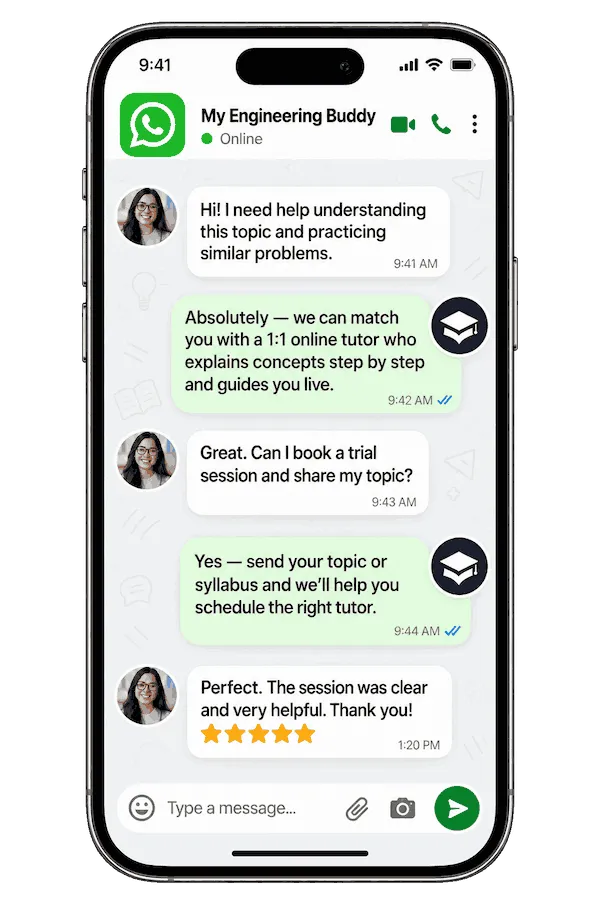
WhatsApp MEB for a quick quote — average response time under 1 minute.
Who This Concurrent Programming Tutoring Is For
Concurrent programming trips up students who sailed through data structures and algorithms. The mental model shifts entirely — from sequential reasoning to coordinated, interleaved execution. If you’re stuck, you’re not alone.
- Undergraduates taking an OS or concurrency module who can write sequential code but lose track the moment two threads share state
- Graduate students whose research involves parallel systems, distributed algorithms, or real-time scheduling
- Students retaking after a failed first attempt — deadlock, livelock, and starvation are the most commonly misunderstood topics, and a second pass with the wrong explanation makes it worse
- Students at universities like MIT, Carnegie Mellon, Georgia Tech, ETH Zurich, Imperial College London, University of Toronto, and UNSW whose concurrency assignments carry significant weight
- Students with a project submission in 1–3 weeks who need to debug a specific thread-safety issue, not a full course review
- Parents supporting a computer science student whose confidence has dropped after mid-terms
Whether you need help with Java’s synchronized keyword, Python’s GIL, POSIX pthreads, or Go channels — the tutor matches your stack.
1:1 Tutoring vs Self-Study vs AI vs YouTube vs Online Courses
Self-study works if your textbook examples compile cleanly — concurrent bugs often don’t reproduce on demand. AI tools explain thread safety in the abstract but can’t watch you write a monitor and tell you where your invariant breaks. YouTube covers the producer-consumer problem well; it stops when your specific deadlock scenario doesn’t match the video. Online courses give you the theory at a fixed pace with no live feedback. With a 1:1 concurrent programming tutor from MEB, the session is calibrated to your exact assignment, your language runtime, and the specific error message in front of you right now.
Outcomes: What You’ll Be Able To Do in Concurrent Programming
After working with a concurrent programming tutor through MEB, students can solve thread-safety problems in Java using locks, semaphores, and the java.util.concurrent library without second-guessing every shared variable. They can analyze a given piece of multithreaded code and identify race conditions, potential deadlocks, and liveness violations before running it. Students learn to model producer-consumer, reader-writer, and dining-philosophers problems correctly, and explain the reasoning behind each synchronisation choice. They can write correct concurrent Go programs using goroutines, channels, and the sync package. They can present the difference between parallelism and concurrency clearly in viva-style questions — a distinction many students muddle right up to their final exam.
Based on feedback from 40,000+ sessions collected by MEB from 2022 to 2025, 58% of students improved by one full grade after approximately 20 hours of 1:1 tutoring in subjects like Concurrent Programming. A further 23% achieved at least a half-grade improvement.
Source: MEB session feedback data, 2022–2025.
Try your first session for $1 — 30 minutes of live 1:1 tutoring or one homework question explained in full. No registration. No commitment. WhatsApp MEB now and get matched within the hour.
What We Cover in Concurrent Programming (Syllabus / Topics)

Track 1: Foundations of Concurrency
- Processes vs threads — creation, lifecycle, and context switching
- Shared memory vs message passing models
- Race conditions — identification, reproduction, and prevention
- Mutual exclusion: locks, spinlocks, and mutex primitives
- Semaphores — counting and binary, correct usage patterns
- Monitors and condition variables — wait/notify protocols
- Classic problems: producer-consumer, reader-writer, dining philosophers
Textbooks used in this track include The Art of Multiprocessor Programming by Herlihy and Shavit, and Operating System Concepts by Silberschatz, Galvin, and Gagne.
Track 2: Language-Specific Concurrency Models
- Java concurrency:
synchronized,ReentrantLock,ExecutorService,java.util.concurrentpackage - Python threading, multiprocessing, and the Global Interpreter Lock (GIL)
- Go goroutines, channels,
select, and thesyncpackage - C/C++ POSIX pthreads and C++11/14/17
std::threadand atomics - Async/await patterns in Python and JavaScript event loops
- Memory models: visibility guarantees, happens-before relationships
Supporting references include Java Concurrency in Practice by Goetz et al. and the Go language specification for concurrent semantics.
Track 3: Advanced Topics and Correctness
- Deadlock detection, prevention, and avoidance (Banker’s algorithm)
- Livelock and starvation — distinguishing and resolving
- Lock-free and wait-free data structures using compare-and-swap (CAS)
- Software transactional memory (STM) concepts
- Formal reasoning: safety and liveness properties, invariant-based proofs
- Distributed algorithm correctness — consensus, two-phase commit
- Testing concurrent code: stress testing, thread sanitizers, model checkers
Textbooks for this track include Concurrent and Distributed Computing in Java by Garg and selected chapters from Principles of Concurrent and Distributed Programming by Ben-Ari.
Platforms, Tools & Textbooks We Support
Concurrent programming assignments span multiple languages, IDEs, and runtime environments. MEB tutors work directly in your setup — no context-switching overhead on your end.
- IDEs: IntelliJ IDEA, Eclipse, VS Code, CLion
- Languages: Java, Python, Go, C, C++, Rust (introductory)
- Debugging tools: Java VisualVM, ThreadSanitizer (TSan), Helgrind (Valgrind)
- Model checkers: SPIN, TLA+
- Version control: Git — tutors can review your repo directly
- Course platforms: Canvas, Gradescope, Moodle — tutors familiar with submission formats
The Stanford University Computer Science department publishes open resources on concurrent systems that some MEB tutors reference for advanced track students.
What a Typical Concurrent Programming Session Looks Like
The tutor opens by checking where you left off — usually a specific piece of broken multithreaded code or a concept like condition variable spurious wakeups that didn’t click last time. You share your screen or paste the code into the shared doc. The tutor walks through it line by line using a digital pen-pad, annotating thread interleavings and highlighting exactly where the happens-before relationship breaks. You then rewrite the critical section yourself while the tutor watches — not the tutor doing it for you. If a deadlock scenario comes up, the tutor draws the resource allocation graph live. By the end of the session, you have one concrete practice task: rewrite the reader-writer lock from scratch without looking at the notes, or trace through a given execution sequence and identify all possible outcomes. Next session’s topic is agreed before you log off.
How MEB Tutors Help You with Concurrent Programming (The Learning Loop)
Diagnose: In the first session, the tutor runs a short live diagnostic — asking you to explain a simple two-thread program and trace its possible interleavings. This reveals whether the gap is in mental modelling, language syntax, or the underlying OS-level behaviour. Most students have at least one of these wrong.
Explain: The tutor works through problems live on a digital pen-pad, drawing execution traces, lock acquisition sequences, and memory visibility diagrams. Abstract definitions from a textbook become specific, reproducible steps you can follow.
At MEB, we’ve found that students who struggle with concurrent programming almost always have the same root gap: they’re reasoning about threads as if they run in a fixed order. One session fixing that mental model unlocks everything else — semaphores, monitors, lock-free code, all of it.
Practice: You attempt the problem yourself while the tutor is present — not after the session. This is deliberate. Concurrent bugs are silent until they’re not, and a tutor watching you write code can catch a missing volatile or an incorrect lock scope before it becomes a 3-hour debugging session at midnight.
Feedback: The tutor explains exactly where reasoning broke down and why the approach would fail under a specific thread scheduling scenario. “This works most of the time” is not acceptable — the tutor pushes for correctness under all valid interleavings.
Plan: Each session ends with a clear next step: a specific problem to attempt, a chapter section to read, or a piece of existing code to audit for thread safety. Progress is tracked session to session.
Sessions run over Google Meet. The tutor uses a digital pen-pad or iPad with Apple Pencil. Before your first session, share your course outline or assignment spec, a recent piece of code you struggled with, and your submission deadline. The first session covers both the diagnostic and your most urgent problem. Start with the $1 trial — 30 minutes of live tutoring that also serves as your first diagnostic.
Students consistently tell us that the moment concurrent programming clicks isn’t when they read the definition of a race condition — it’s when a tutor shows them two specific thread interleavings on the same five lines of their own code and they see exactly how the variable gets corrupted.
Tutor Match Criteria (How We Pick Your Tutor)
Not every CS tutor understands concurrent programming deeply. MEB matches on specifics.
Subject depth: Tutors are screened for the exact topics your course covers — whether that’s Java concurrency for a second-year module, POSIX threads for a systems programming course, or formal liveness proofs for a graduate seminar. A tutor who only knows one language runtime won’t be matched to a course that needs three.
Tools: All tutors use Google Meet with a digital pen-pad or iPad and Apple Pencil. Live annotation is non-negotiable for a subject where execution traces matter.
Time zone: Matched to your region — US, UK, Gulf, Canada, Australia. No scheduling gymnastics.
Goals: Tutors are briefed on whether you need exam preparation, assignment debugging, conceptual depth for a research project, or ongoing weekly support through a semester.
Unlike platforms where you fill out a form and wait, MEB responds in under a minute, 24/7. Tutor match takes under an hour. The $1 trial means you test before you commit. Everything runs over WhatsApp — no logins, no intake forms.
Study Plans (Pick One That Matches Your Goal)
The tutor builds your specific sequence after the first diagnostic session. Three common patterns: Catch-up (1–3 weeks) — you have a gap in a specific area like deadlock avoidance or Java’s memory model and an assignment or exam approaching fast. Exam prep (4–8 weeks) — structured revision across all concurrency topics, past paper walkthroughs, and timed problem sets. Weekly support — ongoing sessions aligned to your semester, covering each new topic as it appears and reviewing assignments before submission. The tutor adjusts pace and depth each week based on where you are.
Pricing Guide
Concurrent programming tutoring starts at $20/hr for standard undergraduate modules and runs to $40/hr for most advanced topics. Graduate-level work — lock-free algorithms, formal verification, distributed consensus — is available up to $100/hr depending on tutor specialisation and urgency.
Rate factors include: course level, specific language runtime required, deadline pressure, and tutor availability. Niche combinations — Rust concurrency with formal model checking, for example — sit at the higher end.
For students targeting top programmes at universities like Carnegie Mellon, MIT, ETH Zurich, or Imperial, tutors with active research or industry backgrounds in concurrent systems are available at higher rates. Share your specific goal and MEB will match the tier to your ambition.
Availability tightens in April and November — semester finals in the US and UK overlap, and parallel computing tutoring demand spikes at the same time. Book before the crunch.
Start with the $1 trial — 30 minutes, no registration, no commitment. WhatsApp MEB for a quick quote.
A common pattern MEB tutors observe is that students often understand individual concurrency primitives in isolation but cannot combine them correctly under real assignment constraints — that gap is exactly what 1:1 sessions are built to close.
Source: MEB tutor observation across 40,000+ sessions, 2008–2025.
FAQ
Is concurrent programming hard?
It’s harder than most sequential programming courses. The difficulty isn’t syntax — it’s reasoning about programs that don’t execute in a fixed order. Students who are strong at algorithms often still struggle with concurrency because the mental model is fundamentally different. It becomes manageable with the right guided approach.
How many sessions are needed?
Most students close a specific gap — one assignment, one exam topic — in 3–5 sessions. A full course rescue from mid-semester typically takes 10–15 sessions. The tutor maps a realistic plan after the first diagnostic so you know what you’re committing to before session two.
Can you help with homework and assignments?
MEB tutoring is guided learning — you understand the work, then submit it yourself. The tutor explains concepts, walks through similar examples, and checks your reasoning. See our Academic Integrity policy and Why MEB page for full details on what we help with and what we don’t.
Will the tutor match my exact syllabus or exam board?
Yes. Before matching, MEB asks for your course outline, university, and the specific language or runtime your module uses. A tutor who covers Java concurrency but not POSIX threads won’t be matched to a C systems course. Match accuracy is checked before the first session.
What happens in the first session?
The tutor runs a short diagnostic — usually asking you to trace a two-thread program and explain what can go wrong. This identifies whether your gap is conceptual, language-level, or in formal reasoning. The rest of the session addresses your most urgent problem directly. Nothing is wasted.
Is online tutoring as effective as in-person?
For concurrent programming, yes — and often more so. Screen sharing means the tutor sees your exact code and error output. The digital pen-pad produces clearer execution traces than a whiteboard. Students in different time zones consistently report the same session quality as local tutoring at a fraction of the cost.
What’s the difference between concurrency and parallelism — and does it matter for tutoring?
Concurrency is about program structure — multiple logical tasks that can overlap. Parallelism is about simultaneous execution on multiple cores. Many courses test both under the same module. MEB tutors cover both, and your tutor will clarify exactly which your assignment or exam requires before you start working through problems.
Can MEB help with concurrent programming in Go specifically?
Yes. Go’s concurrency model — goroutines, channels, the select statement, and the sync package — is covered by tutors who use Go in practice, not just teach it theoretically. Common Go assignment issues like channel deadlocks and goroutine leaks are among the most frequently addressed topics.
Can I get concurrent programming help at midnight?
Yes. MEB operates across time zones and typically responds on WhatsApp in under a minute at any hour. If your tutor isn’t available right then, MEB will find a match within the hour. Deadline emergencies happen — that’s exactly what 24/7 availability is for.
What if I don’t like my assigned tutor?
Tell MEB via WhatsApp. A replacement is arranged immediately — no forms, no waiting period. The $1 trial exists precisely so you can assess fit before committing to a full session block. If the first session doesn’t click, the swap is free.
How do I get started?
Three steps: WhatsApp MEB with your course details and the topic you’re stuck on. MEB matches you to a verified concurrent programming tutor, usually within the hour. Your first session is the $1 trial — 30 minutes live or one homework question explained in full. No registration required.
How do I find a concurrent programming tutor in my city?
You don’t need to. MEB sessions run entirely online over Google Meet — same tutor quality whether you’re in New York, London, Dubai, Toronto, or Sydney. Students who searched for a local tutor consistently report that online sessions with MEB are more focused and better-paced than in-person alternatives they tried first.
Trust & Quality at My Engineering Buddy
Every MEB tutor goes through a multi-stage vetting process: academic credential review, a subject-specific written screening, and a live demo session evaluated by a senior MEB reviewer. For concurrent programming, tutors are specifically tested on their ability to explain race conditions, trace thread interleavings, and diagnose deadlock scenarios in real code — not just define terms. Ongoing session feedback is monitored, and tutors with declining ratings are replaced. Rated 4.8/5 across 40,000+ verified reviews on Google.
MEB tutoring is guided learning — you understand the work, then submit it yourself. For full details on what we help with and what we don’t, read our Academic Integrity policy and Why MEB.
MEB has served students across the US, UK, Canada, Australia, Gulf, and Europe in 2,800+ subjects since 2008. Within Computer Science, MEB covers everything from introductory programming to advanced graduate topics — including systems programming tutoring, high-performance computing help, and memory management tutoring alongside concurrent programming. The depth of subject coverage means students rarely need to look elsewhere as their course progresses.
Our experience across thousands of sessions shows that students who come to us with concurrent programming problems have usually been given the right textbook — Herlihy and Shavit, Goetz, Silberschatz — but no one has ever shown them how to trace an execution by hand. That’s the first thing we fix.
Explore Related Subjects
Students studying Concurrent Programming often also need support in:
- Operating Systems
- Distributed Systems
- Algorithms
- Object-Oriented Programming
- Data Structures and Algorithms
- Computer Organisation and Architecture
- Design Patterns
Next Steps
Ready to move forward? Here’s what to do:
- Share your course outline or assignment spec, the language or runtime your module uses, and your submission or exam date
- Share your availability and time zone — US, UK, Gulf, Canada, and Australia are all covered
- MEB matches you with a verified concurrent programming tutor, usually within 24 hours — often within the hour
- First session starts with a diagnostic so every minute is used on what matters
Before your first session, have ready:
- Your course syllabus or assignment brief
- A recent piece of code you struggled with, or a past exam question you couldn’t finish
- Your exam or submission deadline date — the tutor builds the session plan around it
Visit www.myengineeringbuddy.com for more on how MEB works.
WhatsApp to get started or email [email protected].
Reviewed by Subject Expert
This page has been carefully reviewed and validated by our subject expert to ensure accuracy and relevance.




