Hire Verified & Experienced
Machine Design Tutors
4.8/5 40K+ session ratings collected on the MEB platform



Hire The Best Machine Design Tutor
Top Tutors, Top Grades. Without The Stress!


52,000+ Happy Students From Various Universities






How Much For Private 1:1 Tutoring & Hw Help?
Private 1:1 Tutoring and HW help Cost $20 – 35 per hour* on average.
Most students who fail Machine Design don’t lack effort — they hit shaft design or fatigue analysis and have no one to walk them through the numbers.
Machine Design Tutor Online
Machine Design is an applied mechanical engineering discipline covering the analysis and synthesis of mechanical components — shafts, gears, bearings, fasteners, springs, and power transmission systems — equipping students to size, select, and evaluate parts under real load conditions.
Finding a reliable Machine Design tutor near me is harder than it sounds — most general tutors stop at statics and dynamics. MEB’s 1:1 online tutoring and homework help goes further: shaft stress analysis, gear train design, bearing selection, fatigue life calculations, and FEA interpretation. If you’re working through a computer-aided design curriculum that includes Machine Design, MEB tutors know both the theoretical and software sides. One tutor. Your syllabus. Your exam date.
- 1:1 online sessions tailored to your exact course and syllabus
- Expert-verified tutors with mechanical engineering depth in Machine Design
- Flexible time zones — US, UK, Canada, Australia, Gulf
- Structured learning plan built after a diagnostic session
- Ethical homework and assignment guidance — you understand the work before you submit
52,000+ students across the US, UK, Canada, Australia, and the Gulf have used MEB since 2008 — including students in Computer-Aided Design subjects like Machine Design, SolidWorks tutoring, and engineering drawing help.
Source: My Engineering Buddy, 2008–2025.
How Much Does a Machine Design Tutor Cost?
Most Machine Design sessions run $20–$40/hr. Graduate-level or FEA-heavy topics go up to $100/hr depending on tutor specialisation. The $1 trial gets you 30 minutes live or one homework question explained in full — no registration required.
| Level / Need | Typical Rate | What’s Included |
|---|---|---|
| Undergraduate (most levels) | $20–$40/hr | 1:1 sessions, homework guidance |
| Graduate / Advanced FEA | $40–$100/hr | Expert tutor, simulation depth |
| $1 Trial | $1 flat | 30 min live session or 1 homework question |
Tutor availability tightens around end-of-semester deadlines and final exam periods. Book early if your submission is within three weeks.
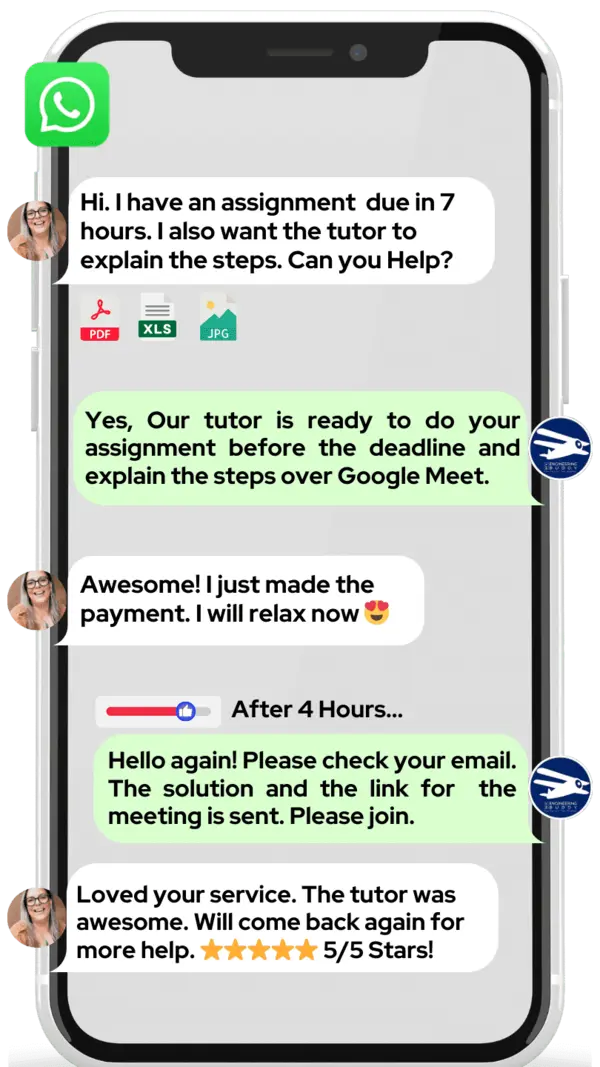
WhatsApp MEB for a quick quote — average response time under 1 minute.
Who This Machine Design Tutoring Is For
Machine Design sits at the intersection of theory and application. Students who struggle usually aren’t weak at maths — they lose marks on free body diagrams, load case setup, or misapplied design standards. This tutoring is for anyone who needs those gaps closed fast.
- Undergraduate mechanical or aerospace engineering students covering shafts, gears, bearings, and fasteners
- Graduate students tackling advanced fatigue analysis, fracture mechanics, or design optimisation projects
- Students retaking after a failed first attempt and needing to rebuild from the correct foundations
- Students with a university conditional offer depending on passing this module
- Students 4–6 weeks from finals with significant gaps in design methodology still to close
- Students working through computer-aided engineering programmes where Machine Design feeds directly into simulation coursework
Students come to MEB from programmes at institutions including MIT, Georgia Tech, Purdue, the University of Michigan, Imperial College London, TU Delft, UNSW Sydney, and the University of Toronto — among many others.
1:1 Tutoring vs Self-Study vs AI vs YouTube vs Online Courses
Self-study works if you’re disciplined, but Machine Design problems have branching failure modes — self-study gives you no feedback on which branch you’re misapplying. AI tools answer fast but can’t spot the moment you’ve set up a load case wrong. YouTube is useful for overviews of gear ratios or shaft analysis concepts, but stops cold when your specific problem diverges. Online courses move at a fixed pace — no adjustment for your exam date or your gaps. 1:1 tutoring with MEB is live, calibrated to your exact design syllabus, and corrects errors in the moment before they become habits that cost marks.
Outcomes: What You’ll Be Able To Do in Machine Design
After working with an MEB Machine Design tutor, students solve shaft design problems from load analysis through to diameter selection and safety factor verification. They apply Goodman and Gerber criteria correctly to fatigue life questions. They model gear trains — calculating speed ratios, torques, and contact stresses — without reverting to formula sheets they don’t understand. They select bearings using dynamic load ratings and L10 life calculations. They explain design decisions in written reports and defend their FEA boundary conditions under exam conditions.
Based on feedback from 40,000+ sessions collected by MEB from 2022 to 2025, 58% of students improved by one full grade after approximately 20 hours of 1:1 tutoring in subjects like Machine Design. A further 23% achieved at least a half-grade improvement.
Source: MEB session feedback data, 2022–2025.
What We Cover in Machine Design (Syllabus / Topics)

Mechanical Component Design
- Shaft design: torsion, bending, combined loading, critical speed
- Keyways, splines, and interference fits — tolerancing and stress concentration
- Bolted joint analysis: bolt sizing, preload, gasket factor
- Spring design: compression, extension, and torsion springs
- Welded joint design and weld size calculations
- Clutches and brakes — torque capacity and thermal analysis
Core references: Shigley’s Mechanical Engineering Design (Budynas & Nisbett), Norton’s Machine Design: An Integrated Approach.
Power Transmission and Gear Systems
- Spur, helical, bevel, and worm gear geometry and tooth forces
- AGMA stress analysis — bending and contact stress, safety factors
- Gear train speed and torque relationships — simple and compound trains
- Rolling element bearings: radial and thrust loads, L10 life, selection
- Belt and chain drive design — V-belt sizing, chain pitch selection
- Power screws: lead, efficiency, and self-locking conditions
Core references: Shigley’s Mechanical Engineering Design (Ch. 13–17), Juvinall & Marshek’s Fundamentals of Machine Component Design.
Fatigue, Fracture, and Design Standards
- S-N curves, endurance limits, and modifying factors (surface, size, reliability)
- Goodman, Gerber, and Soderberg criteria — when and how to apply each
- Stress concentration factors: theoretical Kt and notch sensitivity q
- Fracture mechanics basics: stress intensity factor K, fracture toughness Kic
- Factor of safety selection — deterministic vs probabilistic design
- Introduction to FEA in design validation — ANSYS and Abaqus result interpretation
Core references: Shigley’s Ch. 6–8, Dowling’s Mechanical Behavior of Materials.
At MEB, we’ve found that most marks lost in Machine Design exams come from one specific error: students apply the right formula to the wrong loading model. Before drilling equations, our tutors spend time making sure the free body diagram and load case are set up correctly. That one shift usually moves a student up a full grade band.
Platforms, Tools & Textbooks We Support
Machine Design coursework regularly involves CAD and FEA platforms alongside hand calculations. MEB tutors support students working in SolidWorks, ANSYS Workbench, CATIA, Creo, and Autodesk Inventor. Sessions cover both the mechanical theory and the correct tool workflow — so your FEA results and your hand calculations agree.
- SolidWorks Simulation (FEA, stress plots, factor of safety maps)
- ANSYS Mechanical (static structural, fatigue, modal analysis)
- Creo Parametric and Creo Simulate
- CATIA Part Design and Generative Structural Analysis
- Autodesk Inventor and Nastran In-CAD
- MATLAB for gear ratio, spring, and shaft calculation scripts
What a Typical Machine Design Session Looks Like
The tutor opens by checking where the previous session ended — usually a shaft design problem with combined loading or a gear contact stress calculation. The student shares their working on screen. The tutor uses a digital pen-pad to annotate the free body diagram, identifying exactly where the load model went wrong before touching a single equation. They work through a new problem together — say, an AGMA bending stress check on a helical gear — the student replicates the steps, the tutor watches for the moment understanding breaks down. The session closes with two practice problems assigned: one similar, one slightly harder, and a note of what opens next time (bearing selection or fatigue criterion application).
How MEB Tutors Help You with Machine Design (The Learning Loop)
Diagnose: The first session is a diagnostic. The tutor asks you to attempt a problem you’ve already struggled with — not to assess you, but to locate exactly where the reasoning breaks. It’s usually more specific than “I don’t get fatigue” — it’s one modifying factor being misapplied, or an incorrect assumption on the stress element orientation.
Explain: The tutor works through a live example on the digital pen-pad. Not a textbook solution — a re-worked version of your problem, annotated step by step, with the reasoning behind each decision made visible.
Practice: You attempt the next problem while the tutor is present. Not after the session. Live, so errors get caught before they’re repeated five more times on your own.
Feedback: The tutor marks through your working and explains not just what was wrong but what the examiner or grader would have penalised and why. That distinction matters for your next assignment.
Plan: Each session ends with a clear topic for next time and a specific gap to close. No vague “revise chapter 6” — an actual sequence tied to your exam date or submission deadline.
Sessions run on Google Meet with a digital pen-pad or iPad and Apple Pencil. Before your first session, have your course outline or syllabus, a recent assignment or past paper attempt, and your exam or submission date ready. Start with the $1 trial — 30 minutes of live Machine Design tutoring that also serves as your first diagnostic.
Students consistently tell us that the biggest shift in Machine Design isn’t understanding more content — it’s understanding why their answers were wrong. Once a student can self-diagnose an error in a shaft calculation or a gear stress setup, their speed and confidence on unseen problems jump significantly.
Tutor Match Criteria (How We Pick Your Tutor)
Not every mechanical engineer can teach Machine Design at exam level. MEB matches on four criteria.
Subject depth: the tutor must have graduate-level or professional background in mechanical component design — not just general mechanical engineering. Gear analysis, bearing selection, and fatigue criteria require specialist depth.
Tools: all tutors use Google Meet with a digital pen-pad or iPad and Apple Pencil — essential for working through annotated free body diagrams and design calculations in real time.
Time zone: matched to your region — US, UK, Gulf, Canada, or Australia — so sessions don’t require a 6am alarm.
Goals: whether your target is exam pass marks, project submission, conceptual depth for a design elective, or graduate research support, the tutor is selected for that specific aim.
Unlike platforms where you fill out a form and wait, MEB responds in under a minute, 24/7. Tutor match takes under an hour. The $1 trial means you test before you commit. Everything runs over WhatsApp — no logins, no intake forms.
Study Plans (Pick One That Matches Your Goal)
After the diagnostic session, the tutor builds the sequence — but most Machine Design students fall into one of three plans. Catch-up (1–3 weeks): targeted sessions on the highest-weight topics, past paper problems, and rapid gap-closing before finals. Exam prep (4–8 weeks): systematic coverage of every major component type, followed by timed practice and examiner feedback on worked solutions. Weekly support: semester-long sessions aligned to your lecture schedule and assignment deadlines, building problem-solving fluency as topics are introduced.
Pricing Guide
Machine Design tutoring starts at $20/hr for undergraduate-level sessions. Advanced topics — graduate fatigue mechanics, FEA-linked design validation, research-project support — run $40–$100/hr depending on tutor background and topic complexity. Rate factors include your level, how niche the topic is, timeline urgency, and tutor availability.
Availability tightens toward end-of-semester deadlines. If your submission or exam is within four weeks, book now.
For students targeting top engineering programmes or roles at precision engineering firms, MEB has tutors with professional industry and R&D backgrounds available at higher rates — share your specific goal and MEB will match the tier to your ambition.
Start with the $1 trial — 30 minutes, no registration, no commitment. WhatsApp MEB for a quick quote.
MEB has served over 52,000 students since 2008 across 2,800+ subjects. Machine Design is among the highest-demand mechanical engineering modules on the platform — sessions are available 24/7 across every major time zone.
Source: My Engineering Buddy, 2008–2025.
FAQ
Is Machine Design hard?
It’s considered one of the harder undergraduate mechanical engineering modules. The difficulty is that it combines mechanics of materials, dynamics, and engineering judgment simultaneously. Students who struggle usually have a specific gap — shaft loading, fatigue criteria, or gear geometry — not a general weakness.
How many sessions are needed?
Most students working toward a specific exam or assignment need 6–15 sessions. Students with broader gaps across multiple component types — gears, bearings, shafts, fatigue — typically need closer to 15–20 hours to build reliable problem-solving fluency across the full syllabus.
Can you help with homework and assignments?
MEB tutoring is guided learning — you understand the work, then submit it yourself. The tutor explains the method, works through similar examples, and checks your reasoning. See our Academic Integrity policy and Why MEB page for full details on what we help with and what we don’t.
Will the tutor match my exact syllabus or exam board?
Yes. Before matching, MEB asks for your course name, university, and syllabus outline. The tutor is selected based on that specific content — not just “mechanical engineering.” Share your course code and any past papers you have access to.
What happens in the first session?
The tutor runs a short diagnostic — you attempt a problem you’ve already struggled with. This identifies the exact point of breakdown. The rest of the session builds from there. By the end, you have a clear topic plan and one or two practice problems to attempt before the next session.
Is online tutoring as effective as in-person?
For Machine Design, yes — the digital pen-pad replicates whiteboard working in full. Tutors annotate diagrams, stress elements, and gear geometry in real time on screen. Most students find the recorded session link useful for reviewing worked examples after the session.
What’s the difference between Shigley’s and Norton’s for Machine Design?
Both are industry-standard references. Shigley’s (Budynas & Nisbett) is more widely used in US undergraduate programmes and covers AGMA gear standards in depth. Norton’s Machine Design has a stronger integrated design-project approach. MEB tutors work with both — tell us which your course uses.
Can MEB help with FEA-based Machine Design assignments?
Yes. MEB tutors support FEA workflows in ANSYS, Abaqus, SolidWorks Simulation, and Creo Simulate as part of CAE tutoring and Machine Design sessions. The tutor helps you set up boundary conditions correctly, interpret stress plots, and align FEA results with your hand calculations.
Can I get Machine Design help at midnight?
Yes. MEB operates 24/7. WhatsApp MEB at any hour — average response time is under a minute. Sessions can be booked same-day in most time zones. This matters most in the 48 hours before a submission deadline.
What if I don’t like my assigned Machine Design tutor?
Tell MEB over WhatsApp after the first session. A different tutor is matched within hours. No forms, no explanation required. The $1 trial structure means you find out quickly whether the fit is right before committing to a full package.
How do I get started?
Three steps: WhatsApp MEB with your course name and syllabus, get matched with a verified Machine Design tutor — usually within the hour — and start the $1 trial. Thirty minutes live or one assignment question explained in full. No registration required.
Do you offer group Machine Design sessions?
MEB’s core model is 1:1. Group sessions for small study groups (2–3 students) can be arranged — ask over WhatsApp. Rates and availability vary. Most students find 1:1 more effective for Machine Design because design problems are individual and errors are person-specific.
Trust & Quality at My Engineering Buddy
Every MEB tutor goes through subject-specific screening: a written assessment, a live demo session observed by MEB, and an ongoing review based on student feedback. Machine Design tutors must demonstrate depth in component analysis — not just general mechanical knowledge. Rated 4.8/5 across 40,000+ verified reviews on Google.
MEB tutoring is guided learning — you understand the work, then submit it yourself. For full details on what we help with and what we don’t, read our Academic Integrity policy and Why MEB.
MEB has been running since 2008, serving 52,000+ students across the US, UK, Canada, Australia, Gulf, and Europe in 2,800+ subjects. Within Computer-Aided Design and mechanical engineering, some of the highest-demand subjects alongside Machine Design include technical drawing tutoring and surface modeling help. MEB’s tutoring methodology is documented at our tutoring methodology page.
Try your first session for $1 — 30 minutes of live 1:1 tutoring or one homework question explained in full. No registration. No commitment.
WhatsApp MEB now
and get matched within the hour.
Explore Related Subjects
Students studying Machine Design often also need support in:
- Sheet Metal Design
- Siemens NX
- HyperMesh
- ANSYS Mechanical APDL
- STAR-CCM+
- Computer-Aided Manufacturing (CAM)
- Fusion 360
Next Steps
Getting started takes about two minutes. Here’s what to do:
- Share your course name, syllabus or exam board, and the topics you’re most stuck on
- Share your time zone and availability — sessions run 24/7
- MEB matches you with a verified Machine Design tutor, usually within the hour
- The first session starts with a diagnostic so every minute is used on your actual gaps
Before your first session, have ready:
- Your course outline or syllabus (or the name of the textbook your lecturer uses)
- A recent assignment or past paper attempt you struggled with
- Your exam date or submission deadline
The tutor handles the rest. Visit www.myengineeringbuddy.com for more on how MEB works.
WhatsApp to get started or email meb@myengineeringbuddy.com.
A common pattern our tutors observe is that students who reach out two weeks before their Machine Design exam are already behind by one week. The students who do best are the ones who book the diagnostic session while they still have time to act on what it finds. Four weeks out is the sweet spot.
Reviewed by Subject Expert
This page has been carefully reviewed and validated by our subject expert to ensure accuracy and relevance.