~1 min
Average Reply Time
~1 hour
To Be Matched With A Tutor
30 Min Trial
75% Find Their Tutor On The 1st Trial
$20-35+/hr
Premium Yet Affordable Learning
Struggling with mollusc systematics, shell morphology, or cephalopod evolution? Most students hit a wall within the first few weeks — MEB fixes that.
Malacology Tutor Online
Malacology is the branch of zoology focused on molluscs — including gastropods, bivalves, cephalopods, and chitons. It covers taxonomy, shell morphology, physiology, ecology, and evolutionary biology, equipping students to classify, analyse, and study molluscan diversity.
If you’ve searched for a Malacology tutor near me and found almost nothing, that’s the problem MEB was built to solve. As part of our broader zoology tutoring offering, we connect you with 1:1 online Malacology tutors who know the subject at the level you’re studying — undergraduate, graduate, or research support. You get a tutor who has worked through the same taxonomic debates, the same lab reports, the same gaps that cost marks. No guarantees — but a real shot at closing them.
- 1:1 online sessions tailored to your specific course and syllabus
- Expert-verified tutors with subject-specific knowledge in molluscan biology
- Flexible time zones — US, UK, Canada, Australia, Gulf
- Structured learning plan built after a diagnostic session
- Ethical academic guidance — you understand before you submit
52,000+ students across the US, UK, Canada, Australia, and the Gulf have used MEB since 2008 — including students in Zoology subjects like Malacology, Entomology, and Herpetology.
Source: My Engineering Buddy, 2008–2025.
How Much Does a Malacology Tutor Cost?
Most Malacology sessions run $20–$40/hr. Graduate-level or specialist research support can reach $100/hr. Not sure if it’s worth the spend? Start with the $1 trial — 30 minutes live or one homework question explained in full.
| Level / Need | Typical Rate | What’s Included |
|---|---|---|
| Standard (most undergrad levels) | $20–$35/hr | 1:1 sessions, homework guidance |
| Advanced / Graduate / Specialist | $35–$100/hr | Expert tutor, research-level depth |
| $1 Trial | $1 flat | 30 min live session or 1 homework question |
Tutor availability tightens significantly during end-of-semester and dissertation submission periods. Book early if you’re working to a deadline.
WhatsApp MEB for a quick quote — average response time under 1 minute.
Who This Malacology Tutoring Is For
Malacology sits at an unusual intersection — it’s highly visual, taxonomy-heavy, and demands comfort with both lab work and evolutionary theory. Most students who come to MEB are stuck on one of those three.
- Undergraduate biology students covering invertebrate zoology or systematics modules
- Graduate students writing dissertations on molluscan ecology, physiology, or palaeontology
- Students retaking after a failed first attempt at a zoology unit exam
- Students with a coursework or lab report submission deadline approaching
- Parents watching a child’s confidence drop alongside their biology grades
- Researchers needing structured support on molluscan taxonomy or cladistics methods
Students we’ve worked with come from programmes at institutions including the University of Michigan, University of Edinburgh, University of Queensland, UC Santa Barbara, and Utrecht University — all plain text, not endorsements.
1:1 Tutoring vs Self-Study vs AI vs YouTube vs Online Courses
Self-study works if you’re disciplined, but Malacology taxonomy is notoriously hard to self-correct. AI tools explain concepts quickly but can’t tell you why your cladogram is wrong. YouTube covers gastropod basics well — it stops when you’re stuck on chiton plate terminology. Online courses give you structure at a fixed pace, no room for your specific lab gaps. 1:1 tutoring with MEB is live, calibrated to your exact course, and corrects your reasoning on the spot — especially useful when you’re confusing Polyplacophora with Aplacophora for the third time.
Outcomes: What You’ll Be Able To Do in Malacology
After working with an online Malacology tutor through MEB, you’ll be able to solve classification problems across all seven molluscan classes without second-guessing your reasoning. You’ll analyse shell morphology from specimens or diagrams and connect structural features to ecological function. Apply phylogenetic methods to molluscan lineages, including cephalopod evolution and bivalve radiation events. Explain the functional significance of the mantle, radula, and haemocoel in different class contexts. Write lab reports and assignment answers that clearly distinguish between morphological and molecular taxonomy arguments — the distinction most students blur.
Based on feedback from 40,000+ sessions collected by MEB from 2022 to 2025, 58% of students improved by one full grade after approximately 20 hours of 1:1 tutoring in subjects like Malacology. A further 23% achieved at least a half-grade improvement.
Source: MEB session feedback data, 2022–2025.
Try your first session for $1 — 30 minutes of live 1:1 tutoring or one homework question explained in full. No registration. No commitment. WhatsApp MEB now and get matched within the hour.
What We Cover in Malacology (Syllabus / Topics)

Molluscan Taxonomy and Systematics
- Classification of the seven molluscan classes: Gastropoda, Bivalvia, Cephalopoda, Polyplacophora, Scaphopoda, Aplacophora, Monoplacophora
- Morphological vs molecular approaches to molluscan phylogeny
- Shell structure: periostracum, prismatic layer, nacreous layer
- Taxonomic keys and identification of gastropod and bivalve species
- Cladistic analysis applied to molluscan lineages
- Nomenclature rules under the International Code of Zoological Nomenclature
Core texts include Brusca, Moore & Shuster’s Invertebrates (3rd ed.) and Ruppert, Fox & Barnes’s Invertebrate Zoology (7th ed.).
Molluscan Physiology and Ecology
- Mantle function: shell secretion, respiration, and sensory roles
- Radula structure and feeding strategies across classes
- Circulatory and excretory systems: open vs closed haemocoels
- Reproductive strategies: direct development, veliger larvae, brooding
- Ecological roles: filter feeding, predation, biofouling, reef association
- Invasive mollusc species and their ecological impact (e.g. zebra mussels, Pacific oysters)
Recommended: Wilbur’s The Mollusca series and Ponder & Lindberg’s Phylogeny and Evolution of the Mollusca.
Cephalopod Biology and Applied Malacology
- Cephalopod nervous systems and behaviour: octopus cognition, camouflage mechanisms
- Coleoid vs nautiloid evolutionary divergence
- Palaeontology of ammonites and belemnites
- Commercial and conservation relevance: squid fisheries, giant clam farming, abalone aquaculture
- Molluscs in biomedical research: conotoxins, shell biomineralisation models
Useful reference: Nixon & Young’s The Brains and Lives of Cephalopods and relevant chapters in American Association for the Advancement of Science publications.
What a Typical Malacology Session Looks Like
The tutor opens by checking your last topic — usually shell morphology terminology or a classification exercise you attempted between sessions. From there, you and the tutor work through a specific problem on screen: identifying a specimen from a scanning electron micrograph, building a cladogram for bivalve families, or dissecting the logic of a past exam question on cephalopod evolution. The tutor uses a digital pen-pad to annotate diagrams and label structures live. You replicate the reasoning or explain it back. Errors get caught and fixed in the moment — not after you’ve already submitted. The session closes with a specific practice task (two identification exercises, one short-answer draft) and a note on the next topic to hit.
How MEB Tutors Help You with Malacology (The Learning Loop)
Diagnose: In the first session, the tutor identifies exactly where your understanding breaks down — whether that’s confusing gastropod torsion with detorsion, misapplying cladistic terminology, or structuring lab report arguments poorly. This isn’t a generic quiz; it’s targeted to your course and your answers.
Explain: The tutor works through problems live, annotating molluscan diagrams with a digital pen-pad. You see the reasoning built step by step — not just the answer.
Practice: You attempt the next problem with the tutor present. Malacology rewards repetition with specimens and diagrams; the session gives you that repetition with immediate correction.
At MEB, we’ve found that students who struggle with Malacology taxonomy almost always have the same root problem: they’ve memorised class names without building a mental image of what each animal actually looks like. Fix the image, and the taxonomy clicks.
Feedback: Every error gets a step-by-step explanation of why the reasoning failed and where marks would have been lost in an exam or lab report context. Not just “wrong” — why, and how to fix it.
Plan: The tutor sets the next topic, notes what needs revisiting, and keeps a progression log so nothing is skipped. Sessions build on each other rather than starting from scratch each time.
Sessions run on Google Meet with a digital pen-pad or iPad and Apple Pencil for diagram work. Before your first session, send your course syllabus or module outline and any lab report or assignment you’ve recently struggled with. The first session starts with the diagnostic — that’s also where the $1 trial fits. Start with the $1 trial — 30 minutes of live tutoring that also serves as your first diagnostic.
Students consistently tell us that Malacology clicked only when they stopped trying to memorise the classes in isolation and started seeing each one through a body-plan lens — the tutor’s job is to build that lens in the first two sessions.
Source: My Engineering Buddy session observations, 2022–2025.
Tutor Match Criteria (How We Pick Your Tutor)
Not every zoology tutor knows Malacology. MEB matches on specifics.
Subject depth: Tutors are matched to your exact level — first-year invertebrate zoology, upper-division systematics, or graduate-level molluscan ecology. A tutor who has studied or taught cephalopod phylogeny is not matched to a student needing help with basic bivalve anatomy.
Tools: Every tutor works on Google Meet with a digital pen-pad or iPad and Apple Pencil — diagram annotation is non-negotiable for a visual subject like Malacology.
Time zone: Matched to your region — US, UK, Gulf, Canada, or Australia. No scheduling guesswork.
Goals: Whether you need exam-score recovery, conceptual depth in cephalopod biology, homework guidance, or dissertation-level research support, the match reflects that goal — not a generic “biology tutor” assignment.
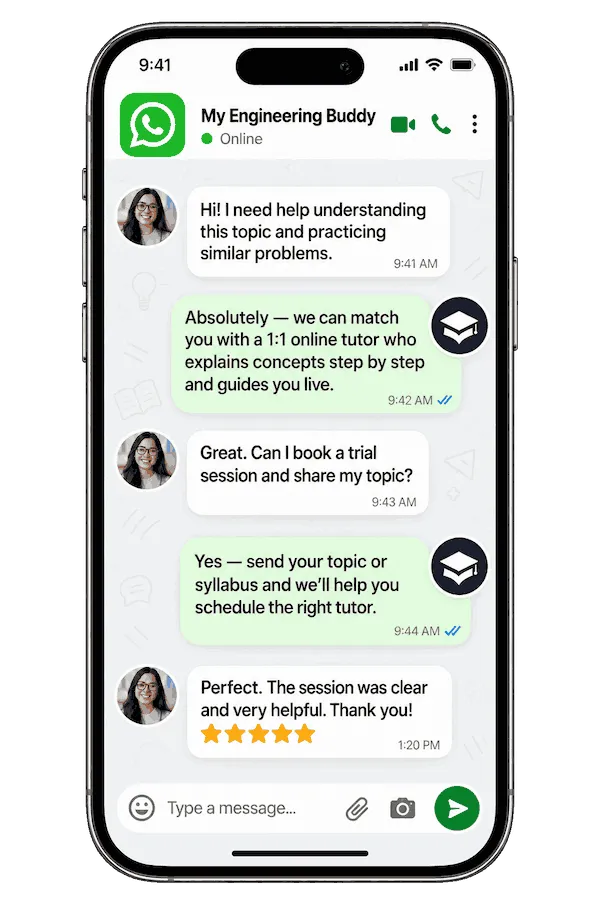
Unlike platforms where you fill out a form and wait, MEB responds in under a minute, 24/7. Tutor match takes under an hour. The $1 trial means you test before you commit. Everything runs over WhatsApp — no logins, no intake forms.
A common pattern our tutors observe is that students arrive having read the chapter but unable to apply it. In Malacology, reading about the radula is not the same as being able to use it as a diagnostic feature. The session closes that gap.
Study Plans (Pick One That Matches Your Goal)
Catch-up (1–3 weeks): for students behind on taxonomy or lab work with an exam or submission approaching fast. Tutor prioritises the highest-yield gaps first. Exam prep (4–8 weeks): structured revision across all molluscan classes, past paper practice, and lab report technique. Ongoing weekly support: aligned to your semester schedule and coursework deadlines, with the tutor tracking your module progression. After the diagnostic, the tutor builds a specific session sequence — nothing is generic.
Pricing Guide
Malacology tutoring starts at $20/hr for most undergraduate levels. Graduate and specialist research support runs up to $100/hr depending on depth, timeline, and tutor background. Rate factors include your level, how niche the topic is, how tight your deadline is, and tutor availability at your preferred times.
For students targeting top research programmes or competitive graduate admissions where zoology coursework grades matter, tutors with active research backgrounds in molluscan biology or marine invertebrate ecology are available at higher rates — share your specific goal and MEB will match the tier to your needs.
Availability shrinks fast around end-of-semester and dissertation deadlines. Start with the $1 trial — 30 minutes, no registration, no commitment. WhatsApp MEB for a quick quote.
FAQ
Is Malacology hard?
It depends on your background. Students comfortable with general biology find taxonomy and morphology manageable. The difficulty spikes when phylogenetic methods and molecular systematics enter the picture. Most students need help with one specific area — not the whole subject.
How many sessions are needed?
Most students see a clear difference after 4–6 sessions. Closing a full module’s gaps before an exam typically takes 10–15 hours. Graduate-level dissertation support varies widely. The diagnostic session gives you a realistic projection based on your specific gaps.
Can you help with homework and assignments?
Yes. MEB tutoring is guided learning — you understand the work, then submit it yourself. See our Academic Integrity policy and Why MEB page for full details on what we help with and what we don’t. The tutor explains; you write and submit.
Will the tutor match my exact syllabus or exam board?
Yes. Send your module outline or course syllabus before the first session. The tutor aligns to your specific content — not a generic invertebrate zoology overview. If your course uses a specific textbook or lab manual, flag that too.
What happens in the first session?
The tutor runs a short diagnostic — usually a mix of classification questions and a specimen description task — to identify exactly where your understanding breaks down. The rest of the session starts working on the highest-priority gap. Nothing is wasted.
Is online tutoring as effective as in-person?
For Malacology, often more so. Digital pen-pad annotation of shell diagrams and cladograms is clearer on screen than whiteboard work. You can share your own lab images or past paper scans directly. Time zone flexibility means you can book when you actually need help.
Can I get Malacology help late at night or at weekends?
Yes. MEB operates 24/7 across time zones. If you’re in the US, UK, Gulf, or Australia and need a session at 11pm on a Sunday before a Monday lab report deadline, tutors are available. WhatsApp MEB and you’ll have a response within a minute.
What if I don’t like my assigned tutor?
Say so. MEB will rematch you, usually within the same day. The $1 trial exists precisely for this — you’re testing the tutor fit before committing to a block of sessions. No awkward conversations required. Just message MEB on WhatsApp.
Do you offer group Malacology sessions?
No. MEB is 1:1 only. Every session is built around your specific gaps, your course, and your exam date. Group sessions move at the slowest student’s pace — 1:1 moves at yours.
How do I find a Malacology tutor in my city?
You don’t need one in your city. MEB tutors work online via Google Meet, matched to your time zone. Students in New York, London, Dubai, Sydney, and Toronto all access the same pool of verified Malacology tutors. Location is not a constraint.
What’s the difference between Malacology and conchology — and does MEB cover both?
Conchology is the study of shells specifically, often as a hobbyist pursuit. Malacology is the scientific study of the full animal — physiology, behaviour, ecology, and taxonomy. MEB covers Malacology at the academic level, which includes shell morphology as one component alongside the broader biology.
How do I get started?
Start with the $1 trial — 30 minutes of live tutoring or one homework question explained in full. Three steps: WhatsApp MEB, get matched to a verified Malacology tutor, and begin your trial session. No registration. No intake form. Just a message.
Trust & Quality at My Engineering Buddy
Every MEB tutor goes through subject-specific screening — not a generic competency test. For Malacology, that means demonstrated knowledge of molluscan taxonomy, phylogenetics, and lab-report-level writing, verified through a live demo evaluation before they work with any student. Ongoing session feedback is reviewed to catch any quality drop early. Tutors hold relevant degrees in zoology, marine biology, or related biological sciences, and many have research or fieldwork backgrounds in invertebrate ecology. Rated 4.8/5 across 40,000+ verified reviews on Google.
MEB tutoring is guided learning — you understand the work, then submit it yourself. For full details on what we help with and what we don’t, read our Academic Integrity policy and Why MEB.
MEB has served 52,000+ students across the US, UK, Canada, Australia, the Gulf, and Europe since 2008, covering 2,800+ subjects. Within Zoology, that includes dedicated support for Ichthyology tutoring, Mammalogy tutoring, and Ornithology tutoring alongside Malacology. See our tutoring methodology for how sessions are structured across all subjects.
Our experience across thousands of sessions shows that the students who improve fastest in Malacology are not necessarily the ones who study more — they’re the ones who get specific feedback on their exact errors within 48 hours of making them.
Explore Related Subjects
Students studying Malacology often also need support in:
Next Steps
When you message MEB, have these ready:
- Your course syllabus or module outline, plus the exam board or university programme name
- A recent assignment, lab report, or past paper attempt you struggled with
- Your exam or submission deadline, and your available time zones for sessions
MEB matches you with a verified Malacology tutor — usually within 24 hours, often within the hour. The first session starts with a diagnostic so every minute is used on the right thing.
Visit www.myengineeringbuddy.com for more on how MEB works.
WhatsApp to get started or email [email protected].
Reviewed by Subject Expert
This page has been carefully reviewed and validated by our subject expert to ensure accuracy and relevance.