~1 min
Average Reply Time
~1 hour
To Be Matched With A Tutor
30 Min Trial
75% Find Their Tutor On The 1st Trial
$20-35+/hr
Premium Yet Affordable Learning
Most students who struggle with Nematology aren’t failing because the subject is impossible — they’re failing because nematode taxonomy, life cycles, and host-parasite interactions are genuinely dense, and a textbook can’t tell you where your reasoning broke down.
Nematology Tutor Online
Nematology is the scientific study of nematodes — microscopic, unsegmented roundworms found in virtually every ecosystem. It covers their taxonomy, morphology, life cycles, ecology, and roles as plant pathogens, animal parasites, and free-living organisms in soil and aquatic environments.
If you’ve searched for a Nematology tutor near me, you’ve landed in the right place. MEB connects you with a verified 1:1 online Nematology tutor for academic coursework in Zoology and its specialisations — covering everything from free-living soil nematodes to parasitic species affecting crops and livestock. Sessions are built around your exact syllabus, your exam board, and the gaps your last assignment exposed. No generic content. No wasted time.
- 1:1 online sessions tailored to your specific course or syllabus
- Expert-verified tutors with graduate-level training in nematology and related invertebrate biology
- Flexible time zones — US, UK, Canada, Australia, Gulf
- Structured learning plan built after a diagnostic session
- Ethical academic guidance — you understand the work before you submit it
52,000+ students across the US, UK, Canada, Australia, and the Gulf have used MEB since 2008 — including students in Zoology subjects like Nematology, Entomology, and Acarology.
Source: My Engineering Buddy, 2008–2025.
How Much Does a Nematology Tutor Cost?
Most Nematology tutoring sessions run $20–$40/hr. Graduate-level or highly specialised topics — advanced parasitology, molecular nematology, or research-method support — can reach $100/hr. Not sure what tier you need? Start with the $1 trial: 30 minutes of live 1:1 tutoring, or one homework question explained in full.
| Level / Need | Typical Rate | What’s Included |
|---|---|---|
| Standard (undergraduate) | $20–$35/hr | 1:1 sessions, homework guidance |
| Advanced / Graduate / Research | $35–$100/hr | Expert tutor, niche depth, thesis support |
| $1 Trial | $1 flat | 30 min live session or 1 homework question |
Tutor availability tightens during end-of-semester exam periods. Book early if you have a fixed deadline.
WhatsApp MEB for a quick quote — average response time under 1 minute.
Who This Nematology Tutoring Is For
Nematology draws students from zoology, plant pathology, agriculture, and biomedical science programmes. The material is specific, the terminology is dense, and most courses assume a working knowledge of invertebrate biology that not every student arrives with.
- Undergraduate students in zoology or biology programmes encountering nematodes for the first time in a parasitology or invertebrate module
- Graduate and Masters students building on foundational taxonomy to study host-parasite systems or soil ecology
- PhD candidates needing a clear grounding in nematode identification methods before fieldwork or lab work begins
- Students retaking a module after a failed first attempt — particularly those who lost marks on life cycle diagrams or morphological classification
- Students whose coursework submission deadline is approaching and who still have significant gaps in plant-parasitic nematode identification or control strategies
- Parents supporting a biology or agriculture student who has hit a wall with the microscopy and taxonomy components
Students studying at universities including UC Davis, Cornell, Wageningen, the University of Florida, the University of Leeds, and the Australian National University have come to MEB for support in this area.
1:1 Tutoring vs Self-Study vs AI vs YouTube vs Online Courses
Self-study works if you’re disciplined — but nematode identification requires someone to catch the errors in your reasoning before they become habits. AI tools give fast definitions; they can’t watch you misclassify a Meloidogyne species and correct you in real time. YouTube covers introductory life cycles well and stops there. Online courses are structured but paced for the average student, not your exam date. 1:1 tutoring with MEB is calibrated to your exact module — your exam board, your practical, your specific gaps in Nematology.
Outcomes: What You’ll Be Able To Do in Nematology
After working with an MEB Nematology tutor, students consistently report being able to tackle material they previously found impossible. You’ll be able to identify and classify nematode species using morphological keys, analyze life cycle diagrams for both free-living and parasitic taxa, explain host-finding and infection mechanisms in plant-parasitic genera such as Heterodera and Pratylenchus, apply integrated pest management principles to nematode control scenarios, and present experimental data on nematode population dynamics clearly and accurately. These aren’t vague goals — they’re the specific exam and coursework components where students most often drop marks.
Based on feedback from 40,000+ sessions collected by MEB from 2022 to 2025, 58% of students improved by one full grade after approximately 20 hours of 1:1 tutoring in subjects like Nematology. A further 23% achieved at least a half-grade improvement.
Source: MEB session feedback data, 2022–2025.
Supporting a student through Nematology? MEB works directly with parents to set up sessions, track progress, and keep coursework on schedule. WhatsApp MEB — average response time is under a minute, 24/7.
Try your first session for $1 — 30 minutes of live 1:1 tutoring or one homework question explained in full. No registration. No commitment. WhatsApp MEB now and get matched within the hour.
What We Cover in Nematology (Syllabus / Topics)

Track 1: Nematode Biology and Taxonomy
- Nematode morphology — cuticle structure, internal anatomy, sensory organs
- Taxonomic classification at family, genus, and species level
- Use of morphological keys and diagnostic characters
- Free-living vs parasitic nematode distinctions
- Molecular approaches to nematode identification (PCR, rDNA sequencing basics)
- Major orders: Rhabditida, Tylenchida, Dorylaimida
Core texts: Introduction to Nematology by Dropkin; An Introduction to Nematodes by Poinar; Plant Nematology edited by Perry, Moens, and Starr.
Track 2: Plant-Parasitic Nematology
- Biology of economically important genera: Meloidogyne, Heterodera, Globodera, Pratylenchus, Ditylenchus
- Host-parasite interactions and feeding site development
- Symptoms, yield loss, and crop damage assessment
- Nematode sampling and extraction methods from soil and plant tissue
- Integrated pest management — cultural, chemical, biological control
- Nematicide modes of action and resistance management
Core texts: Plant Nematology (Perry et al.); Root-Knot Nematodes (Moens, Perry, Jones); Nematology: Advances and Perspectives (Chen, Chen, Dickson).
Track 3: Animal Parasitology and Ecology
- Animal-parasitic nematodes: Ascaris, Trichinella, Caenorhabditis elegans as model organism
- Life cycle stages and transmission routes in animal hosts
- Soil ecology: nematode trophic groups and ecosystem function
- Nematode biodiversity indices and community analysis
- Biocontrol agents: entomopathogenic nematodes (Steinernema, Heterorhabditis)
- Aquatic nematode ecology and marine biodiversity
Core texts: Foundations of Parasitology by Roberts and Janovy; Soil Ecology and Ecosystem Services (Wall et al.); Smithsonian Institution resources on invertebrate diversity.
At MEB, we’ve found that students who can’t reliably distinguish endoparasitic from ectoparasitic feeding strategies tend to lose marks on the same exam questions every time — not because they haven’t studied, but because no one has walked them through the diagnostic logic step by step.
What a Typical Nematology Session Looks Like
The tutor opens by checking the previous topic — usually wherever the student lost marks on a life cycle question or a morphological identification exercise. From there, you work through specific problems on screen: the tutor might pull up a diagram of Meloidogyne feeding site development, or walk through a step-by-step key for separating Tylenchida from Dorylaimida. The tutor uses a digital pen-pad to annotate diagrams in real time. You replicate the identification process or explain your reasoning aloud — the tutor catches the error before it becomes a pattern. The session closes with a concrete practice task (one classification exercise, one life cycle diagram to complete) and a note of the next topic to cover.
How MEB Tutors Help You with Nematology (The Learning Loop)
Diagnose: In the first session, the tutor identifies exactly where your understanding breaks down — whether that’s nematode morphology terminology, host-parasite mechanism explanations, or control strategy application. Most students arrive with one or two specific weak points, not a complete gap.
Explain: The tutor works through live problems using a digital pen-pad — annotating a cuticle cross-section, tracing a Heterodera life cycle stage by stage, or showing exactly how a cyst nematode differs from a root-knot nematode at the microscopic level. Every explanation is built around your exam questions.
Practice: You attempt the problem with the tutor present. Not after the session. During it. That’s when misconceptions surface and can be corrected.
Feedback: The tutor shows you step by step where your answer lost marks — and more usefully, why the marking scheme expects that specific level of detail on nematode feeding site descriptions or population dynamic calculations.
Plan: At the close of each session, the tutor maps the next topic and sets a short practice task. You know exactly what to work on and why.
Sessions run over Google Meet. The tutor uses a digital pen-pad or iPad with Apple Pencil. Before your first session, have your course outline or syllabus ready, plus any past assignments where you lost marks. The first session is both a diagnostic and a working session — no introductory fluff, just the material.
Start with the $1 trial — 30 minutes of live tutoring that also serves as your first diagnostic.
Students consistently tell us that the moment things shift is when a tutor shows them the exact line in their answer where the examiner stopped awarding marks — and what a correct answer at that level actually looks like. That specificity is what changes the grade.
Tutor Match Criteria (How We Pick Your Tutor)
Your tutor is matched — not randomly assigned. Here’s what MEB looks at:
Subject depth: The tutor must hold a graduate qualification in nematology, invertebrate zoology, plant pathology, or a closely related field — and must have worked at the level your course operates at, whether that’s undergraduate module, Masters dissertation, or PhD research.
Tools: Every tutor works on Google Meet with a digital pen-pad or iPad and Apple Pencil — essential for annotating diagrams and working through identification keys live.
Time zone: Matched to your region — US, UK, Gulf, Canada, or Australia. No awkward session times.
Goals: Whether you need exam-score improvement, conceptual depth on parasitic mechanisms, homework guidance, or research support, the tutor’s background is matched to that specific outcome.
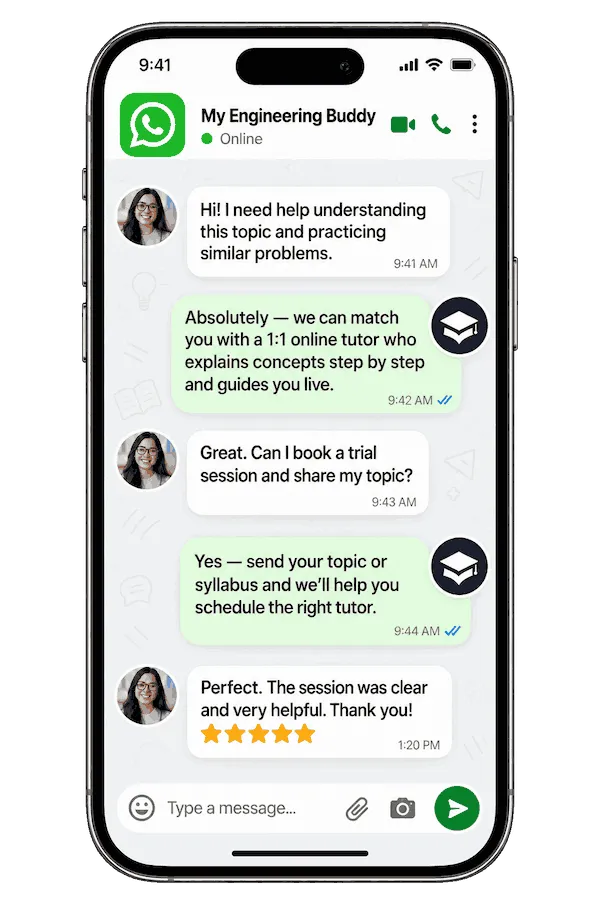
Unlike platforms where you fill out a form and wait, MEB responds in under a minute, 24/7. Tutor match takes under an hour. The $1 trial means you test before you commit. Everything runs over WhatsApp — no logins, no intake forms.
Study Plans (Pick One That Matches Your Goal)
The tutor builds the specific session sequence after your diagnostic — but here’s how most students structure their time. Catch-up (1–3 weeks): for students behind on taxonomy or parasitology content before a submission or test. Exam prep (4–8 weeks): structured revision across all three content tracks, timed to your exam date. Weekly support: ongoing sessions aligned to your module’s lecture schedule and coursework deadlines. For students in Protozoology or animal physiology modules running alongside Nematology, the tutor can coordinate coverage across both subjects.
Pricing Guide
Standard Nematology tutoring runs $20–$40/hr for most undergraduate and taught Masters modules. Niche graduate topics — molecular nematode identification, biocontrol agent efficacy research, or dissertation methodology — reach up to $100/hr. Rate factors include topic complexity, your timeline, and tutor availability in your time zone.
Availability tightens in the final four weeks before end-of-semester exams. If you have a fixed date, book now.
For students targeting research programmes at institutions with strong nematology departments, tutors with active research or field experience in plant pathology and soil ecology are available at higher rates — share your specific goal and MEB will match the tier to your need.
Start with the $1 trial — 30 minutes, no registration, no commitment. WhatsApp MEB for a quick quote.
MEB has been running since 2008. 52,000+ students. 4.8/5 on Google. The $1 trial exists because we’d rather prove the match works than ask you to commit upfront.
Source: My Engineering Buddy, 2008–2025.
FAQ
Is Nematology hard?
It’s a specialist subject. The taxonomy is precise, the terminology is dense, and the morphological distinctions between genera require careful, systematic learning. Students who struggle most usually lack a strong foundation in invertebrate classification. That gap is fixable quickly with 1:1 guidance on the right diagnostic logic.
How many sessions are needed?
Most students see clear improvement in their exam answers within 6–10 sessions. Students with significant gaps — particularly in plant-parasitic taxonomy or host-parasite mechanisms — typically benefit from 15–20 hours of structured support. Your tutor will give a realistic estimate after the first diagnostic session.
Can you help with homework and assignments?
Yes — MEB tutoring is guided learning. The tutor explains the material, works through the method, and helps you understand the reasoning. You complete and submit the work yourself. See our Academic Integrity policy and Why MEB page for full details on what we help with and what we don’t.
Will the tutor match my exact syllabus or exam board?
Yes. Before your first session, share your course outline, module guide, or exam board specification. The tutor prepares around your exact content — whether that’s a UK university module, a North American graduate course, or an agriculture-focused programme in Australia or the Gulf.
What happens in the first session?
The tutor runs a short diagnostic — asking you to explain a life cycle, classify a specimen from a description, or work through a past exam question. This takes 10–15 minutes. The rest of the session addresses the gaps that surface. You leave with a clear plan for the next 4–6 weeks.
Is online tutoring as effective as in-person?
For Nematology, yes — and in some ways better. Diagram annotation with a digital pen-pad, screen-shared microscope images, and access to digital identification keys all work smoothly in an online format. Students in remote locations or outside university centres particularly benefit from not being limited to local tutor availability.
What’s the difference between plant-parasitic and free-living nematodes, and do tutors cover both?
Plant-parasitic nematodes — genera like Meloidogyne and Heterodera — feed on root tissue and cause significant crop damage. Free-living nematodes occupy soil and aquatic ecosystems as decomposers and predators. MEB tutors cover both, including the ecology, identification, and applied management contexts your course requires.
Can MEB help with nematode identification for lab practicals or research projects?
Yes. Tutors can walk you through morphological key usage, explain how to interpret diagnostic characters under microscopy, and help you understand molecular identification methods including basic PCR and rDNA marker interpretation — depending on your course level and what your practical requires.
Do you offer group Nematology sessions?
No. MEB is 1:1 only — every session is built around one student’s specific gaps, exam board, and timeline. Group sessions dilute that. If two students from the same cohort need help, they each get a separate tutor session calibrated to their individual weak points.
Can I get Nematology help at short notice — even late at night?
Yes. MEB operates 24/7 via WhatsApp. Message any time — average response is under a minute. If your submission is tomorrow morning or your exam is in 48 hours, send a message now. Tutor availability at short notice varies, but MEB will find the best match possible given your timeline.
How do I get started?
Three steps: WhatsApp MEB, get matched with a verified Nematology tutor (usually within an hour), then start the $1 trial — 30 minutes of live tutoring or one homework question explained in full. Share your exam board, module name, and current gap when you message.
Trust & Quality at My Engineering Buddy
Every MEB tutor goes through subject-specific vetting — not just a CV check. Tutors submit to a live demo evaluation where they explain a concept, handle a student question they didn’t see coming, and demonstrate how they use the digital pen-pad to annotate diagrams. Ongoing session feedback is reviewed after every block of sessions. Rated 4.8/5 across 40,000+ verified reviews on Google. Tutors working in Nematology and related invertebrate biology subjects hold graduate degrees and, in most cases, active research or teaching experience in the field.
MEB tutoring is guided learning — you understand the work, then submit it yourself. For full details on what we help with and what we don’t, read our Academic Integrity policy and Why MEB.
MEB has been running since 2008, serving 52,000+ students across the US, UK, Canada, Australia, the Gulf, and Europe in 2,800+ subjects. In Zoology and related life sciences — including subjects like Animal Physiology tutoring and Taxonomy help — MEB tutors are matched for depth, not just availability. Read more about how sessions are structured at our tutoring methodology page.
Our experience across thousands of sessions shows that students in specialist biology subjects like Nematology improve fastest when the tutor spends the first 15 minutes asking questions, not explaining — because what the student thinks is a knowledge gap is often a reasoning gap that looks completely different once you surface it.
Explore Related Subjects
Students studying Nematology often also need support in:
Next Steps
Ready to get started? Here’s what to do:
- Share your exam board or course outline, your hardest topic, and your current timeline
- Share your availability and time zone
- MEB matches you with a verified Nematology tutor — usually within 24 hours
Before your first session, have ready: your exam board and syllabus (or course outline), a recent past paper attempt or assignment you struggled with, and your exam or deadline date. The tutor handles the rest.
Visit www.myengineeringbuddy.com for more on how MEB works.
WhatsApp to get started or email [email protected].
18 years. 52,000+ students. 2,800+ subjects. If Nematology is the one blocking your grade or your research, MEB has a tutor for exactly that.
Source: My Engineering Buddy, 2008–2025.
Reviewed by Subject Expert
This page has been carefully reviewed and validated by our subject expert to ensure accuracy and relevance.