~1 min
Average Reply Time
~1 hour
To Be Matched With A Tutor
30 Min Trial
75% Find Their Tutor On The 1st Trial
$20-35+/hr
Premium Yet Affordable Learning
Most students hitting a wall in Animal Physiology aren’t struggling with effort — they’re missing the mechanistic link between structure and function. One session that fixes that costs $1.
Animal Physiology Tutor Online
Animal Physiology is the scientific study of how animal organ systems — circulatory, respiratory, nervous, endocrine, and renal — function at cellular and whole-organism levels, equipping students to analyze physiological mechanisms and apply them in biological research and veterinary science.
If you’ve searched for an Animal Physiology tutor near me and come up empty, MEB works online — live, 1:1, across every time zone. Our zoology tutoring team includes specialists in comparative and mammalian physiology, ready for undergraduate modules, graduate coursework, and everything between. You won’t memorise your way through osmoregulation or action potential propagation — you’ll understand it, then keep it.
- 1:1 online sessions tailored to your specific course syllabus and exam board
- Expert-verified tutors with subject-specific knowledge in animal systems
- Flexible time zones — US, UK, Canada, Australia, and Gulf covered
- Structured learning plan built after a diagnostic session in your first hour
- Ethical academic guidance — you understand the work before you submit
52,000+ students across the US, UK, Canada, Australia, and the Gulf have used MEB since 2008 — including students in Zoology subjects like Animal Physiology, Mammalogy, and Embryology.
Source: My Engineering Buddy, 2008–2025.
How Much Does an Animal Physiology Tutor Cost?
Most Animal Physiology tutoring sessions run $20–$40/hr depending on level and topic complexity. Advanced or graduate-level modules can reach $100/hr. New students can test the service for $1 — 30 minutes of live 1:1 tutoring or one homework question solved and fully explained.
| Level / Need | Typical Rate | What’s Included |
|---|---|---|
| Standard (most undergrad levels) | $20–$35/hr | 1:1 sessions, homework guidance |
| Advanced / Graduate / Specialist | $35–$100/hr | Expert tutor, research-level depth |
| $1 Trial | $1 flat | 30 min live session or 1 homework question |
Tutor availability tightens significantly around semester mid-terms and finals. Book early if you’re within six weeks of a deadline.
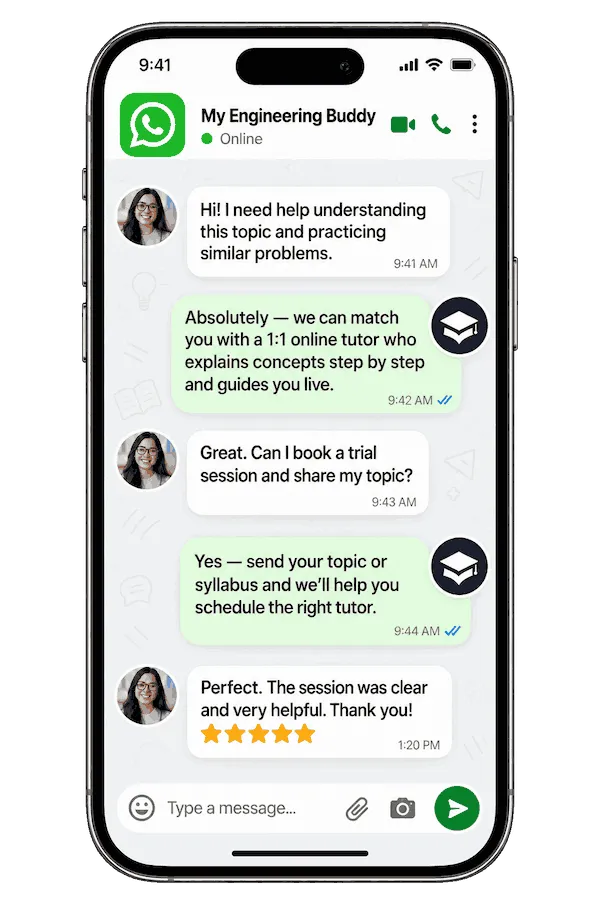
WhatsApp MEB for a quick quote — average response time under 1 minute.
Who This Animal Physiology Tutoring Is For
This is for students who can read the textbook but still can’t explain why the sodium-potassium pump matters to muscle contraction — or why their exam answers keep losing marks on mechanism questions. If you know the words but not the logic behind them, that’s exactly the gap 1:1 tutoring closes.
- Undergraduate biology, zoology, and veterinary science students tackling systems physiology modules
- Graduate students preparing for qualifying exams that include comparative or mammalian physiology
- Students retaking after a failed first attempt in a physiology unit
- Students with a university conditional offer that depends on passing this module
- Parents watching a child’s confidence drop alongside their grades in a physiology course
- Pre-med and pre-vet students who need a solid physiological foundation before clinical coursework
MEB tutors have supported students at institutions including Cornell, UC Davis, University of Edinburgh, University of Queensland, Utrecht University, and Wageningen University — in both taught and research programmes.
At MEB, we’ve found that Animal Physiology students who struggle most are rarely weak in biology overall — they hit a wall specifically at integrative physiology, where understanding one system requires knowing how it talks to three others. That’s not a reading problem. That’s a structure problem our tutors fix in the first two sessions.
1:1 Tutoring vs Self-Study vs AI vs YouTube vs Online Courses
Self-study works if you’re disciplined, but physiology without feedback means you’ll reinforce the wrong mental model of a pathway and not know it until the exam. AI tools explain concepts fast but can’t probe your understanding of a specific renal clearance question or catch where your logic breaks. YouTube covers osmoregulation at a general level — it stops when you need to work through a specific problem step by step. Online courses move at a fixed pace that doesn’t adjust when you spend three weeks stuck on hormonal regulation. 1:1 tutoring with MEB is calibrated to your exact Animal Physiology syllabus, corrects errors in real time, and makes sure the mechanism — not just the label — is locked in before you move on.
Outcomes: What You’ll Be Able To Do in Animal Physiology
After consistent 1:1 work, students can explain the full sequence of action potential generation and propagation in both neurons and cardiac muscle, not just name the phases. They analyze how the renin-angiotensin-aldosterone system responds to changes in blood pressure and plasma osmolarity — with the mechanism, not just the outcome. They apply knowledge of thermoregulation strategies to compare ectothermic and endothermic species in an exam question without blanking. They write clear, mark-earning answers on hormonal feedback loops. They present respiratory gas exchange data from comparative species in a way that addresses both the physiology and the evolutionary context.
Supporting a student through Animal Physiology? MEB works directly with parents to set up sessions, track progress, and keep coursework on schedule. WhatsApp MEB — average response time is under a minute, 24/7.
Based on feedback from 40,000+ sessions collected by MEB from 2022 to 2025, 58% of students improved by one full grade after approximately 20 hours of 1:1 tutoring in subjects like Animal Physiology. A further 23% achieved at least a half-grade improvement.
Source: MEB session feedback data, 2022–2025.
Try your first session for $1 — 30 minutes of live 1:1 tutoring or one homework question explained in full. No registration. No commitment. WhatsApp MEB now and get matched within the hour.
What We Cover in Animal Physiology (Syllabus / Topics)

Neurophysiology and Sensory Systems
- Resting and action potential: ion channels, gating, and refractory periods
- Synaptic transmission — chemical and electrical, excitatory and inhibitory
- Central vs peripheral nervous system structure and integrative function
- Sensory receptor types: mechanoreception, photoreception, chemoreception
- Reflex arcs and motor control pathways
- Neuroendocrine integration and hypothalamic-pituitary axes
Core texts include Randall, Burggren & French’s Eckert Animal Physiology and Hill, Wyse & Anderson’s Animal Physiology (Sinauer). Your tutor will map sessions to whichever edition your course uses.
Circulatory, Respiratory, and Renal Physiology
- Cardiac cycle, stroke volume, Frank-Starling mechanism, and output regulation
- Gas exchange: Fick’s law applied to gills, lungs, and integument
- Oxygen dissociation curves — Bohr effect, Root effect, and species variation
- Renal filtration, tubular reabsorption, and countercurrent multiplication
- Osmoregulation strategies in marine, freshwater, and terrestrial animals
- Comparative respiratory anatomy — tidal, flow-through, and cutaneous systems
Students working at UCL, University of Melbourne, or Utrecht will find tutors familiar with the laboratory report formats and data interpretation questions common in these modules. Textbook references include Moyes & Schulte’s Principles of Animal Physiology.
Endocrinology, Thermoregulation, and Energetics
- Hormone classes — peptide, steroid, and amine — and their receptor mechanisms
- Feedback loops: insulin-glucagon axis, cortisol regulation, thyroid control
- Ectothermy vs endothermy: metabolic rate, Q10, and thermal tolerance
- Reproductive endocrinology: estrous cycles, photoperiodism, and mating strategies
- Metabolic scaling, basal metabolic rate, and Kleiber’s Law
- Energy budgets and the trade-offs between growth, reproduction, and maintenance
Tutors reference Sherwood, Klandorf & Yancey’s Animal Physiology: From Genes to Organisms and Withers’ Comparative Animal Physiology where relevant.
What a Typical Animal Physiology Session Looks Like
The tutor opens by checking the previous topic — say, renal countercurrent multiplication — with two quick recall questions to confirm what held and what didn’t. Then you move into the new problem: the session might focus on how the renin-angiotensin-aldosterone system integrates with ADH during dehydration stress. The tutor works through the mechanism on a digital pen-pad in real time, annotating the pathway while you follow. You then replicate the explanation — narrating the feedback loop from low blood pressure to aldosterone secretion — while the tutor listens for where the logic breaks. Corrections happen in the moment, not at the end. The session closes with a specific practice question left for you to attempt before the next session, and the next topic — say, comparative respiratory gas exchange — is flagged so you can do a light pre-read.
How MEB Tutors Help You with Animal Physiology (The Learning Loop)
Diagnose: In the first session, the tutor asks you to explain a specific physiological process — osmoregulation in a marine teleost, or the cardiac Frank-Starling mechanism. The gaps in your explanation tell the tutor exactly where to start. No time wasted on what you already know.
Explain: The tutor works through live problems on screen using a digital pen-pad, annotating pathways, drawing feedback loops, and building the mechanistic picture step by step — not bullet points, but the actual logic chain that examiners reward.
Practice: You attempt the next problem with the tutor present. This isn’t homework — it’s supervised application. The tutor watches your reasoning in real time, not just your answer.
Feedback: Errors are corrected at the step where they occur, not at the end. You find out precisely why a mark was lost — whether it was a missed ion, a broken feedback loop, or a correct fact applied to the wrong system.
Plan: Each session ends with the next topic confirmed, a targeted practice task set, and a note on what the diagnostic flagged as the remaining priority. Progress is tracked session by session.
Sessions run on Google Meet with a digital pen-pad or iPad and Apple Pencil for annotation. Before your first session, have your course outline or syllabus ready, plus any past exam questions or assignments you’ve struggled with. The first session functions as both a diagnostic and a working session — nothing is wasted. Start with the $1 trial — 30 minutes of live tutoring that also serves as your first diagnostic.
Students consistently tell us that Animal Physiology clicked when they stopped trying to memorise systems separately and started seeing them as one integrated conversation. The endocrine system talks to the renal system. The nervous system talks to both. Once you map those conversations, exam questions become much more answerable.
Tutor Match Criteria (How We Pick Your Tutor)
Every Animal Physiology tutor match is based on four criteria:
Subject depth: The tutor must have demonstrable knowledge at your specific level — undergraduate systems physiology is different from graduate comparative physiology, and the tutor is vetted accordingly.
Tools: All tutors use Google Meet paired with a digital pen-pad or iPad and Apple Pencil. Mechanism diagrams and pathway annotations are drawn live — not screenshared from a slide deck.
Time zone: Your tutor is matched to your region — US, UK, Gulf, Canada, or Australia — so sessions start on time and fit your schedule.
Goals: Whether you need exam-score improvement, conceptual depth on a specific system, homework guidance, or research support at graduate level, the match reflects that specific target.
Unlike platforms where you fill out a form and wait, MEB responds in under a minute, 24/7. Tutor match takes under an hour. The $1 trial means you test before you commit. Everything runs over WhatsApp — no logins, no intake forms.
Study Plans (Pick One That Matches Your Goal)
After the first diagnostic, your tutor builds the session sequence to fit your timeline. For students 1–3 weeks from an exam, the plan is a targeted gap-close focused on the highest-yield topics — renal physiology, hormonal regulation, and comparative respiratory systems tend to carry the most marks. For a 4–8 week exam prep window, sessions move through all major systems with integrated past-paper practice built in from week three. For ongoing weekly support through a semester, the plan runs in parallel with your lecture schedule, reinforcing each system as it’s taught. The tutor adjusts pace after each session based on what’s sticking and what isn’t.
Pricing Guide
Animal Physiology tutoring starts at $20/hr for standard undergraduate modules. Graduate-level work, research-method support, and highly specialised comparative physiology topics run up to $100/hr. Rate factors include your level, the complexity of the topics involved, your timeline, and tutor availability at your preferred hours.
For students targeting graduate programmes at institutions like Johns Hopkins, Edinburgh, or Wageningen — or preparing for qualifying exams with a physiology component — tutors with research backgrounds in integrative and comparative physiology are available at higher rates. Share your specific goal and MEB will match the tier to your ambition.
Availability narrows during semester finals and mid-term windows in the US, UK, and Australia. If you’re within six weeks of an assessment, book sooner rather than later.
Start with the $1 trial — 30 minutes, no registration, no commitment. WhatsApp MEB for a quick quote.
MEB has covered 2,800+ subjects since 2008 — from embryology tutoring to comparative anatomy, with the same 1:1 model, the same diagnostic-first approach, and the same $1 trial that lets you test before committing.
Source: My Engineering Buddy, 2008–2025.
FAQ
Is Animal Physiology hard?
It’s demanding because it requires integrating multiple systems simultaneously — you can’t understand renal function without knowing the cardiovascular and endocrine context. Students who struggle usually lack that integrative framing, not biological ability. That’s what 1:1 tutoring addresses directly.
How many sessions do most students need?
Students closing specific gaps before an exam often need 6–10 sessions. Those building from scratch across a full module typically work for 15–20 hours over a semester. Your tutor gives a realistic projection after the first diagnostic session.
Can you help with homework and assignments?
Yes — MEB tutoring is guided learning. The tutor works through the question with you, explains the mechanism, and checks your understanding. You complete and submit the work yourself. See our Academic Integrity policy and Why MEB page for full details on what we help with and what we don’t.
Will the tutor match my exact syllabus or exam board?
Yes. Before the first session, share your course outline, module code, or exam board. MEB tutors cover major frameworks including those used at US, UK, Australian, and European universities. Tutors align sessions to your specific assessment format.
What happens in the first session?
The tutor runs a short diagnostic — asking you to explain a specific physiological process — to identify real gaps. The rest of the session addresses the most urgent one. You leave with a clear session plan and a targeted practice task.
Is online Animal Physiology tutoring as effective as in-person?
For physiology specifically, the digital pen-pad makes mechanism diagrams clearer than most whiteboards. Students consistently report the same depth of explanation. Time zone flexibility also means you can book sessions that would be impossible to arrange in person.
What’s the difference between Animal Physiology and Comparative Physiology?
Animal Physiology covers the mechanisms within and across organ systems in animals generally. Comparative Physiology focuses on how those mechanisms differ between species and relate to evolutionary adaptation. Most undergraduate Animal Physiology courses include a comparative component — your tutor covers both angles as needed.
Can Animal Physiology tutoring help with laboratory data interpretation questions?
Yes. Many exam boards include data-handling questions based on graphs, experimental outputs, or physiological measurements. Tutors work through interpretation strategies — reading oxygen dissociation curves, analysing renal clearance data, interpreting hormone assay results — alongside the underlying physiology.
Can I get Animal Physiology help at midnight or on weekends?
MEB operates 24/7. Sessions are available across US, UK, Gulf, and Australian time zones. WhatsApp MEB at any hour and a response typically comes within a minute. Weekend and late-night slots do fill quickly during exam periods.
What if I don’t connect with my assigned Animal Physiology tutor?
Let MEB know after the first session. A replacement tutor is matched within hours — no argument, no friction. The $1 trial exists precisely so you test the fit before committing to a longer plan.
How do I get started with Animal Physiology tutoring?
Three steps: WhatsApp MEB, share your level and what you’re working on, and start your $1 trial — 30 minutes live or one question fully explained. You’re matched and in a session typically within the hour.
Do Animal Physiology tutors cover both vertebrate and invertebrate systems?
Yes. MEB tutors cover vertebrate and invertebrate physiology — from mammalian renal function to insect gas exchange by tracheal systems. If your course includes a specific taxonomic group, mention it when you contact MEB and the match will reflect that focus.
Trust & Quality at My Engineering Buddy
Every MEB tutor goes through subject-specific vetting — not a general science screen. For Animal Physiology, that means demonstrated knowledge of integrative physiology at least one level above the student’s own. Tutors complete a live demo evaluation before being matched with students, and session feedback is reviewed on an ongoing basis. Rated 4.8/5 across 40,000+ verified reviews on Google, MEB has operated since 2008 across the US, UK, Canada, Australia, and the Gulf.
MEB tutoring is guided learning — you understand the work, then submit it yourself. For full details on what we help with and what we don’t, read our Academic Integrity policy and Why MEB.
MEB supports students in Zoology and related disciplines — including those needing mammalogy tutoring, ornithology help, and herpetology tutoring — across 2,800+ subjects, all with the same 1:1 model. The platform has been running since 2008 with a consistent focus on expert-matched, diagnostic-first tutoring for students at undergraduate, graduate, and research level.
Our experience across thousands of sessions shows that the students who improve fastest in Animal Physiology aren’t those who study longest — they’re the ones who get corrected earliest. One session that catches a persistent misconception about membrane potential or hormonal feedback can unblock weeks of stalled progress.
Explore Related Subjects
Students studying Animal Physiology often also need support in:
Next Steps
When you contact MEB, share your exam board or course outline, the topic or system you’re finding hardest, and your current timeline. Include your time zone and preferred session hours.
MEB matches you with a verified Animal Physiology tutor — usually within 24 hours, often faster. The first session begins with a diagnostic so every minute goes toward something that matters.
Before your first session, have ready:
- Your syllabus or module outline (or course code if you can’t find the document)
- A recent past-paper attempt or homework question you struggled with
- Your exam date or assignment deadline
The tutor handles the rest. Visit www.myengineeringbuddy.com for more on how MEB works.
WhatsApp to get started or email [email protected].
Reviewed by Subject Expert
This page has been carefully reviewed and validated by our subject expert to ensure accuracy and relevance.